Scroll down for English Version
Figure della scrittura, a cura di Rita Selvaggio, esplora i passaggi tra arte e letteratura: non cerca nelle parole l’equivalente di un’immagine, ma osserva che cosa accade quando un artista, un’opera o un ritratto diventano materia letteraria e ne trasformano la forma.
A Palazzo Schifanoia — il cui nome invita a «schivar la noia» — il tempo non procede da sinistra a destra. Si dispone pazientemente sulla parete.
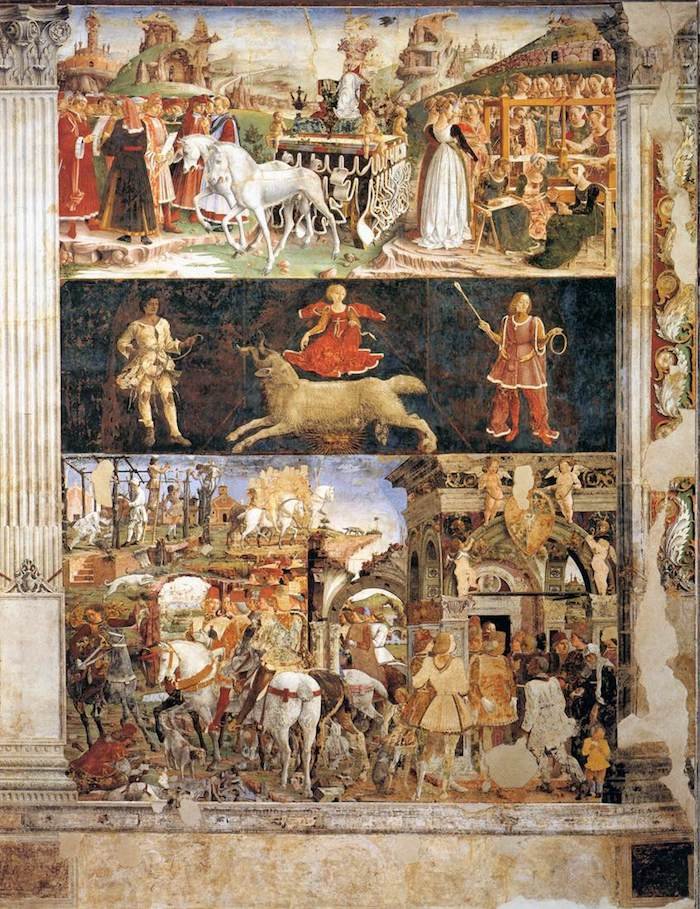
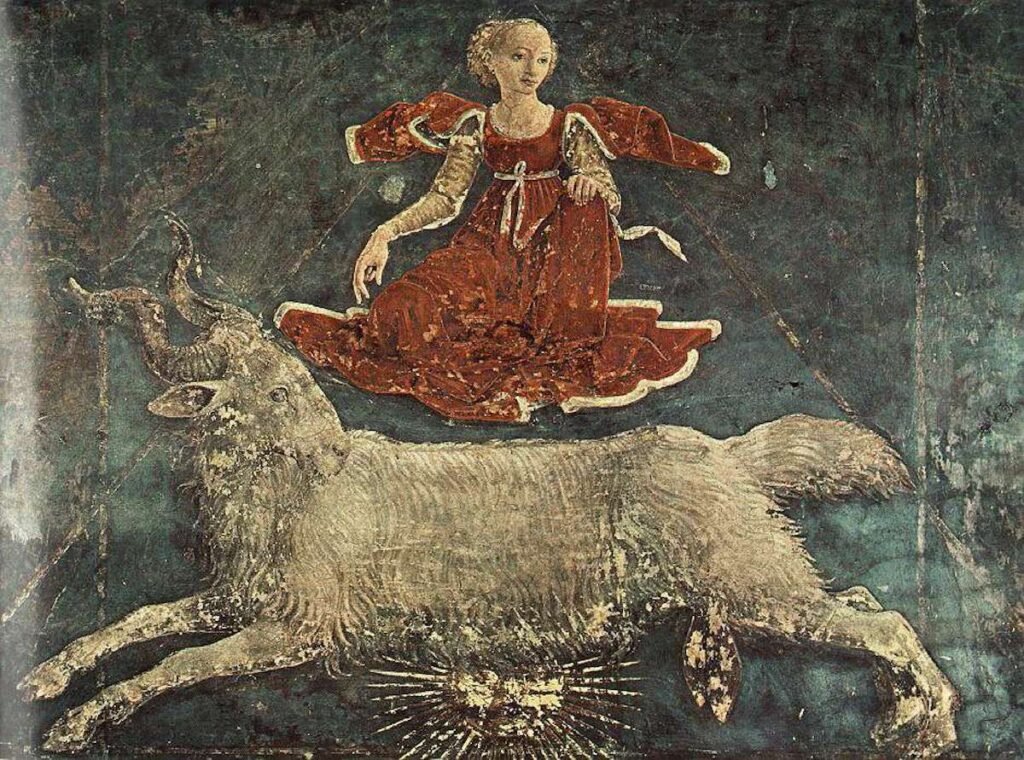
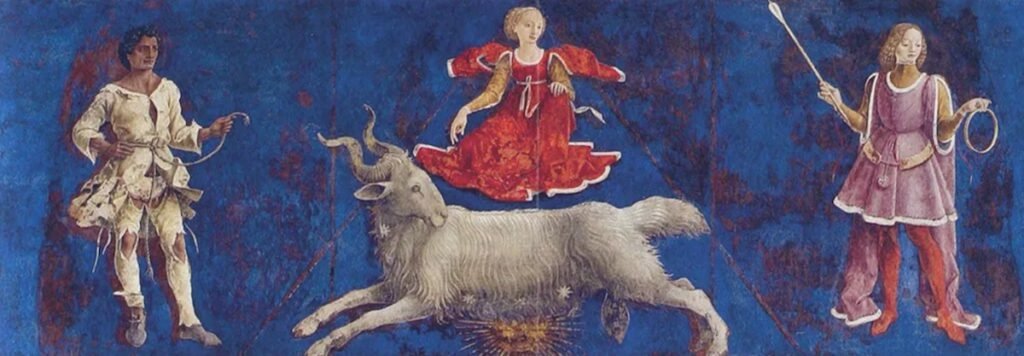
Nel Mese di Marzo di Francesco del Cossa, in alto Minerva avanza sul carro; al centro l’Ariete attraversa una fascia di cielo insieme alle enigmatiche figure dei decani; più in basso Borso d’Este entra nel presente, tra cavalli, cortigiani, scene di governo. Il mito, gli astri, la vita terrena non si succedono. Accadono insieme, separati in registri e trattenuti dalla stessa superficie.
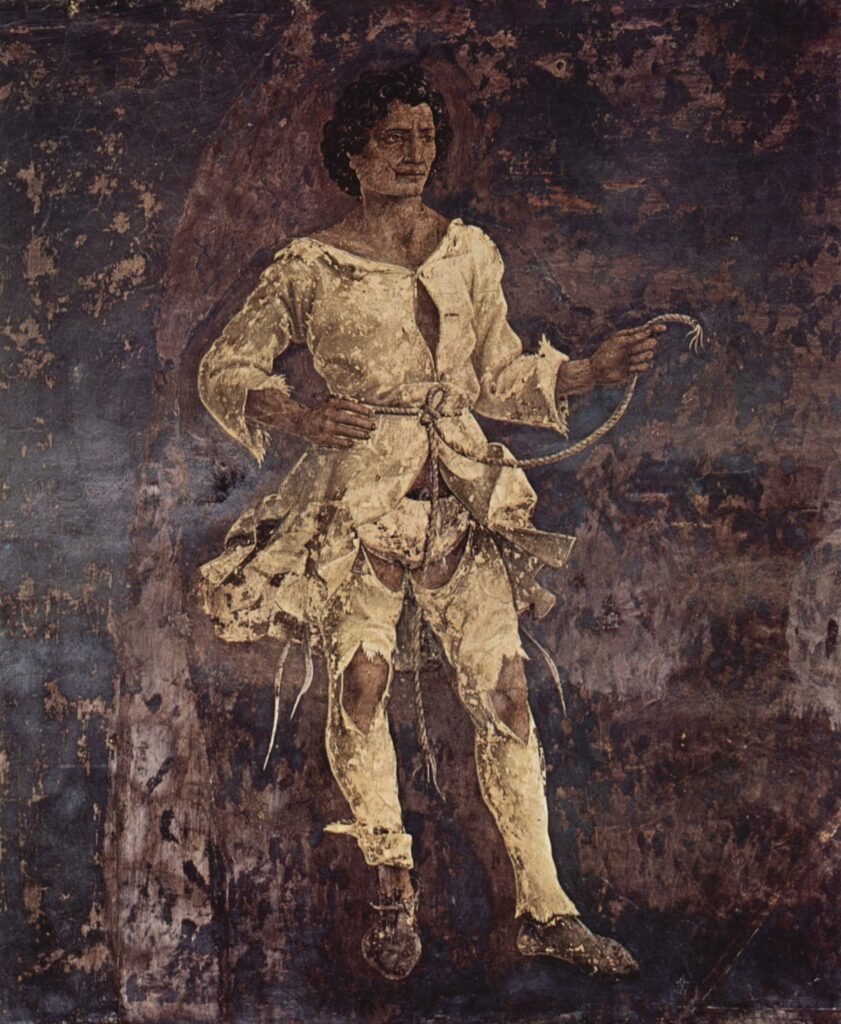
L’occhio, però, non è tenuto a rispettarne l’ordine. Può salire dal duca a Minerva, fermarsi su un volto, ridiscendere, attraversare un dettaglio senza conoscerne il significato. Può anche non sapere che cosa sta guardando. Una delle presenze più magnetiche di quella parete — un giovane in stracci bianchi, il corpo scuro sospeso contro un fondo azzurro — raggiunse Ali Smith proprio così: separata dal luogo al quale apparteneva, riprodotta sulle pagine di una rivista d’arte.
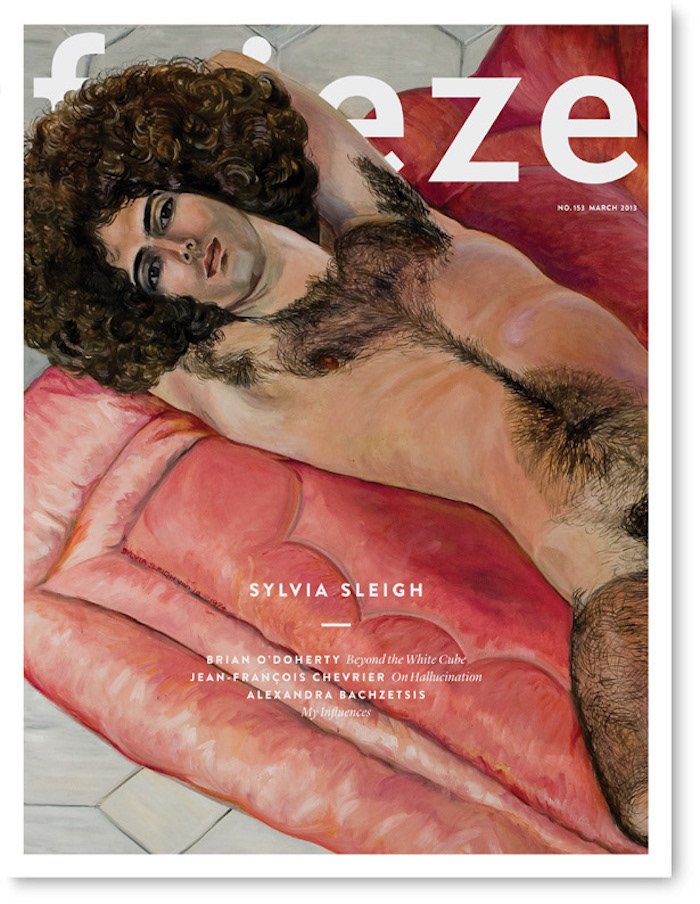
Era l’aprile del 2013. Durante la colazione Smith sfogliava il numero 153 di frieze, datato marzo, quando una riproduzione a tutta pagina la costrinse a fermarsi. Apriva «Picture Piece: Frescoes in the Palazzo Schifanoia, Ferrara», un breve testo di Jan Verwoert pubblicato nella rubrica One Takes (pp. 112–114). Isolato contro l’azzurro, appariva uno dei decani del Mese di Marzo: il giovane nero in stracci bianchi; sulla pagina di fronte, una fascia riuniva le tre figure astrologiche del registro mediano.
Verwoert non ricostruiva la biografia di Del Cossa. Leggeva gli affreschi attraverso la conferenza tenuta da Aby Warburg a Roma nel 1912 e seguiva la migrazione dei decani: dall’antichità ai testi astrologici compilati a Baghdad da Abū Ma‘shar, tradotti in ebraico a Toledo da Abraham ibn Ezra, passati successivamente attraverso una versione francese e infine tradotti in latino da Pietro d’Abano, fino alla parete ferrarese. In Del Cossa, scriveva, il «cuore greco» di quelle figure tornava a battere; con Agamben, le immagini non erano semplici rappresentazioni, ma «segnature» capaci di trasmettere una forza. Smith incontrava dunque il giovane in stracci dentro un articolo che lo descriveva già come una forma sopravvissuta al viaggio.
Smith non aveva ancora visto Palazzo Schifanoia; di Francesco del Cossa sapeva poco o nulla. Prima venne la figura, poi il nome. Soltanto dopo, Ferrara.
Del Cossa entra così nella scrittura di Smith nello stesso modo in cui era già rientrato nella storia: per frammenti.
Gli affreschi del Salone dei Mesi non hanno attraversato indenni i cinque secoli che li separano da noi. Il palazzo perse la propria funzione, cambiò proprietari e destinazioni; le pitture furono ricoperte. Quando nell’Ottocento cominciarono a riaffiorare, ciò che tornava alla vista non portava necessariamente con sé il nome di chi lo aveva dipinto. Anche Francesco del Cossa era scomparso dalla propria parete.
Per ritrovarlo servì un altro frammento: non un’immagine, questa volta, ma una scrittura.
Il 25 marzo 1470 Del Cossa aveva indirizzato a Borso d’Este una lettera. Vi rivendicava come propri i tre mesi verso l’anticamera — Marzo, Aprile e Maggio — e protestava per il compenso ricevuto. Non parlava da esecutore anonimo: affermava il valore del lavoro, il proprio nome, la qualità della pittura. Più di quattro secoli dopo, ritrovata nel 1885 nell’Archivio di Stato di Modena, quella lettera avrebbe contribuito a ricongiungere un autore alle immagini.
La storia dell’arte poteva ripartire da lì. Ma soltanto fino a un certo punto.
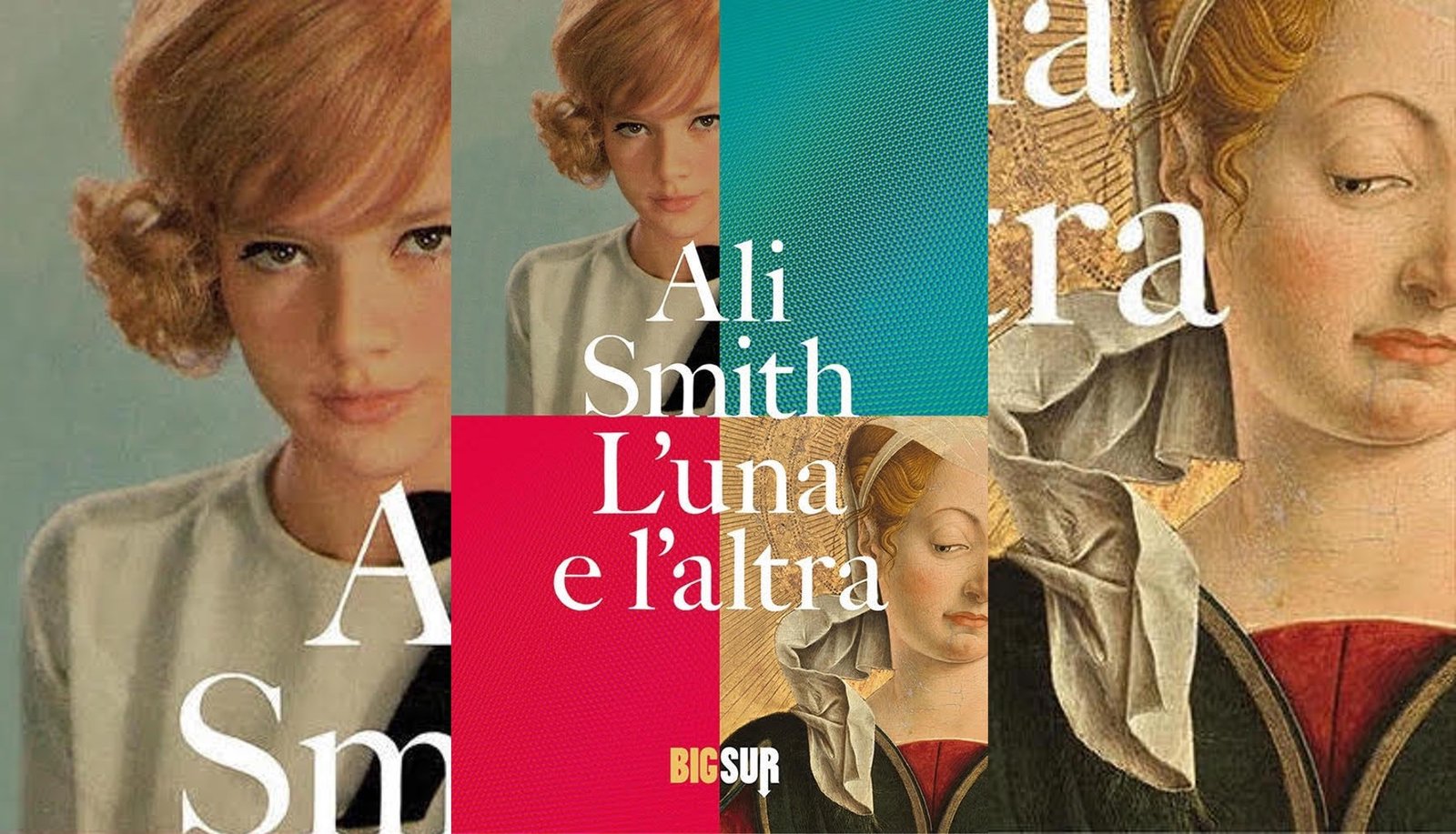
Di Del Cossa rimangono opere, documenti, attribuzioni: abbastanza per riconoscere un artista, troppo poco per ricostruire una vita senza vuoti. È forse in questa sproporzione — tra la straordinaria presenza di ciò che ha dipinto e la scarsità di ciò che sappiamo di lui — che comincia davvero L’una e l’altra (SUR, 2016).
Ali Smith non incontra un personaggio in attesa di essere raccontato. Incontra ciò che la storia ha conservato di una persona: immagini, un nome, poche tracce, una lettera. La finzione comincia dove quelle tracce smettono di rispondere.
È lì che Smith inventa il suo Francesco.
Non colma una lacuna biografica. Fa quasi il contrario: prende l’incertezza che circonda Del Cossa e rifiuta di risolverla. La trasforma nella condizione stessa del personaggio. Il Francesco di L’una e l’altra attraversa ciò che una biografia dovrebbe stabilizzare: uomo e donna, passato e presente, corpo e immagine, chi guarda e chi è guardato.
Il dato storico resta e oppone resistenza. Bartolomeo Garganelli, Ercole de’ Roberti, Cosmè Tura, Borso d’Este, la lettera del 1470: Smith conserva gli appigli della vicenda documentata e lascia che altrove il possibile occupi lo spazio libero. Francesco storico e Francesco letterario non possono più coincidere.
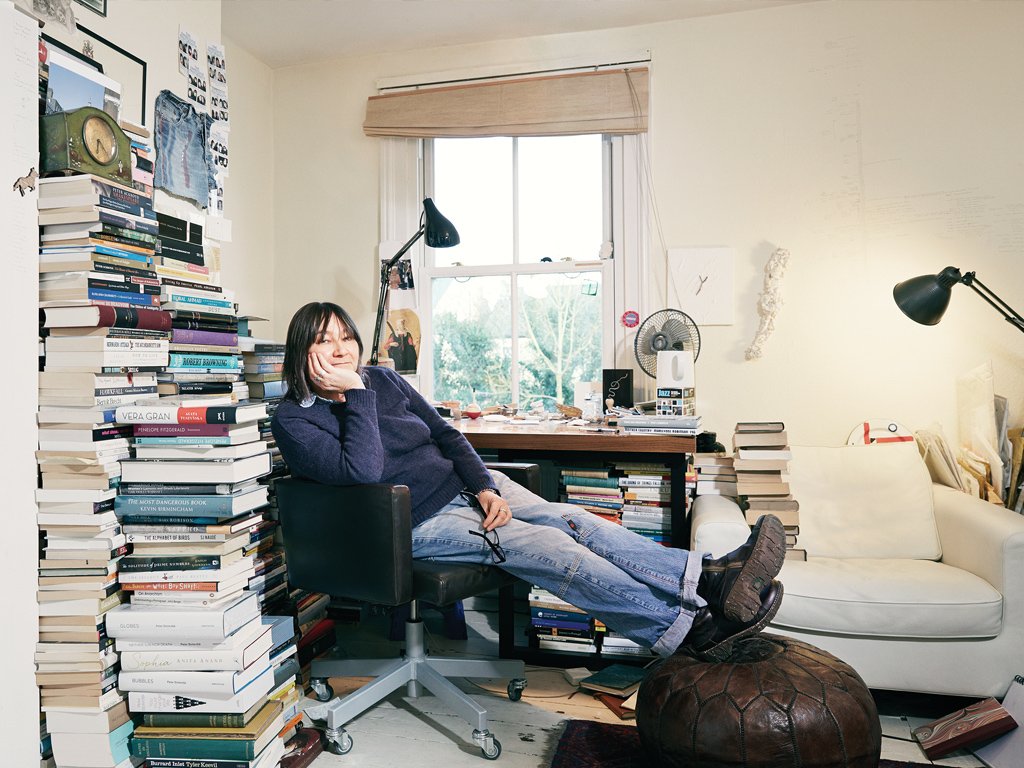
Anche il nome passa dal documento alla finzione. Smith lo chiama «Francescho», la grafia con cui Del Cossa nomina sé stesso nel corpo della lettera del 1470, prima della sottoscrizione latina «Franciscus del Cossa». Il personaggio porta ancora il nome dell’artista, ma non è più interamente lui.
Smith ha raccontato che la forma di L’una e l’altra nasce anche dalla tecnica dell’affresco: la superficie visibile e ciò che persiste sotto di essa. Il romanzo si compone di due parti, una dedicata a George, adolescente inglese che ha appena perduto la madre, l’altra al pittore ferrarese Francescho. Il libro fu pubblicato in due versioni, identiche nel contenuto ma con l’ordine delle parti invertito: alcune copie si aprono con la storia di Francescho e proseguono con quella di George; altre presentano l’ordine opposto. Nessuna sequenza possiede il primato.
Il rapporto fra affresco e struttura narrativa è stato ampiamente riconosciuto dalla critica. Daniel Lea ha osservato come “How to Be Both” trasferisca nella narrazione la struttura di “layer and underlayer”; Robert Kusek e Wojciech Szymański hanno letto il romanzo attraverso la Nachleben warburghiana e la migrazione delle immagini di Schifanoia. Proprio queste letture consentono di spostare la domanda.
Non soltanto: che cosa rimane sotto un’immagine?
Ma: che cosa rimane sotto un nome?
Prima di diventare il Francesco di Ali Smith, Del Cossa aveva già conosciuto due forme di perdita. Le pitture erano scomparse sotto lo scialbo; il nome era stato separato dalle opere. La riscoperta ottocentesca restituì le une allo sguardo, la ricerca documentaria ricongiunse l’altro alla parete. Nessuna delle due poteva restituire una persona.
La letteratura non possiede documenti ulteriori né corregge l’archivio. Può però inoltrarsi là dove ciò che è accertabile lascia posto a ciò che resterà senza risposta.
Il Francesco che ne emerge viene dopo: può esistere soltanto quando la storia ha stabilito fin dove è possibile seguirlo.
Francescho dopo Francesco.
Ma tra questi due Francesco ce ne sono stati altri.
Nel 1912 Aby Warburg portò Schifanoia al X Congresso internazionale di storia dell’arte di Roma. Non cercava l’identità di un pittore: seguiva il viaggio delle presenze astrologiche della fascia mediana, i decani, riconoscendovi forme venute dall’antichità e passate attraverso testi, traduzioni, culture. La parete ferrarese diventava il punto provvisorio di arrivo di una migrazione.
Schifanoia cessava così di essere un monumento immobile del Rinascimento. Nelle sue pitture confluivano tempi remoti: forme già in viaggio prima di essere dipinte, destinate a viaggiare ancora.
Prima di essere un luogo e un nome, Schifanoia è dunque, per Smith, un’immagine incontrata per caso: fotografata, riprodotta, giunta fino a un tavolo da colazione.
Prima dell’informazione viene un arresto. Prima di sapere, guardare.
La storia dell’arte compie necessariamente il movimento contrario: riconduce quel corpo alla parete, la parete al programma iconografico, il programma alla corte estense, i decani alla genealogia ricostruita da Warburg. Restituisce relazioni, provenienze, significati.
La letteratura può conservare qualcosa di ciò che precede la spiegazione.
Il Francesco di Smith nasce anche da questa distanza: tra ciò che sappiamo di Del Cossa e l’uomo che continua a mancare dietro le opere.
Warburg aveva mostrato che un’immagine non appartiene interamente al tempo che la ospita. Anche L’una e l’altra appartiene a questa logica di sopravvivenza e migrazione delle forme. La domanda, allora, può cambiare.
Non soltanto: come sopravvive un’immagine?
Ma: che cosa accade alla persona alla quale quell’immagine viene ricondotta?
Un dipinto può attraversare i secoli senza possedere una biografia. Appena un nome torna accanto a un’opera nasce un altro desiderio: sapere chi fosse, come vivesse, che corpo avesse, chi amasse. Le immagini continuano a mostrarsi. I documenti, a un certo punto, finiscono.
Di Francesco del Cossa non possediamo alcun ritratto certo. Il volto manca quanto la vita.
È significativo che Smith collochi un possibile autoritratto proprio nella stessa fascia del Mese di Marzo. Non nel giovane nero in stracci che l’aveva fermata davanti alla pagina di frieze, ma nella terza figura del registro mediano: il giovane androgino che tiene un cerchio e una lunga freccia. Nel romanzo, la possibilità che Francescho vi abbia dipinto il proprio volto appartiene alla finzione, non alla storia dell’arte. Ma è precisamente questo il gesto: dove nessuna immagine documenta il viso dell’artista, la letteratura gli permette di apparire dentro la sua opera.
Smith compie così ciò che è precluso allo storico: immagina un corpo e gli dà un volto.
Il suo Francescho è nato femmina e vive come uomo. Il romanzo non presenta questa possibilità come una scoperta né come una correzione biografica. La colloca dove il documento tace. Smith non sostiene che Francesco fosse una donna: lascia che la finzione misuri ciò che il passato non può più confermare né smentire.
Se leggessimo L’una e l’altra come una biografia alternativa, sostituiremmo una certezza con un’altra. Smith mantiene invece aperta l’incertezza, lasciando che acquisti consistenza senza risolversi.
La scelta di genere rende visibile il punto in cui conoscenza e immaginazione si separano. Ogni figura storica arriva fino a noi in una distribuzione diseguale di presenze e assenze: qualcosa è documentato; altro rimane ipotetico o è andato perduto.
Per questo il doppio più silenzioso del romanzo potrebbe non essere soltanto George e Francescho, presente e Quattrocento, una metà e l’altra. Corre anche tra Francesco del Cossa e Francescho.
Uno appartiene alla storia e si sottrae mentre i documenti cercano di definirlo. L’altro appartiene alla finzione e acquista un corpo proprio perché non pretende di essere vero.
Tra i due non c’è uno specchio.
C’è un intervallo.
Ed è dentro questo intervallo che appare George.
Anche lei arriva dopo una perdita. Sua madre è morta da pochi mesi e il tempo, da allora, si è diviso: una George di prima e una George di dopo. Ma il lutto non obbedisce alla cronologia. Il passato entra nel presente senza chiedere permesso.
È la madre ad aver portato George davanti a Del Cossa.
Durante un viaggio in Italia aveva voluto raggiungere Ferrara e vedere Schifanoia. George l’aveva seguita con quella resistenza adolescente che permette di essere presenti senza sapere ancora che cosa, di quel presente, diventerà irripetibile. Dopo la morte della madre, gli affreschi acquistano un’altra gravità: appartengono ormai a un tempo condiviso con qualcuno che non c’è più.
Il romanzo accosta così due assenze non equivalenti. Di Del Cossa restano troppo poche tracce per ricostruire una vita; della madre George conserva una quantità quasi dolorosa di parole, discussioni, viaggi, canzoni, gesti. Né la scarsità né l’abbondanza restituiscono una persona.
Anche Francescho ha perduto la madre. Come George. Ma più della simmetria conta il tempo che le due perdite producono.
I morti non rimangono dove il tempo li ha collocati.
La madre continua a parlare dentro le frasi della figlia. Un viaggio concluso modifica ancora ciò che George vede. Un pittore del Quattrocento osserva una ragazza del XXI secolo davanti a un suo quadro. Un affresco sepolto sotto lo scialbo riaffiora. Una lettera d’archivio riconsegna un nome a una parete. Ciò che è stato non smette di accadere soltanto perché il suo presente è finito.
Le due parti del romanzo portano entrambe lo stesso numero: “one”. Non c’è un “due” ordinatamente successivo. La critica ha letto questo dispositivo come simultaneità, reciprocità, bothness. Ma esso compie anche un gesto più concreto: rende instabile la distinzione stessa fra prima e dopo.
Per George, sua madre è prima e continua a essere adesso.
Per Francescho, il Quattrocento è finito e continua ad accadere.
Per noi, Francesco del Cossa è morto da più di cinque secoli e continua a cambiare.
È questa terza temporalità a trasformarlo in figura letteraria.
Smith non riporta Del Cossa in vita. Gli concede un altro presente: può guardare George davanti a un suo dipinto, ricordare una vita che non possiamo verificare, possedere un corpo che nessun documento certifica. La finzione non aggiunge informazioni all’archivio. Cambia il tempo nel quale possono essere pensate.
La storia dell’arte ricongiunge: un’opera a un autore, un documento a una data, una forma a una tradizione. La letteratura può permettere che ciò che non si lascia ricongiungere continui a produrre forma.
Tra Francesco e Francescho resta una distanza che nessuna attribuzione può colmare. Tra George e sua madre, una conversazione che la memoria può continuare ma non riaprire. Tra la riproduzione incontrata da Smith e Schifanoia rimane il viaggio di un’immagine che, staccatasi dalla parete, vi ritorna attraverso uno sguardo.
Tornando nel Salone dei Mesi, la parete appare allora diversa.
Nel Mese di Marzo ci sono ancora Minerva, l’Ariete, i decani, Borso d’Este: il tempo degli dei, degli astri, della corte. Ma sulla superficie si sono depositati altri tempi, mai dipinti: gli anni dell’occultamento, la riemersione degli affreschi, la lettera ritrovata, lo sguardo di Warburg, una mattina dell’aprile 2013 davanti al numero di marzo di frieze.
E infine il romanzo.
Non l’ultimo strato dell’affresco. Non la sua spiegazione.
Un altro luogo nel quale Francesco può apparire.
La storia dell’arte ha restituito il suo nome alla parete. L’una e l’altra non restituisce l’uomo che lo portava. Lascia aperta la distanza tra ciò che di Francesco del Cossa possiamo conoscere e la figura che ancora possiamo immaginare.
Dopo Francesco, Francescho.
E dopo Francescho, di nuovo Francesco.
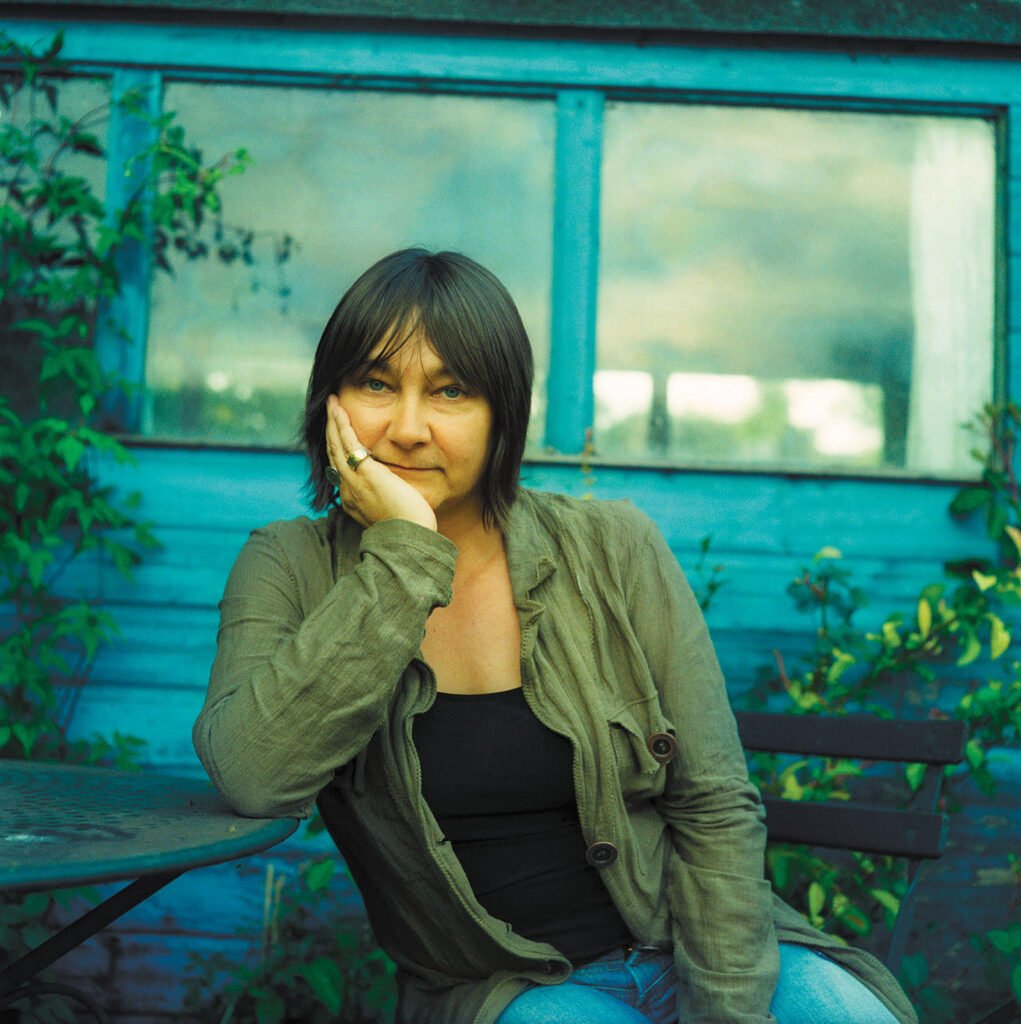
Ali Smith
Ali Smith (Inverness, 1962) è una scrittrice e saggista scozzese. Autrice di romanzi, racconti e testi critici, ha costruito un’opera caratterizzata dalla sperimentazione formale e dall’intreccio fra letteratura, arti visive, storia e vita contemporanea. Con “How to Be Both” (2014; in italiano L’una e l’altra, SUR) ha vinto il Goldsmiths Prize, il Costa Novel Award e il Baileys Women’s Prize for Fiction ed è stata finalista al Booker Prize. Vive a Cambridge.
Francesco del Cossa
Francesco del Cossa (Ferrara, 1435/36 circa – Bologna, 1477/78 circa) è stato uno dei maggiori protagonisti della scuola ferrarese del Quattrocento. Attivo inizialmente alla corte degli Este, partecipò alla decorazione del Salone dei Mesi di Palazzo Schifanoia, dove gli sono attribuiti i mesi di marzo, aprile e maggio. Dopo aver contestato in una celebre lettera a Borso d’Este l’inadeguatezza del compenso ricevuto, lasciò Ferrara e si stabilì a Bologna. Qui realizzò, tra le altre opere, il Polittico Griffoni, uno dei vertici della pittura rinascimentale dell’Italia settentrionale. Morì ancora giovane, probabilmente di peste, durante l’epidemia che colpì Bologna tra il 1477 e il 1478.
Figures, Written, a column by Rita Selvaggio, explores how art finds its way into literature. Rather than searching for a verbal equivalent of an image, it asks what happens when an artist, an artwork or a portrait enters a literary work and reshapes it from within.
FRANCESCHO DOPO FRANCESCO Ali Smith / Francesco del Cossa
“An image encountered by chance, a letter that resurfaced from an archive, a name restored to the wall. In “How to Be Both” (Hamish Hamilton Publisher), Ali Smith enters the gaps in Francesco del Cossa’s biography and invents Francescho: not to rewrite history, but to explore what remains between document and fiction.“
At Palazzo Schifanoia — its name a play on words inviting one to ‘shun boredom’ (schivar la noia) — time does not move from left to right. It arranges itself patiently on the wall.
In Francesco del Cossa’s Month of March, Minerva advances on her chariot above; at the centre, Aries crosses a band of sky alongside the enigmatic figures of the decans; lower down, Borso d’Este enters the present, among horses, courtiers, scenes of rule. Myth, the stars, earthly life do not follow one another. They happen together, separated into registers and held by the same surface.
The eye, though, is not bound to respect that order. It can climb from the duke to Minerva, linger on a face, descend again, move across a detail without knowing its meaning. It may not even know what it is looking at. One of the most magnetic presences on that wall — a young man in white rags, his dark body suspended against a blue ground — reached Ali Smith in exactly this way: severed from the place it belonged to, reproduced on the pages of an art magazine.
It was April 2013. Over breakfast, Smith was leafing through issue 153 of frieze, dated March, when a full-page reproduction made her stop. It opened ‘Picture Piece: Frescoes in the Palazzo Schifanoia, Ferrara’, a short text by Jan Verwoert published in the One Takes column (pp. 112–114). Isolated against the blue, one of the decans of the Month of March appeared: the Black youth in white rags; on the facing page, a horizontal strip showed the three astrological figures of the middle register.
Verwoert was not reconstructing Del Cossa’s biography. He read the frescoes through the lecture Aby Warburg gave in Rome in 1912, tracing the decans’ migration: from antiquity to the astrological texts compiled in Baghdad by Abū Ma’shar, translated into Hebrew in Toledo by Abraham ibn Ezra and, via a French version, into Latin by Pietro d’Abano, all the way to the Ferrarese wall. In Del Cossa, he wrote, the figures’ ‘Greek heart’ beat again; after Agamben, the images were not mere representations but ‘signatures’ capable of transmitting a force. Smith met the youth in rags inside an article that already described him as a form that had survived its own journey.
Smith had not yet seen Palazzo Schifanoia; of Francesco del Cossa she knew little or nothing. The figure came first, then the name. Only after that, Ferrara.
Del Cossa enters Smith’s writing the same way he had already re-entered history: in fragments.
The frescoes of the Salone dei Mesi did not survive the five centuries separating them from us unscathed. The palace lost its function, changed owners and uses; the paintings were plastered over. When they began to resurface in the nineteenth century, what came back into view did not necessarily bring with it the name of the artist who had painted it. Francesco del Cossa, too, had disappeared from his own wall.
Finding him again took another fragment: not an image, this time, but a piece of writing.
On 25 March 1470, Del Cossa addressed a letter to Borso d’Este. In it he claimed as his own the three months towards the antechamber — March, April and May — and protested at the payment he had received. He did not speak as an anonymous hand: he asserted the value of the work, his own name, the quality of the painting. More than four centuries later, retrieved in 1885 from the State Archive of Modena, that letter would help reunite an author with the images.
Art history could begin again from there. But only up to a point.
What remains of Del Cossa are works, documents, attributions: enough to recognise an artist, too little to reconstruct a life without gaps. It is perhaps in this disproportion — between the extraordinary presence of what he painted and the scarcity of what we know of him — that How to Be Both (Hamish Hamilton, 2014) truly begins.
Ali Smith does not encounter a character whose story is waiting to be told. She encounters what history has preserved of a person: images, a name, a few traces, a letter. Fiction begins where those traces stop answering.
It is there that Smith invents her own Francesco.
She does not fill a biographical gap. She does almost the opposite: she takes the uncertainty surrounding Del Cossa and refuses to resolve it. She turns it into the very basis of the character’s existence. The Francescho of How to Be Both crosses the boundaries that biography is expected to fix in place: man and woman, past and present, body and image, the one who looks and the one who is looked at.
The historical record remains and pushes back. Bartolomeo Garganelli, Ercole de’ Roberti, Cosmè Tura, Borso d’Este, the letter of 1470: Smith holds on to these points of historical reference, leaving room for possibility beyond them. The historical Francesco and the literary Francescho can no longer coincide.
The name, too, passes from document into fiction. Smith takes up ‘Francescho’, the spelling with which Del Cossa names himself in the body of the 1470 letter, before its Latin signature, ‘Franciscus del Cossa’. The character still carries the artist’s name, but is no longer entirely him.
Smith has said that the form of How to Be Both also grew out of fresco technique: the visible surface and what persists beneath it. The novel’s two halves — one centred on George, an English teenager who has just lost her mother, the other on the Ferrarese painter — were published in two different orders. In some copies Francescho comes first, in others George. Neither sequence takes precedence.
The relationship between fresco and narrative structure has been widely recognised by critics. Daniel Lea has observed how How to Be Both transposes into narrative the structure of ‘layer and underlayer’; Robert Kusek and Wojciech Szymański have read the novel through Warburg’s Nachleben and the migration of Schifanoia’s images. It is precisely these readings that allow the question to shift.
Not only: what remains beneath an image?
But: what remains beneath a name?
Before becoming Ali Smith’s Francescho, Del Cossa had already known two kinds of loss. The paintings had disappeared beneath whitewash; the name had been severed from the works. The nineteenth-century rediscovery made the paintings visible again; documentary research reunited the name with the wall. Neither could restore a person.
Literature holds no further documents, nor does it correct the archive. But it can venture into the place where what is verifiable gives way to what will remain unanswered.
The Francesco who emerges from this comes after: he can exist only once history has established how far he can be followed.
Francescho after Francesco.
But between these two Francescos, there have been others.
In 1912 Aby Warburg brought Schifanoia to the Tenth International Congress of the History of Art in Rome. He was not looking for a painter’s identity: he traced the journey of the astrological presences in the middle band, the decans, recognising in them forms that had come down from antiquity and passed through texts, translations, cultures. The Ferrarese wall became a temporary destination in that migration.
Schifanoia thus ceased to be a motionless monument of the Renaissance. Distant times converged in its paintings: forms already travelling before they were painted, destined to travel further.
Before being a place and a name, Schifanoia is, for Smith, an image met by chance: photographed, reproduced, brought to a breakfast table.
Before information comes a pause. Before knowing, looking.
Art history necessarily moves in the opposite direction: it leads that body back to the wall, the wall back to the iconographic programme, the programme back to the Este court, the decans back to the genealogy reconstructed by Warburg. It restores relations, provenances, meanings.
Literature can preserve something of what precedes explanation.
Smith’s Francesco is also born of this distance: between what we know of Del Cossa and the man whose works survive him but do not fully reveal him.
Warburg had shown that an image does not belong entirely to the time that houses it. How to Be Both, too, belongs to this survival and migration of forms. This raises a further question.
Not only: how does an image survive?
But: what happens to the person to whom that image is traced back?
A painting can survive for centuries while its maker’s life remains unknown. As soon as a name returns beside a work, another desire follows: to know who he was, how he lived, what body he had, whom he loved. The images remain before us. At some point, the documents run out.
Of Francesco del Cossa we possess no securely identified portrait. The face is missing as much as the life.
It is telling that Smith places a possible self-portrait in that very same band of the Month of March. Not in the Black youth in rags whose image had made her pause over a page of frieze, but in the third figure of the middle register: the androgynous youth holding a hoop and a long arrow. In the novel, the possibility that Francescho painted his own face there belongs to fiction, not to art history. But this is precisely the gesture: where no image documents the artist’s face, literature allows him to appear inside his own work.
Smith does, then, what the historian cannot: she imagines a body and gives it a face.
Her Francescho was born female and lives as a man. The novel does not present this possibility as a discovery, nor as a biographical correction. It places it where the document falls silent. Smith does not claim that Francesco was a woman: she lets fiction measure what the past can no longer confirm or deny.
If we were to read How to Be Both as an alternative biography, we would simply be replacing one certainty with another. Smith instead lets the uncertainty take shape without resolving it.
This choice about gender brings into view the point where knowledge and imagination part ways. Every historical figure reaches us through an uneven distribution of presences and absences: something is documented; the rest remains hypothetical, or is lost.
The novel’s subtler doubling, then, lies not only between George and Francescho, the present and the Quattrocento, one half and the other. It also lies between Francesco del Cossa and Francescho.
One belongs to history and withdraws even as the documents try to define him. The other belongs to fiction and takes on a body precisely because he need not be historically verifiable.
Between the two there is no mirror.
There is an interval.
And it is inside this interval that George appears.
She, too, arrives after a loss. Her mother died a few months earlier, and time, since then, has split in two: a George before, and a George after. But grief does not obey chronology. The past enters the present without asking permission.
It was her mother who first took George to see Del Cossa’s paintings.
During a trip to Italy, she had wanted to visit Ferrara and see Schifanoia. George had followed with the reluctance of adolescence, present without yet knowing which moments would become irreplaceable. After her mother’s death, the frescoes acquire a different weight: they now belong to a time shared with someone who is no longer there.
The novel thus sets side by side two unequal absences. Of Del Cossa too few traces remain to reconstruct a life; of her mother, George retains an almost painful abundance of words, arguments, journeys, songs, gestures. Neither scarcity nor abundance gives a person back.
Francescho, too, lost his mother. Like George. But what matters more than the symmetry is the time each of the two losses produces.
The dead do not stay where time has placed them.
The mother goes on speaking inside her daughter’s sentences. A journey long over still changes what George sees. A fifteenth-century painter watches a twenty-first-century girl in front of one of his pictures. A fresco buried beneath whitewash resurfaces. A letter from an archive gives a name back to a wall. What has been does not stop happening simply because its present is over.
The novel’s two halves both carry the same number: ‘one’. No ‘two’ follows neatly after. Critics have read this device as simultaneity, reciprocity, bothness. But it also does something more concrete: it destabilises the very distinction between before and after.
For George, her mother belongs to before and remains part of now.
For Francescho, the Quattrocento is over and keeps happening.
For us, Francesco del Cossa has been dead for more than five centuries and keeps changing.
It is this third temporality that turns him into a literary figure.
Smith does not bring Del Cossa back to life. She grants him another present: he can watch George in front of one of his paintings, remember a life we cannot verify, inhabit a body no document records. Fiction adds no information to the archive. It changes the temporal frame within which the archive can be understood.
Art history reunites: a work with an author, a document with a date, a form with a tradition. Literature can allow what refuses to be reunited to go on producing form.
Between Francesco and Francescho a distance remains that no attribution can close. Between George and her mother, a conversation memory can continue but not reopen. Between the reproduction Smith encountered and Schifanoia lies an image’s journey away from the wall and back to it through the act of looking.
When we return to the Salone dei Mesi, the wall looks different.
In the Month of March, Minerva is still there, and Aries, the decans, Borso d’Este: the time of gods, of stars, of the court. But other times, never painted, have settled onto the surface: the years of concealment, the frescoes’ resurfacing, the letter’s recovery, Warburg’s gaze, a morning in April 2013 spent over the March issue of frieze.
And, finally, the novel.
Not the fresco’s last layer. Not its explanation.
Another place in which Francesco can appear.
Art history has given his name back to the wall. How to Be Both does not bring back the man who bore it. It leaves open the distance between what we can know of Francesco del Cossa and the figure we can still imagine.
After Francesco, Francescho.
And after Francescho, Francesco again.
Ali Smith
Ali Smith (born in Inverness in 1962) is a Scottish novelist and essayist. The author of novels, short stories and critical writings, she has developed a body of work distinguished by formal experimentation and by the interweaving of literature, visual art, history and contemporary life. How to Be Both (2014; published in Italian as L’una e l’altra by SUR) won the Goldsmiths Prize, the Costa Novel Award and the Baileys Women’s Prize for Fiction, and was shortlisted for the Booker Prize. She lives in Cambridge.
Francesco del Cossa
Francesco del Cossa (Ferrara, c. 1435/36 – Bologna, c. 1477/78) was one of the leading figures of the fifteenth-century Ferrarese school. Initially active at the Este court, he contributed to the decoration of the Hall of the Months in Palazzo Schifanoia, where the frescoes for March, April and May are attributed to him. After protesting, in a celebrated letter to Borso d’Este, that he had been inadequately paid, he left Ferrara and settled in Bologna. There he produced, among other works, the Griffoni Polyptych, one of the masterpieces of Renaissance painting in northern Italy. He died while still young, probably of plague, during the epidemic that struck Bologna between 1477 and 1478.