English version below —
Ruota attorno a tre concetti – l’immagine, l’ombra e il doppio – la mostra ospitata alla Fondazione ICA Milano The Second Shadow. Dozie Kanu Mirroring Marc Camille Chaimowicz, with Shared Echoes and Kindred Spirits. A cura di Rita Selvaggio (con il supporto di Giulia Civardi) e prodotta in collaborazione con Nicoletta Fiorucci Foundation, la mostra in corso fino al 23 maggio si sviluppa in modo speculare con al centro del progetto il dialogo tra Jean Cocteau (2003 – 2014) di Marc Camille Chaimowicz (Parigi 1947 – Londra 2024) e una nuova installazione site-specific di Dozie Kanu (Houston 1993).
La mostra mette in dialogo due installazioni ambientali concepite come stanze, non proponendo una ricostruzione filologica, ma un dispositivo di ripercussione, in cui i due ambienti si confrontano e si condizionano a distanza, come superfici specchianti che dilatano il concetto stesso di immagine, opera e, non ultima, di realtà.
In mostra le opere di Kai Althoff, Camille Blatrix, Dora Budor, Valentin Carron, Matt Copson, Trisha Donnelly, Pierre Huyghe, Jannis Kounellis, Le Corbusier, Jasper Marsalis, Otobong Nkanga, Precious Okoyomon, Jennifer Packer, Gianni Piacentino, Cinzia Ruggeri, Dayanita Singh, Z. Susskind, SoiL Thornton, Lynette Yiadom-Boakye e Heimo Zobernig.
Segue l’intervista con la curatrice Rita Selvaggio —
Elena Bordignon: Immagine, ombra e doppio: la mostra che hai curato alla Fondazione ICA si fonda su tre topoi densi di significato, ancor più complessi nel momento in cui si intrecciano con figure come Jean Cocteau e Marc Camille Chaimowicz. Potresti raccontare come si articolano le relazioni tra questi due artisti e Dozie Kanu, che ha lavorato a stretto contatto con te alla realizzazione della mostra?
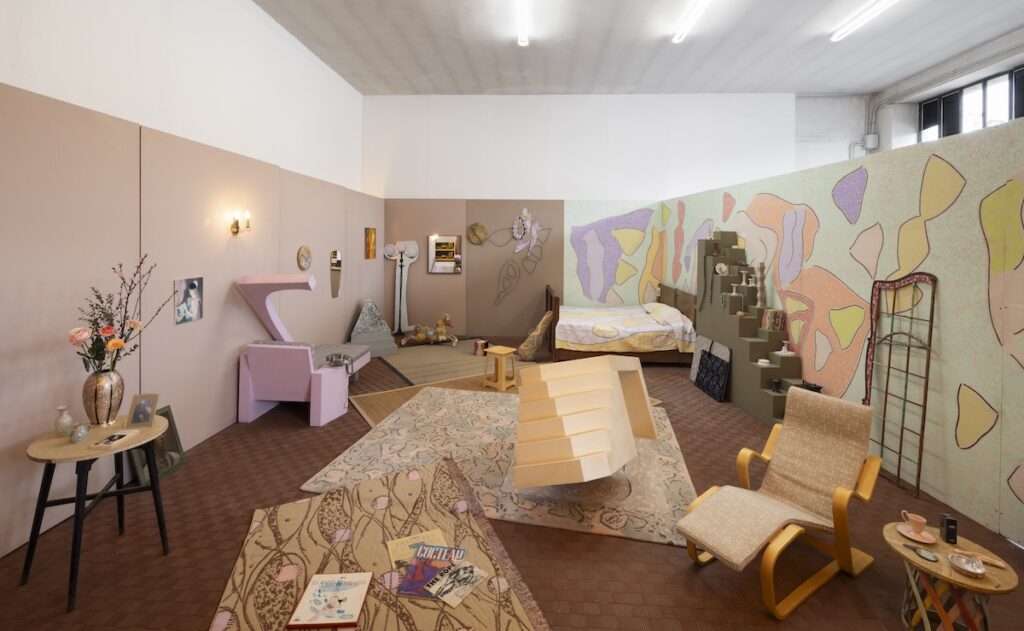
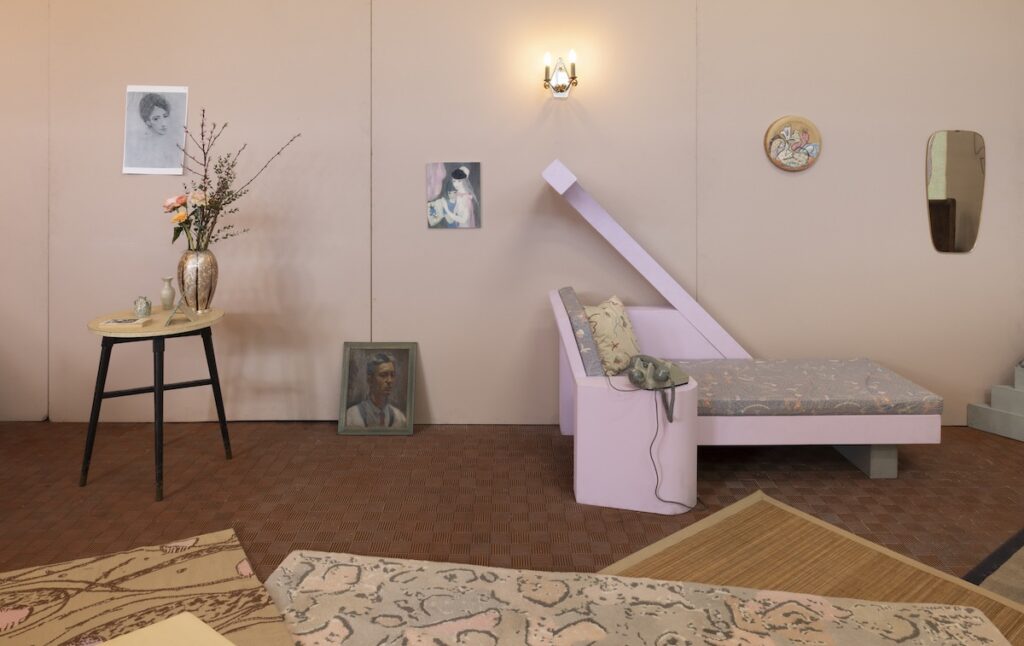
R.S. La mostra nasce dalla collaborazione tra Fondazione ICA Milano e Nicoletta Fiorucci Foundation intesa non come semplice sostegno, ma come parte integrante della costruzione curatoriale ed editoriale. Concettualmente non si fonda sull’intenzione di mettere in relazione tre artisti secondo una logica genealogica o di influenza, ma su una condizione più instabile: quella in cui l’immagine non coincide mai con sé stessa, ma si sdoppia, slitta e si ritarda. In questo senso, Jean Cocteau non è tanto una figura di riferimento quanto un operatore—qualcuno che ha pensato l’immagine come attraversamento, come soglia attiva, come dispositivo capace di restituire il visibile solo dopo averlo incrinato.È precisamente in questa linea che si inserisce il lavoro di Marc Camille Chaimowicz. La sua installazione Jean Cocteau…(2003-2014) non funziona come una ricostruzione né come un omaggio, ma come una struttura ospitante: un ambiente che assorbe, trattiene e ridistribuisce presenze, immagini, oggetti, senza mai fissarli definitivamente. Il letto, la poltrona, i tappeti—tutti elementi di uso quotidiano—non stabilizzano lo spazio domestico, ma lo rendono poroso, disponibile a una continua riattivazione. Cocteau, qui, non è citato: è disperso, diluito, quasi respirato all’interno della forma stessa dell’installazione. In una conversazione con Dan Fox, Chaimowicz sosteneva che Jean Cocteau, cambiando a ogni presentazione specifica, evita la noia. In un certo senso è una condizione ideale: non c’è l’ansia legata al nuovo lavoro, ancora non verificato, ma allo stesso tempo permane un margine di sorpresa. Diceva anche che dovremmo resistere alla tirannia del tempo lineare, a favore di un tempo molto più elusivo, labirintico, generoso e ambiguo, forse persino benevolo. Nel momento in cui riconosciamo che può ripiegarsi su sé stesso — dove, per esempio, eventi recenti possono apparire lontani e quelli più lontani farsi improvvisamente prossimi — acquisiamo una maggiore flessibilità della forma.
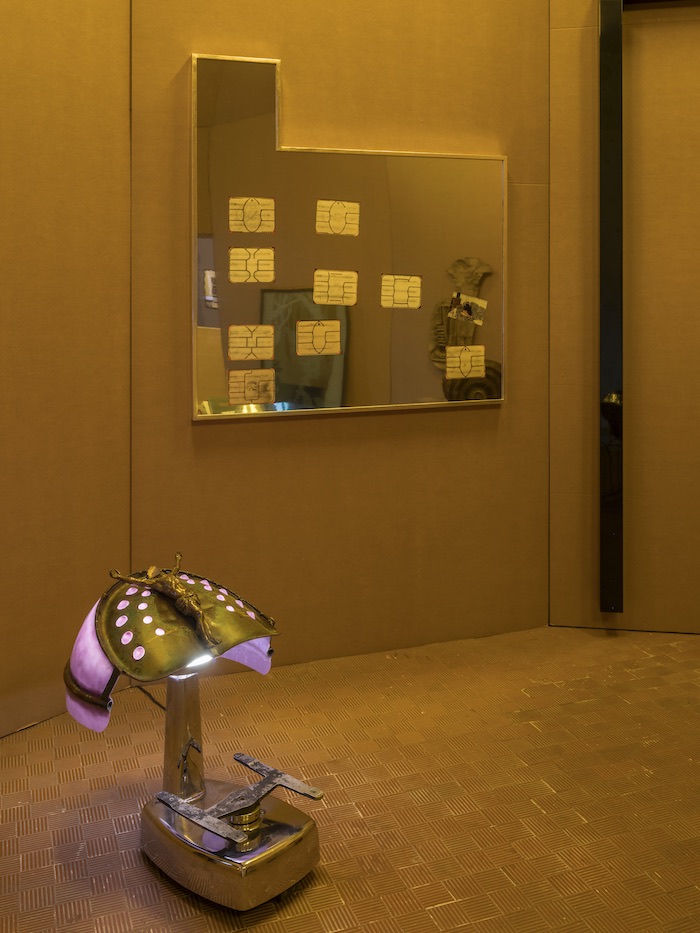
Quando Dozie Kanu entra in questo campo, non si pone in una posizione di risposta o di commento. Piuttosto, introduce uno scarto. Il suo intervento non prolunga il dialogo, ma lo devia, lo rifrange. Se la stanza di Chaimowicz trattiene e distribuisce presenze secondo una logica di interiorità espansa, Kanu lavora per sospensione e tensione: i suoi oggetti—ventilatori, assemblaggi industriali, superfici segnate dall’uso—non costruiscono un ambiente nel senso tradizionale, ma attivano forze. Come se lo spazio stesso fosse continuamente attraversato da correnti invisibili che, però, non sono atmosferiche. Non simulano un clima, né costruiscono un ambiente immersivo. Come nel cinema di Cocteau, l’aria è prodotta, attivata, resa esplicita nei suoi effetti. I ventilatori non accompagnano lo spazio: lo mettono in funzione. Introducono una perturbazione che precede ogni possibile azione, come se lo spazio stesso esitasse, si preparasse a un passaggio. La vibrazione continua che generano non è un sottofondo, ma un regime: tiene le cose in sospensione, impedisce che si stabilizzino, espone l’ambiente a una trasformazione sempre imminente.
In questo senso, la relazione tra i tre non è triangolare, né simmetrica. È piuttosto una catena di slittamenti. Cocteau introduce una grammatica dell’immagine come passaggio e trasformazione; Chaimowicz la traduce in una struttura abitabile che funziona come campo di accoglienza e dispersione; Kanu, infine, interviene su questa struttura non per abitarla, ma per alterarne le condizioni di possibilità, spostando l’attenzione da ciò che si vede a ciò che agisce.
La mostra si costruisce esattamente in questo spazio intermedio: non tra le opere, ma tra i regimi di visibilità che ciascuno di questi artisti mette in gioco. Non un dialogo, dunque, ma una serie di rifrazioni—dove ogni immagine, prima di apparire, sembra dover attraversare la propria ombra.
E.B. Il dialogo tra Jean Cocteau e Marc Camille Chaimowicz si costruisce attraverso rimandi, citazioni e stratificazioni indirette, spesso affidate a dettagli e atmosfere. In che modo Dozie Kanu interviene su questa distanza, trasformandola in un’esperienza spaziale e materiale concreta attraverso la sua installazione all’ICA?
R.S. Il punto non è tanto che Dozie Kanu “risponda” al dialogo tra Jean Cocteau e Marc Camille Chaimowicz, quanto che ne modifichi le condizioni di trasmissione. Quel dialogo, costruito per accumulo di rimandi e allusioni, resta in una dimensione mediata, quasi atmosferica. Kanu interviene esattamente lì dove questa mediazione rischierebbe di restare invisibile: la rende fisicamente percepibile.
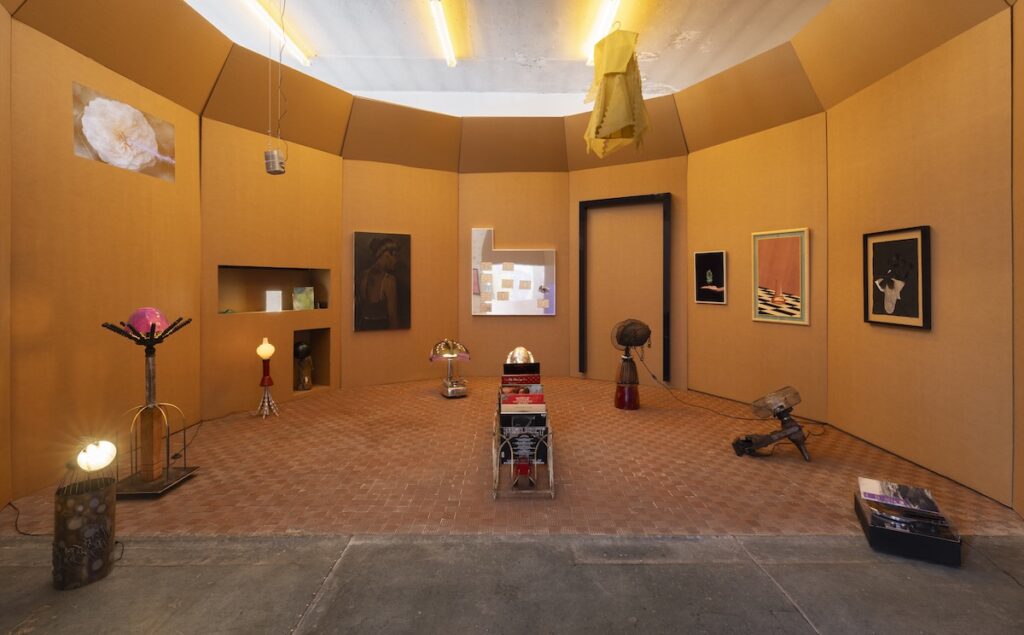
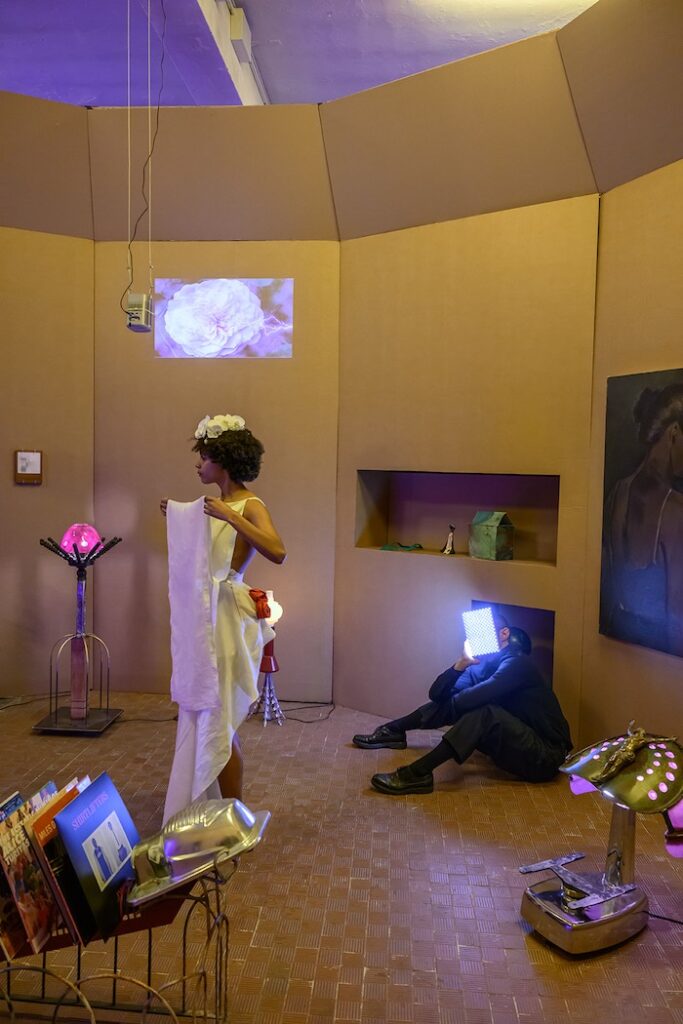
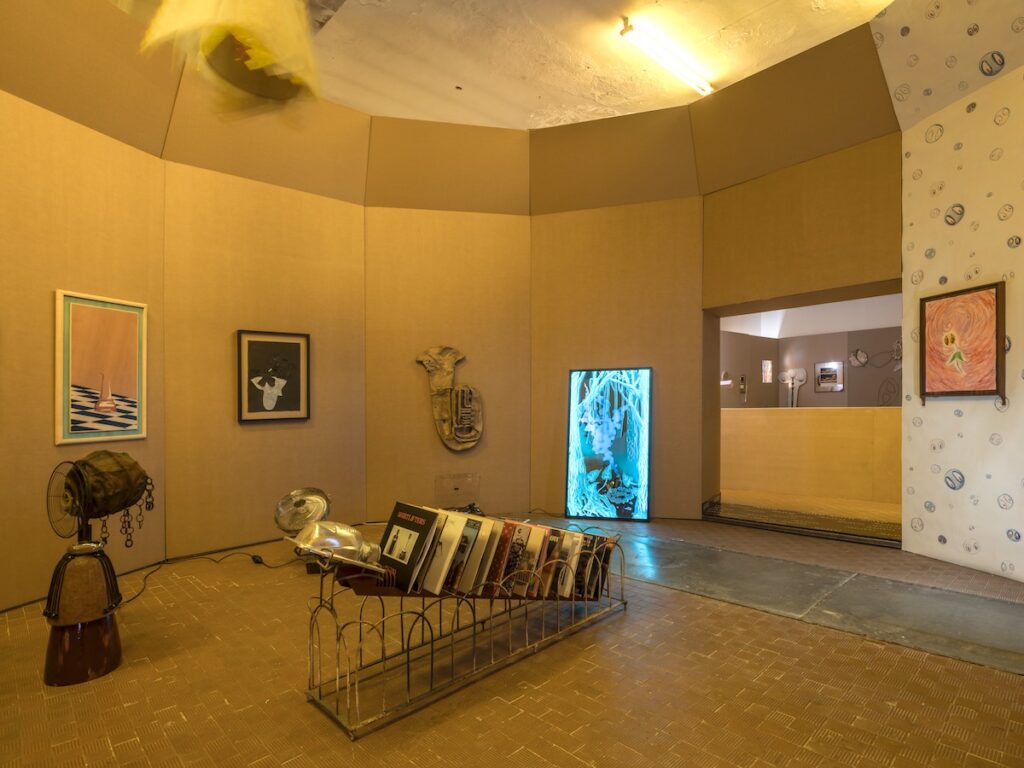
Lo fa mettendo lo spazio in funzione. I ventilatori, innanzitutto, non sono elementi scenografici: operano come veri e propri attivatori. Generano correnti, spostano aria, producono una vibrazione continua che attraversa l’ambiente. Non si limitano a “stare” nello spazio—lo attraversano, lo rendono instabile, lo tengono in movimento. In questo modo, ciò che nel dialogo Cocteau/Chaimowicz si dà come eco o risonanza, qui diventa una presenza concreta, quasi tattile.
Anche i materiali seguono questa logica. Le superfici segnate, gli assemblaggi industriali, gli oggetti che portano tracce d’uso non costruiscono un racconto, né introducono un repertorio simbolico. Piuttosto, interrompono la continuità dello sguardo: costringono a una negoziazione fisica con lo spazio, a un’attenzione che non è più solo visiva ma corporea. Il dialogo “a distanza” viene così tradotto in una serie di micro-attriti, di resistenze, di interferenze.
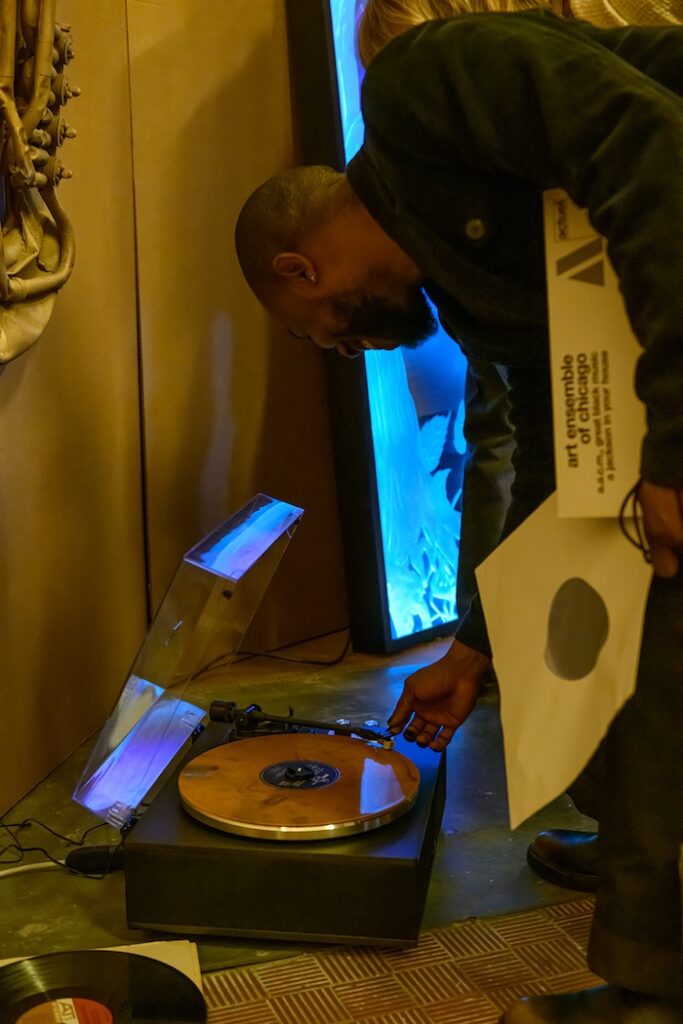
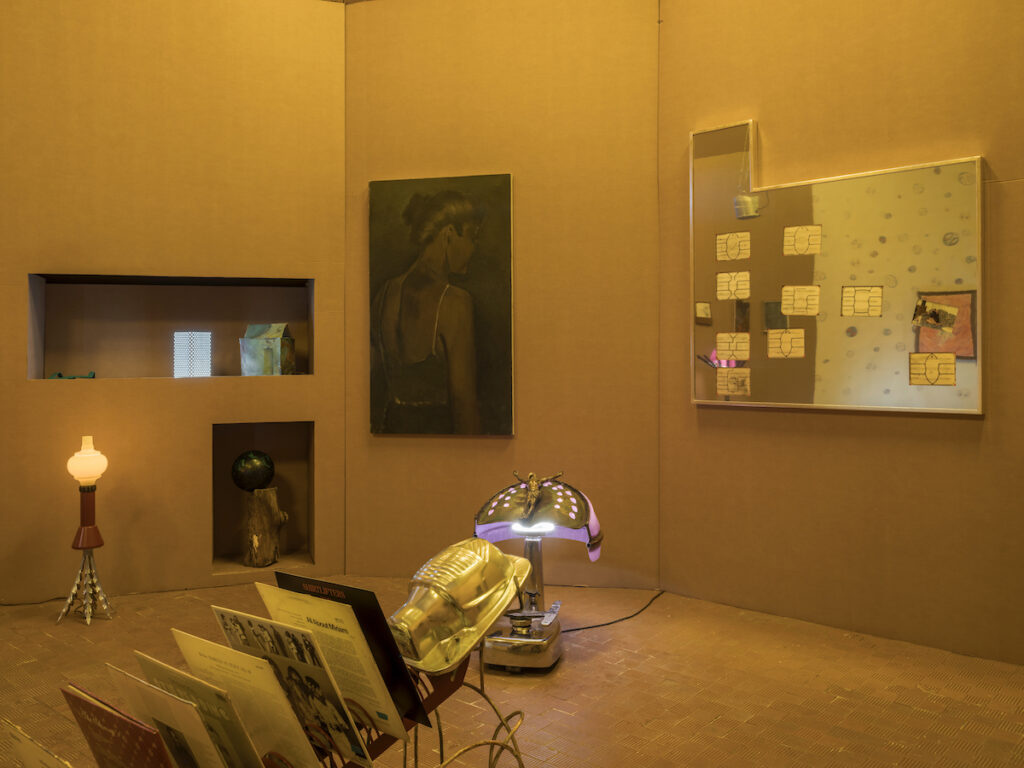
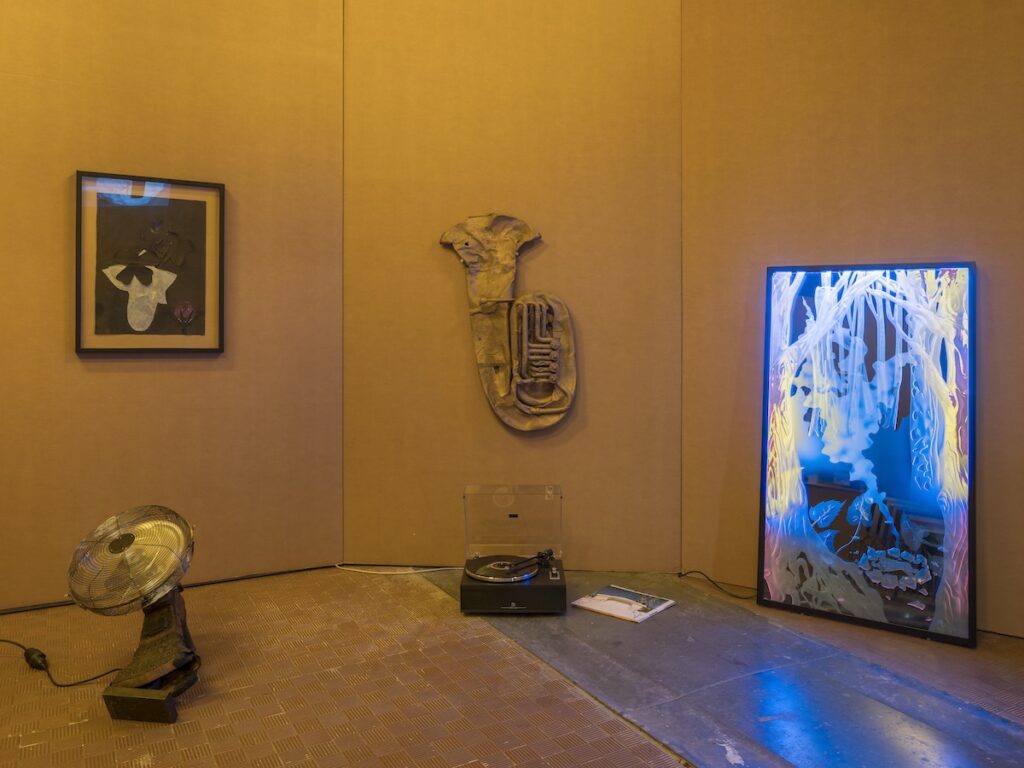
C’è poi un altro passaggio decisivo: Kanu introduce nel suo ambiente presenze che non appartengono né a Cocteau né a Chaimowicz, ma al proprio campo di riferimento—musicale, visivo, culturale. La collezione di vinili, per esempio, non è un semplice inserto autobiografico: è un sistema di intensità. Ogni disco porta con sé una temporalità, un ritmo, una memoria che non si allinea con quella dell’installazione accanto, ma la attraversa lateralmente. È qui che il dialogo si trasforma definitivamente: non più uno scambio tra due poli, ma un campo aperto in cui più frequenze coesistono senza risolversi.
In questo senso, l’intervento di Kanu non colma la distanza tra Cocteau e Chaimowicz, né la rende più leggibile. La espone, piuttosto, come una forza in atto—qualcosa che si manifesta attraverso movimento, suono, attrito. Il dialogo smette di essere una relazione da interpretare e diventa una condizione da attraversare.
E.B. La dimensione domestica sembra costituire non solo il punto di partenza concettuale, ma anche il principio formale della mostra. Potresti soffermarti su alcune dinamiche di rispecchiamento e raddoppiamento che attraversano le due installazioni, mettendo in relazione oggetti, materiali e modalità di percezione dello spazio?
R.S. In Jean Cocteau…la dimensione domestica non si organizza come spazio stabile, ma come un sistema regolato da protocolli interni, e il più decisivo è quello che riguarda la presenza di Andy Warhol. All’interno dell’installazione, ad esempio, Warhol non è mai una presenza contingente. È una costante. Un elemento che “deve” esserci, ma che cambia forma, soggetto, configurazione a seconda del contesto in cui l’opera viene riattivata. Questo significa che non stiamo parlando di un inserto iconografico, ma di un dispositivo di adattamento: Warhol è ciò che permette all’installazione di non chiudersi su sé stessa, di restare permeabile al luogo che la ospita. A Milano, la scelta di The Last Supper rende questo protocollo pienamente leggibile. Non è una scelta tematica, ma dovuta al contesto e al campo urbano che ospita la mostra. L’immagine entra in relazione diretta con la città, con la sua memoria visiva, con il Cenacolo leonardesco, ma soprattutto con la riflessione che Warhol stesso aveva già costruito su quell’immagine: una riflessione sulla riproducibilità, sulla serialità, sulla circolazione dell’icona. In questo senso, Warhol funziona come una cerniera: tiene insieme l’interno e l’esterno, il domestico e il pubblico, l’intimità e la storia dell’immagine. Senza questa presenza, la stanza di Chaimowicz rischierebbe di restare un ambiente chiuso, autoreferenziale. Con il Warhol, invece, si apre—si connette, si espone, si lascia attraversare.
È qui che il lavoro di Dozie Kanu interviene in modo preciso. Weighing forgiveness in light of (upgrade) del 2026 non dialoga genericamente con il tema dell’Ultima Cena, ma entra in tensione con questo stesso protocollo. Dove Warhol mantiene l’immagine in uno stato di circolazione—riproducibile, moltiplicabile, trasferibile—Kanu la blocca, la sottopone a una condizione di misura e peso. Il Cristo non è più immagine che si diffonde, ma corpo inserito in un sistema tecnico che lo trattiene, lo carica, lo rende verificabile. Ne deriva uno scarto netto: Warhol garantisce la mobilità dell’immagine, la sua capacità di attraversare contesti; Kanu ne sospende il flusso e la riporta a una condizione materiale, quasi giudicante.
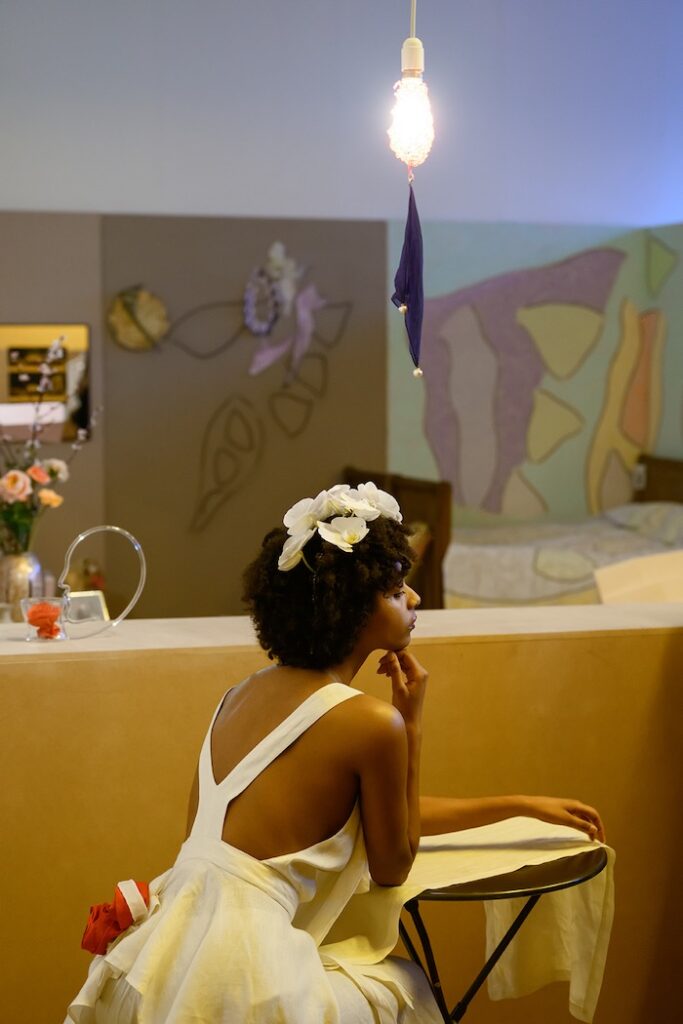
Nella stanza di Dozie, la carta da parati di Precious Okoyomon introduce uno scarto più radicale di quanto possa apparire a prima vista. Il motivo degli occhi—disseminati senza gerarchia come particelle, anime, spore, quasi come una polvere visiva—non organizza lo spazio ma lo rende instabile, attraversato da una molteplicità di sguardi che non si lasciano ricondurre a un unico punto di vista. Sono occhi in fiamme, un’epidermide psichica e politica, una pelle che respira e che guarda. Non si tratta di un pattern nel senso decorativo del termine, ma di una superficie attiva, una membrana che guarda. A differenza dei motivi di Marc Camille Chaimowicz, che costruiscono una grammatica dell’interno, una misura dell’intimità, qui il decorativo eccede la funzione di ordine e diventa una condizione percettiva. Gli occhi non ornano la parete: la trasformano in un campo di presenza diffusa, in cui lo spettatore non può più assumere una posizione esterna. È come se lo spazio, anziché essere osservato, restituisse lo sguardo, lo moltiplicasse, lo trattenesse. In questo senso, Microsphereology it’s Atmosphere Ethics e Like a doorway to God, gli innesti di Precious Okoyomon, entrambi del 2025, agiscono come un controcampo rispetto alla stanza di Chaimowicz. Se lì, il decorativo struttura e accoglie, qui disorienta e espone. Non c’è più distanza possibile, ma una prossimità insistente, quasi epidermica, in cui vedere significa già essere visti.
E ancora, in Marc Camille Chaimowicz, l’elemento scalare è una condizione spaziale implicita, un principio modulare che organizza e distribuisce lo spazio. Non è necessariamente una scala dichiarata, ma una struttura che orienta: nei passaggi, nelle variazioni di quota, nella disposizione degli arredi e degli oggetti. La scala, qui, lavora—regola il movimento, misura le distanze, costruisce una grammatica del corpo nello spazio. L’Abito scala – Omaggio a Escher (1985) di Cinzia Ruggeri, uno dei “kindred spirits” di Kanu, introduce una torsione. La scala è esplicita, visibile, quasi didascalica—ma non è più operativa. Non organizza lo spazio, non guida il corpo: è il corpo a portarla, o meglio, a renderla immagine. E nel dichiararsi come “omaggio”, incorpora già una dimensione di instabilità, di perdita di orientamento, senza uscire da sé. A livello di display accade poi qualcosa di ulteriore. L’abito non è semplicemente esposto: è sospeso, e l’aria artificiale di un ventilatore lo attraversa, lo fa vibrare. Quella scala, ormai svuotata di funzione architettonica, viene rimessa in movimento da una forza esterna. Non si percorre, ma si anima.
Potremmo parlare anche delle rose, quella di Trisha Donnelly e quella di Jannis Kounellis che si fronteggiano nell’area di Dozie Kanu, e che si incontrano nello stesso regime di visibilità.
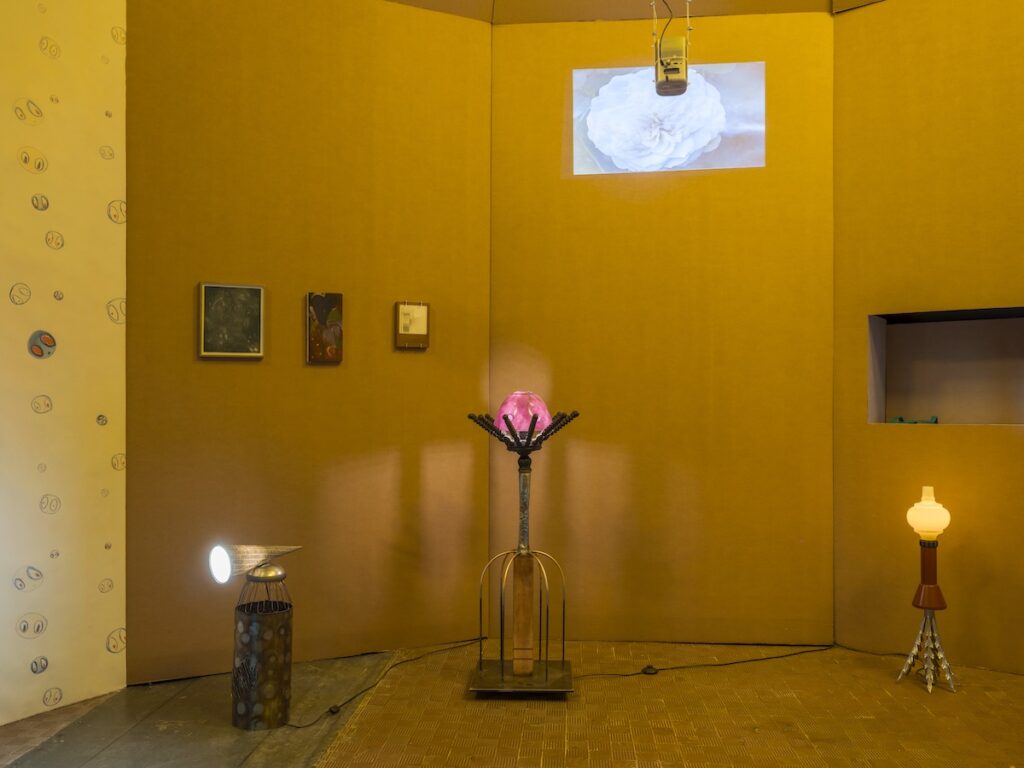
In Untitled (2008), la rosa bianca — piena, quasi eccessiva nella sua fioritura — si offre come superficie sensibile: trattiene la luce, la piega, la disperde nei suoi petali. È un’immagine che sembra ancora credere nella propria apparizione. Anche quando è attraversata da un’improvvisa linea di energia che la taglia, non perde del tutto la sua coerenza interna: continua a fiorire. La perturbazione non la nega, la attraversa. È un evento che insiste sulla sua pelle, senza cancellarla. La Rosa Nera (1966) di Kounellis, invece, non è attraversata: è già stata colpita. Non c’è un prima e un dopo, non c’è un evento visibile che la incrini. L’incrinatura coincide con la sua stessa forma. Il nero non arriva dall’esterno, non è una forza che interviene: è la condizione originaria dell’immagine. Per questo il fiore non fiorisce — o meglio, fiorisce in negativo, come se ogni petalo fosse già stato sottratto alla sua evidenza. Tra queste due rose si apre una distanza precisa. Non è solo cromatica, ma ontologica. La rosa bianca continua a negoziare con la propria visibilità: accoglie l’interferenza, la lascia passare, l’energia che la attraversa non distrugge l’immagine, ma la intensifica, la rende più instabile, più vibrante. È una rosa che resta nel campo del fenomeno, anche quando viene perturbata. La rosa nera, al contrario, ha già attraversato quella soglia. Non è più fenomeno, ma traccia. Non si lascia perturbare perché è già oltre la possibilità della perturbazione. In essa, la crisi dell’immagine non è un evento, ma uno stato.
E tuttavia — ed è qui che il parallelismo si fa più sottile — entrambe operano una forma di scarto rispetto all’idea stessa di fiore. Nessuna delle due è innocente. La prima perché è esposta a una forza che la eccede; la seconda perché è stata svuotata dall’interno. Se la rosa bianca è un corpo attraversato, la rosa nera è un corpo già trasformato. Se la prima trattiene ancora la promessa della fioritura, la seconda ne conserva soltanto il nome.
E forse è proprio in questo slittamento — tra attraversamento e sottrazione — che le due immagini entrano in relazione: non come opposizioni, ma come due modalità distinte di mettere in crisi l’apparire.
Potremmo continuare a lungo, seguendo altre traiettorie, aprendo ulteriori corrispondenze, ma questi esempi bastano a rendere evidente una cosa: il display non è il risultato di un accumulo, né di un’intuizione generica. È una costruzione precisa, calibrata, dove ogni elemento — anche il più apparentemente marginale — è stato pensato, disposto, deciso con una cura quasi millimetrica.
E.B. La pratica di Marc Camille Chaimowicz concepisce l’installazione come una struttura ospitante, aperta a presenze che ne ridefiniscono continuamente l’assetto. In che modo questa logica ha guidato la selezione delle opere dalla Collezione di Nicoletta Fiorucci?
La logica che ha orientato il lavoro non è stata quella di individuare opere “pertinenti” o tematicamente coerenti, ma di riconoscere, all’interno della Collezione di Nicoletta Fiorucci, delle presenze già dotate di una propria capacità di attivazione. In questo senso, il modello resta quello della struttura ospitante di Marc Camille Chaimowicz: un ambiente che non stabilizza le opere ma le espone a una condizione di relazione, dove ogni elemento entra come parte di una coreografia mobile, mai definitivamente chiusa. La variabilità storica delle presenze in Jean Cocteau rende evidente che ciò che conta non è la singola opera, ma il campo di intensità che si genera tra le opere.
È precisamente su questo piano che si è innestato il lavoro con Dozie Kanu. La selezione non risponde a un principio di citazione o omaggio, ma alla possibilità che ogni lavoro introducesse una soglia di instabilità: un punto in cui l’ambiente potesse deviare, aprirsi, o entrare in tensione. Le opere non sono state quindi “inserite” nello spazio, ma chiamate a operare al suo interno, come agenti capaci di modificarne l’equilibrio.
Allo stesso tempo, questa costellazione non è neutra: Kanu ha orientato la scelta verso artisti e pratiche con cui avverte una prossimità reale, quasi una continuità sotterranea di ricerca. Non si tratta di affinità dichiarative, ma di consonanze operative — modi di trattare i materiali, di pensare la funzione, di attraversare lo spazio — che rendono queste presenze non semplici innesti, ma interlocutori attivi all’interno del suo linguaggio. Kanu riprende così la logica ospitante di Chaimowicz, ma la sposta. Se in Chaimowicz essa si dà come un interno carico di memoria e di proiezione, in Kanu diventa un campo operativo, attraversato da forze più esplicite: materiali, sonore, meccaniche. Le opere della collezione, in questo contesto, non si limitano a essere accolte, ma vengono sollecitate, quasi messe al lavoro. È qui che il rispecchiamento si trasforma in rifrazione: la stessa modalità — ospitare, accogliere, mettere in relazione — viene mantenuta, ma sottoposta a una pressione diversa, che ne altera il comportamento.
In questo senso, la selezione non è mai stata una scelta di opere, ma la costruzione di una condizione: un ambiente in cui esse potessero agire, più che significare.
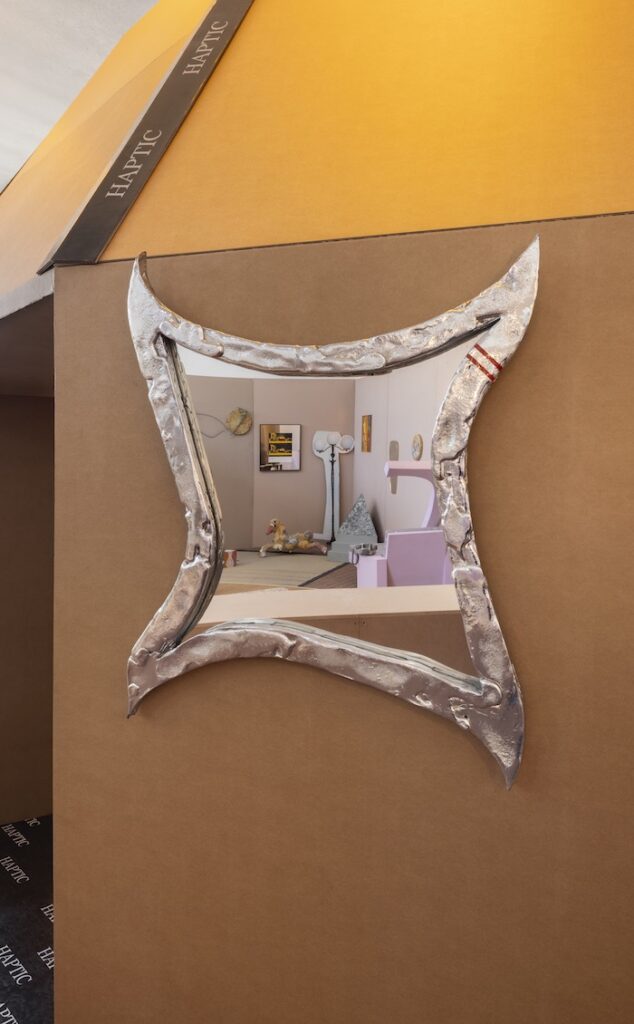
E.B.Nell’installazione di Kanu, la struttura in cartone rinforzato—quasi una cupola—si tiene insieme attraverso la ripetizione della parola haptic, che si rincorre anche lungo la soglia d’ingresso: in che modo questa insistenza sul tatto orienta la nostra esperienza di uno spazio che sembra eccedere la dimensione puramente fisica?
R.S. Ciò che Kanu mobilita attraverso la ripetizione della parola haptic non è il tatto nella sua dimensione immediata e sensoriale, ma un registro più elusivo—che opera a distanza, senza contatto. La parola tiene insieme la struttura quasi come una forza vincolante, e allo stesso tempo sfugge a ogni lettura letterale. Rimanda piuttosto a una forma di memoria sensoriale, a quelle pressioni che ci plasmano senza mai diventare pienamente afferrabili.
In questo senso, il lavoro si orienta verso un campo invisibile di relazioni: migrazione, ascendenza, storie generazionali—forze che non toccano direttamente il corpo, eppure vi lasciano impronte precise. Non si presentano come immagini o narrazioni, ma come condizioni che attraversano lo spazio, come un’atmosfera che non si vede ma si percepisce. Ciò che emerge è una nozione di tatto differita, dislocata—meno un atto che una trasmissione, qualcosa che ci attraversa prima ancora che siamo in grado di nominarlo.
E.B. Trovo molto poetica e generosa l’immagine insita nel titolo della mostra “The Second Shadow”. Mi racconti da dove è nata l’idea di abbracciare con questa immagine ambigua e affascinante il concetto della mostra?
R.S. L’immagine della Second Shadow non nasce come un titolo illustrativo, ma come una necessità interna al progetto. Fin dall’inizio era chiaro che la mostra non potesse essere pensata nei termini di un’estensione o di un dialogo lineare tra due artisti, ma come uno scarto: qualcosa che si produce dopo l’immagine, quando questa incontra un’altra presenza, un altro tempo, un altro spazio.
L’ombra, in questo senso, è già una forma di traduzione — una figura che non coincide mai con il corpo che la genera. Ma l’idea di una seconda ombra introduce un ulteriore slittamento: non la duplicazione di un’origine, ma ciò che resta dopo che l’immagine ha già attraversato un primo processo di trasformazione. È un’immagine che arriva in ritardo, ma proprio per questo è più libera, meno vincolata alla somiglianza, più disponibile alla deviazione.
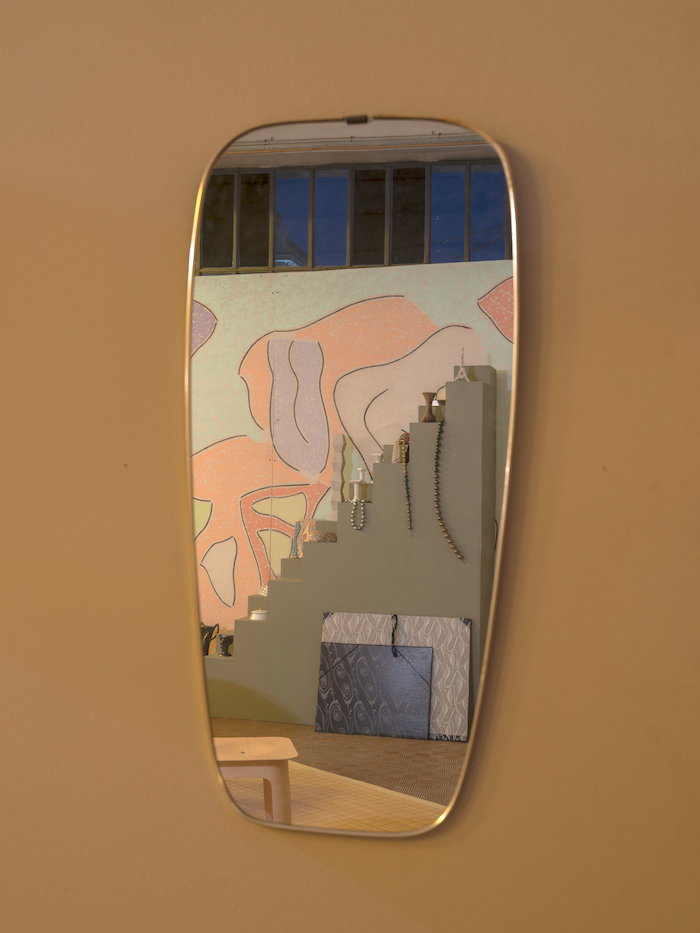
Il riferimento a Cocteau — e alla sua idea che gli specchi dovrebbero pensare prima di riflettere — è stato decisivo, perché introduce una sospensione: l’immagine non è più immediata, ma trattenuta, quasi interrogata. È importante ricordare che questa intuizione non nasce in isolamento: Cocteau la raccoglie e la rilancia a partire da una sensibilità già presente in Jacques Rigaut, figura legata al Dada parigino, autore di scritture brevi e taglienti, attraversate da un radicale rifiuto dell’automatismo dell’esistenza. In una sua celebre esortazione — “e ora riflettete, specchi” — l’immagine non è più semplice restituzione, ma viene chiamata a pensare. La seconda ombra emerge esattamente in questo intervallo, come il risultato di un’immagine che ha preso tempo.
All’interno della mostra, questo si traduce in una relazione non speculare tra Chaimowicz e Kanu. La stanza di Chaimowicz può essere intesa come una prima ombra — una traduzione già mediata di Jean Cocteau in uno spazio abitabile, intimo, teatrale. L’intervento di Kanu non si sovrappone né replica, ma si situa dopo: come una rifrazione che rende visibile il processo stesso del guardare, del ricordare, del trasformare.
In questo senso, il titolo tiene insieme una tensione: da un lato qualcosa di quasi impalpabile; dall’altro una struttura molto precisa, che riguarda il modo in cui le immagini persistono, si spostano e continuano ad agire senza mai fissarsi definitivamente. È un’immagine ambigua, sì, ma proprio perché rifiuta di chiudersi — e lascia spazio a ciò che nella mostra resta in movimento.
E.B. In parallelo alla mostra, stai costruendo una sorta di diario online che racconta e sviscera il progetto espositivo. Di cosa si tratta?
R.S. Non si tratta di un diario, ma di una narrazione parallela che accompagna la mostra e che viene diffusa attraverso l’inoltro di newsletters periodiche. Piuttosto, lo definirei uno spazio editoriale che ne disloca il centro, un dispositivo che permette al progetto di continuare a prodursi altrove, secondo altre temporalità e altre forme. Sin dall’inizio l’idea era quella di superare i limiti fisici di un documento cartaceo: evitare la fissità del catalogo per lavorare su una forma aperta, espandibile, capace di accogliere nel tempo contributi diversi. Il programma online nasce così come una costellazione di interventi — testi, immagini, materiali sonori — che non spiegano la mostra, ma la attraversano, la deviano, ne spostano progressivamente il baricentro. Come suggerisce anche l’incipit del programma, non è un’estensione, ma uno spostamento. È un progetto che prende forma attraverso una collaborazione precisa tra ICA Milano, Nicoletta Fiorucci Foundation e Lenz Press, e che trova proprio in questa dimensione condivisa la sua natura processuale. Ogni episodio introduce una voce, una prospettiva, una memoria che entra in relazione con l’impianto espositivo senza mai coincidere con esso.
In questo senso, più che un diario, è un archivio in atto: qualcosa che si costruisce nel tempo, che resta aperto, e che permette alla mostra di esistere come un campo mobile, non circoscritto allo spazio fisico. È anche un modo per lavorare sulla durata: laddove il percorso espositivo si offre come esperienza situata, il programma online ne estende la temporalità non attraverso la registrazione, ma attraverso una serie di rifrazioni successive.
Al termine, l’intero progetto rimarrà permanentemente accessibile sul sito di Lenz Press: https://lenz.press/products/the-second-shadow come una forma di pubblicazione diffusa e stratificata: non un catalogo chiuso, ma un archivio vivo, consultabile nel tempo.
Per questo non racconta la mostra: la mette di nuovo in movimento.
The Second Shadow: Dozie Kanu Mirroring Marc Camille Chaimowicz, with Shared Echoes and Kindred Spirits
Curated by Rita Selvaggio with the support of Giulia Civardi , curator Nicoletta Fiorucci Collection
ICA Milano
The exhibition The Second Shadow. Dozie Kanu Mirroring Marc Camille Chaimowicz, with Shared Echoes and Kindred Spirits brings into dialogue two environmental installations conceived as rooms: Jean Cocteau (2003–2014) by Marc Camille Chaimowicz (Paris 1947 – London 2024) and a new site-specific intervention by Dozie Kanu (1993, Houston), designed as a response to and reflection of the historic work.
Artists: Kai Althoff, Camille Blatrix, Dora Budor, Valentin Carron, Matt Copson, Trisha Donnelly, Pierre Huyghe, Jannis Kounellis, Le Corbusier, Jasper Marsalis, Otobong Nkanga, Precious Okoyomon, Jennifer Packer, Gianni Piacentino, Cinzia Ruggeri, Dayanita Singh, Z. Susskind, SoiL Thornton, Lynette Yiadom-Boakye, and Heimo Zobernig.
Interview with Rita Selvaggio —
Elena Bordignon: Image, shadow, and double: the exhibition you curated at Fondazione ICA is grounded in three densely layered topoi, made even more complex as they intersect with figures such as Jean Cocteau and Marc Camille Chaimowicz. Could you describe how the relationships between these two artists and Dozie Kanu—who worked closely with you on the exhibition—are articulated?
R.S. The exhibition emerges from a collaboration between ICA Milano and the Nicoletta Fiorucci Foundation, understood not as mere support, but as an integral part of both its curatorial and editorial construction. Conceptually, it is not grounded in the intention to bring three artists into relation through a genealogical or influence-based logic, but rather in a more unstable condition: one in which the image never fully coincides with itself, but doubles, shifts, and is deferred. In this sense, Jean Cocteau is less a point of reference than an operator—someone who conceived the image as passage, as an active threshold, as a device capable of returning what is visible only after having unsettled it.
It is precisely along this line that the work of Marc Camille Chaimowicz unfolds. His installation Jean Cocteau… (2003–2014) does not function as a reconstruction or homage, but as a hosting structure: an environment that absorbs, holds, and redistributes presences, images, and objects without ever fixing them definitively. The bed, the armchair, the carpets—elements of everyday use—do not stabilise the domestic space, but instead render it porous, open to continual reactivation. Cocteau, here, is not cited: he is dispersed, diluted, almost absorbed into the very form of the installation. In a conversation with Dan Fox, Chaimowicz remarked that Jean Cocteau… changes with each specific showing, which avoids boredom. In a sense it’s an ideal situation: there isn’t the anxiety associated with new work, given that it isn’t yet proven, but equally there remains a degree of surprise. He also noted that we should resist the tyranny of linear time in favour of one that is much more elusive, labyrinthine, generous and ambiguous, perhaps even kindly. Once we recognise that it can fold in on itself—where, for example, recent events can seem distant and more distant ones seem closer—we gain a greater flexibility of form.
When Dozie Kanu enters this field, he does not position himself in terms of response or commentary. He introduces a shift. His intervention does not extend the dialogue but redirects it, refracts it. If Chaimowicz’s room holds and distributes presences within an expanded interior logic, Kanu works through suspension and tension: his objects—fans, industrial assemblages, surfaces marked by use—do not construct an environment in the traditional sense, but activate forces. As if the space itself were continuously traversed by invisible currents that are anything but atmospheric. They do not simulate a climate, nor do they produce an immersive setting. As in Cocteau’s cinema, air is produced, activated, made explicit in its effects. The fans do not accompany the space; they set it in motion. They introduce a disturbance that precedes any possible action, as though the space itself were hesitating, preparing for a passage. The continuous vibration they generate is not a background but a regime: it holds things in suspension, prevents them from settling, and exposes the environment to a transformation that is always imminent.
In this sense, the relation between the three is neither triangular nor symmetrical. It is, rather, a chain of displacements. Jean Cocteau introduces a grammar of the image as passage and transformation; Marc Camille Chaimowicz translates it into a habitable structure that operates as a field of reception and dispersion; Dozie Kanu, in turn, intervenes in this structure not in order to inhabit it, but to alter its framework of possibility, shifting attention from what is seen to what acts.
The exhibition takes shape precisely within this intermediate space: not between the works, but between the regimes of visibility each of these artists sets into play. Not a dialogue, then, but a series of refractions—where each image, before appearing, seems to have to pass through its own shadow.
E.B. The dialogue between Jean Cocteau and Marc Camille Chaimowicz is constructed through references, citations, and indirect stratifications, often entrusted to details and atmospheres. How does Dozie Kanu intervene in this distance, transforming it into a concrete spatial and material experience through his installation at ICA?
R.S. The point is not so much that Dozie Kanu “responds” to the dialogue between Jean Cocteau and Marc Camille Chaimowicz, but that he modifies its mode of transmission. That dialogue, constructed through an accumulation of references and allusions, remains within a mediated, almost atmospheric mode. Kanu intervenes precisely where this mediation risks remaining invisible: he makes it physically perceptible.
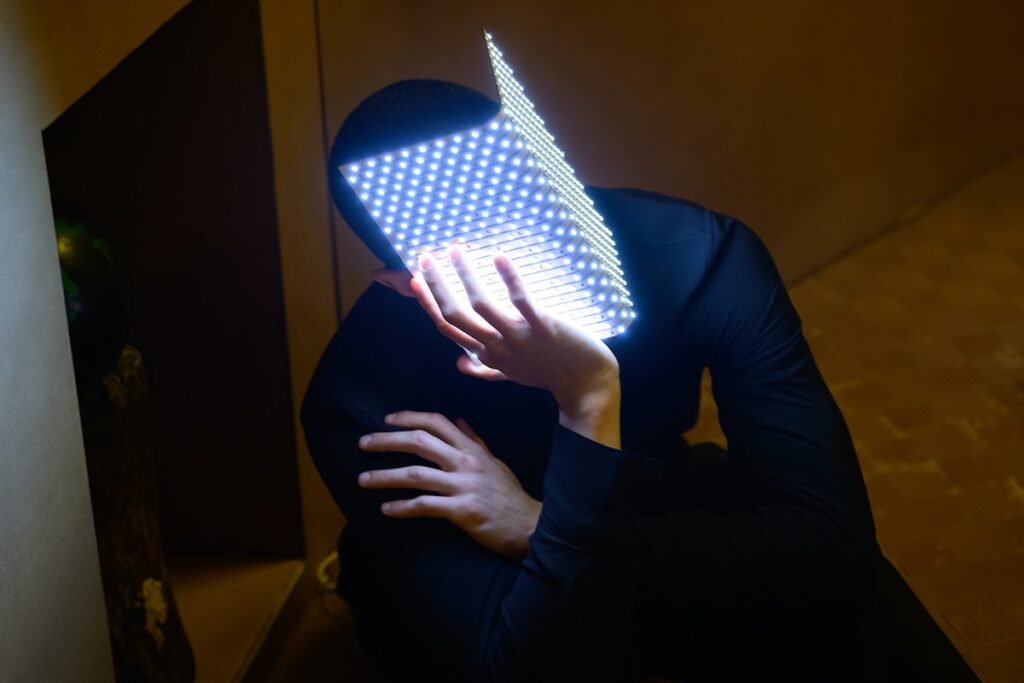
He does so by setting the space in operation. The fans, first of all, are not scenographic elements: they function as active agents. They generate currents, displace air, produce a continuous vibration that runs through the environment. They do not simply “occupy” the space—they traverse it, destabilise it, keep it in motion. In this way, what in the Cocteau/Chaimowicz dialogue appears as echo or resonance becomes here a concrete, almost tactile presence.
The materials follow the same logic. Marked surfaces, industrial assemblages, objects bearing traces of use do not construct a narrative, nor do they introduce a symbolic repertoire. Rather, they interrupt the continuity of the gaze: they compel a physical negotiation with space, an attention that is no longer purely visual but bodily. The “distance” of the dialogue is thus translated into a series of micro-frictions, resistances, and interferences.
There is, moreover, a decisive shift: Kanu introduces into his environment presences that belong neither to Cocteau nor to Chaimowicz, but to his own field of reference—musical, visual, cultural. The vinyl collection, for instance, is not a simple autobiographical insertion; it is a field of intensities. Each record carries with it a temporality, a rhythm, a memory that does not align with that of the adjacent installation, but cuts across it laterally. It is here that the dialogue is definitively transformed: no longer an exchange between two poles, but an open field in which multiple frequencies coexist without resolution.
In this sense, Kanu’s intervention does not bridge the distance between Cocteau and Chaimowicz, nor does it render it more legible. It exposes it, rather, as a force in operation—something that manifests through movement, sound, and friction. The dialogue ceases to be a relation to be interpreted and becomes a condition to be traversed.
E.B. The domestic dimension appears to constitute not only the conceptual point of departure, but also the formal principle of the exhibition. Could you elaborate on some of the dynamics of mirroring and doubling that traverse the two installations, bringing into relation objects, materials, and modes of spatial perception?
R.S. In Jean Cocteau…, the domestic does not organise itself as a stable space, but as a system governed by internal protocols, the most decisive of which concerns the presence of Andy Warhol. Within the installation, Warhol is never a contingent presence. It is a constant. An element that “must” be there, yet one that changes form, subject, and configuration according to the context in which the work is reactivated. This means that we are not dealing with an iconographic insertion, but with a device of adaptation: Warhol is what allows the installation to remain open, to resist closure, to stay permeable to the site that hosts it. In Milan, the choice of The Last Supper renders this protocol fully legible. It is not a thematic decision, but one determined by the context and by the urban field in which the exhibition is situated. The image comes into direct relation with the city, with its visual memory, with Leonardo’s Cenacolo, but above all with the reflection that Warhol himself had already constructed around that image: a reflection on reproducibility, seriality, and the circulation of the icon. Here, Warhol functions as a hinge, holding together interior and exterior, the domestic and the public, intimacy and the history of the image. Without this presence, Chaimowicz’s room would risk remaining closed, self-referential. With Warhol, instead, it opens—it connects, exposes itself, allows itself to be traversed.
It is precisely here that Dozie Kanu intervenes. Weighing forgiveness in light of (upgrade) (2026) does not engage with the theme in any generic way, but enters into tension with this very protocol. Where Warhol maintains the image in a state of circulation—reproducible, repeatable, transferable—Kanu arrests it, subjects it to measurement and weight. Christ is no longer an image that circulates, but a body inserted into a technical system that holds it, loads it, renders it verifiable. The result is a sharp deviation: Warhol guarantees the mobility of the image, its capacity to move across contexts; Kanu suspends that flow and returns it to a material state, almost juridical in its insistence.
In Kanu’s room, the wallpaper by Precious Okoyomon introduces a more radical shift than might first appear. The motif of eyes—scattered without hierarchy like particles, souls, spores, almost like a visual dust—does not organise space but destabilises it, saturating it with a multiplicity of gazes that cannot be reduced to a single point of view. They are eyes in flames, a psychic and political epidermis, a skin that breathes and looks back. This is not pattern in a decorative sense, but an active surface, a membrane that sees. Unlike the motifs in Chaimowicz, which construct a grammar of the interior, a measure of intimacy, here the decorative exceeds any ordering function and becomes a perceptual condition. The eyes do not adorn the wall: they transform it into a field of diffuse presence in which the viewer can no longer occupy an external position. It is as though space, rather than being observed, returned the gaze, multiplied it, held it in suspension. Thus Microsphereology it’s Atmosphere Ethics and Like a Doorway to God (both 2025) operate as a counter-field to Chaimowicz’s room. Where there, the decorative structures and receives, here it disorients and exposes. Distance collapses into an insistent proximity, almost epidermal, in which to see is already to be seen.
And further, in Chaimowicz, the scalar element functions as an implicit spatial mode, a modular principle that organises and distributes the environment. It is not necessarily a literal staircase, but a structuring device that orients movement: in passages, in shifts of level, in the arrangement of furnishings and objects. The staircase, here, works—it regulates movement, measures distance, constructs a grammar of the body in space. Abito scala – Omaggio a Escher (1985) by Cinzia Ruggeri, one of Kanu’s “kindred spirits,” introduces a torsion. The staircase is explicit, visible, almost didactic—but no longer operative. It does not organise space, does not guide the body: it is the body that carries it, or rather renders it as image. And in declaring itself as an “homage,” it already incorporates a dimension of instability, of disorientation, without ever leaving itself. At the level of display, something further occurs. The garment is not simply exhibited: it is suspended, and the artificial air of a fan passes through it, setting it in motion. That staircase, now emptied of its architectural function, is reactivated by an external force. It is no longer traversed, but animated.
We could also speak of the roses—those of Trisha Donnelly and Jannis Kounellis—which face one another within Kanu’s space, meeting within the same regime of visibility.
In Untitled (2008), the white rose—full, almost excessive in its bloom—offers itself as a sensitive surface: it holds light, bends it, disperses it across its petals. It is an image that still seems to believe in its own appearance. Even when traversed by a sudden line of energy that cuts through it, it does not entirely lose its internal coherence: it continues to flower. The disturbance does not negate it; it passes through it. It is an event that insists upon its skin without erasing it.
The Black Rose (1966) by Jannis Kounellis, by contrast, is not traversed: it has already been struck. There is no before and after, no visible event that fractures it. The fracture coincides with its very form. The black does not arrive from the outside, nor is it an intervening force: it is the image’s originating condition. For this reason, the flower does not bloom—or rather, it blooms in the negative, as if each petal had already been withdrawn from its own evidence.
Between these two roses, a precise distance opens up. It is not merely chromatic, but ontological. The white rose continues to negotiate its own visibility: it receives interference, allows it to pass, the energy that crosses it does not destroy the image but intensifies it, rendering it more unstable, more vibrant. It remains within the field of the phenomenon, even as it is disturbed. The black rose, on the contrary, has already crossed that threshold. It is no longer phenomenon but trace. It does not allow itself to be perturbed because it already lies beyond the possibility of perturbation. In it, the crisis of the image is not an event, but a state.
And yet—and this is where the parallel becomes more subtle—both enact a displacement with respect to the very idea of the flower. Neither is innocent. The first because it is exposed to a force that exceeds it; the second because it has been hollowed out from within. If the white rose is a body traversed, the black rose is a body already transformed. If the former still holds the promise of blooming, the latter retains only its name.
It is perhaps precisely in this shift—between traversal and subtraction—that the two images enter into relation: not as oppositions, but as two distinct modalities through which appearance is put into crisis.
One could continue at length, following other trajectories, opening further correspondences, but these examples suffice to make one thing clear: the display is not the result of accumulation, nor of a generic intuition. It is a precise, calibrated construction, in which every element—even the most seemingly marginal—has been considered, placed, and determined with almost millimetric care.
E.B. The practice of Marc Camille Chaimowicz conceives the installation as a hosting structure, open to presences that continually redefine its configuration. In what way did this logic inform the selection of works from the Nicoletta Fiorucci Collection?
R.S. The logic that oriented the work was not that of identifying “relevant” or thematically coherent works, but of recognising, within the Nicoletta Fiorucci Collection, presences already endowed with their own capacity for activation. The model remains that of Marc Camille Chaimowicz’s hosting structure: an environment that does not stabilise works but exposes them to a relational framework, where each element enters as part of a mobile choreography, never definitively closed. The historical variability of presences within Jean Cocteau… makes it clear that what matters is not the individual work, but the field of intensity that emerges between them.
It is precisely on this level that the work with Dozie Kanu took shape. The selection does not follow a principle of citation or homage, but rather the possibility that each work might introduce a threshold of instability—a point at which the environment could deviate, open, or enter into tension. The works were therefore not “inserted” into the space, but called upon to operate within it, as agents capable of modifying its equilibrium.
At the same time, this constellation is not neutral: Dozie Kanu oriented the selection towards artists and practices with which he senses a real proximity, almost a subterranean continuity of research. These are not declared affinities, but operative consonances—ways of handling materials, of thinking function, of moving through space—that render these presences not simple insertions, but active interlocutors within his language. Kanu thus takes up Marc Camille Chaimowicz’s hosting logic, but shifts it. Where in Chaimowicz it takes the form of an interior charged with memory and projection, in Kanu it becomes an operational field, traversed by more explicit forces: material, sonic, mechanical. The works from the collection, in this context, are not merely received, but solicited—almost set to work. It is here that mirroring turns into refraction: the same mode—hosting, receiving, placing in relation—is maintained, but subjected to a different pressure that alters its behaviour. The selection was never a matter of choosing works, but of constructing a condition: an environment in which they could act, rather than signify.
E.B. In Kanu’s installation, the reinforced cardboard structure—almost a dome—holds together through the repeated inscription of the word haptic, which also runs along the threshold of entry: how does this insistence on touch shape the way we experience a space that seems to exceed the purely physical?
R.S. What Kanu mobilises through the repeated inscription of haptic is not touch in its immediate, tactile sense, but a more elusive register—one that operates at a distance, without contact. The word holds the structure together almost like a binding force, yet at the same time it slips away from any literal reading. It points instead to a form of sensorial memory, to those pressures that shape us without ever becoming fully graspable. In this sense, the work turns toward an invisiblefield of relation: migration, ancestry, generational histories—forces that do not touch the body directly, yet leave precise imprints upon it. They are not present as images or narratives, but as conditions that traverse the space, much like an atmosphere that cannot be seen but is nonetheless felt. What emerges is a notion of touch that is deferred, displaced—less an act than a transmission, something that passes through us before we are able to name it.
E.B. I find the image contained in the exhibition title The Second Shadow both poetic and generous. Could you tell me how the idea of embracing this ambiguous and compelling image came about?
R.S. The image of the Second Shadow did not emerge as an illustrative title, but as an internal necessity of the project. From the outset, it was clear that the exhibition could not be conceived in terms of an extension or a linear dialogue between two artists, but as a deviation: something that takes place after the image, when it encounters another presence, another time, another space.
Shadow, in this sense, is already a form of translation—a figure that never fully coincides with the body that casts it. But the idea of a second shadow introduces a further shift: not the duplication of an origin, but what remains after the image has already undergone a first process of transformation. It is an image that arrives belatedly, and precisely for that reason is freer, less bound to resemblance, more open to deviation.
The reference to Jean Cocteau—and to his idea that mirrors should think before they reflect—was decisive, because it introduces a suspension: the image is no longer immediate, but held back, almost interrogated. It is important to recall that this intuition does not arise in isolation: Cocteau takes it up and rearticulates it from a sensibility already present in Jacques Rigaut, a figure associated with Parisian Dada, whose brief, incisive writings are marked by a radical refusal of the automatism of existence. In his well-known injunction—“and now, reflect, mirrors”—the image is no longer mere restitution, but is called upon to think. The second shadow emerges precisely within this interval, as the result of an image that has taken time.
Within the exhibition, this takes form as a non-specular relation between Chaimowicz and Kanu. Chaimowicz’s room may be understood as a first shadow—a translation of Cocteau already mediated into a habitable, intimate, theatrical space. Kanu’s intervention neither overlaps nor replicates it, but comes after: as a refraction that renders visible the very process of looking, remembering, and transforming. The title holds together a tension: on the one hand, something almost impalpable; on the other, a highly precise structure, concerning the ways in which images persist, shift, and continue to act without ever fixing themselves definitively. It is an ambiguous image, certainly—but precisely because it refuses closure, leaving space for what, within the exhibition, remains in motion.
E.B. In parallel with the exhibition, you are developing a kind of online diary that recounts and unpacks the project. What exactly is it?
R.S. It is not a diary, but rather a parallel narrative that accompanies the exhibition and is disseminated through a series of periodic newsletters. Rather, I would describe it as an editorial space that displaces the centre, a device that allows the project to continue producing itself elsewhere, according to other temporalities and forms. From the outset, the intention was to exceed the physical limits of a printed document: to avoid the fixity of the catalogue and instead work with an open, expandable form, able to accommodate contributions over time. The online programme thus takes shape as a constellation of interventions—texts, images, sonic materials—that do not explain the exhibition, but traverse it, divert it, and gradually shift its centre of gravity. As the programme’s opening suggests, it is not an extension, but a displacement.
It is a project that emerges through a precise collaboration between ICA Milano, the Nicoletta Fiorucci Foundation, and Lenz Press, and it is precisely in this shared dimension that its processual nature resides. Each episode introduces a voice, a perspective, a memory that connects with the exhibition’s structure without ever coinciding with it. In this sense, it is less a diary than an archive in the making: something that unfolds over time, remains open, and allows the exhibition to exist as a mobile field, not confined to its physical site. It is also a way of working on duration: where the exhibition presents itself as a situated experience, the online programme extends its temporality not through documentation, but through a series of successive refractions.
In the end, the entire project will remain permanently accessible on the Lenz Press website: as a form of distributed, stratified publication: not a closed catalogue, but a living archive, available for consultation over time. For this reason, it does not recount the exhibition; it sets it in motion again.