
English version below —
Per la rubrica New Photography, Sara Benaglia ha intervistato Lucas Leffler —
Sara Benaglia: Nel tuo lavoro, la fotografia sembra “ritornare” al suo stato minerale e chimico. Possiamo interpretarlo come un tentativo di decostruire l’immagine per riscoprirne le origini materiali?
Lucas Leffler: La ricerca a cui mi sono dedicato negli ultimi cinque anni si è concentrata molto sulle specificità materiali e chimiche della fotografia. Penso che l’idea di “riscoperta” sia interessante perché la digitalizzazione che abbiamo vissuto negli ultimi due decenni ha profondamente cambiato il modo in cui percepiamo le proprietà materiali delle cose. Il marketing dietro la “rivoluzione digitale” ha cercato di farci credere che questa avrebbe sostituito tutto ciò che conosciamo, ma pochi anni dopo ci siamo resi conto che in realtà non era così.
Penso che ora viviamo in un periodo di forte ibridazione tra il fisico e il virtuale, in cui ciascuna dimensione rafforza l’altra. Ad esempio, molti giovani fotografi che lavorano con processi analogici scansionano le loro pellicole e le condividono sui social media. In questo senso, non si tratta più di analogico contro digitale, o materiale contro immateriale: è quasi sempre entrambe le cose contemporaneamente. Questo cambiamento rende sempre più obsolete le tradizionali categorizzazioni delle tecniche. Allo stesso tempo, anche il concetto di “scoperta” (piuttosto che di “riscoperta”) sembra rilevante. Le origini materiali dei processi di creazione delle immagini si stanno allontanando sempre più dalle nostre esperienze digitali quotidiane, così come le crisi ecologiche e industriali ad essi collegate. Nel mio lavoro mi occupo spesso di rifiuti industriali o rovine, utilizzandoli come mezzo per costruire nuove mitologie attorno a queste tecniche.
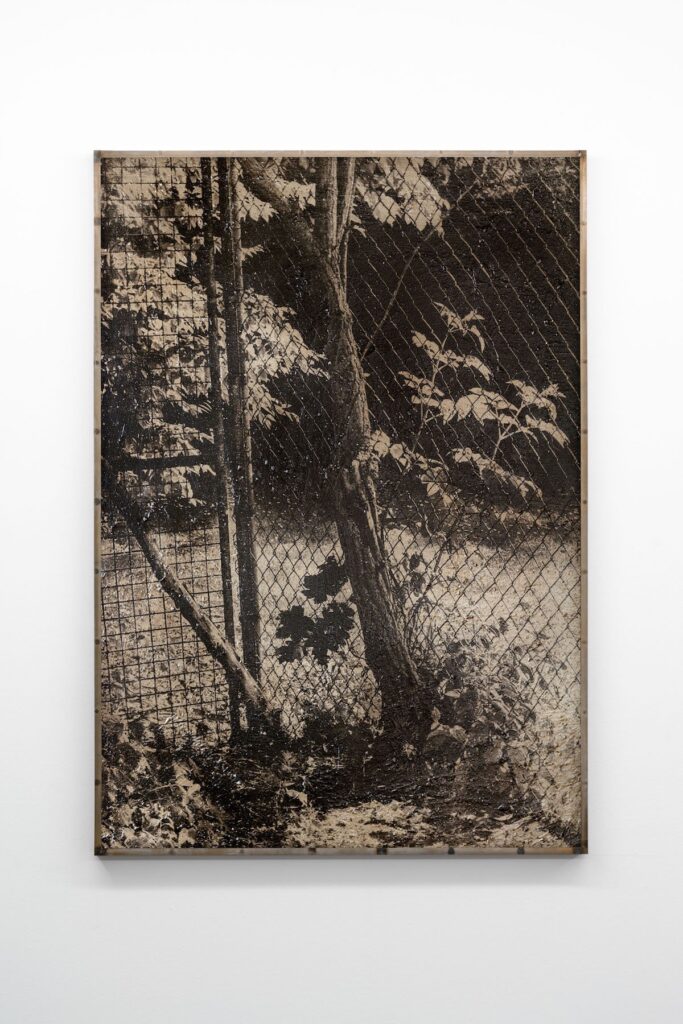
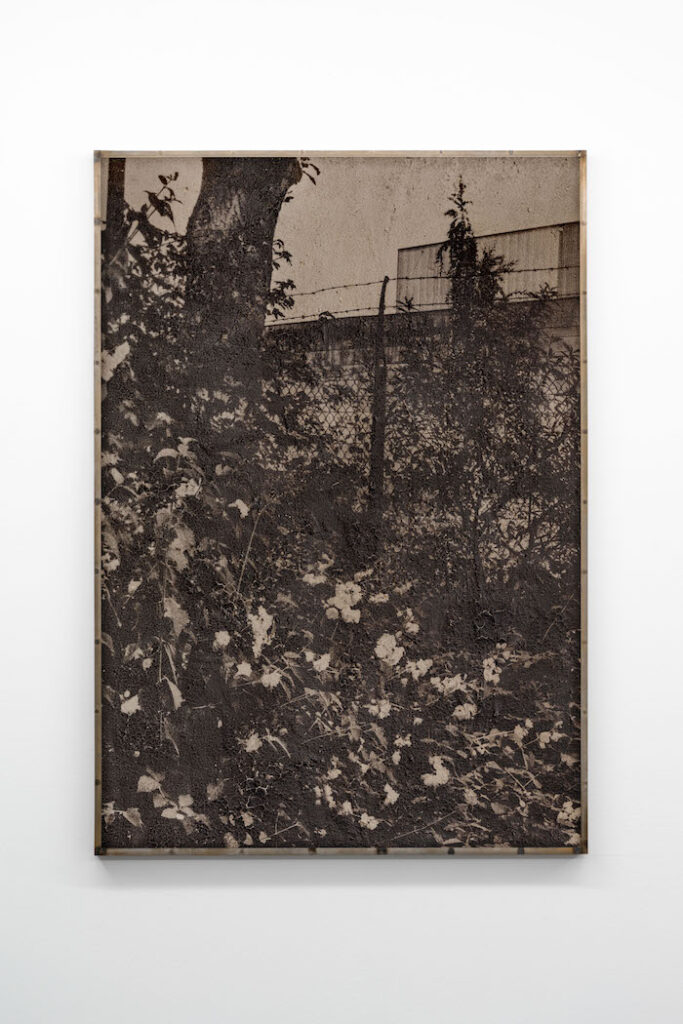
SB: In Mudprints utilizzi fango contenente residui d’argento provenienti da scarti industriali. Quanto è importante per te l’origine del materiale e quanto lo è il suo comportamento come agente fotosensibile?
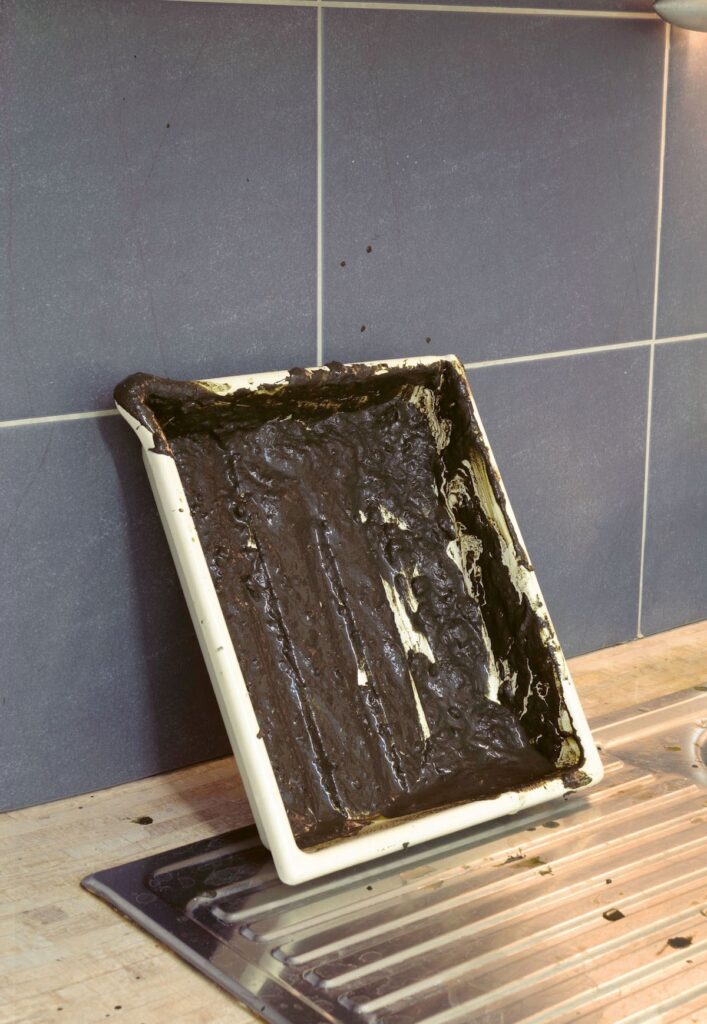
LL: Nel progetto Silver Creek si racconta una storia di inquinamento e si mette in luce la grande specificità della tecnologia dell’argento, ovvero la fotosensibilità del metallo. Il progetto nasce da una storia in cui un operaio di una fabbrica fotografica recuperò tonnellate di fango da un fiume inquinato per estrarre il metallo prezioso. Sebbene ciò sia avvenuto circa un secolo fa, mi è sembrato qualcosa che potesse essere riproposto oggi, ma con un significato molto diverso, plasmato da un contesto post-industriale. In quanto fotografo, l’idea del fango contenente residui d’argento mi ha immediatamente suggerito la possibilità di utilizzarlo per produrre stampe fotografiche in camera oscura. Da allora, sono tornato più volte in questo luogo specifico per raccogliere il fango, osservando come continua a evolversi nel tempo. La fabbrica è ancora lì, sebbene sia cambiata in modo significativo. Scatto foto del paesaggio circostante e utilizzo il fango stesso per stampare queste immagini. Penso che l’uso di questo fango specifico sia importante per l’“aura” che conferisce all’opera. Pensiamo a tutti gli atti performativi che vi stanno dietro.
SB: Il tuo approccio sembra sfidare la trasparenza dell’immagine fotografica: il materiale è per te un ostacolo alla visione, o la radicalizza?
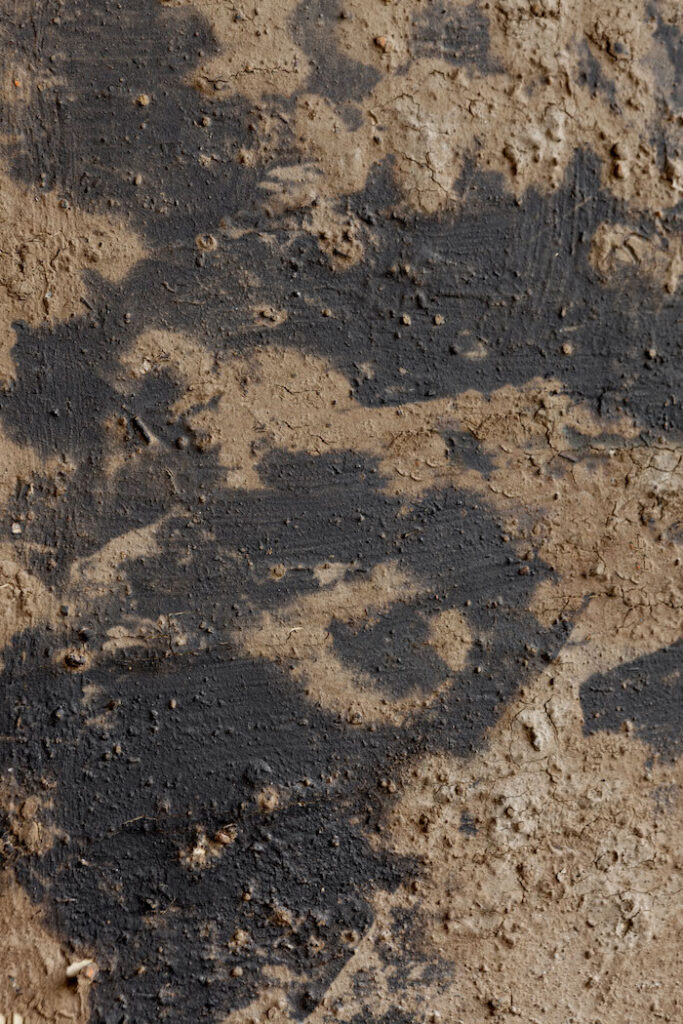
LL: L’uso di un materiale come supporto per un’immagine interferisce con la sua leggibilità e la rende inevitabilmente più astratta. In questo modo, si avvicina maggiormente a un approccio pittorico alla rappresentazione. Tuttavia, questa astrazione non è data dal soggetto dell’immagine o dalla mano dell’artista, ma dal supporto stesso. Di conseguenza, il rapporto diretto e indessicale tra l’immagine e ciò che rappresenta viene parzialmente ostacolato. L’immagine è meno trasparente, mentre il supporto materiale diventa più presente. Gran parte del mio processo di lavoro è dedicato alla ricerca di un equilibrio tra queste due dimensioni. Penso che il risultato si collochi a metà strada tra l’immagine e l’oggetto, più simile a una scultura. Non come un’immagine piatta in 3D che si può girare e guardare da dietro, ma più come una superficie ruvida che potrebbe evocare una vecchia pietra incisa o qualcosa del genere. Credo che le proprietà materiali dell’immagine possano cambiare profondamente il modo in cui la interpretiamo, allo stesso modo in cui lo fanno la scelta del soggetto, la composizione dell’immagine o lo sguardo che adottiamo.
SB: Il progetto Silver Creek nasce da una storia di inquinamento industriale legata alla produzione fotografica. Possiamo considerare il tuo lavoro come una forma di “archeologia ecologica” dell’immagine?
LL: Penso che si possano sicuramente usare queste parole per descrivere il progetto sul torrente. Anche se la ricerca ecologica non era la mia intenzione primaria né ciò che ha motivato la creazione di questo progetto. Spesso vedo la fotografia come un mezzo nato con la società industriale e le nozioni di evoluzione e progresso ad essa associate. La definisco in un certo senso ontologicamente tossica perché è condannata a evolversi continuamente generando tossicità e rovina. Pertanto, mi piace esplorare queste rovine oggi e scoprire cosa possono dirci sul presente.
Mi interessa anche la ricerca incentrata sullo sviluppo di pratiche a emissioni zero nella fotografia. Tuttavia, questa non è la direzione del mio lavoro e per questo motivo non mi sento sempre a mio agio nell’usare il termine “ecologia” per descriverlo – almeno non in senso strettamente pratico. Piuttosto, sono attratto dall’ecologia come modo di pensare, un quadro concettuale piuttosto che una metodologia, anche se riciclo materiali per realizzare alcune opere d’arte.

SB: Nelle tue opere, la fotografia è intrisa di estrazione, spreco e trasformazione. Quanto è importante per te rendere visibile l’impronta ecologica dei media visivi?
LL: Penso che mostrare questo aspetto non sia mai stato per me una sorta di risultato finale, almeno non volevo rendere visibile questo inquinamento o “svelare ciò che è nascosto”. Ciò che mi ha ispirato in una storia come quella del torrente è stato il fatto che potesse riferirsi a una sorta di racconto. È una storia molto piccola, persino un aneddoto dimenticato, ma può comunque ispirare il nostro comportamento nel presente. Mi piace anche l’idea di “abitare un mondo danneggiato”, usando le parole di Haraway, Tsing o Latour. Piuttosto che cercare di “riparare” qualcosa per tornare a uno stato originale, che in realtà non è mai esistito, mi piace l’idea di confrontarci con un ambiente che è stato profondamente ‘trasformato’ e vedere come possiamo affrontarlo.
Rendere visibili queste crisi è importante per non tenerle a distanza, ma non sto cercando di risolverle. C’è anche qualcosa di molto romantico nel modo di rimanere all’interno di queste rovine e vedere come possiamo adattarci e magari creare relazioni con esse. Mi ricorda film come “Nausicaa” o “La principessa Mononoke” o anche i videogiochi di Fumito Ueda o “Final Fantasy VII”.
SB: L’uso di materiali di recupero o contaminati sembra andare contro la logica della purezza tecnica. È anche una critica all’apparente sostenibilità della tecnologia digitale contemporanea?
LL: Credo che l’obiettivo dell’industria sia sempre stato quello di progettare prodotti finali che non abbiano alcun legame con il loro processo di produzione o con l’origine dei materiali. Non sono particolarmente attratto dall’idea di purezza, eppure è un concetto che è stato ampiamente utilizzato dalle Big Tech per commercializzare i propri prodotti. Steve Jobs, ad esempio, ha tratto ispirazione dai giardini zen nel design dell’iPhone. Quando si entra in un Apple Store, gran parte dell’esperienza sensoriale è modellata da un’estetica che riecheggia gli ambienti sacri dei templi. La materialità è vista come qualcosa di imperfetto, instabile, in continuo cambiamento. Si tratta della vecchia idea di Platone, secondo cui il mondo materiale è posto al di sotto del mondo delle idee, che è superiore ad esso. Spesso diciamo che l’esperienza religiosa che le società occidentali hanno perso negli ultimi secoli è stata sostituita da un rapporto sacro con la tecnologia. Forse lavorare con questi materiali recuperati o contaminati potrebbe essere visto come un tentativo di rompere questo rapporto e instillare comportamenti profani nei suoi confronti.
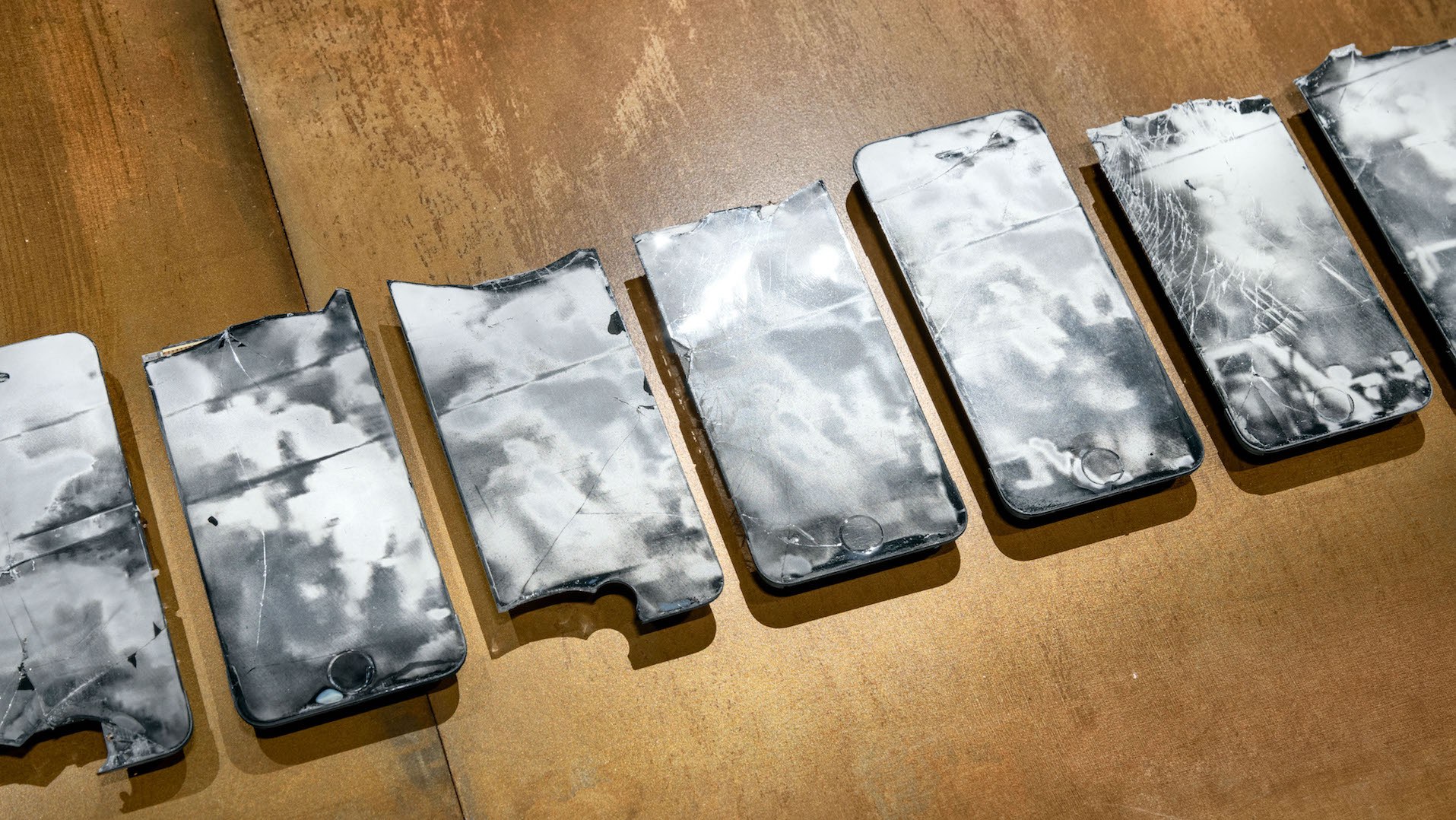
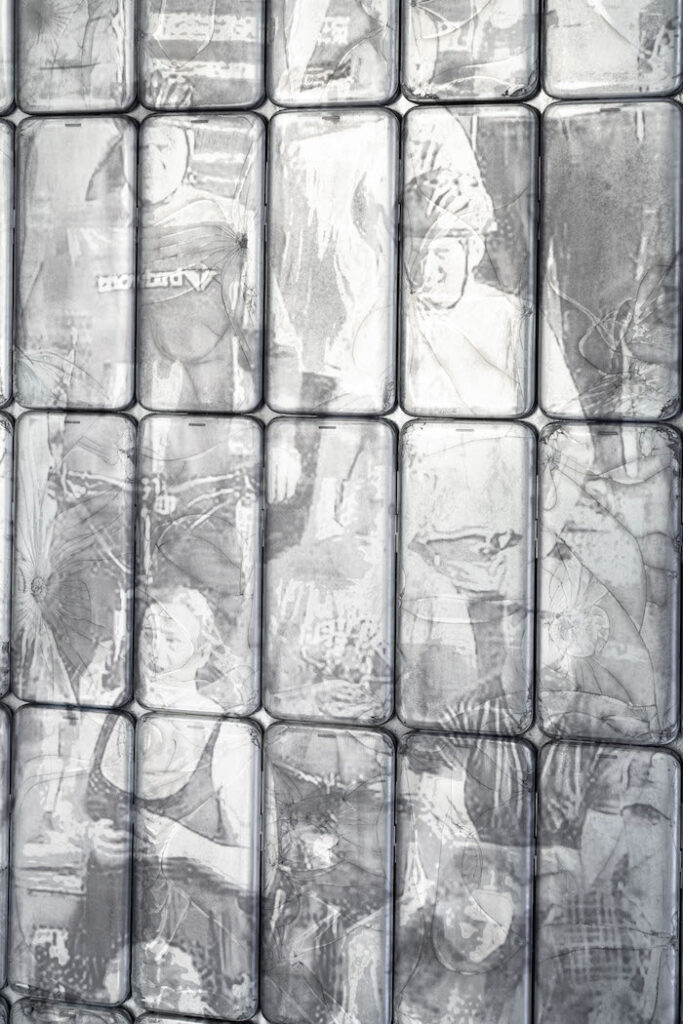
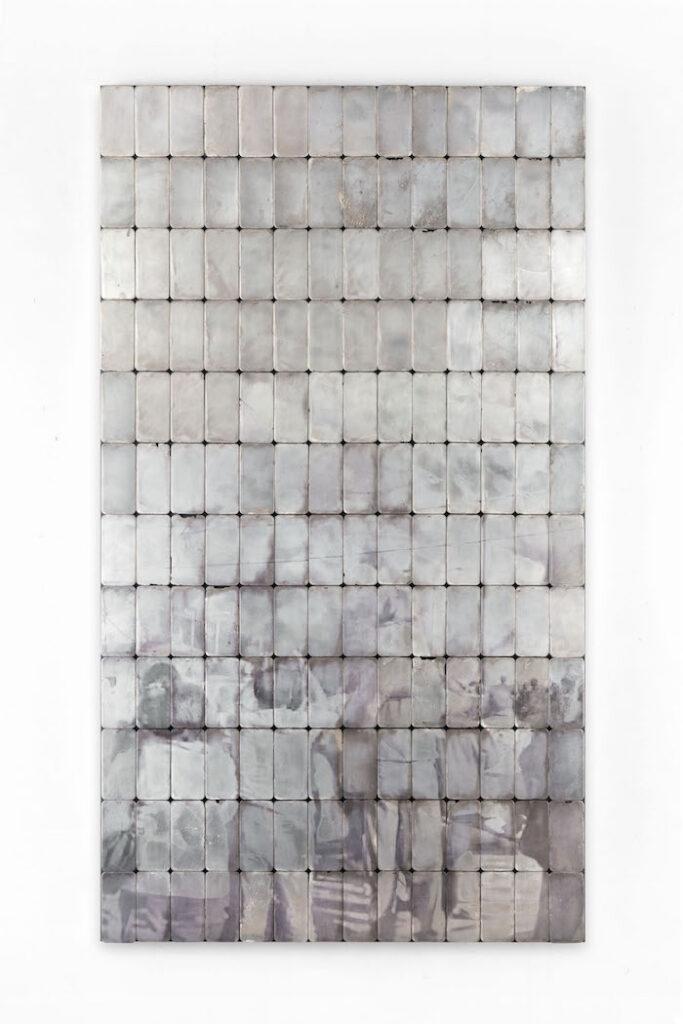
SB: Nella serie Implosion, stampi immagini sugli schermi degli iPhone, evocando il crollo della Kodak e il passaggio al digitale. Che tipo di “rovina” rappresentano per te i dispositivi tecnologici contemporanei?
LL: Si tratta di rovine complesse perché sono interamente globalizzate. Sono fatte di cose che provengono da tutto il mondo, trasformate, e portano con sé un intero corteo di storie. Trovo molto difficile immaginare qualcosa di più complesso di questo. Per questo motivo, è anche praticamente impossibile riciclarli, o almeno sta diventando sempre più difficile.
L’idea di utilizzare schermi LCD mi ha interessato perché, una volta diventati rifiuti, si trasformano in una piccola lastra di vetro nero. Nel XIX secolo, i fotografi che utilizzavano il collodio impiegavano lastre nere (in vetro o ferro) per produrre le loro lastre fotografiche. Il motivo è che l’emulsione si rivelava diventando bianca e quindi era necessario uno sfondo nero. È in qualche modo l’opposto del tradizionale processo all’argento, in cui l’emulsione si scurisce durante lo sviluppo e necessita di uno sfondo bianco, che è la carta. Ho trovato piuttosto divertente vedere che questi schermi “rovinati” sono veramente rovine solo se considerati in relazione alle tecnologie digitali. Possono ancora essere pienamente operativi con processi più vecchi e quindi non sono più rovine secondo questi altri principi.
SB: Il tuo lavoro instaura un dialogo tra tecniche arcaiche (collodio, gelatina d’argento) e mezzi di comunicazione iper-contemporanei: questo cortocircuito temporale è una forma di critica alla narrativa lineare del progresso tecnologico?
LL: Tendiamo a dimenticare che la storia della tecnologia e il suo sviluppo sono sempre stati segnati dal dubbio e dalla contestazione. Laddove la tecnologia appare lineare e inevitabile, essa è in realtà plasmata dalla critica umana. Per contrastare un certo universalismo del progresso tecnologico, penso sia importante ricordare costantemente che sia la storia politica che quella tecnologica sono sempre state scritte dai vincitori. Mi sembra che stiamo vivendo in un’era strana, segnata da una grande tensione intorno all’alta tecnologia. La rinascita delle pratiche analogiche all’inizio degli anni 2010 potrebbe essere collegata a una sfiducia che è cresciuta nel corso del decennio nei confronti delle Big Tech e delle nuove tecnologie che ora associamo al capitalismo e al patriarcato. Penso che tutto questo possa essere associato al pensiero low-tech, che può essere inteso non come un passo indietro, né come un non-uso o una rinuncia, ma come una forma di moderazione consapevole: una riappropriazione della tecnologia. Non richiede una maggiore conoscenza delle tecnologie attuali, ma piuttosto un’esplorazione curiosa di tutto ciò che esiste ed è esistito, qualcosa di più vicino all’archeologia dei media. Una forma di indipendenza raggiunta attingendo al passato, pur ibridandolo sempre con le tecniche del presente.
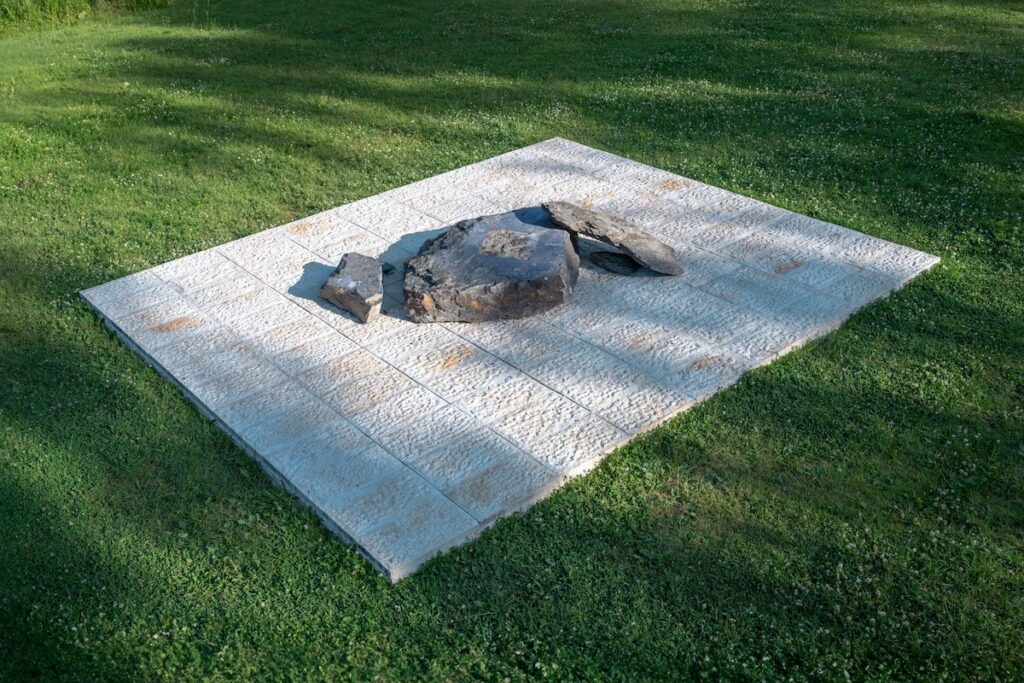
SB: In opere come Iconoruin, il materiale e il sito evocano storie di violenza e dominio. In che modo la materia e la memoria politica si intrecciano nel tuo lavoro?
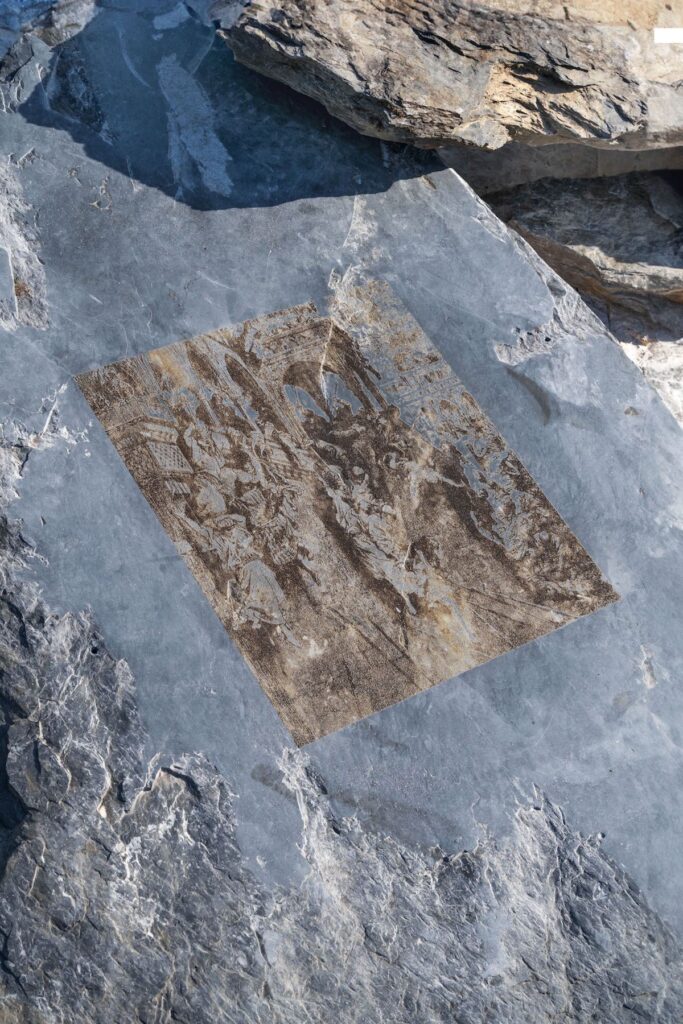
LL: Iconoruin è una scultura all’aperto commissionata per una città specifica profondamente legata alle antiche storie di violenza e dominio occidentali, ovvero le Crociate. Credo che sia per ora l’unica opera che ho realizzato che sia in qualche modo più direttamente collegata alla memoria politica. Con quest’opera ho preso le specificità geologiche della città occidentale in cui lavoravo, costituita principalmente da pietre scistose, e le ho confrontate con la geologia della città conquistata di Gerusalemme, costituita da pietre calcaree. Penso che l’opera sia diventata più politica in questo senso, in quanto il risultato potrebbe sembrare un’architettura distrutta dalla guerra. Volevo evocare ciò che sta accadendo oggi a Gaza e l’idea che queste antiche storie di dominio non siano mai finite.
Ma, come nelle mie opere precedenti, ha molto a che fare con la memoria. Evoca l’idea dei tempi passati con l’estetica della rovina e quindi a volte può sembrare lontana dai problemi del presente. Spero che i miei lavori futuri siano più legati a ciò che sta accadendo oggi, probabilmente attraverso collaborazioni con altri artisti impegnati su questi temi. Ammiro gli artisti che assumono una forte posizione politica nelle loro opere e penso che sia qualcosa che sta diventando sempre più importante da vedere nella scena artistica.
SB: La tua pratica sembra mettere in discussione non solo il modo in cui le immagini vengono prodotte, ma anche chi controlla le condizioni della loro produzione: pensi che esista una politica della materia fotografica?
LL: Le pellicole in celluloide sono composte principalmente da petrolio, e credo che siamo tutti d’accordo sul fatto che esista una politica del petrolio. In realtà, potrebbe trattarsi della materia fotografica del XX secolo, che in seguito è stata sostituita da elementi delle terre rare e metalli critici.
Pur essendo una materia, la fotografia è anche un uso, una pratica, un comportamento. Se nel XX secolo abbiamo scattato foto delle nostre famiglie e delle vacanze, penso che sia principalmente perché alcune aziende hanno deciso di diffondere questa idea per vendere i loro prodotti. Forse questi “momenti” erano in un certo senso fabbricati quanto un rullino.
Sto esplorando queste idee in una recente serie fotografica intitolata Bleached Moments, in cui altero vecchie pubblicità Kodak utilizzando diverse sostanze chimiche. Attraverso questo processo, una sorta di materia chimica emerge dalla tecnologia che svanisce, evocando anche la scomparsa di un certo modello di società — spesso associato all’egemonia americana o alla famiglia nucleare.
Si fa riferimento a un’epoca incentrata sulla supremazia dell’istante e sulla fluidità e immaterialità delle immagini. Un immaginario costruito dal marchio nel corso del XX secolo per vendere i propri prodotti, che svanisce con esso all’alba dell’era digitale.
SB: Nel tuo lavoro attingi spesso a tecniche e materiali legati alla storia della fotografia. Ti interessa anche immaginare o sperimentare le “materie” della fotografia del futuro?
LL: Penso che i miei lavori futuri saranno meno legati alla storia della fotografia ed esploreranno molto di più le materie della tecnologia virtuale, che potremmo vedere come l’evoluzione della fotografia come mezzo di rappresentazione. Durante la mia infanzia ero anche profondamente affascinato dai videogiochi e penso che questo tipo di mezzi interattivi possa essere utilizzato oggi come uno strumento emotivo e politico molto potente. Potrebbe sembrare molto distante dai miei lavori “materiali”, ma penso che collegarli alle realtà digitali possa dare una forza complementare a ciascuno di essi.
Più concretamente, sto attualmente conducendo una ricerca su un vecchio server anarchico in Minecraft. Questo territorio virtuale, profondamente trasformato dall’intensa attività di migliaia di giocatori online nel corso di diversi anni, ha la caratteristica unica di non essere mai stato resettato. Nel tempo, questi server sono diventati “archivi viventi” in costante mutamento, guadagnandosi la reputazione di “cyber wasteland” o “Internet Hell”. L’esplorazione di questo mondo virtuale, danneggiato dall’iperattività, lascia anche un’eco che risuona con la dimensione estrattiva delle nostre società. Minecraft sembra essere un gioco molto “innocente” in cui l’estrazione diventa un processo creativo, ma a mio avviso cristallizza anche le complesse relazioni tra l’umanità, la tecnologia e l’ambiente.
Per il momento sto principalmente esplorando il server e realizzando screenshot dei paesaggi. Ho in programma di stampare le immagini su schermi di computer rotti, il che potrebbe essere più in linea con ciò che faccio con le opere realizzate con l’iPhone. Sto anche registrando video a 360° con visori VR per consentire un approccio più immersivo. Maggiori informazioni in arrivo!
Cover: Lucas Leffler, Implosion of Building. Detail (2022), Sculpture, 400x100x100cm
New Photography | Interview with Lucas Leffler
Interview by Sara Benaglia —
Sara Benaglia: In your work, photography seems to “return” to its mineral and chemical state. Can we interpret this as an attempt to deconstruct the image in order to rediscover its material origins?
Lucas Leffler: The research I have been occupied with for the last 5 years have been indeed very focused on the material and chemical specificities of photography. I think the idea of “re-discovery” is interesting because the digitalization we experienced during the last two decades have deeply changed the way we perceive the material properties of things. The marketing behind the “digital revolution” tried to make us think this will replace everything we know but we realize a few years later that it actually wasn’t the case. I think we are now living in a period of strong hybridity between the physical and the virtual, where each dimension reinforces the other. For example, many younger photographers who work with analog processes scan their films and share them on social media. In that sense, it is no longer a question of analog versus digital, or material versus immaterial—it is almost always both at once. This shift makes traditional categorizations of techniques increasingly obsolete.
At the same time, the notion of “discovery” (rather than “re-discovery”) also feels relevant. The material origins of image-making processes are becoming more and more distant from our everyday digital experiences, as are the ecological and industrial crises connected to them. In my work, I often engage with industrial waste or ruins, using them as a way to construct new mythologies around these techniques.
SB: In Mudprints, you use mud containing silver residues from industrial waste: how important is the origin of the material to you, and how important is its behavior as a photosensitive agent?
LL: In the “Silver Creek” project, it relates a history of pollution and tells about the big specificity of the silver technology which is the photosensitivity of the metal. The project originates from a story in which a worker from a photo-factory recovered tons of mud from a polluted river in order to extract the precious metal. Although this took place about a century ago, it struck me as something that could be reenacted today, but with a very different meaning—one shaped by a post-industrial context. As a photographer, the idea of mud containing silver residues immediately suggested to me the possibility of using it to produce photographic prints in the darkroom.
Since then, I have repeatedly returned to this specific place to collect mud, witnessing how it continues to evolve over time. The factory is still there, although it has changed significantly. I take photos of the surrounding landscape and use the mud itself to print these images. I think using this specific mud is important because of the ‘aura’ it creates to the work. We think of all the performative acts behind it.
SB: Your approach seems to challenge the transparency of the photographic image: is the material an obstacle to vision for you, or does it radicalize it?
LL: Using a material as a carrier for an image will interfere with its readability and will make it inevitably more abstract. In this way, it refers more to a painting approach of representation. However, this abstraction is not given by the image’s subject or by the artist’s hand but by the support itself.
As a result, the direct, indexical relationship between the image and what it represents becomes partially obstructed. The image is less transparent, while the material support becomes more present. Much of my working process is devoted to finding a balance between these two dimensions.
I think the result goes somewhere between the image and the object, more like a sculpture. Not like a 3D-flat-image you can turn around and go behind it but more like a textured surface that might evoke an old engraved stone or something like that. I think the material properties of the image can highly change the way we interpret it, the same way as the choice of a subject does, the image composition or the gaze we assume.
SB: The project related to Silver Creek stems from a history of industrial pollution linked to photographic production. Can we think of your work as a form of “ecological archaeology” of the image?
LL: I think we can definitely use these words to describe the project about the creek. Although the ecological research was not my primary intention nor what motivated the creation of this project.
I often see photography as a medium that is born with the industrial society and the notions of evolution and progress associated with it. I define it as something ontologically toxic in a way because it is condemned to evolve all the time generating toxicity and ruin. Therefore, I like to explore these ruins today and discover what it can tell about the present. I am also interested in research focused on developing zero-emission practices in photography. However, this is not the direction of my own work, and for that reason I am not always comfortable using the term “ecology” to describe it—at least not in a strictly practical sense. Rather, I am drawn to ecology as a way of thinking, a conceptual framework rather than a methodology even if I do recycle stuff to do some artworks.
SB: In your works, photography is steeped in extraction, waste, and transformation: how important is it for you to make the ecological footprint of visual media visible?
LL: I think showing this aspect has never been kind of an end result for me, at least I didn’t want to make this pollution visible or to “unveil what is hidden”. What inspired me in a story like the one of the creek was that it could refer to a sort of tale. It is a very little story, even a forgotten anecdote but it can still inspire our behaviour in the present. I also like the idea of “inhabiting a damaged world” using the words used by Haraway, Tsing or Latour. Rather than trying to “repair” something in order to return to an original state, which never really existed, I like the idea to confront ourselves to an environment that has been deeply ‘transformed’ and to see how we can cope with it.
Making these crises visible is something important in order not to keep them distant, but I am not trying to resolve them. There is also something very romantic in the way of staying within these ruins and see how we can adapt and maybe create relations to them. It reminds me of movies like “Nausicaa” or “Princess Mononoke” or even Fumito Ueda’s video-games or “Final Fantasy VII”.
SB: The use of salvaged or contaminated materials seems to run counter to the logic of technical purity: is it also a critique of the apparent sustainability of contemporary digital technology?
LL: I think the goal of industry has always been to design end-products that never relate to their production process or to the materials’ origin. I am not particularly drawn to the idea of purity, yet it is a concept that has been widely used by Big Tech to market their products. Steve Jobs, for example, drew inspiration from Zen gardens in the design of the iPhone. When entering an Apple Store, much of the sensory experience is shaped by an aesthetic that echoes sacred temple environments.
Materiality is seen as something imperfect, unstable, changing all the time. This is the old idea of Plato where the world of material is placed below the world of ideas which is superior to it. We often say that the religious experience western societies lost during the last centuries has been replaced by a sacred relation to technology. Maybe working with these salvaged or contaminated materials could be seen as an attempt to break this relation and instill profane behaviors towards it.
SB: In the series Implosion, you print images onto iPhone screens, evoking the collapse of Kodak and the shift to digital. What kind of “ruin” do contemporary technological devices represent for you?
LL: These are complex ruins because they are entirely globalized. They are made of things that come from all over the world, transformed, and carry with them a whole procession of stories. I find it very difficult to imagine something more complex than that. Because of that, it is also practically impossible to recycle them, to upcycle them—or at least it is becoming increasingly difficult.
The idea of using LCD screens interested me because, once it becomes waste, it turns into a small black glass plate. In the 19th century, collodion photographers used black plates (in glass or iron) to produce their photographic plates. The reason is the emulsion revealed itself by turning white and then a black background was needed. It is somewhat the opposite of the traditional silver process, where the emulsion darkens during development and needs a white background which is paper. I found it rather amusing to see that these “ruined” screens are only truly ruins when considered in relation to digital technologies. They can still be fully operational with older processes and therefore are no longer ruins according to these other principles.
SB: Your work creates a dialogue between archaic techniques (collodion, silver gelatin) and hyper-contemporary media: is this temporal short-circuit a form of critique against the linear narrative of technological progress?
LL: We tend to forget that the history of technology and its development has always been marked by doubt and contestation. Where technology appears linear and inevitable, it is in fact shaped by human critique. To counter a certain universalism of technological progress, I think it is important to constantly remember that both political and technological history have always been written by the victors.
I feel like we are living in a strange era, marked by a great deal of tension around high-tech. The resurgence of analog practices in the beginning of the years 2010’s could be related with a mistrust that was growing during the decade towards Big Tech and new technology that we associate now to capitalism and patriarchy.
I think all these can be associated with low-tech thinking which can be understood not as a step backward, nor as non-use or a renunciation, but as a form of conscious restraint—a reappropriation of technology. It does not require an increased knowledge of current technologies, but rather a curious exploration of everything that exists and has existed, something closer to media archaeology. A form of independence achieved by reaching into the past, while always hybridizing it with the techniques of the present.
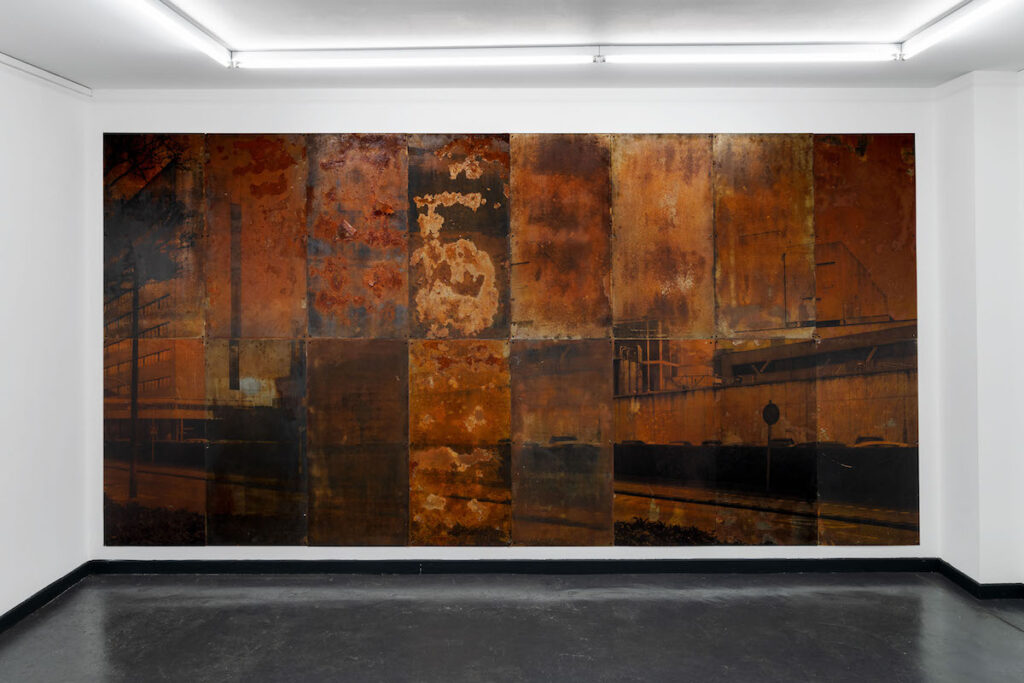
SB: In works such as Iconoruin, the material and the site evoke stories of violence and domination. How do matter and political memory intertwine in your work?
LL: Iconoruin is an outdoor sculpture that was commissioned for a specific city deeply connected to old stories of western violence and domination, which are the Crusades. I think it is for now the only work I made that is more directly linked to political memory in a way. With this work, I took the geological specificities of the western city where I worked, mainly made of shale stones, and I confronted it with the geology of the conquered city of Jerusalem, made of lime stones. I think the work became more political here in the way that the result might have looked like an architecture destroyed by war. I wanted to evoke what is happening today in Gaza and the idea that these old stories of domination never ended.
But like in previous works I made, it has a lot to do with memory. It evokes the idea of past times with the esthetic of the ruin and then it can sometimes feel far away from the problems of the present. I hope my future works will be more connected to what is happening today, probably with collaborations made with other artists engaged with these issues. I admire artists who take a strong political position in their works and I think it is something that is becoming increasingly important to see in the art scene.
SB: Your practice seems to question not only how images are produced, but also who controls the conditions of their production: do you think there is a politics of photographic matter?
LL: Celluloid films are made mainly of petroleum, and I think we all agree on the fact that there is a politics of petroleum. Actually, it could be the photographic matter of the 20th century which has been replaced later by rare-earth elements and critical metals. While it is a matter, photography is also a use, a practice, a behavior. If we took pictures of our families and holiday vacations during the 20th century, I think it is mainly because some companies decided to broadcast this idea to sell their product. Maybe these “moments” were in a way as manufactured as a roll-of-film.
I am exploring these ideas in a recent photo series titled “Bleached Moments”, in which I alter vintage Kodak advertisements using different chemicals. Through this process, a kind of chemical matter emerges from the fading technology, also evoking the disappearance of a certain model of society—one often associated with American hegemony or the nuclear family.
It refers back to a time concerned with the supremacy of the instant and where the fluidity and immateriality of images. An imaginary constructed by the brand throughout the 20th century to sell its products, which fades away with it at the turn of the digital age.
SB: In your work, you often draw on techniques and materials linked to the history of photography. Are you also interested in imagining or experimenting with the “matters” of the photography of the future?
LL: I think my future works will be less connected to the history of photography and will explore much more the matters of virtual technology, which we could see as the evolution of photography as a medium of representation. I was also deeply fascinated by video games during my childhood and I think these types of interactive mediums can be used as a very strong emotional and political tool today. It might feel very distant from my “material” works but I think connecting them to digital realities can give complementary strength to each of them. More concretely, I am currently doing research on an old anarchic server in Minecraft. This virtual territory, profoundly transformed by the intensive activity of thousands of online players over several years, has the unique characteristic of never having been reset. Over time, these servers have become “living archives” in constant flux, earning them the reputation of “cyber wasteland” or “Internet Hell”.
The exploration of this virtual world, damaged by hyperactivity, also leaves an echo that resonates with the extractive dimension of our societies. Minecraft seems to be a very “innocent” game where extraction becomes a creative process but it also crystallizes in my opinion the complex relationships between humankind, technology and the environment.
For the moment I am mainly exploring the server and doing screenshots of landscapes. I am planning to print the images on broken computer screens, which might be more related to what I do with the Iphone works. I am also recording 360° videos with VR headset to permit a more immersive approach. More info to come soon!
Cover: Lucas Leffler, Implosion of Building. Detail (2022), Sculpture, 400x100x100cm