English text below —
Nel tempo dell’altro è una rubrica che attraversa le presenze dell’arte contemporanea nei musei storici, archeologici, universitari. Luoghi dove il tempo si stratifica e l’opera agisce come incontro, attrito o apparizione. Qui si raccontano innesti e interferenze, ascoltando ciò che resta, ciò che torna, e il silenzio che li separa.
Il teatro della luce trattenuta. Sir John Soane’s Museum
A Londra la luce non si impone. Filtra. Si insinua tra mattoni scuri, scivola sulle superfici con discrezione nordica, si trattiene prima di dichiararsi.
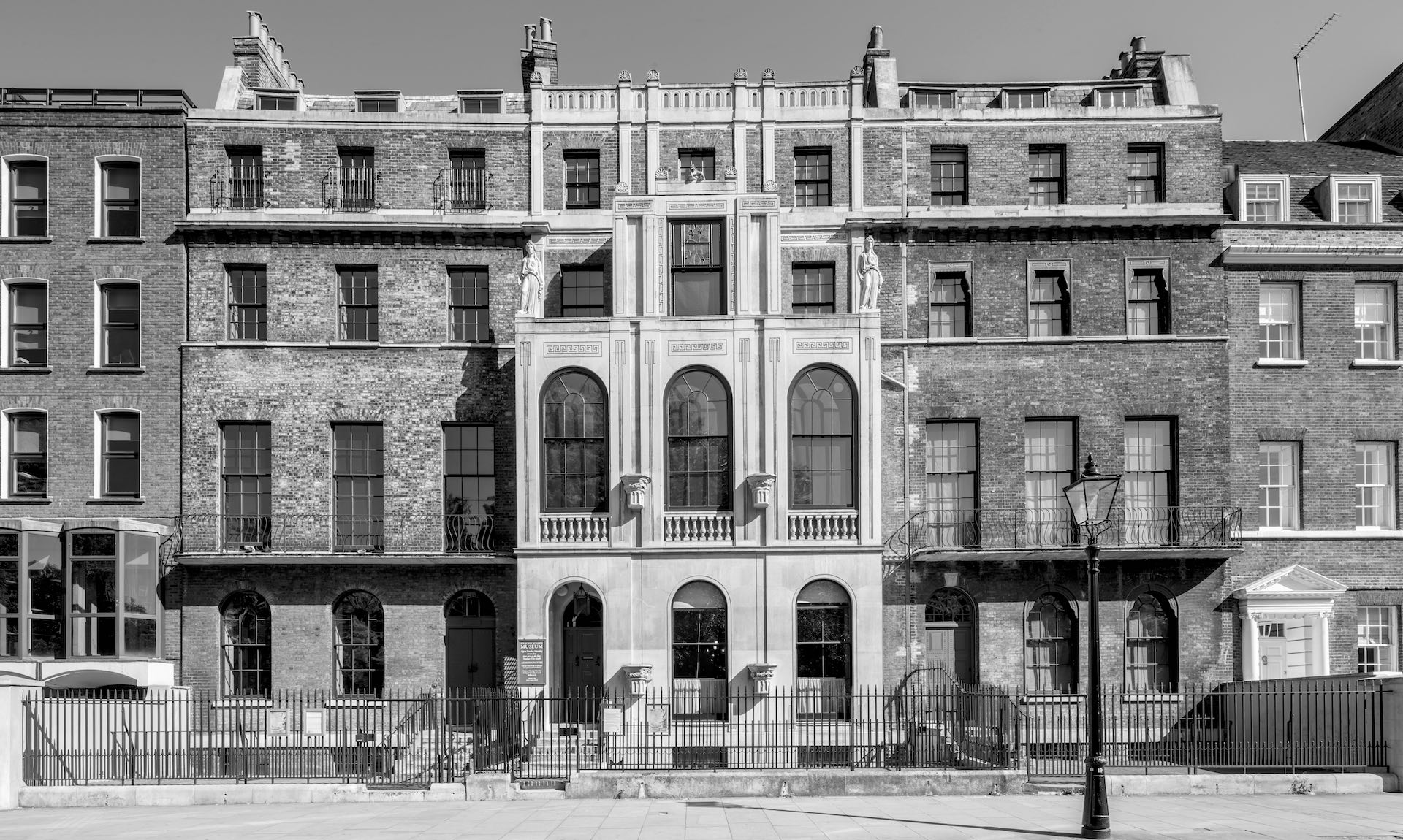
Lincoln’s Inn Fields è una delle piazze più sobrie della città: geometria ordinata, un equilibrio quasi severo. È il più grande impianto georgiano di Londra, nato nel XVII secolo accanto agli Inns of Court, il cuore giuridico della città. Qui si concentrano tribunali, studi legali, istituzioni legate alla legge e all’ordine civile. Non è un quartiere aristocratico nel senso spettacolare di Mayfair, né un distretto commerciale. È un luogo di disciplina, di norma, di misura. Nulla lascia presagire che dietro uno di quei fronti si nasconda un organismo visionario.
Le facciate sono regolari, il perimetro chiuso. Un rettangolo verde trattenuto tra margini severi. Nulla eccede. Il nome stesso, Lincoln’s Inn Fields, conserva una doppia memoria: quella dell’istituzione giuridica che ne delimita l’identità – “Lincoln’s Inn”, una delle antiche corporazioni forensi londinesi – e “Fields”, quella di un passato ancora rurale, quando questo spazio era davvero un campo aperto ai margini della città. Tra legge e campo, tra norma e terreno non ancora disciplinato, la piazza custodisce un’ambiguità originaria. È in questa fenditura che Soane inserisce la propria anomalia, nel cuore del diritto inglese, dove la città si pensa come ordine. In un contesto governato dalla legge e dalla simmetria, egli introduce un interno fatto di deviazioni, compressioni, illusioni prospettiche. L’esterno è ordine; l’interno è montaggio.
La città offre la cornice della norma. La casa costruisce la sua eccezione.
Il Sir John Soane’s Museum non è nato per essere visitato. È nato per restare. Non nel senso della conservazione museale, ma nel senso più ostinato della durata. Quando Sir John Soane – architetto della Bank of England, professore alla Royal Academy, figlio di un muratore che aveva imparato a leggere la materia prima ancora di leggere i libri – decide di trasformare la propria casa in un’opera permanente, non compie un gesto celebrativo. Compie un gesto di controllo.
Nel 1833 ottiene un Act of Parliament che stabilisce che nulla venga alterato: ogni oggetto deve restare dov’è, ogni allineamento, ogni angolo, ogni montaggio visivo deve sopravvivere alla sua morte. Non è soltanto una donazione. È una prescrizione. La disposizione diventa destino. Il museo nasce come atto giuridico prima che come gesto culturale. Non è uno spazio offerto alla contemplazione, ma una clausola resa architettura. L’immutabilità non è un ideale: è una condizione imposta. Soane non consegna una casa al futuro; lo vincola. E tuttavia, proprio questa pretesa di fissità produce una vibrazione. Perché ciò che viene dichiarato intangibile diventa, paradossalmente, più esposto. Ogni sguardo riapre ciò che la legge voleva chiudere. Il controllo non elimina il tempo: lo concentra, lo rende più denso, quasi più pericoloso.
Soane aveva studiato a Roma, aveva attraversato le rovine con la disciplina di chi cerca una grammatica. Aveva compreso che l’antico non è un repertorio di forme ma una lezione di sopravvivenza. Le rovine non parlano di distruzione: parlano di ciò che insiste. Ciò che resta non è mai intatto, ma stratificato. Londra, nel tempo, ha trasformato o cancellato molte delle sue architetture. La Bank of England, una delle sue opere più ambiziose, è stata quasi interamente smantellata. La dispersione urbana ha assorbito la monumentalità. La casa, invece, concentra. Raccoglie. Compatta.
Nel 1815 muore Eliza. La perdita non viene raccontata, non viene resa pubblica. Viene costruita. Il mausoleo nel cimitero di St Pancras, attraversato da una luce che scende dall’alto con disciplina misurata, è un’architettura del trattenimento. Non celebra: custodisce. Negli anni successivi la casa assume la stessa qualità silenziosa. Non diventa memoriale, ma sistema di concentrazione.
Ogni frammento archeologico, ogni sarcofago, ogni modello architettonico, ogni specchio convesso è un atto contro la dispersione. Non si tratta di accumulare, ma di trattenere ciò che altrimenti si dissolverebbe nel flusso del tempo. La luce che penetra dall’alto non è romantica, non è naturale nel senso sentimentale del termine. È controllata. Filtrata. Usata come materia costruttiva. Non illumina semplicemente gli oggetti: li modella, li mette in relazione, li costringe a una convivenza serrata.
La casa non diventa museo per aprirsi al mondo.
Diventa museo per resistergli.
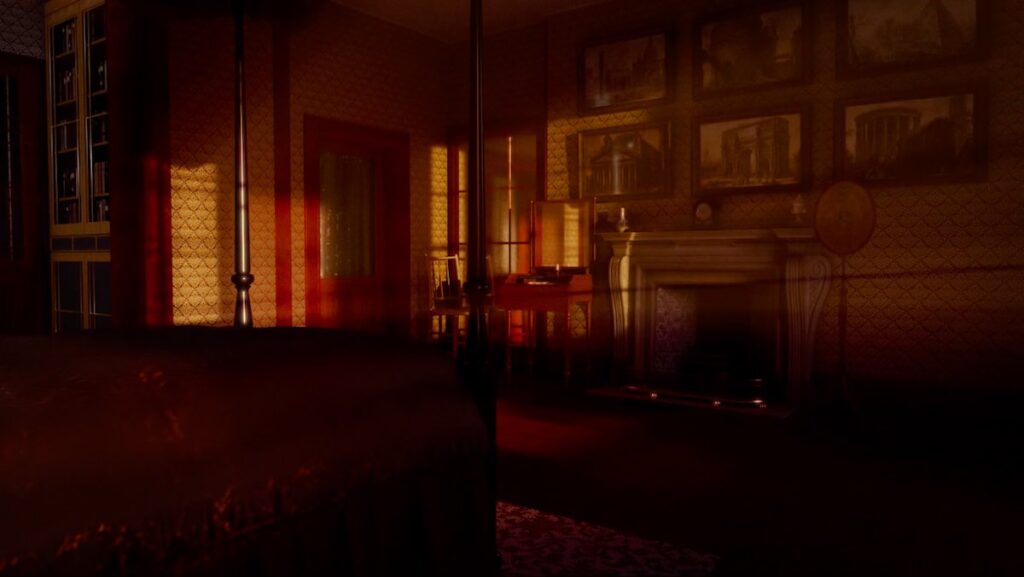
È una biografia scritta in sezione, dove il lutto non è dichiarato ma inscritto nello spazio, e la memoria non è racconto ma disposizione. Entrare nel Sir John Soane Museum significa perdere l’orientamento senza mai sentirsi smarriti. Non c’è asse monumentale, non c’è trionfo prospettico. Lo spazio si contrae e si dilata secondo un ritmo che somiglia più al respiro che alla geometria. Le stanze sono strette, i passaggi obliqui, le soglie quasi improvvise. Ci si muove con cautela, come se ogni passo dovesse essere negoziato.
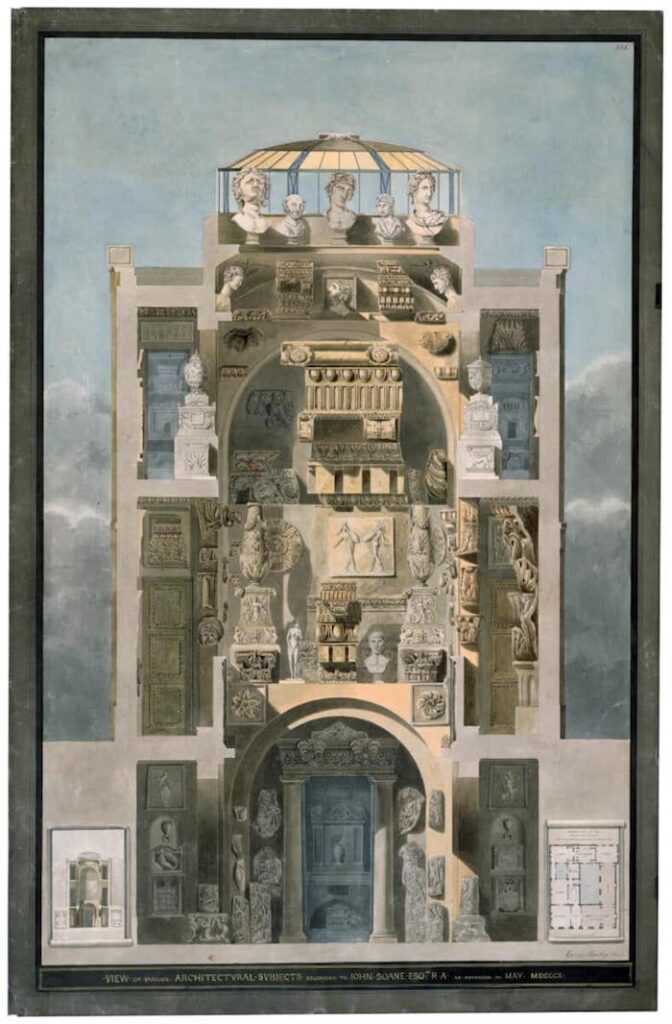
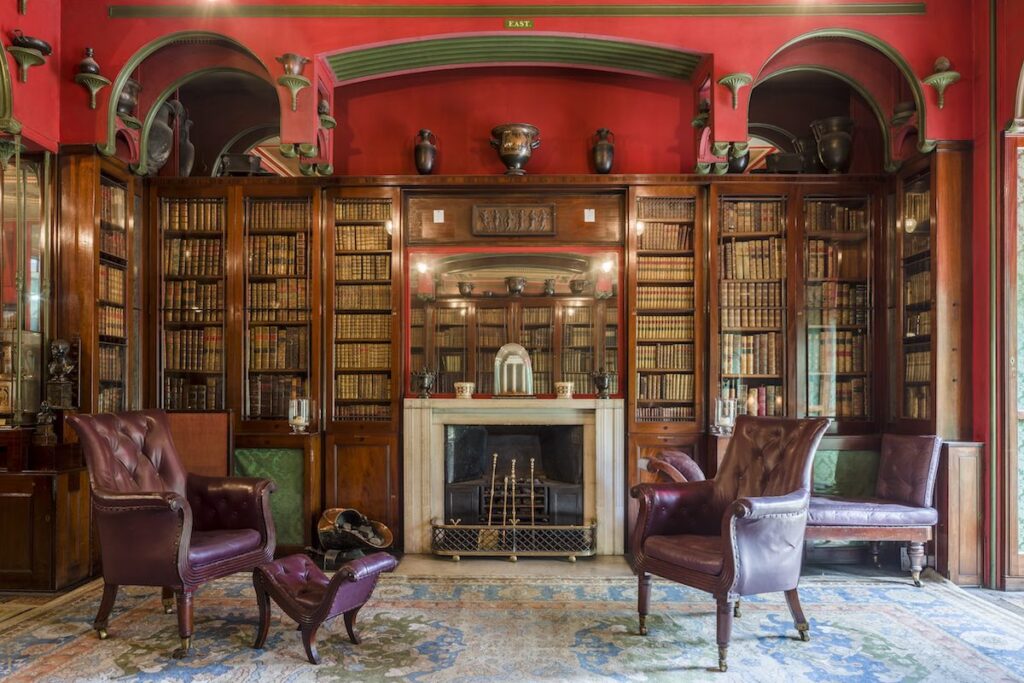
La Dome Area è il centro silenzioso di questo sistema. La luce scende dall’alto, filtrata, lattiginosa, e non produce abbaglio ma concentrazione. Le superfici chiare sembrano assorbire il chiarore invece di rifletterlo. Nulla è spettacolare, e tuttavia tutto è intensamente visibile. La luce non celebra gli oggetti; li tiene insieme, non rivela: ordina. Non separa gli oggetti, li costringe a una relazione inevitabile, a una disciplina silenziosa. Guardare significa accettare una gerarchia che non è dichiarata ma costruita, nulla è neutro: nemmeno il chiarore. Sotto, nella Crypt, il sarcofago di Seti I introduce un tempo ancora più remoto. L’Egitto non appare come esotismo o citazione erudita, ma come strato ulteriore in una costruzione già stratificata. Il passato non è isolato per epoche: convive. Ed è così che la cronologia cede il posto alla compresenza.
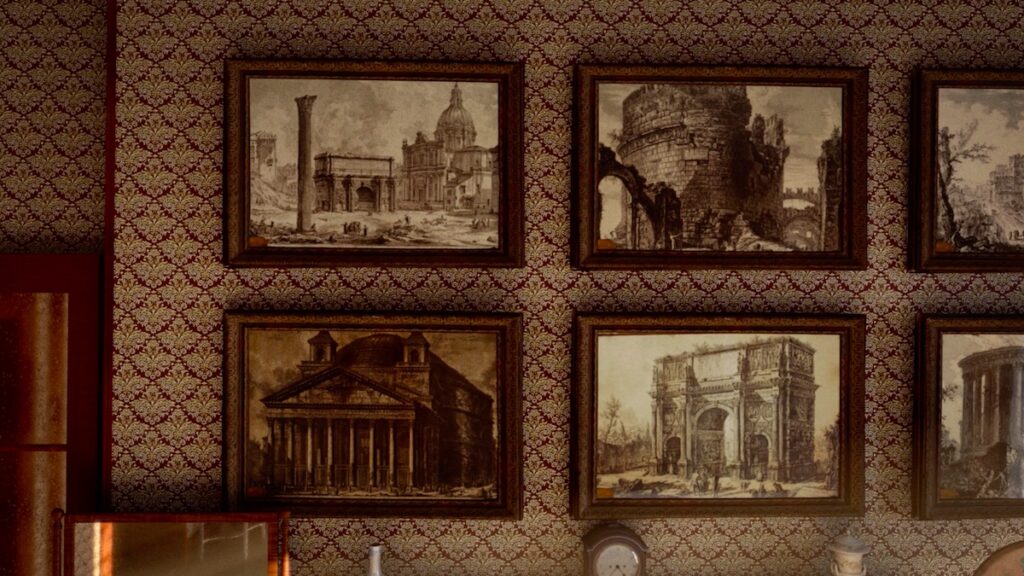
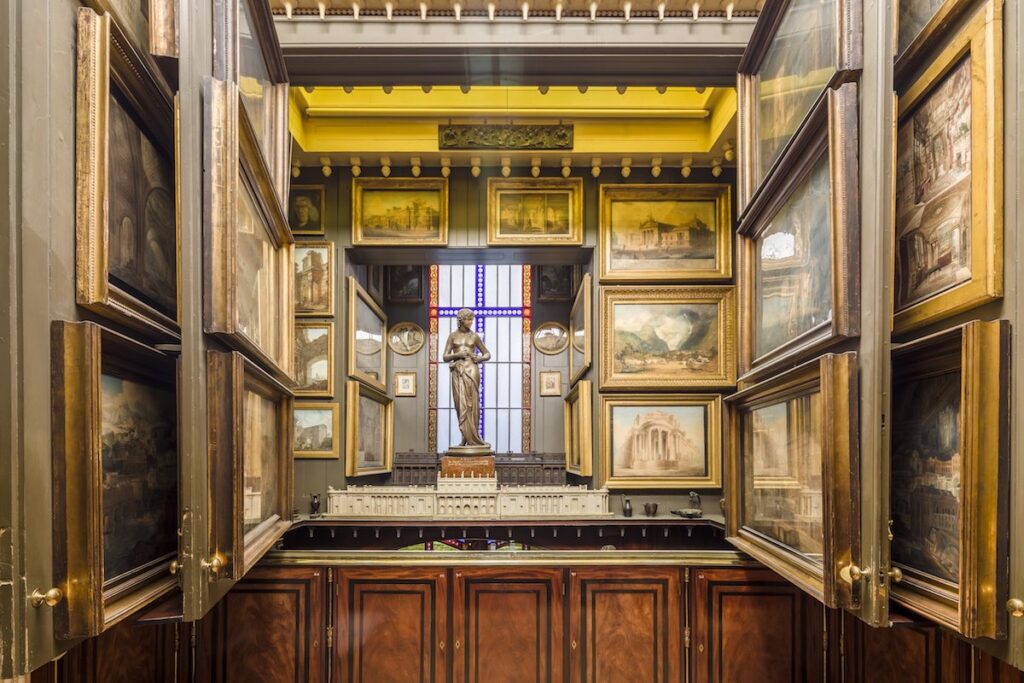
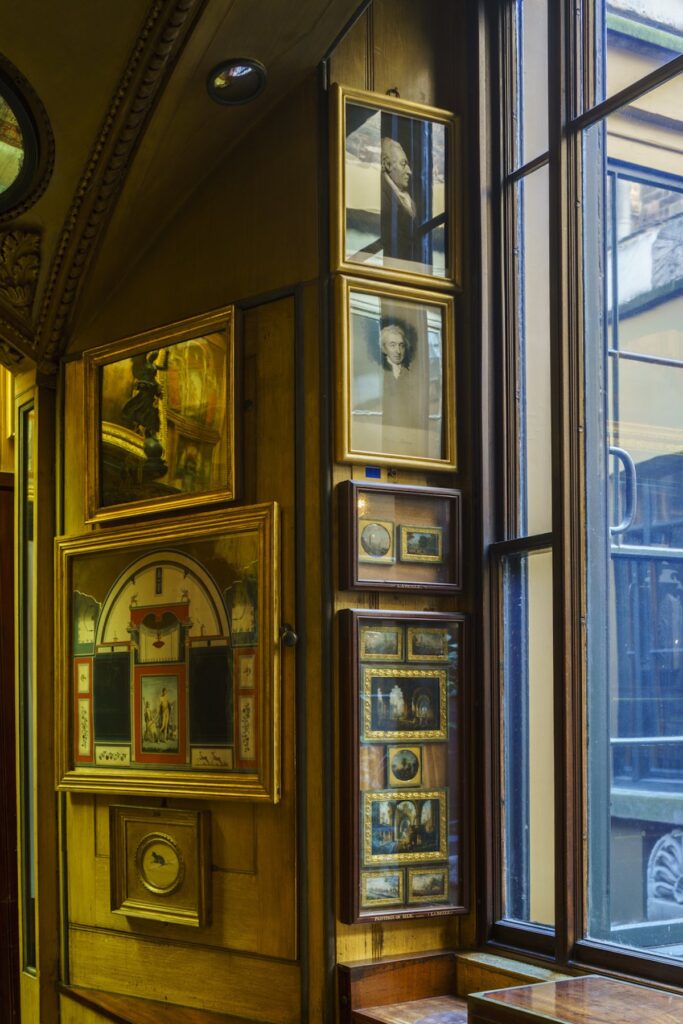
La Picture Room rende esplicito ciò che altrove è implicito. Le pareti si aprono a libro, rivelando immagini nascoste dietro altre immagini. Nulla è definitivo. Ogni superficie contiene un secondo livello, e poi un terzo. L’atto del vedere diventa progressivo, quasi tattile. Ciò che si mostra lo fa per gradi, come se l’opera avesse bisogno di essere persuasa a rivelarsi.
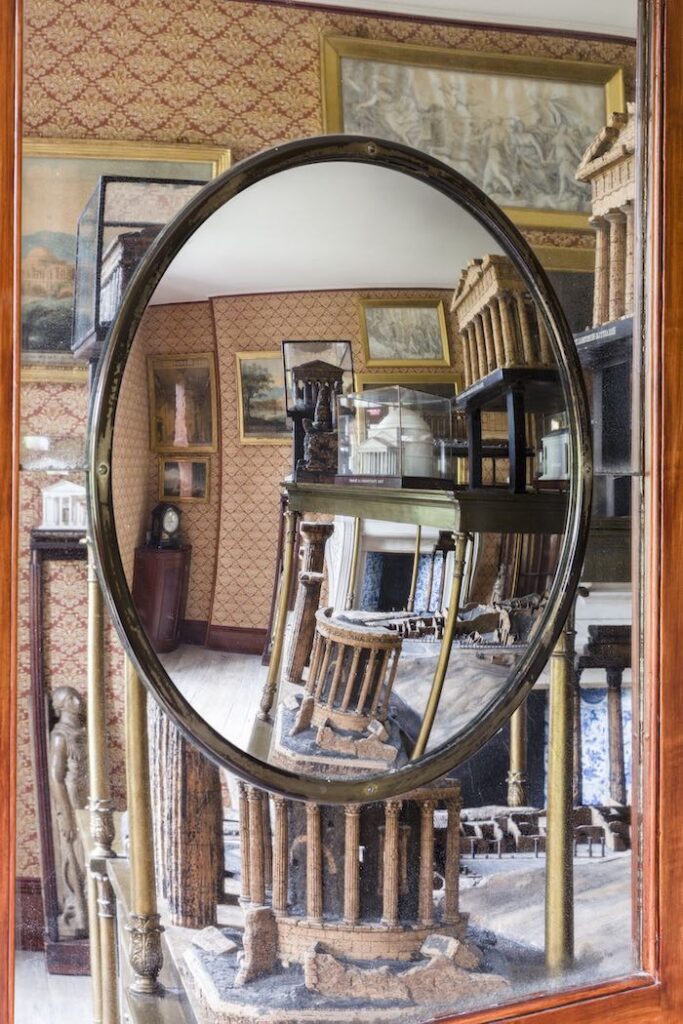
Gli specchi convessi moltiplicano le prospettive e restituiscono lo spazio deformato, espanso, improvvisamente più profondo. In stanze minime si aprono illusioni di vastità. Non si tratta di inganno, ma di consapevolezza: lo spazio non è dato una volta per tutte, è costruito dallo sguardo che lo percorre.
Qui il visitatore non attraversa semplicemente una collezione. Viene lentamente educato a guardare. Il corpo rallenta, si inclina, arretra, si avvicina. Ogni movimento è suggerito dall’architettura stessa, che non impone ma orienta.
Non c’è neutralità museale. Non c’è distanza asettica tra oggetto e osservatore. Tutto è troppo vicino, troppo denso, troppo compresso perché lo sguardo resti superficiale.
Il tempo, in questa casa, non scorre in linea retta. Si piega, ritorna, si sovrappone. Il frammento antico dialoga con il modello architettonico, il dipinto con il calco, la rovina con la miniatura. Non si è mai davanti a un solo strato.
Forse è questo il punto decisivo: il museo non espone soltanto oggetti, ma produce condizioni di attenzione. E in questa attenzione forzata, quasi intima, lo spazio diventa mentale prima ancora che fisico.
Non si visita il Soane per vedere di più.
Lo si visita per vedere diversamente.
In una casa così piena, il presente non può entrare come conquista. Non ha spazio per spiegarsi, non ha superfici libere su cui dichiararsi. Deve imparare un’altra grammatica: quella dell’infiltrazione, dello scarto minimo, della variazione interna. Al Sir John Soane’s Museum l’arte contemporanea non è un’aggiunta: è una prova di sensibilità. Qui ogni intervento si misura con un organismo già saturo, già disposto come un pensiero che non vuole essere interrotto.
Per questo il gesto decisivo resta Retrace Your Steps: Remember Tomorrow (1999–2000), concepita da Hans Ulrich Obrist insieme a Cerith Wyn Evans. Non era una mostra “nel” museo: era il museo che si rivelava come mostra, come dispositivo già contemporaneo nella sua natura. Il titolo—concepito da Douglas Gordon—funzionava come una frase che non descrive ma comanda: ripercorri i tuoi passi, ma ricorda il futuro. E all’improvviso il tempo, lì dentro, smetteva di essere una linea e diventava un circuito, un rimbalzo, una memoria in avanti.
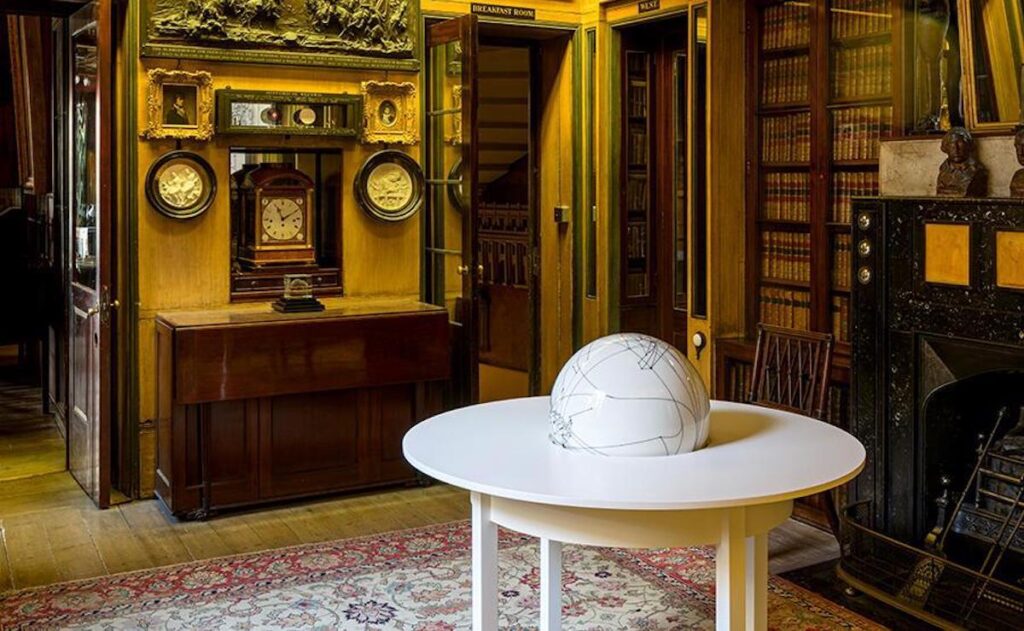
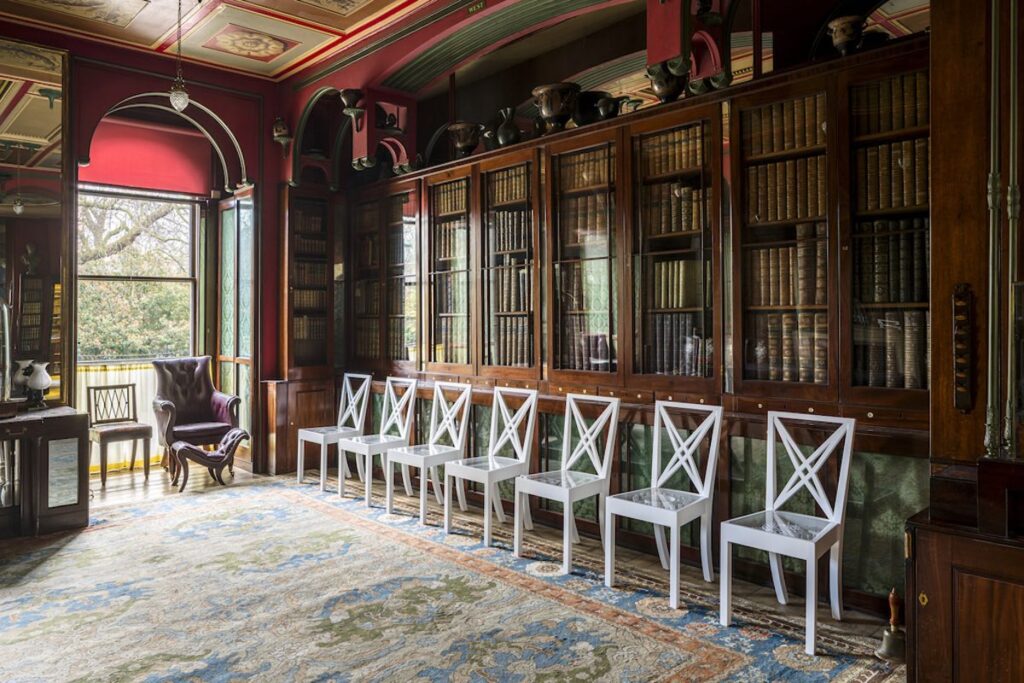
Douglas Gordon, Steve McQueen, Rem Koolhaas comparivano non come presenze che occupano, ma come deviazioni che alterano la percezione: opere disseminate tra gli oggetti storici, non separate, non protette dalla distanza. E Wyn Evans, con Modified Threshold, trasformava l’ingresso in un atto consapevole: una corda con campanelli faceva sì che ogni passaggio producesse suono—un segnale lieve, eppure inequivocabile—come se la casa dicesse: ti ho sentito arrivare, ora guardami con attenzione. Non era spettacolo, ma un’educazione del gesto. Il contemporaneo, qui, non modernizzava il Soane: ne rendeva visibile l’instabilità originaria. Non fu soltanto una mostra. Fu un apprendistato. Obrist non si limitò a curarla: abitò il museo. Dormì nella stanza degli ospiti all’ultimo piano, attraversò di notte le sale buie, trasformò il lunedì – giorno di chiusura – in laboratorio. Gli artisti lavoravano nello spazio come in uno studio temporaneo, senza pubblico, senza spettacolo. Il titolo, il poster, il depliant, la colonna sonora: ogni elemento strutturale diventava opera. Retrace Your Steps: Remember Tomorrow non fu un intervento “site-specific”; fu una messa in questione della forma-mostra stessa. Il Soane non era contenitore ma interlocutore, non sfondo ma organismo. In quell’esperienza si definisce una pratica che Obrist continuerà altrove: la casa come dispositivo narrativo non lineare, come Gesamtkunstwerk già attivo, da non sovrascrivere ma da attraversare.
Retrace Your Steps non introduceva il contemporaneo nel museo: dimostrava che il museo era già contemporaneo, perché già instabile. L’esperienza non produceva opere “dentro” lo spazio; metteva in crisi l’idea stessa di spazio come contenitore. Se Soane aveva fissato ogni oggetto per legge, Obrist riapriva la possibilità che quella fissità fosse solo apparente. Il lunedì senza pubblico, gli artisti al lavoro senza spettacolo, la casa attraversata di notte: tutto indicava una cosa sola — il museo non è ciò che espone, ma ciò che permette. Non è una collezione. È una condizione. Questa è la regola implicita che torna, con forme diverse, negli anni successivi: il presente non alza la voce, modifica l’equilibrio.
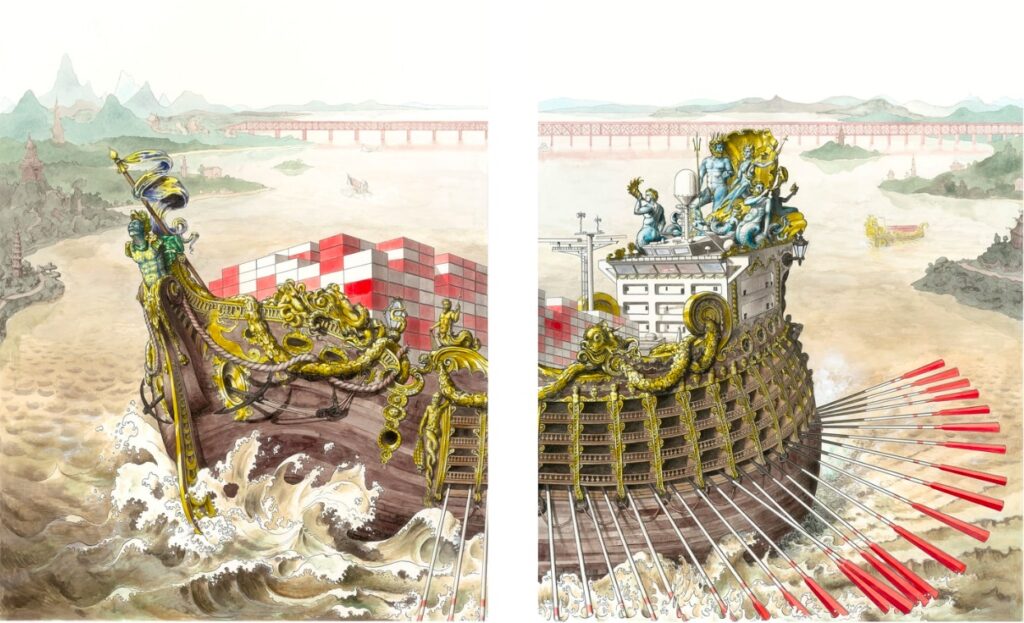
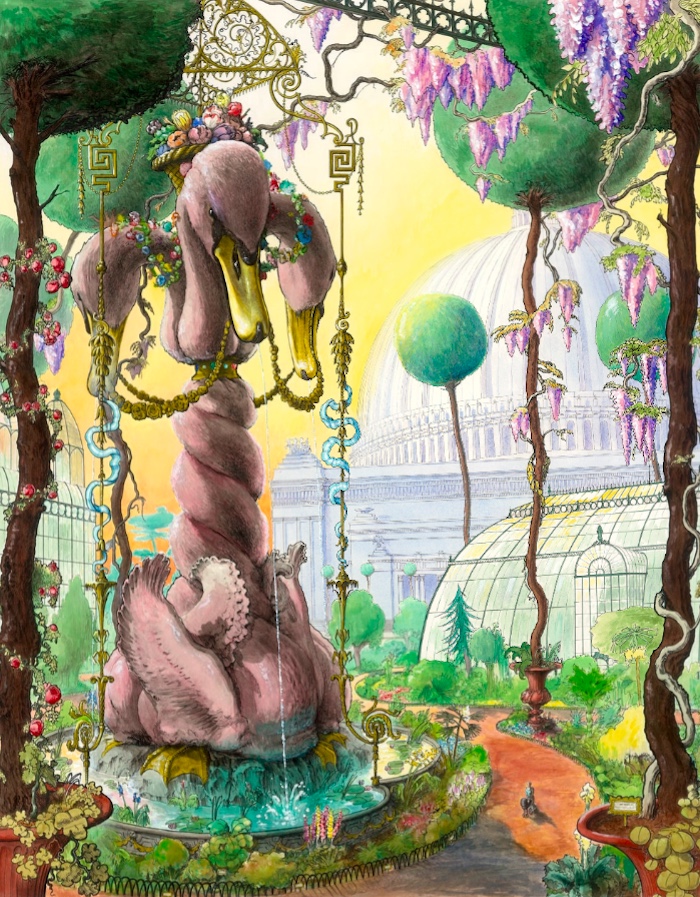
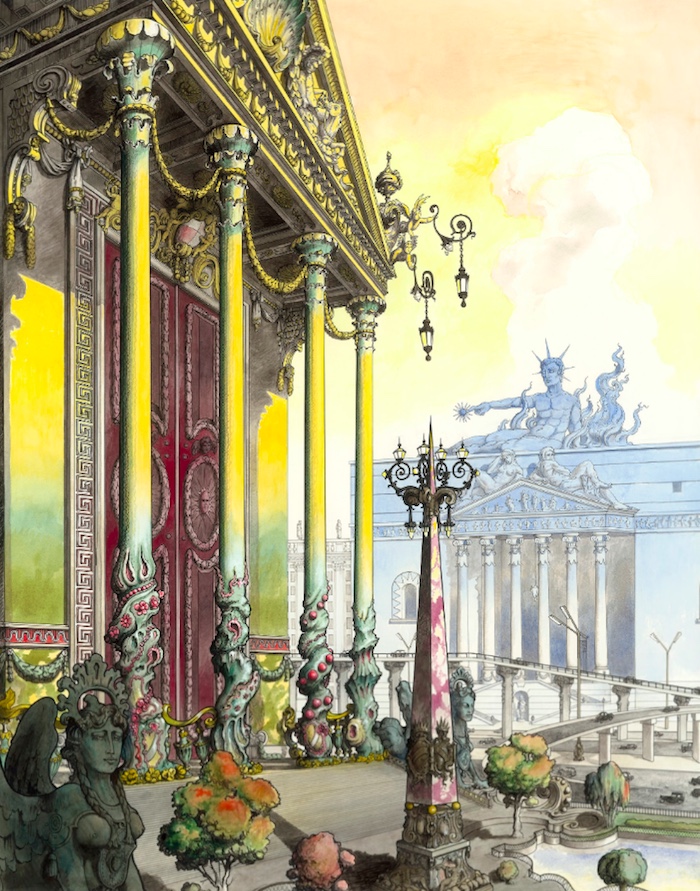
In questa stessa economia del gesto, Pablo Bronstein con A Theatre of Minimum Gesture (2016) entra nel Soane come si entra in una stanza già piena di memoria: non per aggiungere un oggetto, ma per spostare appena l’angolo dello sguardo. La sua pratica—che lavora con l’architettura come linguaggio, con la storia come teatro e con la scena come dispositivo critico—non ha bisogno di imporsi: gli basta far emergere la dimensione performativa che l’edificio custodisce da sempre. Nel Soane, dove le pareti si aprono, gli assi si spezzano, le prospettive si moltiplicano, Bronstein riconosce una teatralità nativa: non quella del fasto, ma quella della regia. Il suo intervento non contraddice la casa; la cita dall’interno, come se ne riscrivesse il copione a bassa voce, facendo affiorare ciò che era già lì—lacoreografia deipassaggi, la disciplina delle apparizioni, l’idea che vedere sia sempre un atto messo in scena.
Nel 2020, Langlands & Bell, con Degrees of Truth, entrano nel museo dalla parte più sensibile: la parola “verità”. In una casa fissata da un Act of Parliament, dove la disposizione è prescritta e la permanenza assume la forma di legge, parlare di verità significa subito parlare di costruzione, di graduazione, di scelta. Loro, che lavorano da sempre sulle architetture invisibili del potere—istituzioni, controllo, sistemi che regolano i corpi senza farsi vedere—non si limitano a “dialogare” con Soane: ne fanno emergere un’altra stratificazione. Se Soane aveva trasformato l’architettura in autobiografia, Langlands & Bell ne rivelano la trama sistemica: l’edificio come macchina epistemica, come luogo in cui la conoscenza viene ordinata, classificata, esposta secondo una volontà precisa. Il loro intervento non contrasta con la casa: la mette a fuoco. E la domanda resta sospesa, insistente ma mai urlata: la conservazione è davvero innocente? la permanenza è davvero neutrale?
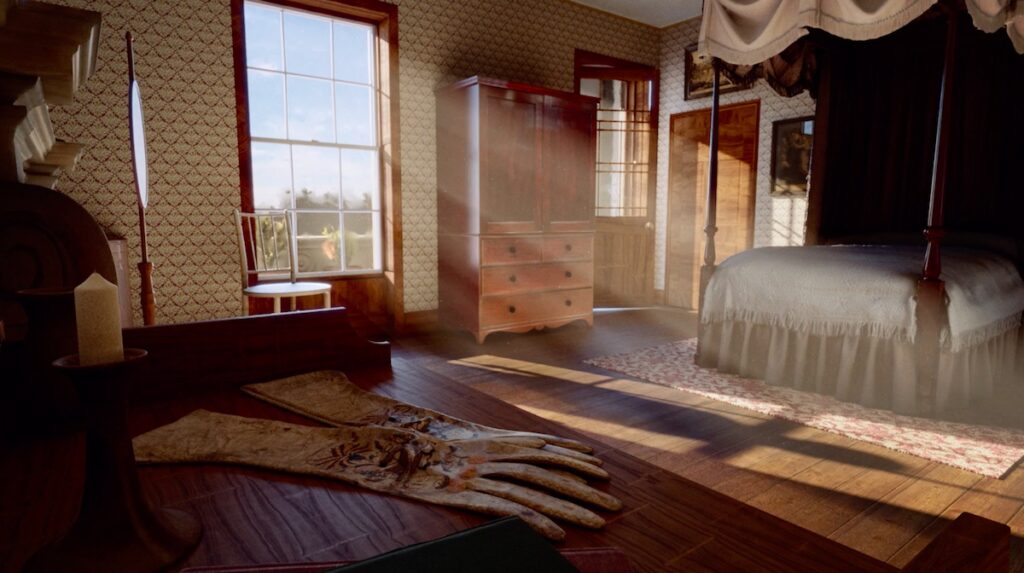
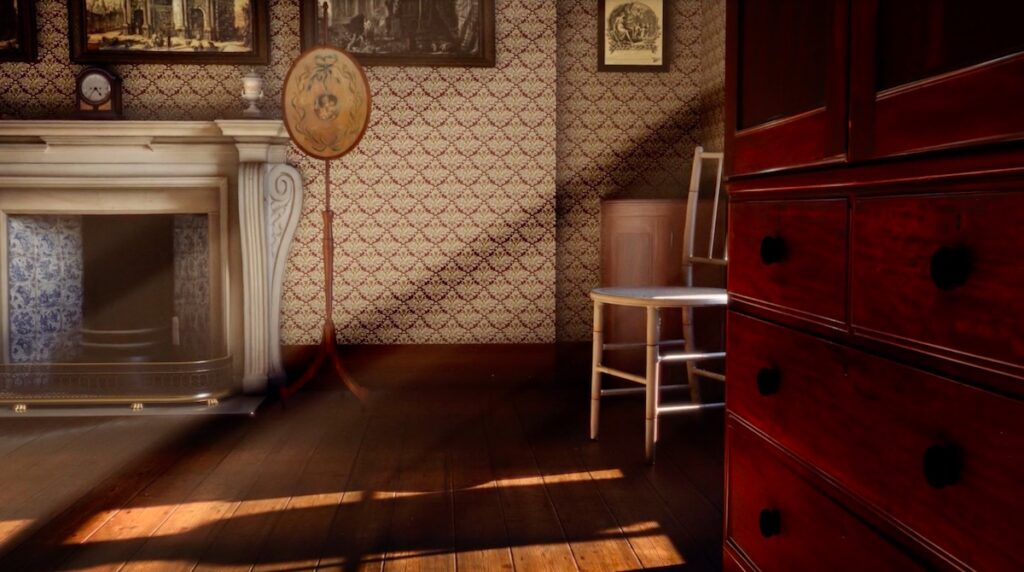
Due anni dopo, nel 2022, Anne-Marie Creamer con Dear Friend, I Can No Longer Hear Your Voice sceglie un’altra via: non lavora sul sistema, ma sul fantasma. Ricostruisce—o meglio: riporta in superficie—uno spazio perduto legato a Eliza Soane. È un gesto che non aggiunge peso alla collezione, ma toglie stabilità alla fissità. Nel Soane, dove tutto è al suo posto “per sempre”, l’immagine in movimento introduce ciò che non si può fissare: vibrazione, durata fragile, tempo che passa mentre lo stai guardando. Non è una ricostruzione archeologica: è un’evocazione. Non restituisce una stanza come dato; restituisce una mancanza come atmosfera. E la casa, che sembra costruita per trattenere luce e oggetti, per un momento trattiene anche una voce che non c’è più: il lutto non come racconto, ma come qualità dell’aria.
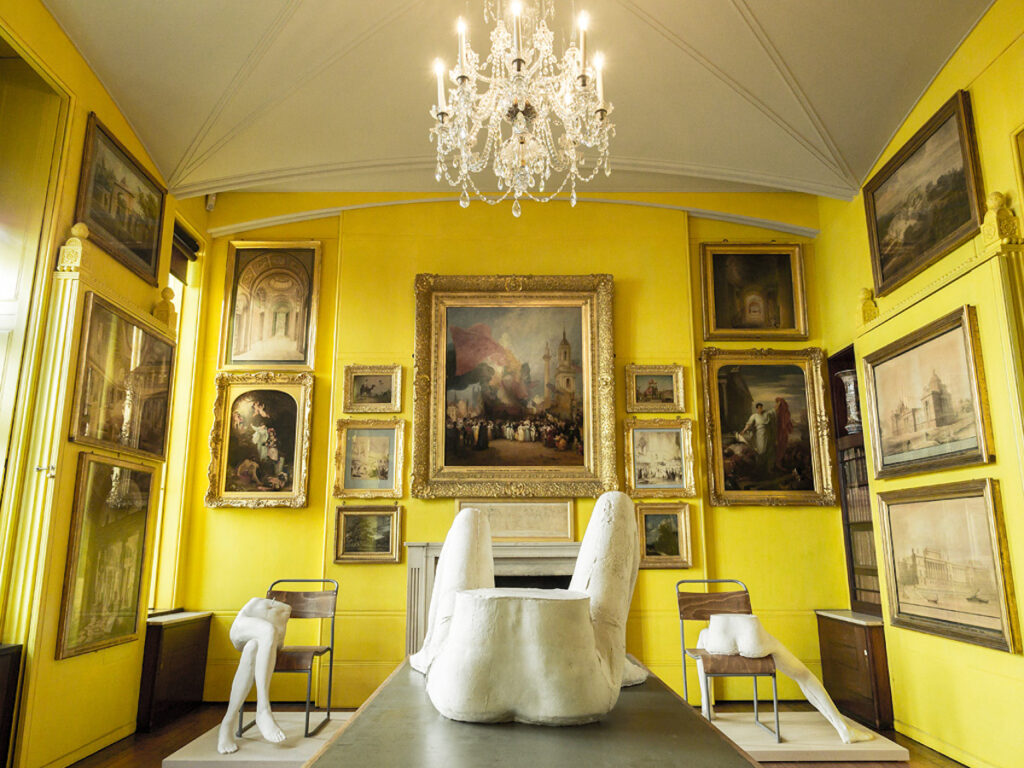
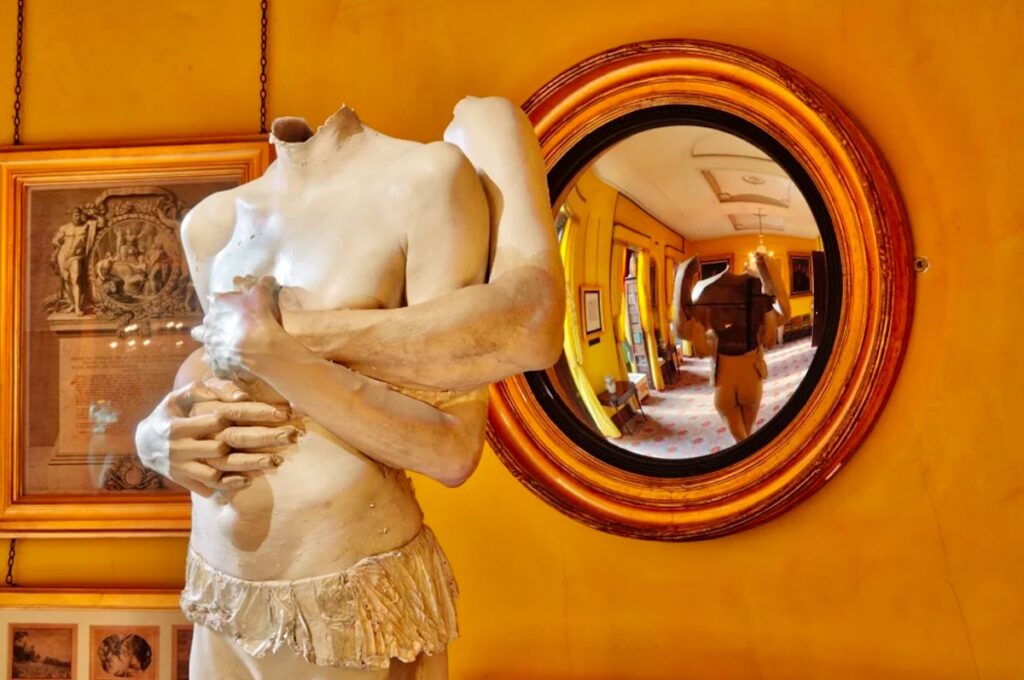
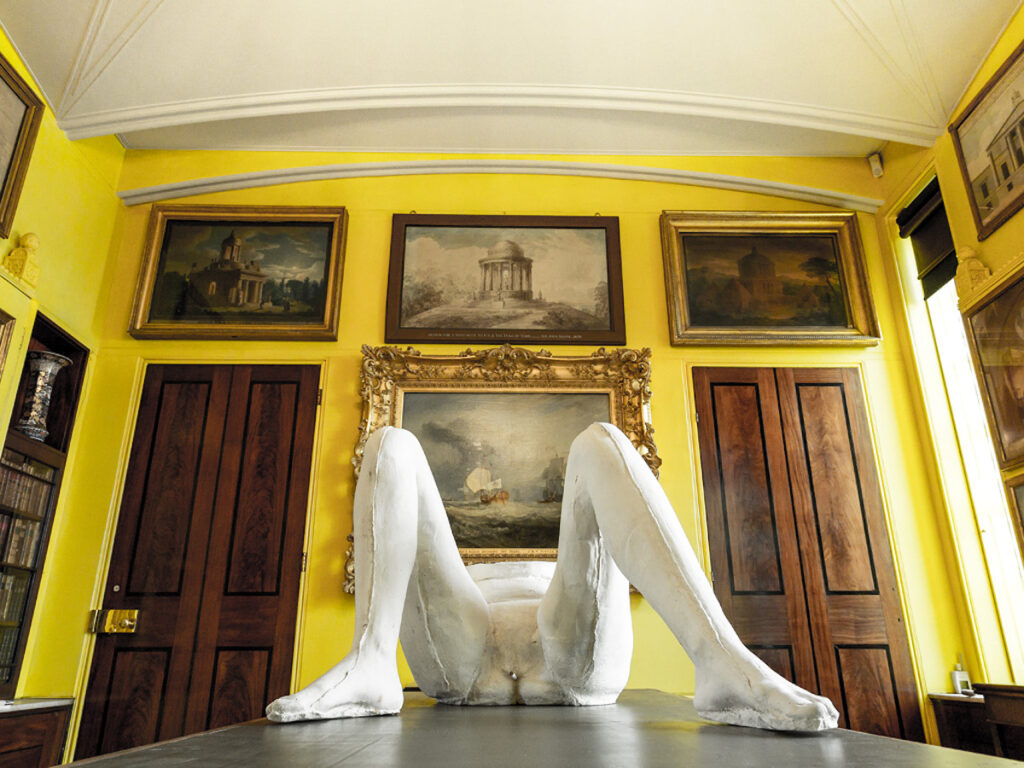
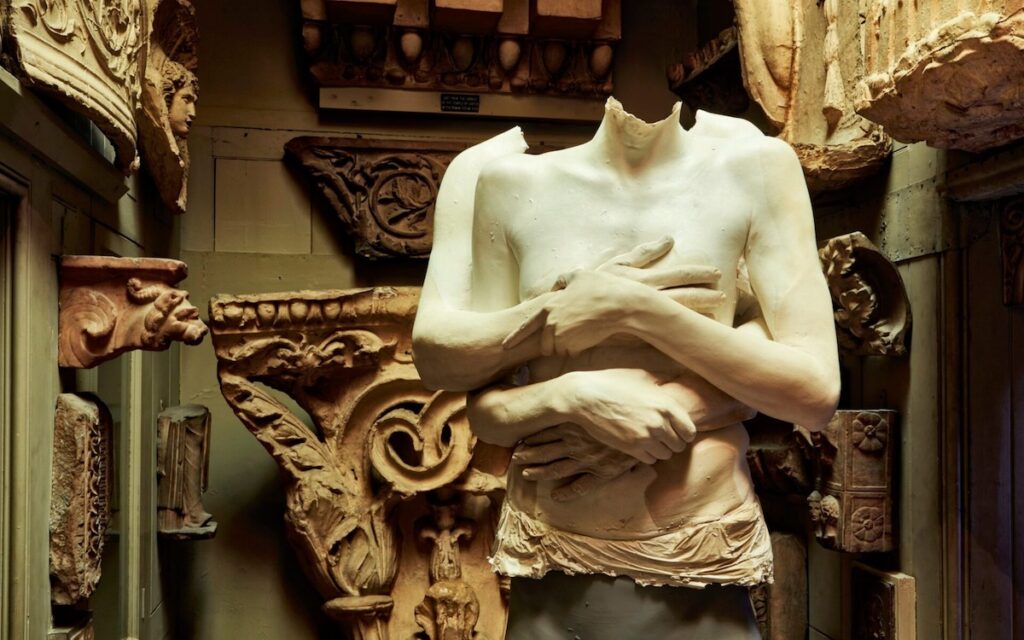
Tra questi due estremi—la verità come costruzione e la perdita come risonanza—si inseriscono interventi che lavorano sul corpo, ma senza teatralità grossolana, senza “shock”. POWER IN WOMAN, aperta il 10 marzo 2016, porta Sarah Lucas dentro la casa come una deviazione silenziosa: figure in gesso bianco, corpi femminili contratti, acefali, piegati, come se la forma fosse ancora in trattativa con la propria possibilità. Il gesso è fragile, polveroso, reversibile: non compete con la pietra, la sfiora. In mezzo a calchi classici e frammenti archeologici, quelle presenze non diventano statue, diventano resistenze. Il potere evocato dal titolo non si proclama: grava. È il peso del corpo nello spazio, un’energia compressa che incrina appena la sicurezza del canone. Soane aveva costruito una casa dove nulla eccede; Lucas mostra che la forma, anche quando si crede eterna, resta esposta alla frattura.
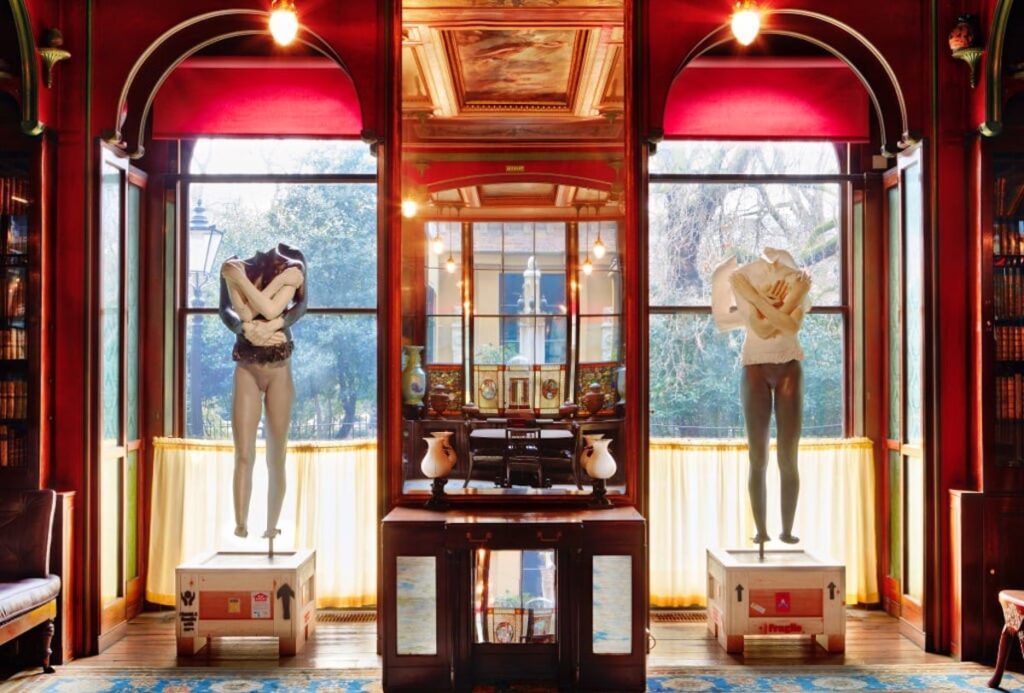
Nel 2017, con Drawn from Life, Marc Quinn continua quel discorso, ma lo sposta dal frammento al rischio dell’intero. Le sue figure femminili—bianche, leggere, colte in un equilibrio instabile—non sono rovine, non sono resti: sono corpi nel momento prima della caduta o dopo il salto. Se i frammenti antichi raccolti da Soane testimoniano ciò che è sopravvissuto, Quinn porta in scena ciò che potrebbe cedere. È una differenza sottilissima eppure decisiva: il museo, che già costringe lo sguardo a rallentare, diventa anche un luogo in cui la gravità si sente di più, perché i corpi contemporanei non imitano l’eternità del marmo, mostrano la tensione muscolare, la precarietà del punto d’appoggio, la possibilità del cedimento. E quella precarietà, dentro una casa dove tutto è fissato, diventa una forma di pensiero: non si oppone alla permanenza, la mette in crisi dall’interno.
E poi c’è l’intervento che sceglie di non essere né corpo né immagine, ma prossimità tra tempi. Neighbours in Space and Time (2022–2023) di Grafton Architects legge un edificio contemporaneo attraverso principi soaniani—luce, sezione, compressione—non come citazione, ma come genealogia silenziosa. Qui la casa non è sfondo: è un interlocutore. Il contemporaneo non entra per contraddire, entra per riconoscere che certe ossessioni—la luce trattenuta, lo spazio come montaggio, la stanza come dispositivo mentale—non appartengono a un secolo solo. Vivono di ritorni, di affinità inattese.
La linea che unisce tutto questo non è il “programma”, ma un’etica del gesto. Il Sir John Soane’s Museum non chiede al presente di portare novità: gli chiede precisione. Non chiede opere che riempiano: chiede interventi che ricalibrino. Qui l’innesto funziona quando non aggiunge volume, ma introduce un’inquietudine misurata—un dubbio sulla verità, una stanza che ritorna come fantasma, un corpo che potrebbe cadere, una soglia che suona, un vicino che attraversa il tempo.
E così il museo resta ciò che è sempre stato: non un contenitore del passato, ma un organismo che obbliga il presente a diventare attento. A non occupare. A non consumare. A sostare abbastanza a lungo da sentire che, in questa casa, anche il futuro—se arriva—arriva piano.
Non è esatto dire che il Sir John Soane’s Museum conserva il passato. Lo dispone. Lo avvicina a qualcos’altro. Lo costringe a convivere.
Camminando tra le stanze, si comprende che nulla è davvero isolato: un sarcofago dialoga con uno specchio, un calco con una miniatura, una rovina con un modello. Le epoche non si succedono, si sfiorano. E in quello sfiorarsi producono una tensione silenziosa, come se il tempo fosse una materia ancora malleabile.
Soane ha voluto disporre ogni cosa come se dovesse restare. Lo ha fatto per legge. Ma ciò che sembra immobile vibra appena, perché ogni sguardo riattiva le distanze, ricompone le relazioni, modifica l’equilibrio. La casa non trattiene il tempo: lo mette in scena mentre scorre.
La luce continua a scendere dall’alto, regolata, misurata. Non illumina per rivelare, illumina per far vedere meglio l’ombra. È una luce che non promette consolazione, ma precisione. Quando si esce e la geometria di Lincoln’s Inn Fields riprende il suo ordine severo, qualcosa è cambiato. Non nella città. Nel modo di guardarla. L’eccezione non è dentro la casa: è nello sguardo che ne è uscito.
Forse è questo il paradosso finale: la permanenza non è immobilità, ma intensificazione. Ciò che è fissato con tanta ostinazione non si cristallizza; si carica. La durata non è il contrario del movimento, è la sua concentrazione. Nel Soane il tempo non viene negato: viene addensato. E in quell’addensarsi produce una forma di lucidità.
Forse la memoria non è ciò che resta, ma ciò che modifica la distanza tra le cose.
E il museo, allora, non è un rifugio contro l’oblio.
È un esercizio di attenzione.
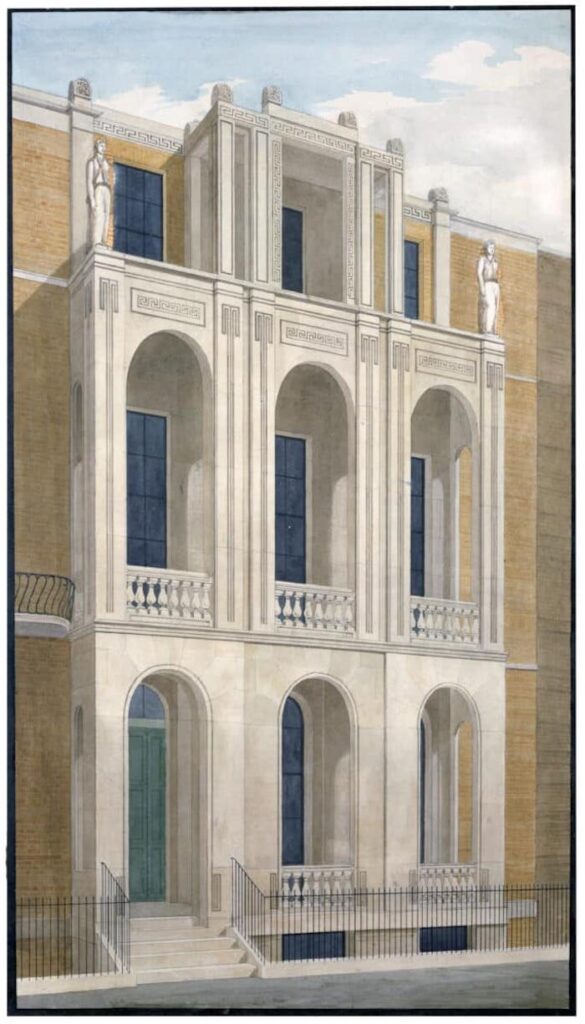
Cover: The frontage of Sir John Soane_s Museum, including no. 12 – 14 Lincoln_s Inn Fields. Photo_ Gareth Gardner
The theatre of held light. Sir John Soane’s Museum
In London, light does not impose itself. It arrives obliquely. It slips between dark bricks, glides across surfaces with a quiet, northern restraint, lingering before it declares itself.
Lincoln’s Inn Fields is one of the most restrained squares in the city: an ordered geometry, an almost severe equilibrium. It is the largest Georgian square in London, laid out in the seventeenth century beside the Inns of Court—the juridical heart of the city. Courts, law offices, institutions tied to law and civil order gather here. It is neither aristocratic in the theatrical sense of Mayfair, nor a commercial district. It is a place of discipline, of rule, of proportion. Nothing suggests that behind one of these façades a visionary organism might be concealed.
The façades are regular, the perimeter closed. A green rectangle held within strict margins. Nothing exceeds. Even the name—Lincoln’s Inn Fields—retains a double memory: that of the legal institution that defines its identity — “Lincoln’s Inn,” one of London’s historic Inns of Court—and “Fields,” recalling a still-rural past, when this space was truly an open field at the edge of the city. Between law and field, between norm and undisciplined ground, the square preserves an original ambiguity.
It is within this fissure that Soane inserts his anomaly, at the very centre of English law, where the city imagines itself as order. Within a context governed by symmetry and rule, he composes an interior of deviations, compressions, and perspectival illusions. Outside, everything aligns. Inside, everything is arranged otherwise.
The city offers the frame of the norm. The house constructs its exception.
The Sir John Soane’s Museum was not conceived to be visited. It was conceived to remain. Not in the museological sense of preservation, but in the more obstinate sense of duration. When Sir John Soane—architect of the Bank of England, professor at the Royal Academy, son of a mason who learned to read matter before he could read books—decides to turn his house into a permanent work, this is no celebratory gesture. It is an act of control. In 1833 he secured an Act of Parliament stipulating that nothing should be altered: every object must remain where it is, every alignment, every angle, every visual arrangement must survive him. This is not simply a donation. It is a prescription. Arrangement becomes destiny. The museum begins as a juridical act before it becomes a cultural one. It is not a space offered to contemplation, but a clause rendered in architecture. Immutability is not an ideal here; it is an imposed condition. Soane does not hand his house over to the future; he binds it to it. And yet, this very insistence on fixity sets up a vibration. What is declared untouchable becomes, paradoxically, more exposed. Each gaze reopens what the law sought to close. Control does not eliminate time; it concentrates it, thickens it, makes it almost more volatile.
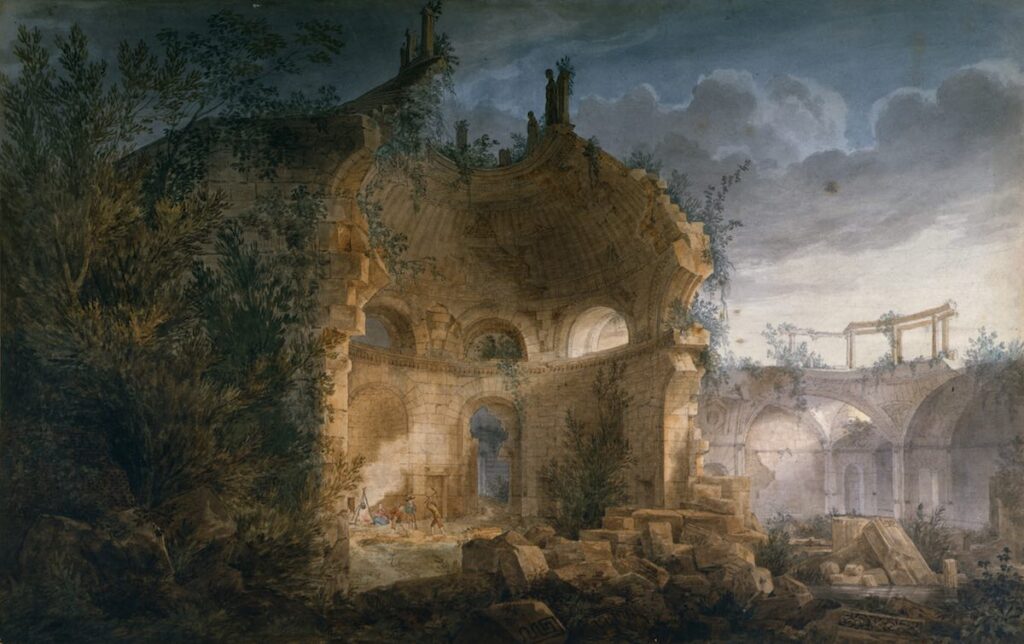
Soane had studied in Rome. He had moved through ruins with the discipline of someone searching for a grammar. He understood that the antique is not a repertoire of forms, but a lesson in survival. Ruins do not speak of destruction; they speak of what persists. What endures is never intact, only layered. London, over time, has transformed or erased many of its architectures. The Bank of England, one of his most ambitious works, has been almost entirely dismantled. Urban dispersion has absorbed its monumentality. The house, instead, gathers. Holds. Compacts.
In 1815, Eliza dies. The loss is not narrated, not made public. It is built. The mausoleum in St Pancras churchyard, traversed by a light that descends from above with measured discipline, is an architecture of restraint. It does not commemorate; it holds. In the years that follow, the house takes on the same quiet quality. It does not become a memorial, but a system of concentration.
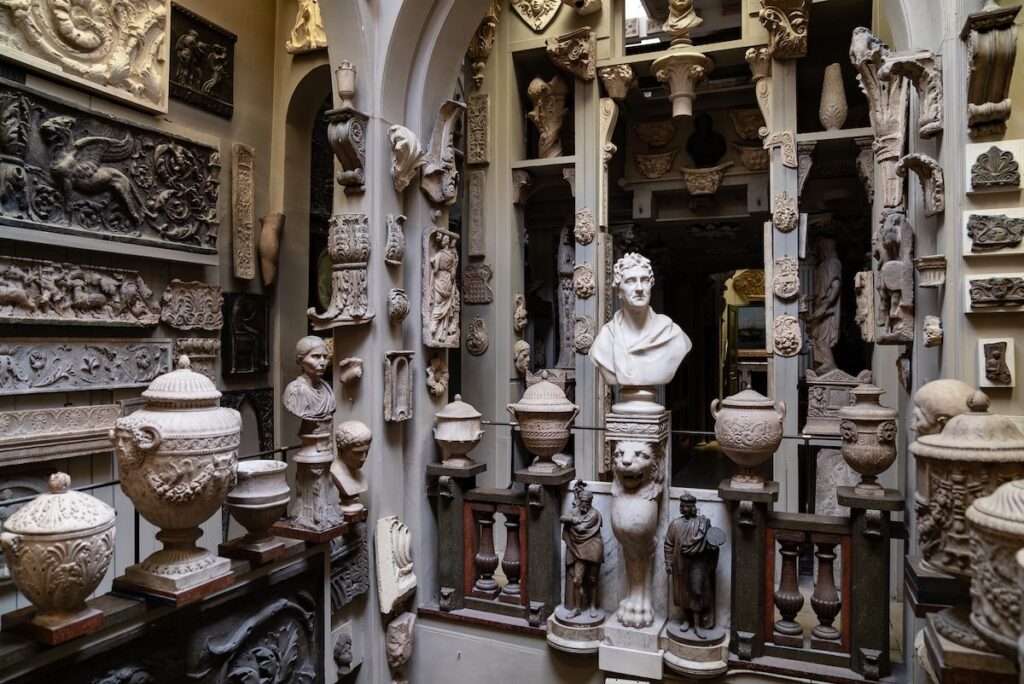
Every archaeological fragment, every sarcophagus, every architectural model, every convex mirror is an act against dispersion. It is not a matter of accumulation, but of holding back what would otherwise dissolve in the flow of time. The light that enters from above is not romantic, nor natural in any sentimental sense. It is controlled. Filtered. Used as a constructive material. It does not simply illuminate objects: it shapes them, brings them into relation, compels them into a tight coexistence.
The house does not become a museum in order to open itself to the world.
It becomes a museum in order to resist it.
It is a biography written in section, where mourning is not declared but inscribed in space, and memory is not narrative but arrangement. To enter the Sir John Soane’s Museum is to lose orientation without ever feeling lost. There is no monumental axis, no perspectival triumph. Space contracts and expands according to a rhythm closer to breathing than to geometry. The rooms are narrow, the passages oblique, the thresholds almost abrupt. One moves with caution, as if each step had to be negotiated.
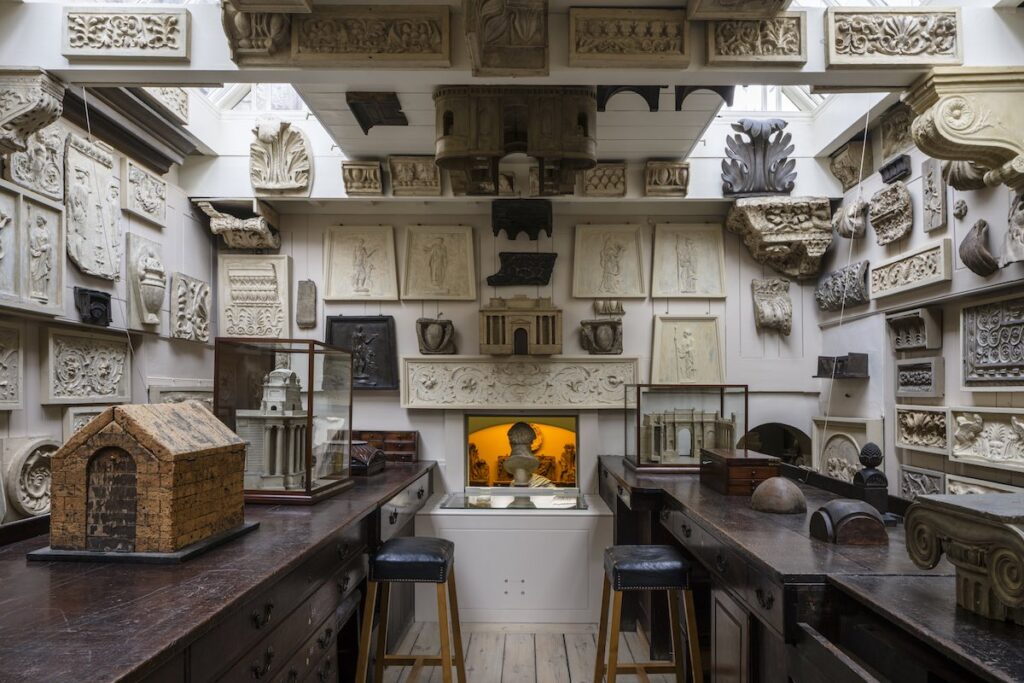
The Dome Area is the silent centre of this system. Light descends from above—filtered, milky—producing not glare but concentration. Pale surfaces seem to absorb brightness rather than reflect it. Nothing is spectacular, and yet everything is intensely visible. Light does not celebrate objects; it holds them together.
It does not reveal: it orders. Rather than separating objects, it binds them into an inevitable relation, a quiet discipline. To look is to accept a hierarchy that is never stated but constructed; nothing is neutral—not even brightness.
Below, in the Crypt, the sarcophagus of Seti I introduces a more remote time. Egypt does not appear as exoticism or learned citation, but as a further layer within an already stratified construction. The past is not arranged by period; it coexists. And here, chronology yields to simultaneity.
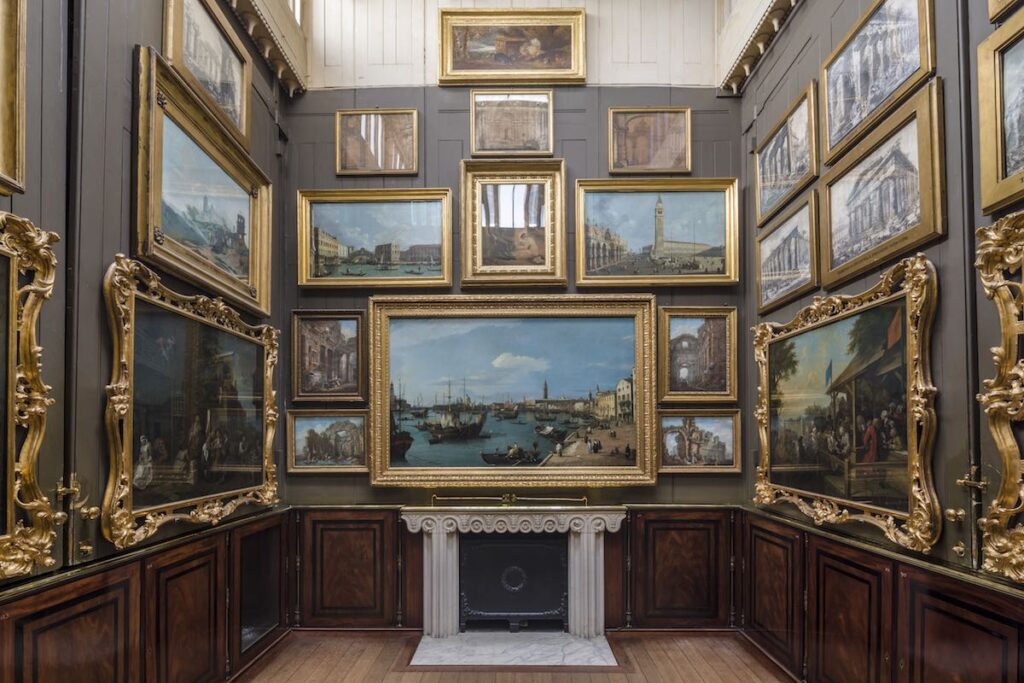
The Picture Room makes explicit what elsewhere remains implicit. The walls open like pages, revealing images concealed behind other images. Nothing is final. Every surface holds a second layer, then a third. The act of seeing becomes progressive, almost tactile. What appears does so gradually, as if the work itself needed to be persuaded to reveal itself. Convex mirrors multiply perspectives, returning space distorted, expanded, suddenly deeper. Within minimal rooms, illusions of vastness unfold. This is not deception, but awareness: space is not given once and for all; it is constructed by the gaze that moves through it.
Here, the visitor does not simply move through a collection. One is slowly taught how to look. The body slows, tilts, withdraws, approaches. Each movement is suggested by the architecture itself, which does not impose but orients.
There is no museological neutrality. No aseptic distance between object and observer. Everything is too close, too dense, too compressed for the gaze to remain superficial.
Time, in this house, does not move in a straight line. It folds, returns, overlaps. The ancient fragment enters into dialogue with the architectural model, the painting with the cast, the ruin with the miniature. One is never faced with a single layer.
Perhaps this is the decisive point: the museum does not simply display objects; it produces conditions of attention. And within this forced, almost intimate attention, space becomes mental before it is physical.
One does not visit Soane to see more.
One visits it to see differently.
In a house so full, the present cannot enter as conquest. There is no space for it to declare itself, no free surface on which to unfold. It must learn another grammar: that of infiltration, of minimal deviation, of internal variation. At the Sir John Soane’s Museum, contemporary art is not an addition; it is a test of sensitivity. Each intervention measures itself against an organism already saturated, already arranged like a thought that resists interruption. For this reason, the decisive gesture remains Retrace Your Steps: Remember Tomorrow (1999–2000), conceived by Hans Ulrich Obrist together with Cerith Wyn Evans. It was not an exhibition “in” the museum: it was the museum revealing itself as exhibition, as a device already contemporary in its nature. The title—conceived by Douglas Gordon—functioned as a sentence that does not describe but commands: retrace your steps, but remember tomorrow. And suddenly time, within those rooms, ceased to be linear and became a circuit, a rebound, a forward memory.
Douglas Gordon, Steve McQueen, Rem Koolhaas appeared not as presences that occupy, but as deviations that alter perception: works dispersed among historical objects, not separated, not protected by distance. And Cerith Wyn Evans, with Modified Threshold, turned the entrance into a conscious act: a rope with bells ensured that each passage produced sound—a light yet unmistakable signal—as if the house were saying: I have heard you arrive, now look carefully. It was not spectacle, but an education of gesture.
The contemporary here did not modernise Soane; it made its original instability visible. It was not merely an exhibition. It was an apprenticeship. Obrist did not simply curate it: he inhabited the museum. He slept in the guest room on the top floor, moved through the darkened rooms at night, turned Mondays—the closing day—into a laboratory. Artists worked in the space as in a temporary studio, without audience, without spectacle. The title, the poster, the leaflet, the soundtrack: each structural element became a work.
Retrace Your Steps: Remember Tomorrow was not a site-specific intervention; it was a questioning of the exhibition-form itself. The Soane was not a container but an interlocutor, not a backdrop but an organism. In that experience, a practice takes shape—one that Obrist would continue elsewhere: the house as a non-linear narrative device, as an already active Gesamtkunstwerk, not to be overwritten, but to be traversed.
Retrace Your Steps did not introduce the contemporary into the museum; it demonstrated that the museum was already contemporary, because already unstable. The experience did not produce works “within” the space; it unsettled the very idea of space as container. If Soane had fixed every object by law, Hans Ulrich Obrist reopened the possibility that such fixity might be only apparent. The Mondays without visitors, the artists at work without spectacle, the house traversed at night: everything pointed to a single fact—the museum is not what it displays, but what it allows. It is not a collection. It is a condition. This is the implicit rule that returns, in different forms, in the years that follow: the present does not raise its voice; it shifts the equilibrium.
Within this same economy of gesture, Pablo Bronstein, with A Theatre of Minimum Gesture (2016), enters the Soane as one enters a room already saturated with memory: not to add an object, but to alter, almost imperceptibly, the angle of vision. His practice—working with architecture as language, with history as theatre, and with the stage as a critical device—does not need to impose itself; it simply brings forth the performative dimension the building has always held. In the Soane, where walls open, axes fracture, and perspectives multiply, Bronstein recognises a native theatricality: not one of spectacle, but of direction. His intervention does not contradict the house; it cites it from within, as if rewriting its script in a low voice, allowing what was already there to surface—the choreography of passages, the discipline of appearances, the sense that seeing is always a staged act.
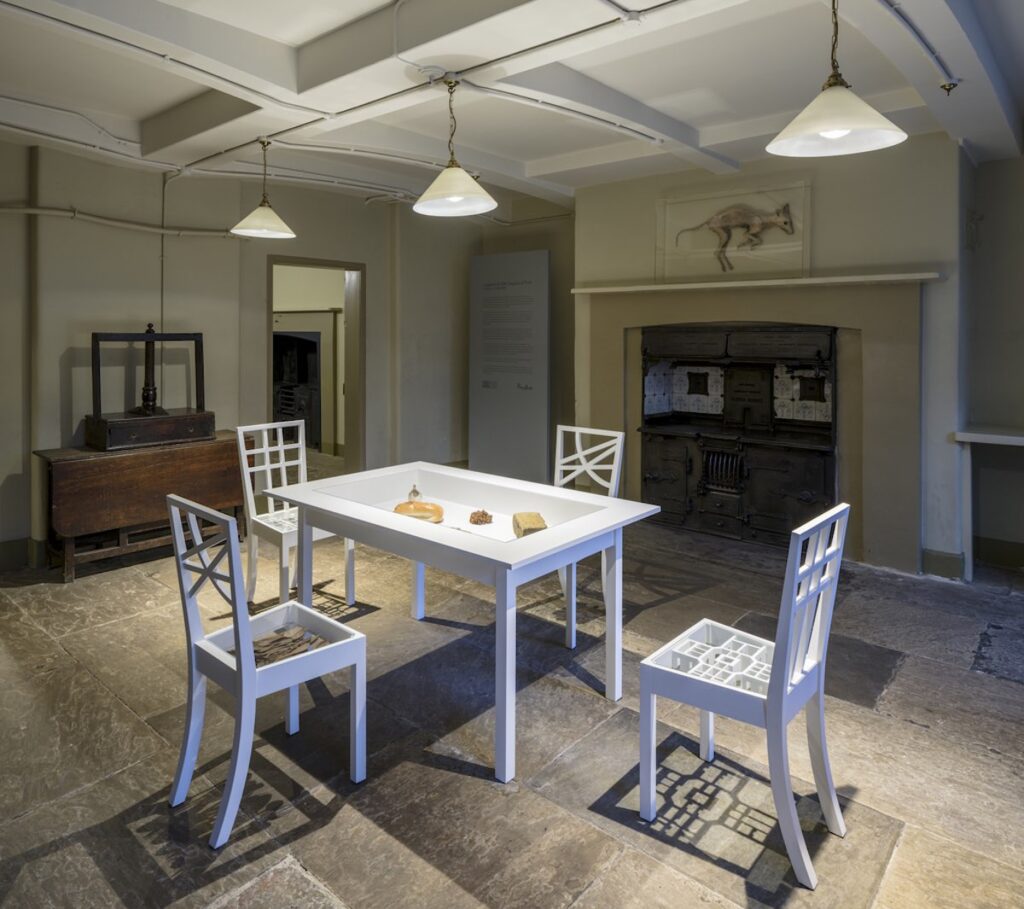
In 2020, Langlands & Bell, with Degrees of Truth, enter the museum at its most sensitive point: the word “truth.” In a house fixed by an Act of Parliament, where arrangement is prescribed and permanence takes the form of law, to speak of truth is immediately to speak of construction, of gradation, of choice. Their work—long concerned with the invisible architectures of power, with institutions, control, and systems that regulate bodies without appearing—does not merely “dialogue” with Soane: it reveals another layer within it. If Soane transformed architecture into autobiography, Langlands & Bell expose its systemic weave: the building as an epistemic machine, as a place where knowledge is ordered, classified, and displayed according to a precise will. Their intervention does not oppose the house; it sharpens it. And the question remains suspended, insistent yet never raised: is preservation truly innocent? is permanence ever neutral?
Two years later, in 2022, Anne-Marie Creamer, with Dear Friend, I Can No Longer Hear Your Voice, takes another path: not the system, but the ghost. She reconstructs—or rather brings back to the surface—a lost space linked to Eliza Soane. It is a gesture that adds no weight to the collection, but unsettles its fixity. In the Soane, where everything is meant to remain “forever” in place, moving image introduces what cannot be fixed: vibration, fragile duration, time passing as one looks. This is not archaeological reconstruction; it is evocation. It does not return a room as fact; it returns an absence as atmosphere. And the house, which seems built to hold light and objects, for a moment also holds a voice no longer there: mourning not as narrative, but as a quality of air.
Between these two poles—truth as construction and loss as resonance—other interventions emerge that work through the body, but without theatrical excess, without shock. POWER IN WOMAN, opened on 10 March 2016, brings Sarah Lucas into the house as a quiet deviation: white plaster figures, contracted female bodies, headless, folded, as if form were still negotiating its own possibility. Plaster is fragile, powdery, reversible: it does not compete with stone; it brushes against it. Among classical casts and archaeological fragments, these presences do not become statues; they become resistances. The power evoked by the title does not declare itself; it weighs. It is the weight of the body in space, a compressed energy that slightly unsettles the certainty of the canon. Soane built a house in which nothing exceeds; Lucas shows that form, even when it claims eternity, remains exposed to fracture.
In 2017, with Drawn from Life, Marc Quinn continues this line of thought, shifting it from the fragment to the risk of the whole. His female figures—white, light, held in unstable balance—are not ruins, not remnants: they are bodies at the moment before a fall or after a leap. If the ancient fragments gathered by Soane testify to what has endured, Quinn stages what might give way. It is a subtle but decisive difference: the museum, already compelling the gaze to slow, becomes a place where gravity is felt more intensely, because contemporary bodies do not imitate the eternity of marble—they expose muscular tension, the precarity of support, the possibility of collapse. And that precarity, within a house where everything is fixed, becomes a form of thought: it does not oppose permanence; it unsettles it from within.
And then there is the intervention that chooses to be neither body nor image, but proximity between times. Neighbours in Space and Time (2022–2023) by Grafton Architects reads a contemporary building through Soanean principles—light, section, compression—not as citation, but as a quiet genealogy. Here the house is not backdrop; it is interlocutor. The contemporary does not enter to contradict, but to recognise that certain obsessions—held light, space as montage, the room as a mental device—do not belong to a single century. They persist through returns, through unexpected affinities.
The line that runs through all of this is not a “programme,” but an ethics of gesture. The Sir John Soane’s Museum does not ask the present to bring novelty; it asks for precision. It asks not for works that fill, but for interventions that recalibrate. Here, insertion succeeds not by adding volume, but by introducing a measured unease—a doubt about truth, a room returning as ghost, a body that might fall, a threshold that sounds, a neighbour crossing time.
And so the museum stays what it has always been: not a container of the past, but an organism that compels the present to become attentive. Not to occupy. Not to consume. But to remain long enough to sense that, in this house, even the future—if it arrives—arrives slowly.
It is not quite accurate to say that the Sir John Soane’s Museum preserves the past. It arranges it. It draws it close to something else. It forces it into coexistence.
Moving through the rooms, one understands that nothing is ever truly isolated: a sarcophagus enters into dialogue with a mirror, a cast with a miniature, a ruin with a model. Periods do not follow one another; they brush against each other. And in that contact, they produce a quiet tension, as if time were still a malleable substance.
Soane arranged everything as if it were meant to remain. He did so by law. And yet what appears fixed vibrates slightly, because every gaze reactivates distances, recomposes relations, alters the balance. The house does not hold time still; it stages it as it passes.
Light continues to descend from above, regulated, calibrated. It illuminates not to reveal, but to make shadow more visible. It is a light that offers no consolation, only precision. When one steps back outside and the geometry of Lincoln’s Inn Fields resumes its severe order, something has shifted. Not in the city. In the way it is seen. The exception is not inside the house; it is in the gaze that leaves it.
Perhaps this is the final paradox: permanence is not immobility, but intensification. What is fixed with such insistence does not crystallise; it charges. Duration is not the opposite of movement; it is its concentration. In the Soane, time is not denied; it is condensed. And in that condensation, it produces a form of clarity.
Perhaps memory is not what remains, but what alters the distance between things.
And the museum, then, is not a refuge against oblivion.
It is an exercise in attention.