Text by Elissa Vinh —
Below street level, in the subterranean gallery space of Fondazione Giuliani, Choreodrome marks Minh Lan Tran’s (Hong Kong, 1997) inaugural showing within an Italian institution. Like the ruins of Ancient Rome buried beneath the city we know today, the cavernous interiors of the exhibition become a space where Tran deposits traces, staging a constant tension between proximity and distance. Throughout, raw and visceral interventions stage the haptic knowledge of materials, their vibrational emissions reaching beyond the visual field and into felt experience.
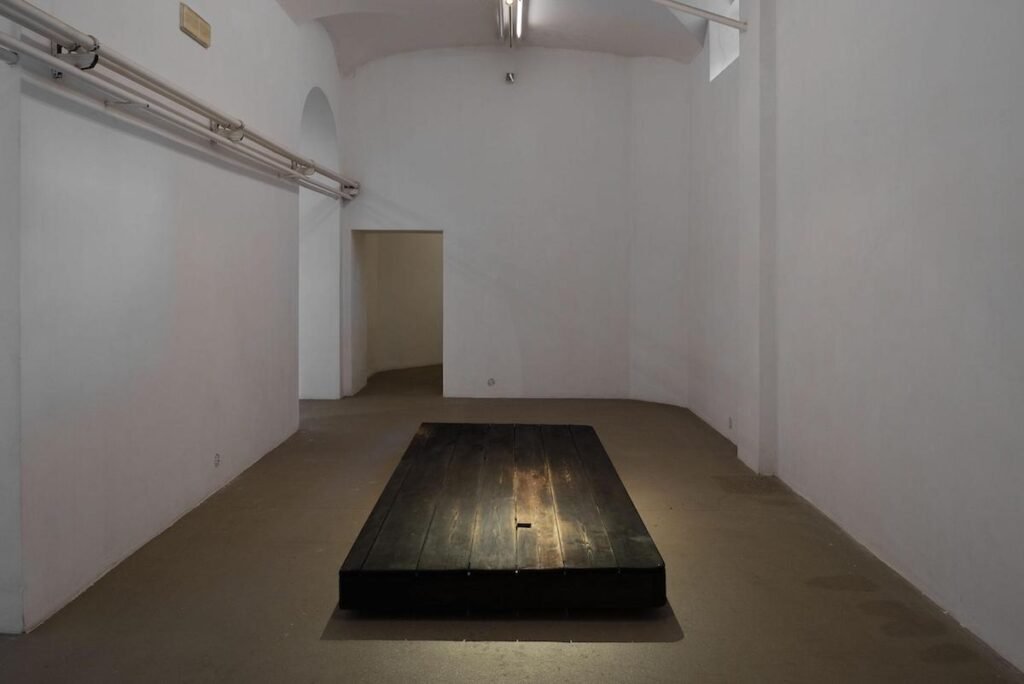
In dim lighting, Unresolved Catharsis I (2026), a rectangular platform saturated with layers of sumi ink opens the show. The wood staining is not uniform as discolouration appears where the texture of grain becomes more noticeable. Throughout the exhibition, there are other re-worked elements originating from Mekane, the workshop founded by the Italian theatre designer Riccardo Buzzanca. This revised archive of theatrical objects invites the temporality of performance in, defusing the tension between fiction and reality, art and its audience. As the exhibition works across these polarities, it becomes a space of in-betweenness, a portal where movement occurs, where exchanges are possible. The incarnated fourth wall no longer stands so rigid and boundaries become traversable.
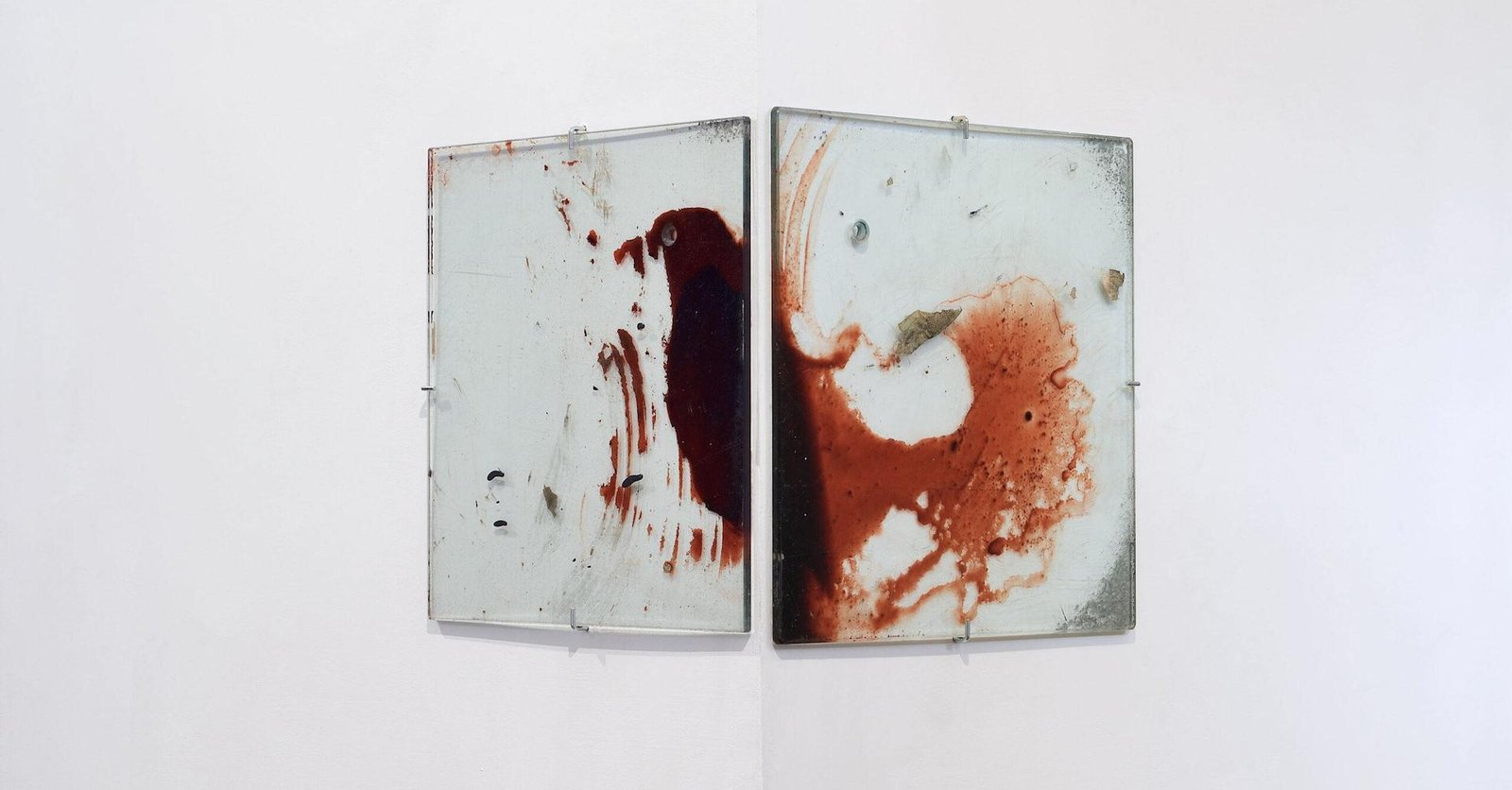
At a turn, the visitor walks in between two works facing each other on diagonally opposite corners. In the interior corner appears Unresolved Catharsis II (2026), two wooden panels layered with sumi ink lining the wall. The texture of the wood reveals circular and curved patterns reminiscent of dancing silhouettes, as if it were remembering shadows cast by human figures. Directly across, constituting the work Split (2026), are two square glass plates stained with sanguineous red ink. Each one is perforated at corresponding points, as if pierced by a high-velocity projectile, yet without the radiating cracks a conchoidal fracture would leave from the energy transfer of such impact. Up close, the glass surface evokes a microscope slide on which the variation in the density of the ink can be observed, ranging from an opaque deep red to a more washed-out tone. The visual dialogue between the two panels of each work is reiterated in their opposing placement, creating a tension that encompasses notions of exteriority and interiority. In between the two works, the visitor stands in the midst of a violent puncture which recalls rubber tapping, a process during which latex is extracted through a groove sliced into the bark to allow the milky sap to drip down into a vessel. This reference to colonial modes of ecological extraction and human exploitation in French Indochinese rubber plantations becomes particularly prominent in Tran’s use of latex as a canvas.
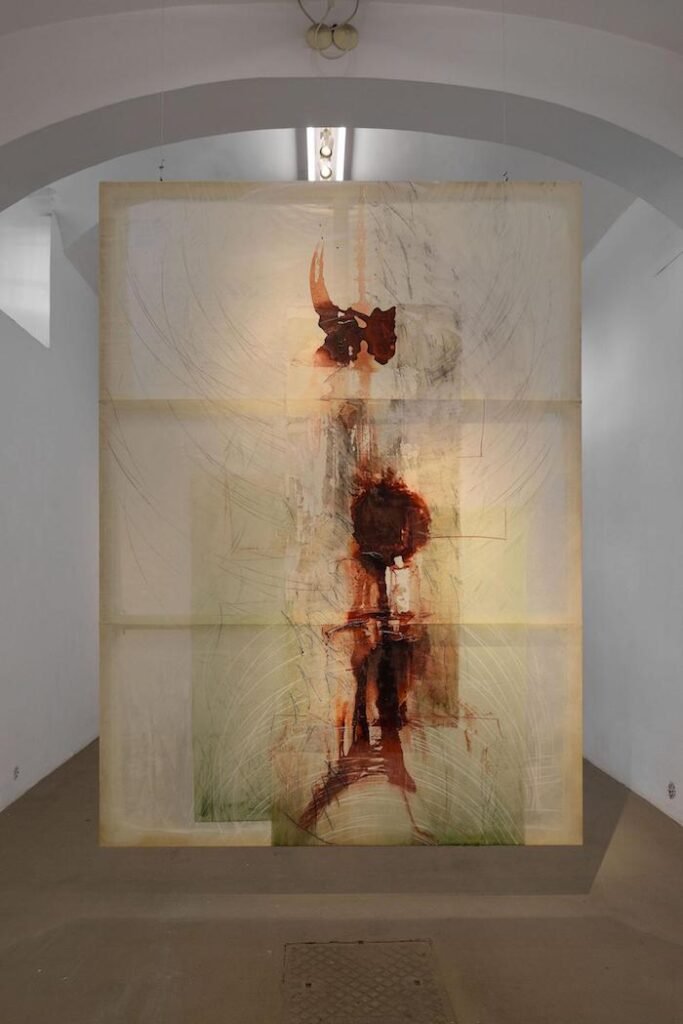
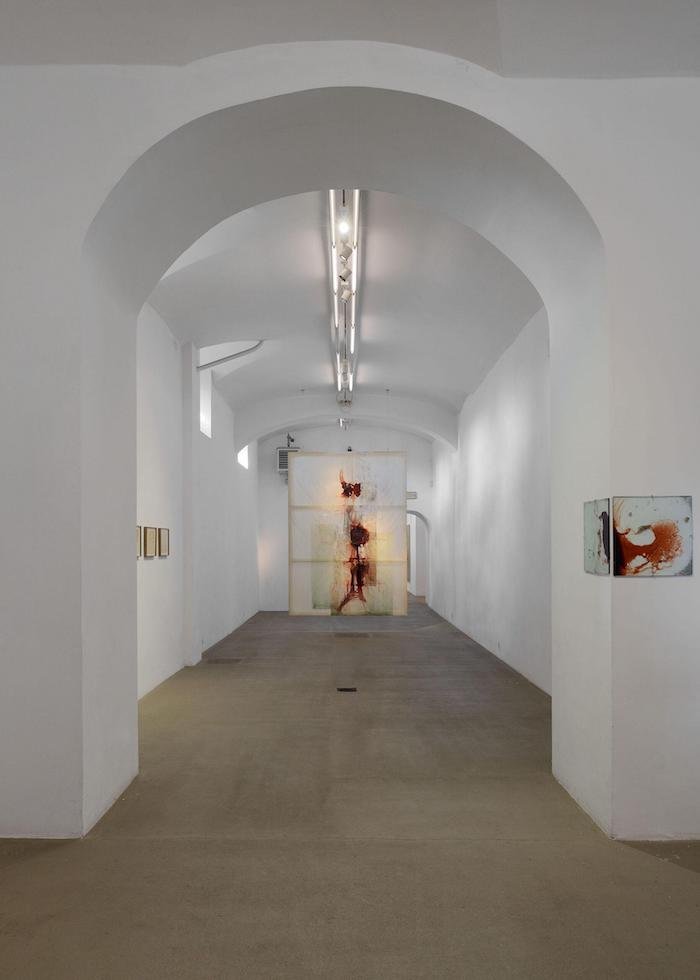
Beyond the arch that follows, a large painted latex work floats between the ceiling and the floor. The composition of Consciousness Transference, IV (2026), is divided in a tripartite arrangement as the latex is stapled together, creating visual segmentation. Trapped in the folds of the material, the staples disappear but the regularity of their indentations runs horizontally across the surface like stitching. The translucence of the stretched latex canvas holds the marks of abstract signs appearing to be numbers on both the front and the back. A red stain towards the top re-inscribes the shapes present in The (O)pening of a Heart 2 – The (O)pening of a Heart 6 (2026), a series of oil on paper works transcribing hand imprints. There is a certain kinetic energy to the painting, where gestural marks almost veer into writing without settling into legibility.
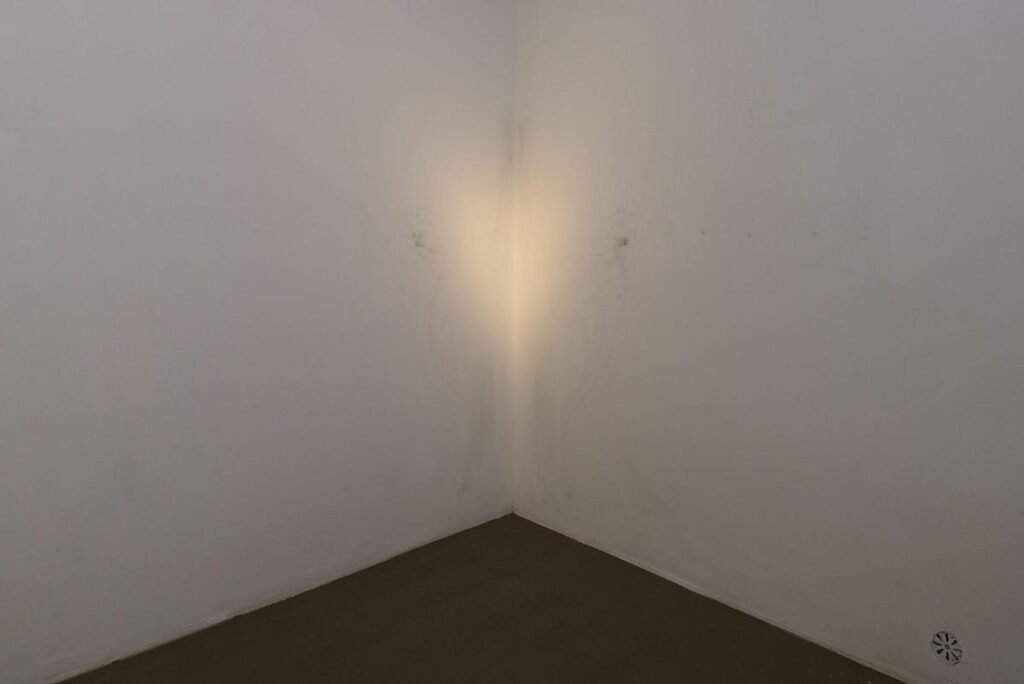
In the corner behind the latex centrepiece, the lighting suffuses a soft glow that seems to emanate from a faintly traced figure. The aura it radiates vivifies the remnant of a performed movement. Before the opening of the show, the artist, whose hands were still imbued with ink, had danced in the space accidentally leaving an imprint onto the wall. It is faint, and it could easily go unnoticed considering it is not on the exhibition’s paper copy of the list of works. Walking past this remnant of a presence invites reflection on the traces a body leaves in passing. As the afternoon gave way to the early evening, the shadows cast by the clerestory windows became more pronounced across the rooms, letting in fleeting silhouettes of passersby in the streets above. These lingering light traces created another layer of passage and presence, an addition to the ones already on display.
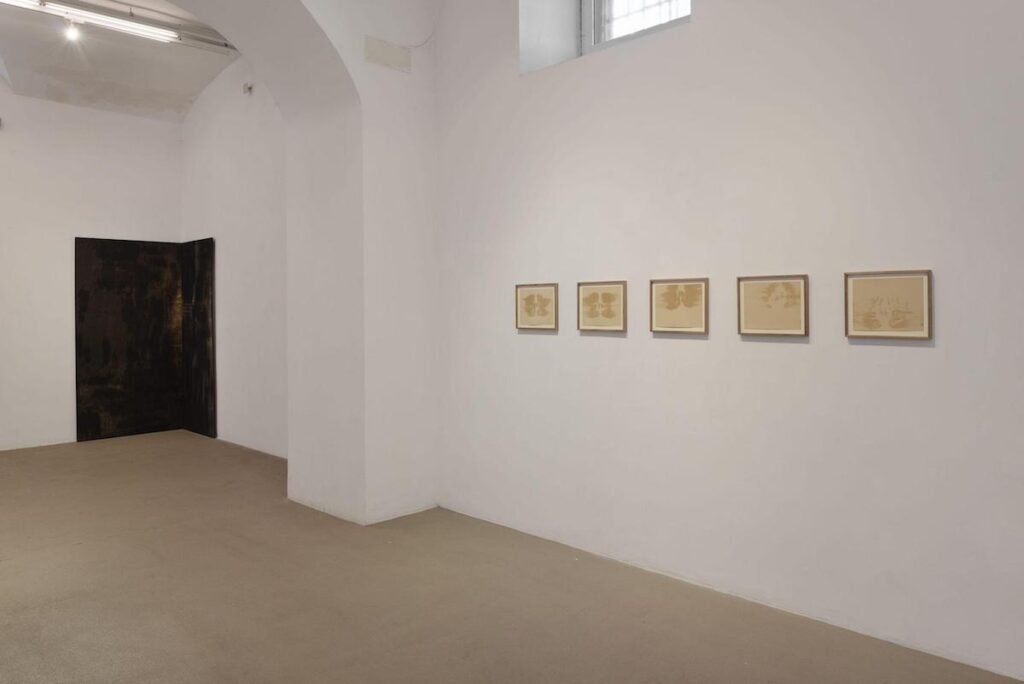
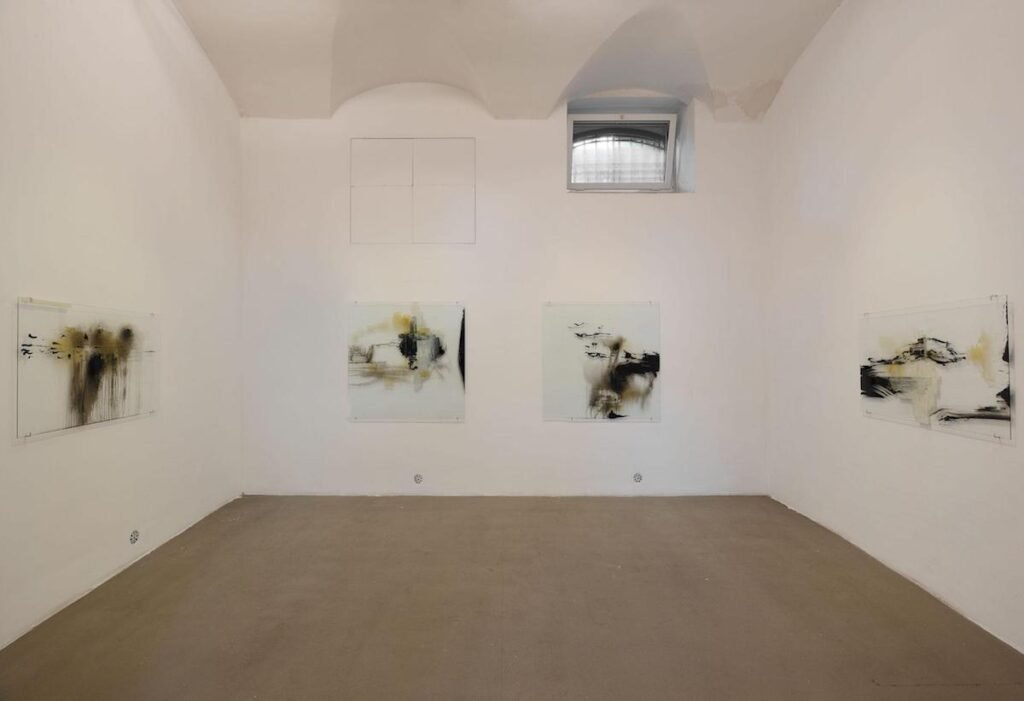
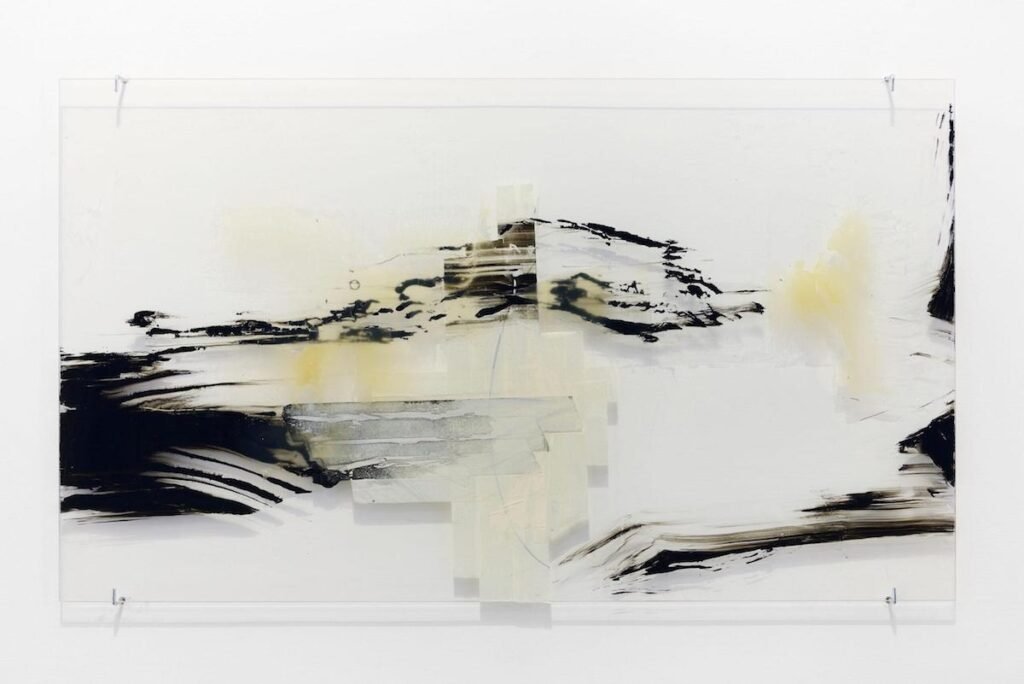
In another room, the visitor becomes surrounded by a display of four glass panels which appear to magnify the composition on their surface. In these studies, the clear medium suggests a certain hypervisibility in comparison to the more opaque materials used in the show. Nonetheless, a sense of ambiguity still emerges as the transparent quality of the glass ironically blurs the dimensional distinctions between the foreground and the background, the front and the back of the work. In Fourth Wall Study, 4 (2026), framed by smeared ink stains, layers of tape on the back of the glass panel create a cross like shape facing the wall. Front on, lithium grease coats the glass panel that separates it from the tacky underside of the tape. The layered composition turns illusory as the visitor is positioned against a thick ointment beneath an adhesive bandage.
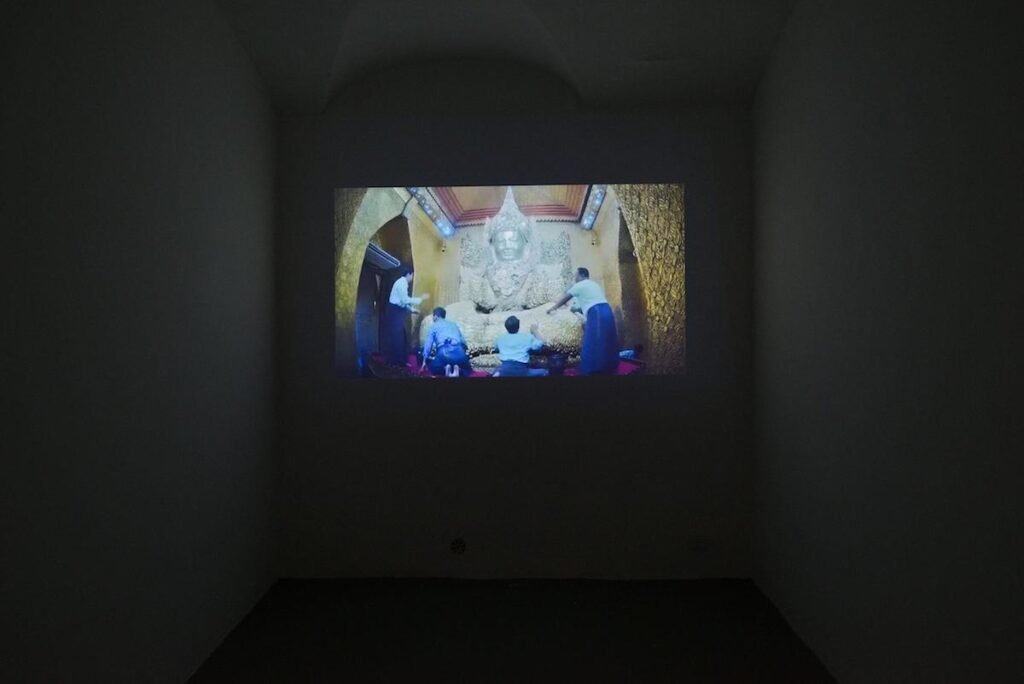
The show culminates in a spatial impasse where the video work CCTC Earth (2026) is projected onto a blank wall. The selection of camera surveillance footage witnesses the impact of earthquakes in a fish market in Thailand, a keirin racetrack in Japan and Mahamuni Pagoda in Myanmar. On the video recordings, the water in the fish tanks begins to sway, cyclists in their colourful jerseys walk away from their bikes, the digital display of rankings of the race glitches, devotees suddenly stop applying gold leaf on the Buddha to exit the scene, and the architectural structure of the Pagoda collapses into a cloud of dust that obscures the camera. The impression left by the footage is not just the tremor itself, but its interruption of the quotidian, the fragility of the everyday, a frame that fills with dust and refuses to clear.
There is an established continuity operating in Choreodrome as it explores the tension between transparency and opacity, distance and proximity, terms that intersect rather than resist one another. As these seemingly oppositional points converge in layered works, contrasts are not set up against each other but together in a dynamic manner. This artistic approach continues to evolve in Tran’s practice, extending its sensibility to convergence across different mediums.
Cover: Minh Lan Tran, Split, 2026. Photo Roberto Apa, courtesy of the Artist and Galerie Balice Hertling, Paris.