English text below —
5 Works
“Le nostre identità non si appellano più all’identico.”
(trad. Enrica Restori, Quodlibet, Macerata, 2007)
— Édouard Glissant, Poetica della relazione
Venezia è una città che galleggia sopra ciò che rimuove. Ogni pietra poggia su una sottrazione, ogni approdo nasconde una frattura, ogni facciata riflette il lento lavoro dell’acqua contro la materia. Ma esiste anche un’altra Venezia, meno visibile, che non appartiene né alla cartolina né alla rovina romantica: una Venezia di lavanderie industriali, di lenzuola consumate, di cooperative, di isole interdette, di pontili provvisori, di cucine collettive, di donne detenute che infilano perline in silenzio. Una città fatta non di monumenti, ma di sistemi di circolazione. Non di immagini, ma di attriti. Poveglia, ad esempio, non è soltanto l’isola “maledetta” che le leggende contemporanee amano trasformare in teatro gotico. Prima ancora di diventare un luogo di fantasmi, è stata soprattutto un dispositivo di separazione. Un’isola costruita per trattenere ciò che la città non voleva vedere: contagio, febbre, quarantena, eccedenza umana.
Nella laguna veneziana, ogni isola sembra incarnare una funzione simbolica precisa: San Michele custodisce i morti, Murano il fuoco e il vetro, Burano il colore e il lavoro domestico. Ogni isola custodiva una funzione invisibile, come se la laguna avesse costruito nei secoli una propria anatomia di filtri, quarantene e soglie attraverso cui Venezia ha tentato di proteggere il proprio corpo fragile dall’esterno e da sé stessa. Poveglia custodisce, invece, l’interruzione. È un’isola-soglia. Un luogo dove il corpo sociale veniva sospeso in uno stato ambiguo: né dentro né fuori dalla città.
Per secoli Venezia ha usato la laguna come un sistema immunitario. Le isole non erano periferie, ma filtri. Poveglia accoglieva i sospetti di peste, le merci contaminate, le attese obbligate. In questo senso è una delle architetture più radicali mai concepite dalla Serenissima: non un monumento alla gloria, ma alla distanza. Una geografia dell’isolamento trasformata in paesaggio. E forse è proprio questo che oggi continua a inquietare. Non le presunte apparizioni, ma il fatto che l’isola conservi ancora una memoria amministrativa della paura. Le sue rovine sembrano dire che ogni civiltà produce luoghi invisibili dove deposita ciò che non riesce a integrare.
La vegetazione che oggi invade gli edifici — fichi selvatici, edera, salicornia, erbe saline — non cancella quella storia: la ricopre lentamente, come fa la laguna con tutto. A Venezia nulla scompare davvero. Affonda appena sotto la superficie.
C’è qualcosa di profondamente veneziano in questo. La città più celebrata al mondo ha sempre costruito la propria bellezza accanto ai propri sistemi di esclusione. E Poveglia è forse il negativo fotografico di Venezia: non la facciata, ma il retro della luce. Persino il nome sembra consumato dalla laguna. L’ipotesi più diffusa lo fa derivare dal latino Popilia oppure Popiliae, forse collegato alla gens Popilia oppure alla presenza di pioppi (populus in latino). In questo caso, Poveglia sarebbe stata originariamente “l’isola dei pioppi”, o un luogo associato a una proprietà romana.
Ma esiste anche una deriva linguistica veneziana molto più sottile: nel passaggio orale e lagunare dei secoli, Popilia avrebbe lentamente perso consistenza fonetica, diventando Povegia, poi Poveglia. È un nome che sembra consumato dall’acqua, levigato dal sale e dal dialetto. E c’è qualcosa di quasi simbolico in questo slittamento. Perché Poveglia è proprio un luogo dove le forme si degradano lentamente senza scomparire del tutto. Anche il nome sembra aver attraversato una quarantena linguistica: isolato, corroso, trasformato dal tempo. In alcune letture più poetiche — non filologiche, ma evocative — il suono stesso di “Poveglia” sembra contenere una specie di oscillazione acquatica: qualcosa che affiora e subito si ritrae. Un nome senza durezza monumentale. Più vicino a una deriva che a una fondazione.
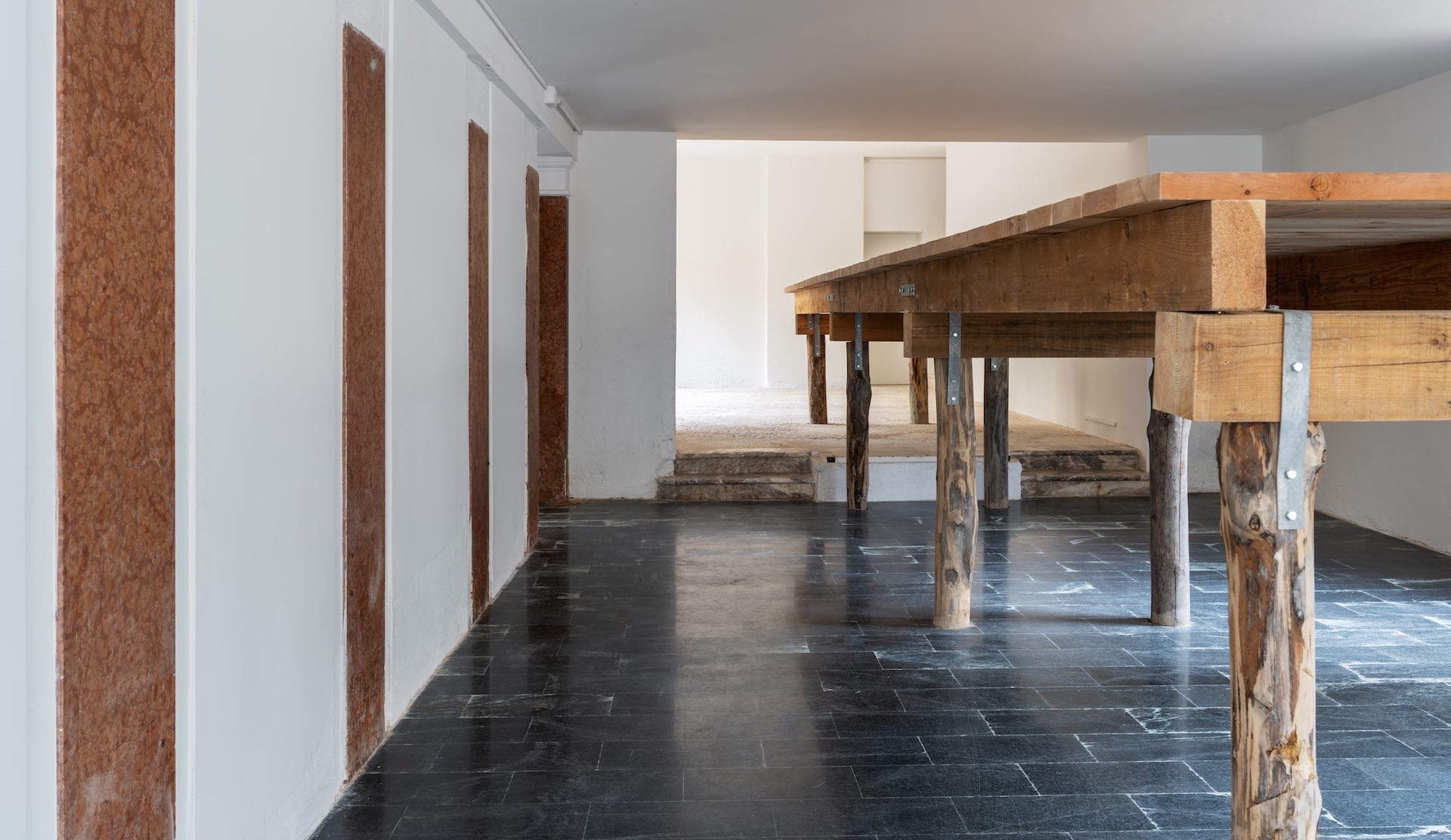
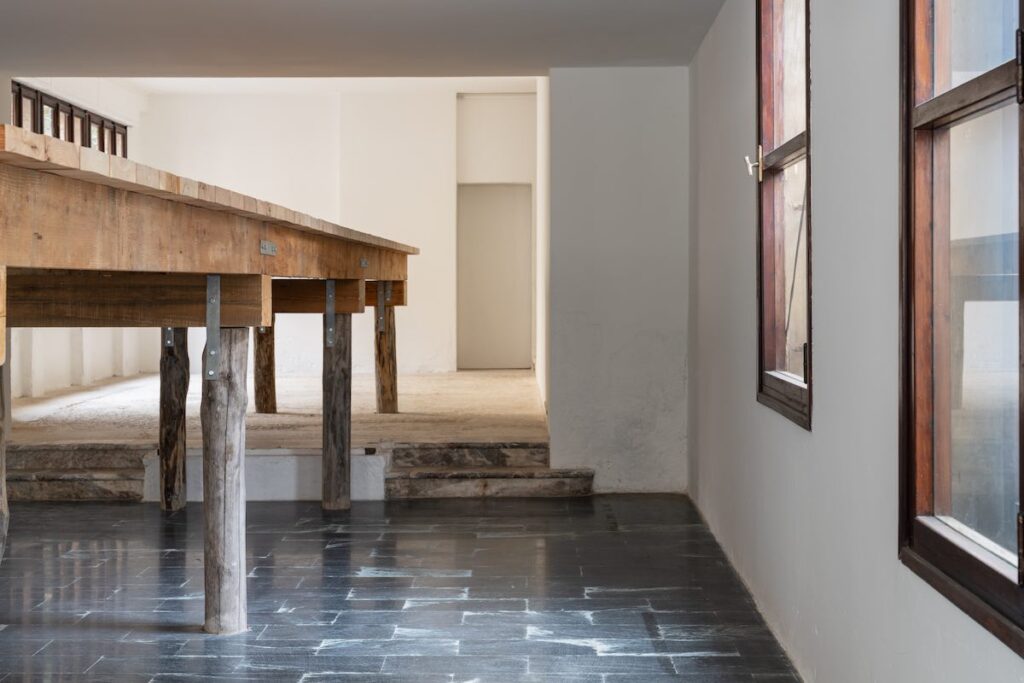
In questo senso, il pontile costruito da Lydia Ourahmane per l’isola non appare semplicemente come un’infrastruttura funzionale, ma come la riattivazione silenziosa di una soglia storica: un accesso verso un luogo che continua a interrogare il rapporto tra esclusione, manutenzione e sopravvivenza collettiva.
È dentro questa geografia porosa che si muove 5 Works, la mostra di Lydia Ourahmane alla Nicoletta Fiorucci Foundation, curata da Polly Staple. Più che un’esposizione, sembra un campo di pressione. Un organismo disseminato nello spazio veneziano prima ancora che nelle stanze della Fondazione. Le opere non arrivano semplicemente dentro il luogo: emergono da esso, come se fossero state lentamente assorbite dall’umidità della laguna, dal lavoro umano che la mantiene in vita, dalle economie invisibili che ne sostengono la sopravvivenza quotidiana. Ma ciò che rende questo processo particolarmente radicale è il rifiuto dell’estrazione. Davanti a Poveglia — isola che per decenni ha resistito alla trasformazione in enclave privata e alla mercificazione turistica della laguna — Ourahmane evita deliberatamente il gesto, quasi automatico nell’arte contemporanea, di prelevare materiali, immagini o rovine per trasformarli in contenuto estetico. Come se alcuni luoghi conservassero il diritto a non diventare completamente trasparenti, a sottrarsi alla piena leggibilità dello sguardo. Il pontile nasce invece come forma di restituzione: non qualcosa sottratto all’isola, ma qualcosa lasciato ad essa. Un’infrastruttura destinata a continuare a esistere anche dopo la mostra. Qui l’opera non nasce da un gesto di appropriazione, non sottrae materia al luogo: vi rimane implicata.
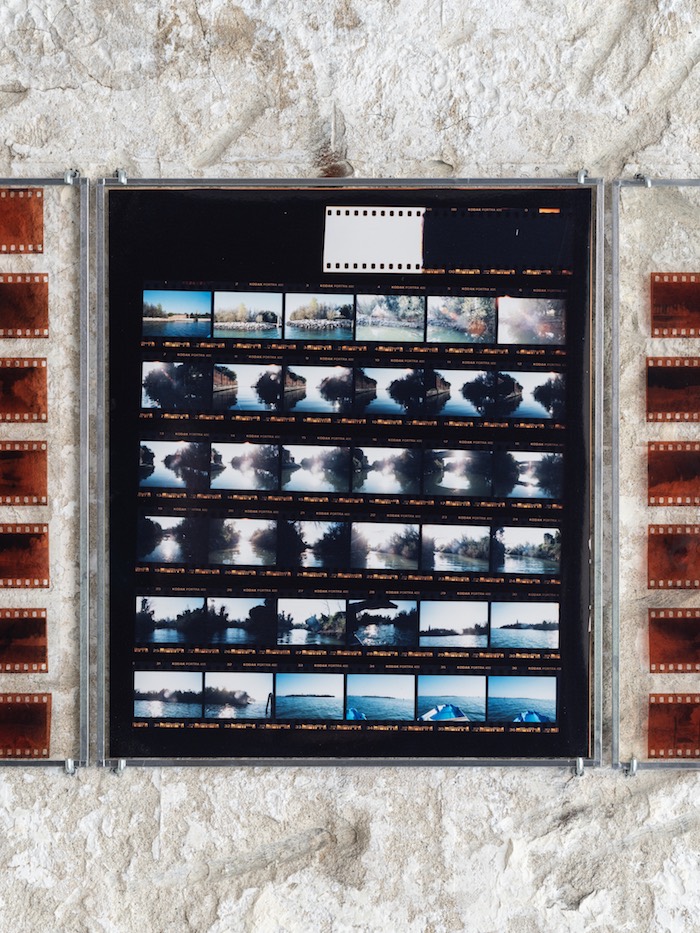
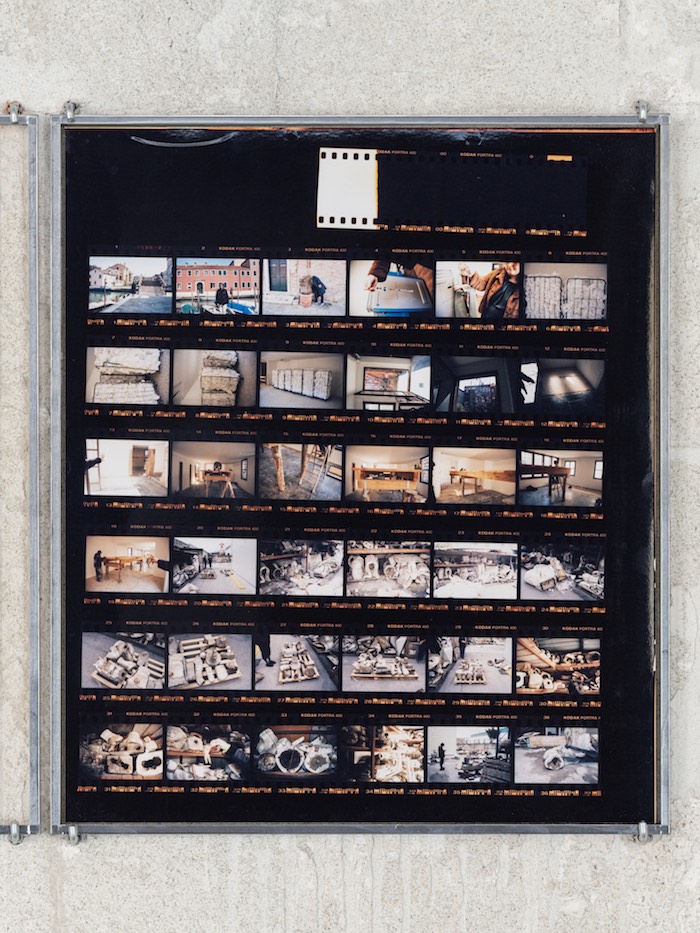
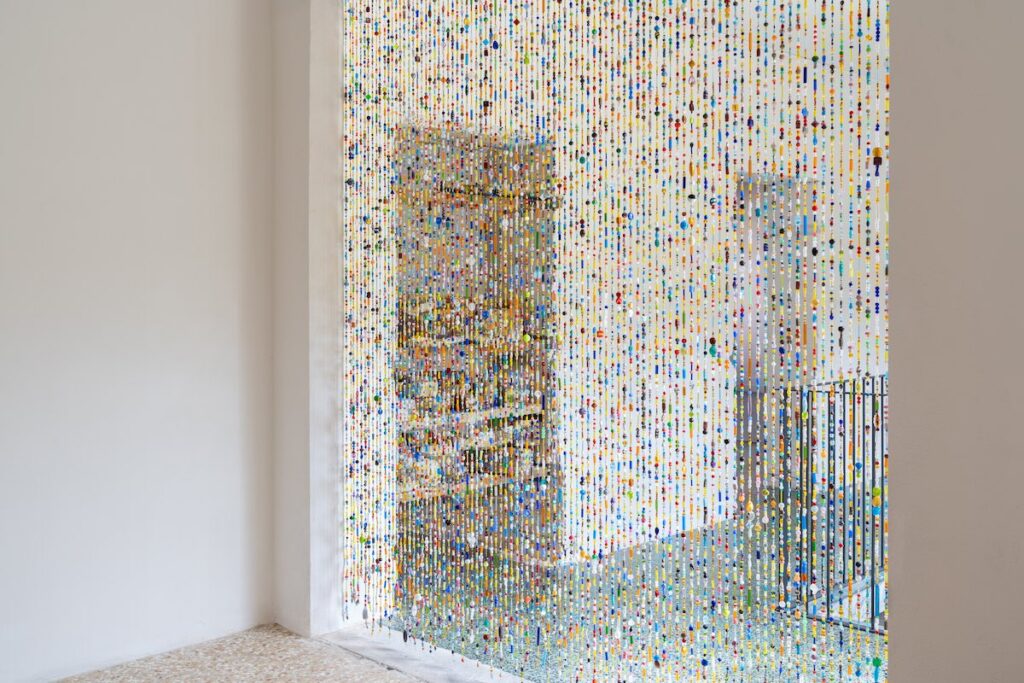
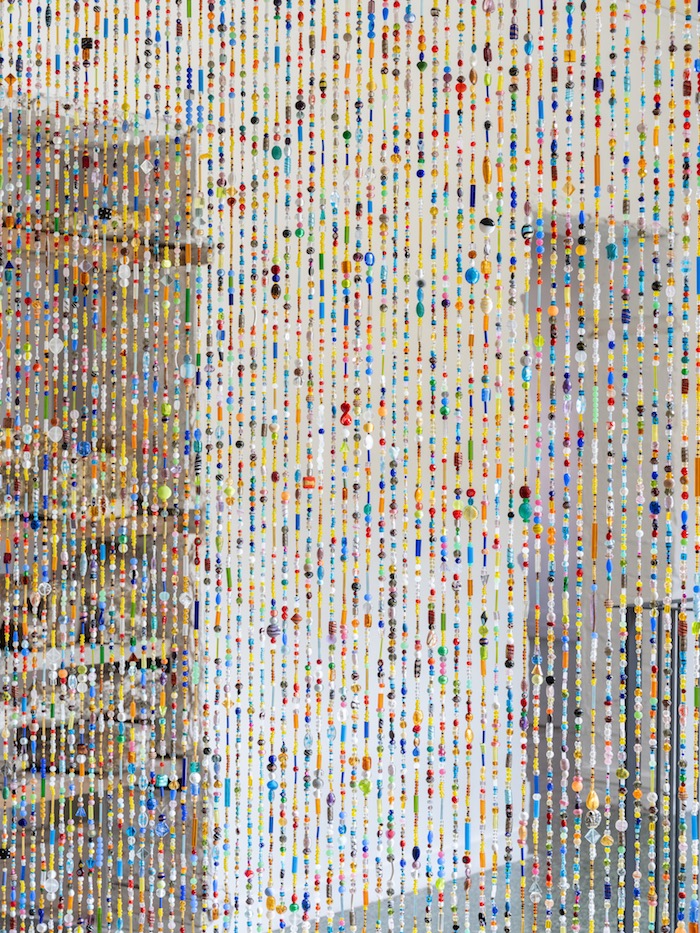
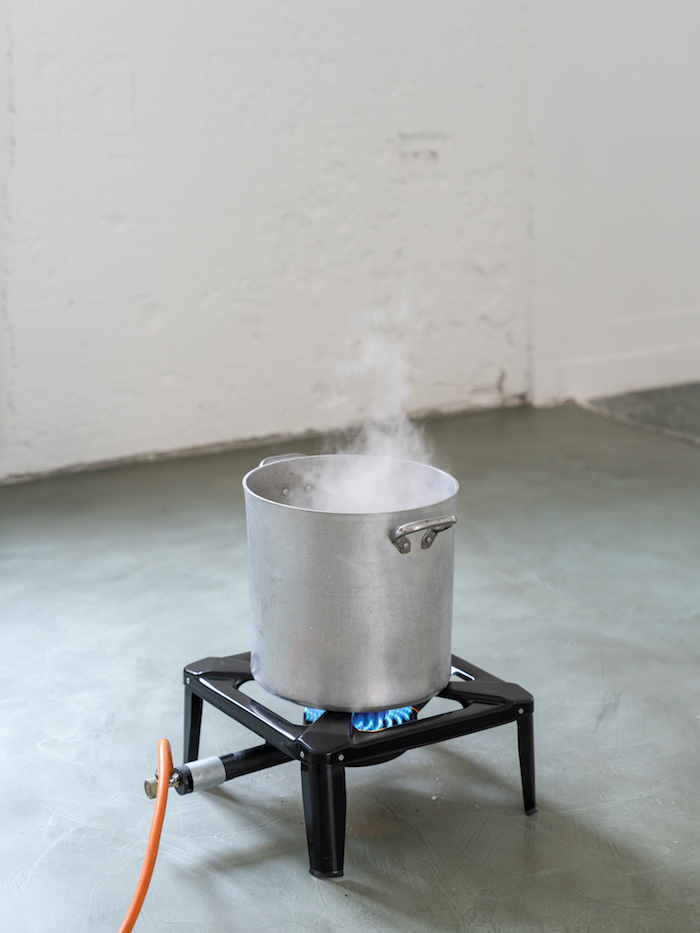
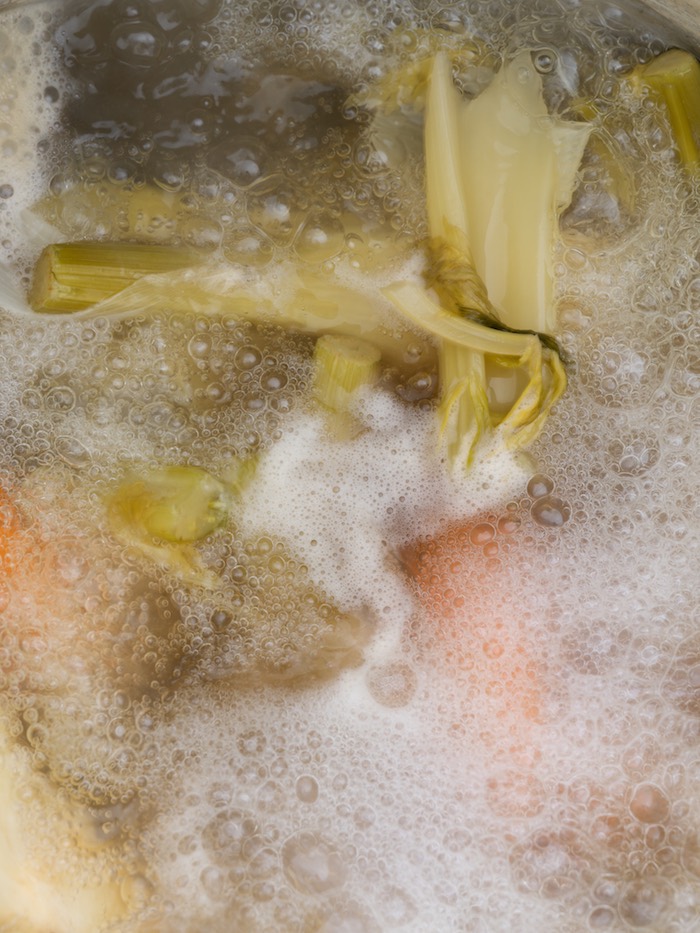
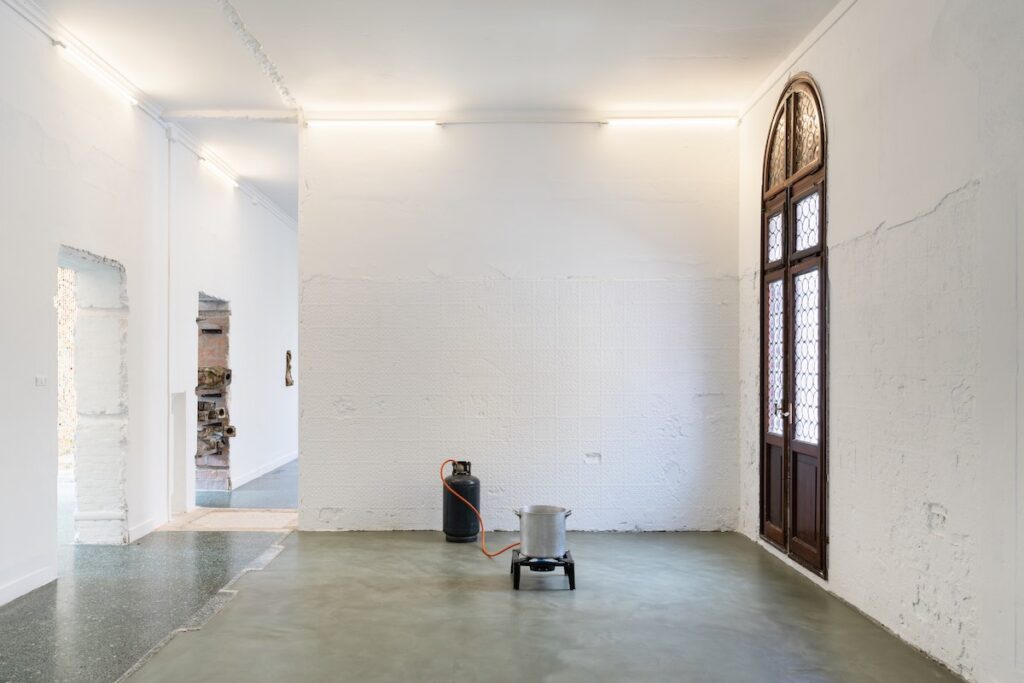
Polly Staple legge il lavoro di Ourahmane non come un insieme di oggetti autonomi, ma come una rete di negoziazioni materiali. Tutto qui sembra transitare da uno stato all’altro: il pontile costruito per l’isola di Poveglia è simultaneamente scultura e infrastruttura; le lenzuola dismesse degli hotel diventano accumulazione scultorea e archivio umano; una tenda di murrine oscilla tra memoria domestica mediterranea e lavoro carcerario. Non occupa lo spazio: lo tiene in una sospensione leggera, come fanno certi veli mossi dal respiro dell’acqua. Ogni murrina porta il tempo paziente di mani detenute, mani che hanno infilato grani di vetro uno dopo l’altro, senza fretta, lasciando passare nelle dita giorni interi, silenzi, ore tutte uguali. Il gesto ripetuto ha consumato il tempo fino a renderlo quasi trasparente. La luce attraversa la tenda e si spezza in piccole febbri di colore, ma non riesce mai a prenderla del tutto. Come la laguna, anche questa materia sembra custodire qualcosa che continua a sottrarsi. La pentola resta sul fuoco come una veglia. Il brodo tira fuori lentamente l’odore delle cose povere: ossa, erbe e acqua che hanno imparato la pazienza. Il vapore sale piano, appanna l’aria, entra nella memoria prima ancora che nello sguardo. È un odore che conosce le case strette, le cucine dove il tempo si misura aspettando che qualcosa arrivi a nutrire qualcuno. Non passa dagli occhi: entra direttamente nel corpo. Dentro quel respiro caldo della materia rimane qualcosa di umano che non si lascia consumare: una cura senza voce, ostinata, che continua a stare al mondo.
Un calco conserva l’assenza dell’oggetto che un tempo conteneva: un angelo che non discende, rimane. Rimane come una pressione minima dentro la materia, come il segno lasciato da qualcosa che è già passato oltre. Nulla si lascia fissare definitivamente. La materia non coincide mai con sé stessa. Migra, slitta, cambia statuto.
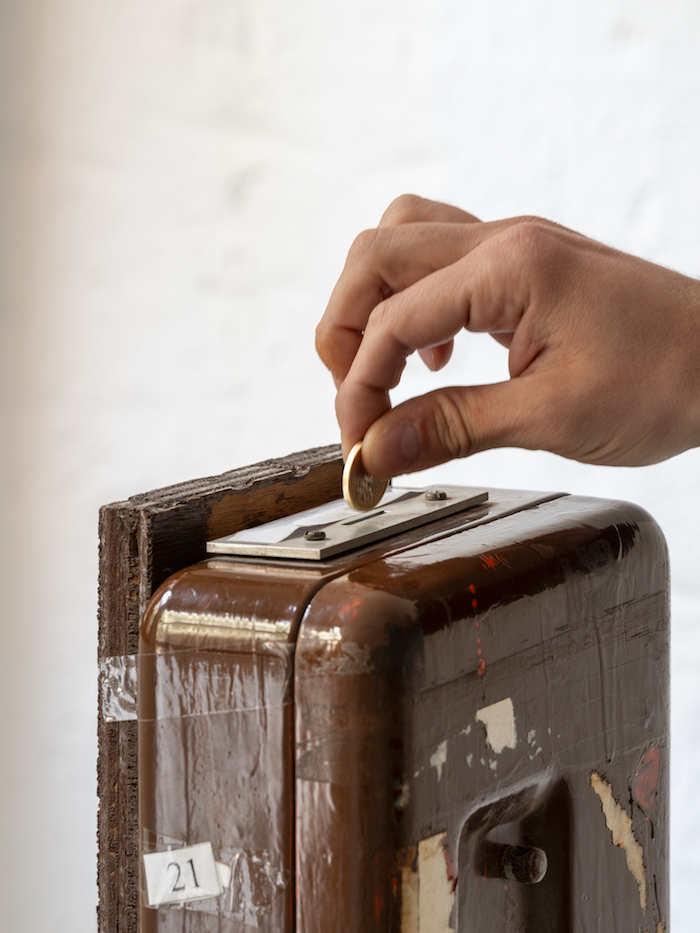
Forse è proprio questo che rende il progetto così distante da una certa estetica della Biennale, spesso ossessionata dall’immagine immediata, dall’effetto, dalla velocità del consumo visivo. Qui invece tutto procede attraverso trasferimenti lenti, processi di usura, sistemi di manutenzione, economie residuali. Persino la luce, a Venezia, sembra obbedire a questa logica di attivazione e scambio. Nella chiesa di San Giovanni Crisostomo, un antico dispositivo a monete illumina temporaneamente la pala di Bellini: la visione dura il tempo di un’offerta. Ourahmane trasferisce quel meccanismo all’interno della mostra, trasformando l’atto stesso del vedere in una soglia economica, rituale e percettiva. La luce non appare come qualcosa di dato, ma come una condizione intermittente, negoziata, quasi precaria. Le opere sembrano chiedere: cosa accade a un oggetto quando perde la propria funzione? Quando una città smette di appartenere ai suoi abitanti? Quando una forma continua a esistere anche dopo essere stata svuotata del proprio uso?
Nella conversazione che segue, Polly Staple attraversa il progetto seguendo le sue soglie più instabili: il rapporto tra arte e funzione, tra scultura e servizio pubblico, tra monumentalità e precarietà. Ma soprattutto emerge un’altra questione, più sotterranea: come lavorare in un luogo senza estrarlo? Come produrre una mostra senza consumare il territorio che la ospita? È una domanda rara oggi, in un sistema artistico fondato sulla mobilità rapida, sulla produzione continua, sulla trasformazione di ogni contesto in superficie disponibile.
Per questo 5 Works non parla semplicemente di Venezia. Ne assume la struttura profonda. Venezia è, da sempre, una città di mediazione: tra terra e acqua, tra commercio e rovina, tra apparizione e sparizione. Ogni cosa qui esiste in uno stato di equilibrio transitorio. Anche il visitatore, entrando nella mostra, sembra perdere la propria posizione stabile. Si muove come sott’acqua, davanti a un pontile collocato all’altezza degli occhi; attraversa stanze dove la luce pulsa come un organismo intermittente; incontra lenzuola che conservano ancora il fantasma dei corpi che le hanno attraversate. Non come memoria nostalgica, ma come persistenza materiale di ciò che continua a restare anche dopo la scomparsa. Come se ogni materiale trattenesse una carica residua: il contatto umano, l’usura, la pressione invisibile delle vite passate attraverso di esso.
E forse è proprio questo il nucleo più potente del lavoro di Ourahmane e della lettura curatoriale di Staple: comprendere che la materia non è mai inerte. Ogni oggetto trattiene relazioni, lavoro, memoria, attrito, violenza, desiderio. Come se la materia possedesse una propria ostinazione silenziosa, una capacità di continuare ad agire anche dopo essere stata scartata, consumata, dimenticata. Anche ciò che è stato dismesso conserva una voce. Anche ciò che sembra esausto conserva una temperatura residua. In laguna, nulla scompare davvero. Tutto si consuma lentamente dentro un’altra forma.
Forse è questo che Venezia insegna più radicalmente: nulla qui coincide mai del tutto con il proprio contorno. La laguna non separa la terra dall’acqua: le accompagna lentamente a somigliarsi. Ogni cosa scivola lentamente verso qualcos’altro: la pietra verso il sale, la luce verso l’acqua, la materia verso la deriva.
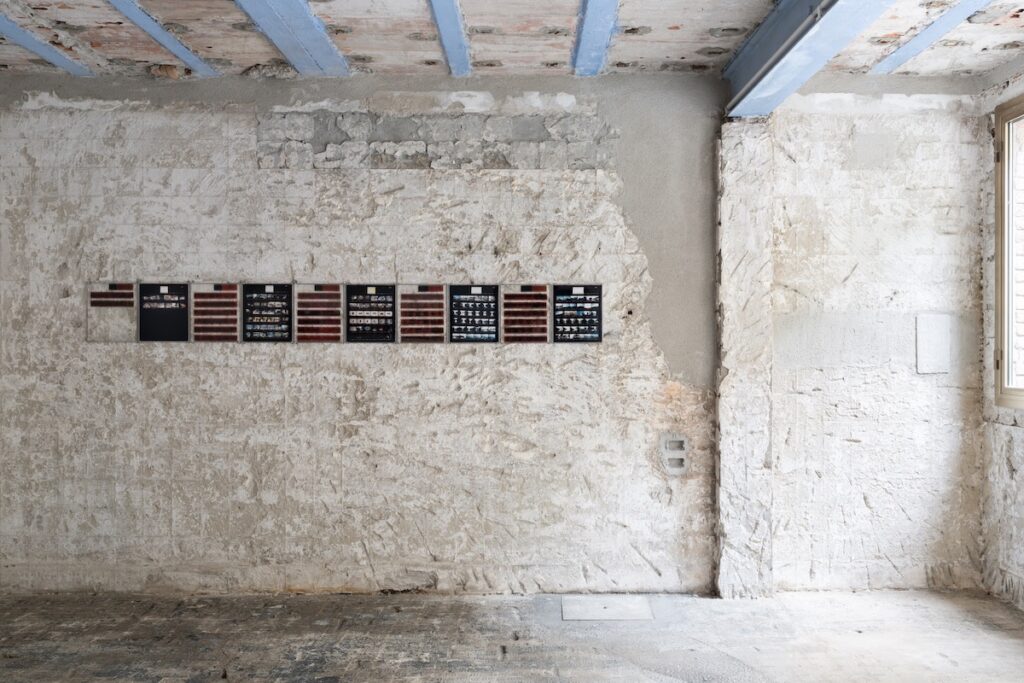
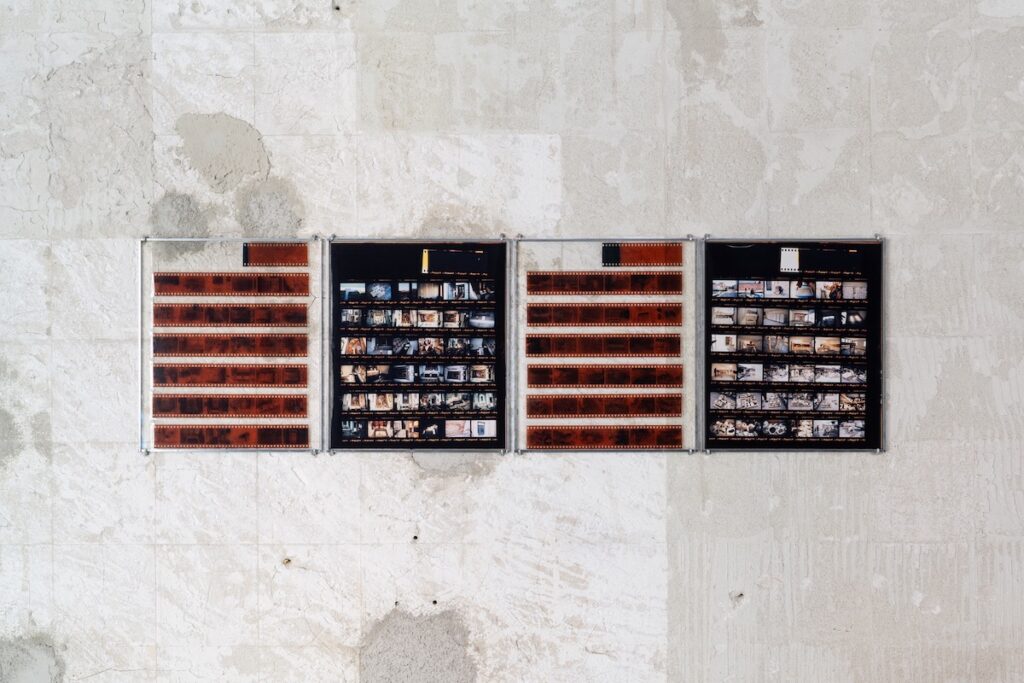
R.S. In 5 Works, molte delle opere sembrano oscillare tra scultura e infrastruttura — tra forma simbolica e funzione sociale reale. Come hai affrontato, come curatrice, questa soglia instabile in cui un’opera può operare simultaneamente come servizio pubblico, monumento e gesto politico?
P.S. Tutte le opere presenti in 5 Works nascono da collaborazioni, transazioni e negoziazioni con individui, organizzazioni e siti storici di Venezia. Nel mio lavoro di curatrice collaboro spesso in stretta relazione con gli artisti per realizzare nuove opere, mostre e pubblicazioni, con l’intento di ampliare la definizione stessa di ciò che l’arte contemporanea può essere. Per questo, lavorare in questo modo con Lydia Ourahmane, con i produttori e con i collaboratori non è stato insolito per me.
La vera collaborazione richiede tempo, cura e un grande investimento di energie; significa costruire fiducia e comprendere la posizione degli altri e ciò che per loro è in gioco. È una modalità etica di relazione che è inscritta nelle opere di Lydia, nel mio ruolo di curatrice e nella mostra stessa. Lydia è una persona straordinaria, capace di coinvolgere direttamente le persone. La mostra è il risultato diretto delle sue interazioni con persone e luoghi di Venezia, guidate da me e dall’ exhibition’s producer Giorgio Mastinu, che vive a Venezia. Come curatrice opero tra l’artista, il committente, i collaboratori e il pubblico.
Sono precisamente interessata a questo luogo — che tu descrivi molto bene come una “soglia instabile”. È uno spazio di potenzialità da cui lavorare come curatrice, ma anche uno spazio che l’opera può occupare e che il pubblico può attraversare. Questa soglia è un luogo del divenire, che resiste al consumo immediato e rende possibili molteplici punti di accesso per lo spettatore. E sì, per me questo è politico. All’interno di una lunga storia dell’arte, mi interessa esplorare quale possa essere la forma del nostro presente. Forse essa può essere localizzata proprio dentro questa soglia.
Per esempio, il pontile inizia la propria esistenza come opera d’arte all’interno della galleria e poi diventerà un pontile pienamente funzionante quando verrà trasferito a Poveglia. Questa duplicità — essere al tempo stesso non funzionale e funzionale, opera d’arte, monumento e infrastruttura pubblica — per me è estremamente potente. Lydia e io siamo entrambe interessate alla politica reale della vita quotidiana, così come a esplorare il modo in cui l’arte stessa viene valorizzata, prodotta, distribuita ed esposta.
RS Nel corso della mostra, Venezia appare meno come uno sfondo che come una materia sottoposta a pressione: turismo, lavoro, abbandono, manutenzione, economie invisibili. Hai concepito la mostra come un modo per reintrodurre attrito e densità sociale dentro un’immagine di Venezia ormai eccessivamente estetizzata?
P.S. Sì, assolutamente. Siamo tutti consapevoli della situazione di Venezia e di come la città venga percepita come in declino, esposta al turismo di massa e alla catastrofe ambientale. Lydia è precisamente interessata a questo attrito, ma vi lavora attraverso un approccio gentile e generoso. Questa non è soltanto una storia su Venezia, ma riguarda più ampiamente le sfide geopolitiche del mondo contemporaneo con cui tutti noi ci stiamo confrontando oggi.
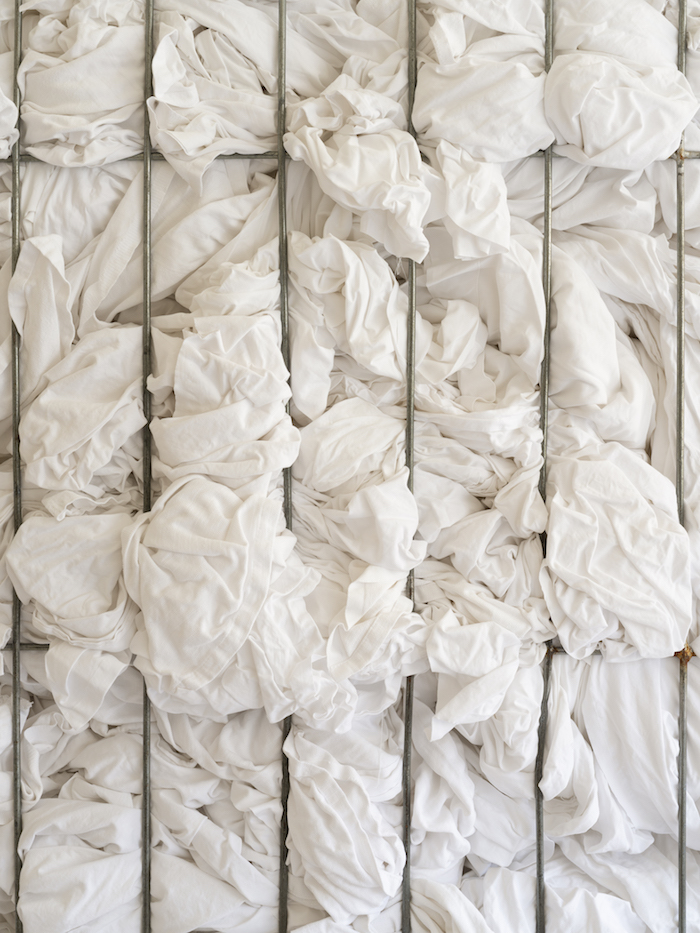
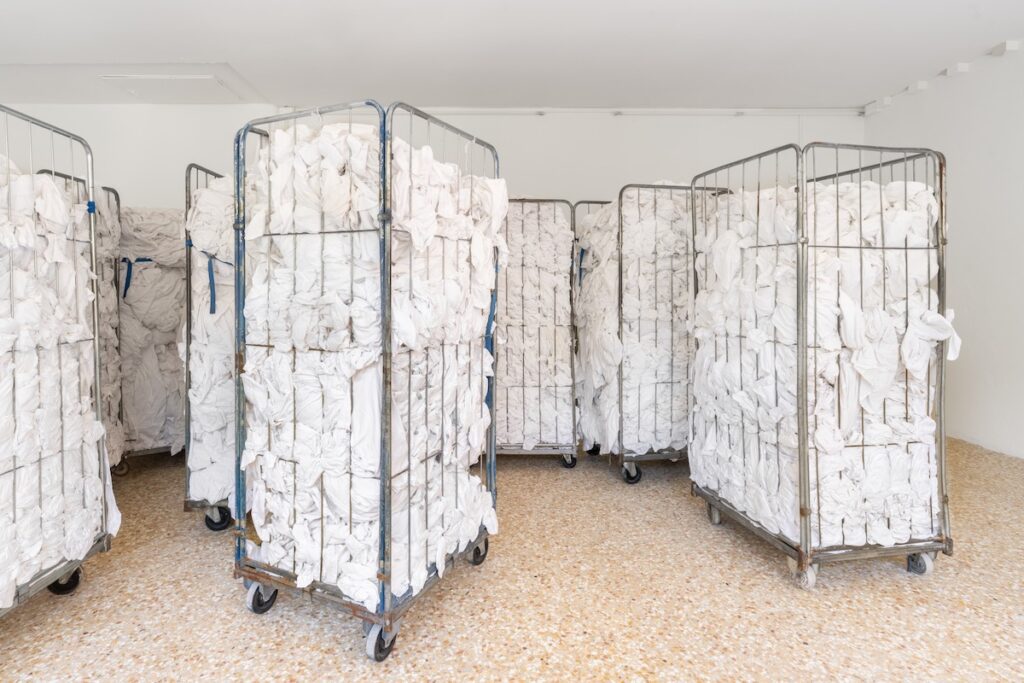
L’opera realizzata con le lenzuola, per esempio, comunica in modo estremamente efficace perché sì, parla del turismo di massa e dello spreco, ma riguarda anche l’intimità e la fragilità dei nostri corpi oppure, ancora, la scultura minimalista modernista e la sua eredità. L’opera comunica attraverso i propri materiali su molteplici livelli: simultaneamente politico, emotivo e storico-artistico.
RS La mostra mette ripetutamente in scena una tensione tra circolazione e sospensione: il pontile in attesa di essere trasferito a Poveglia, la biancheria d’albergo dismessa che entra nello spazio della scultura, la tenda di perline che oscilla tra memoria domestica e lavoro carcerario. Che ruolo ha avuto l’idea di “transito” nel tuo pensiero curatoriale?
P.S.Non sono sicura di pensare all’idea di “transito” in senso stretto, ma sono interessata al modo in cui il lavoro di Lydia Ourahmane opera sempre in uno stato di flusso. Fin dall’inizio discutevamo concetti come il vuoto, l’energia dormiente o contenuta, la trasformazione e l’alchimia. Tutto questo sembrava anche accordarsi — o forse provenire — dal contesto di Venezia, che è una città governata dalle maree. Si percepisce costantemente l’energia intensa di questa città — inclusi i suoi suoni e i suoi odori — e naturalmente la sua storia come centro di scambi commerciali.
La mostra è concepita come una serie di incontri con gli oggetti altamente carichi e in qualche modo performativi di Lydia. Tra le opere è stato volutamente lasciato molto spazio, per creare nello spettatore una sensazione di ricerca mentre attraversa l’edificio. Una coreografia della scoperta che, per me, è estremamente piacevole da abitare — o dentro la quale essere trattenuti — anche solo per un momento. Nel 2025 ho curato una mostra alla Tate Britain con l’artista Ed Atkins, composta da opere molto diverse, ma mi rendo conto ora che possedeva un ritmo e una sensibilità simili.
Ero sempre molto consapevole del fatto che il nostro pubblico sarebbe arrivato alla Nicoletta Fiorucci Foundation dopo aver visto così tante mostre e luoghi disseminati per Venezia. L’idea stessa di “esperienza” è diventata materiale con cui Lydia ha lavorato nell’allestimento della mostra: forse il senso di attesa del pubblico, le sue aspettative e il suo desiderio. Questo era importante quanto creare un ambiente calmo e contemplativo, o fare in modo che il giardino disponesse di sedute e diventasse un luogo in cui leggere il foglio di sala della mostra o semplicemente riposare.
Anche l’architettura della Fondazione è diventata un personaggio all’interno della mostra di Lydia. L’edificio è in qualche modo un enigma: una volta saliti al piano superiore, nella stanza delle lenzuola, per esempio, si perde il senso della propria posizione precisa, e questo permette di concentrarsi sulle esperienze che si stanno vivendo in quel momento. Non ci sono distrazioni.
R.S. Molte opere di Lydia Ourahmane sembrano abitate da forme di presenza latente — da ciò che resta invisibile pur continuando ad agire strutturalmente: fantasmi, materia scartata, oggetti esausti, violenza amministrativa, tracce intime. Come pensi che la mostra negozi il rapporto tra materialità e invisibilità?
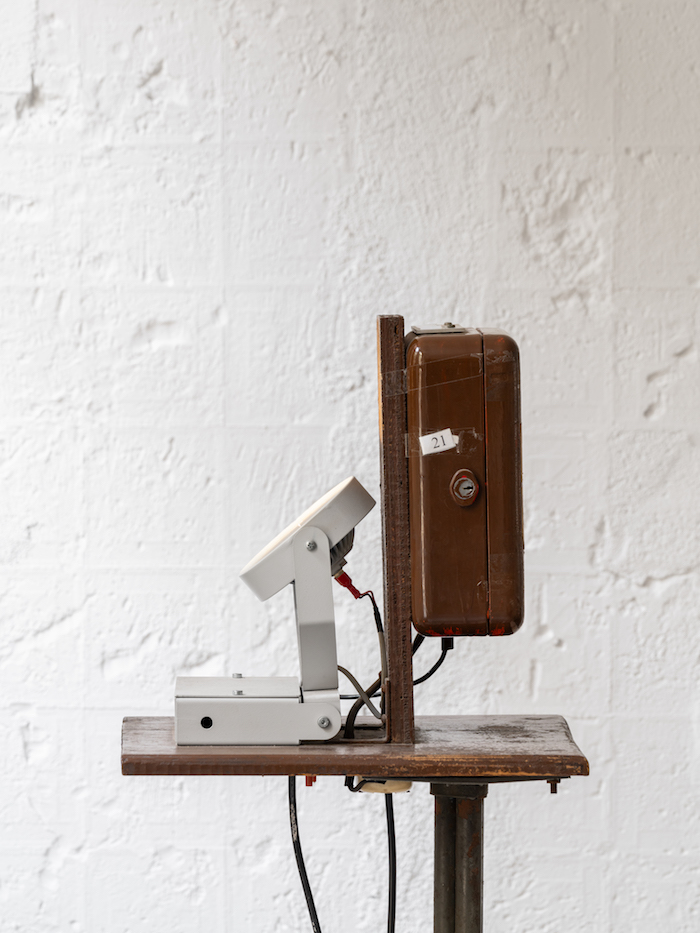
P.S. Venezia non è soltanto sottoposta alle maree e alla pressione dei tantissimi turisti che la attraversano incessantemente; è impossibile non percepire anche il peso della storia dentro la sua grandeur sbiadita e la sua iconografia religiosa. Tutti i fantasmi dei secoli passati. Lydia, a Venezia, è diventata ossessionata dal mondo degli spiriti e dagli edifici da questi infestati. Si chiedeva, per esempio, perché un fantasma dovesse obbedire alle regole dell’architettura e restare confinato entro i limiti di un singolo edificio. Per farla breve — e attraverso diversi slittamenti immaginativi — Lydia ha installato un “angelo” nel muro e ha collegato un sistema di luci LED a una cassetta per offerte votive che il pubblico può attivare inserendo un euro per vedere la mostra…
In questa esposizione la materia negozia costantemente i propri termini. I fantasmi della casa, gli amici assenti e la storia dell’arte vengono resi presenti. Per esempio, per me, la storia dell’edificio come priorato e orfanotrofio femminile emerge con estrema leggerezza attraverso le luci tremolanti, l’angelo nel muro e la zuppa che sobbolle. E non posso fare a meno di vedere anche l’ombra di artisti come Félix González-Torres o Jannis Kounellis nei gesti materiali che Lydia mette in atto attraverso la tenda di perline o l’assemblaggio della biancheria da letto.
Con questa mostra ho cercato consapevolmente di mettere in evidenza gli slittamenti di percezione e prospettiva che Lydia impiega nel suo lavoro. La storia dell’arte ci mostra che il dispiegarsi della visione e dell’atto stesso del vedere è direttamente legato al contesto socioeconomico che produce l’opera d’arte. Le mostre sono luoghi di produzione di conoscenza e, per me, in questa esposizione si genera una forma di Realismo.
R.S. Hai spesso lavorato con artisti che mettono in discussione i confini convenzionali di ciò che un’istituzione può ospitare o sostenere. Nel caso di 5 Works, la mostra si sviluppa attraverso collaborazioni con lavanderie, carceri, associazioni attiviste, fonderie e comunità locali. La Nicoletta Fiorucci Foundation ha dovuto trasformare la propria logica operativa per poter accogliere la mostra?
P.S. Nicoletta Fiorucci è una persona straordinaria, che crede profondamente nella sperimentazione artistica. Si è mostrata incredibilmente aperta rispetto al processo di produzione di questa mostra, partecipando anche come presenza attiva nel percorso compiuto insieme a noi. Mi raccontava che tutto questo rappresenta per lei una gioia. Nicoletta è stata al tempo stesso una sostenitrice convinta e un’amica critica. Ha sostenuto me e Lydia Ourahmane con fiducia e sicurezza, anche nei momenti in cui forse noi stesse non eravamo del tutto certe di come il progetto si stesse sviluppando.
La Nicoletta Fiorucci Foundation è ancora sufficientemente piccola da poter essere agile e operare in modo reattivo ed energico. Uno dei presupposti centrali del progetto veneziano della Fondazione è sempre stato quello di sostenere artisti in residenza e permettere la produzione di nuove opere a Venezia. Nicoletta ha riflettuto con grande attenzione sulla risonanza che implica aprire una Fondazione a Venezia e su come offrire un contributo significativo a una scena già estremamente dinamica.
Il gallerista e architetto Giorgio Mastinu, che è stato il nostro produttore e guida a Venezia, ha avuto anch’egli un ruolo fondamentale nello sviluppo della visione complessiva della Fondazione. È stato importante, per esempio, lavorare quando possibile con veneziani — non soltanto nella produzione delle opere di Lydia, ma anche con il fotografo, il graphic designer del libro e così via — e partecipare attivamente all’infrastruttura culturale della città. Anche Vittoria de Franchis, che cura l’attuale programma della sede londinese della Fondazione, ha avuto un ruolo cruciale come assistente curatore della mostra di Lydia.
La Fondazione è ancora nel processo di costruzione della propria presenza a Venezia, perciò gli artisti e i curatori invitati finora a realizzare progetti — prima Tolia Astakhishvili, con la mostra inaugurale del 2025 curata da Hans Ulrich Obrist, e ora Lydia insieme a me — costituiscono una parte dinamica del modo in cui la Fondazione sviluppa la propria logica operativa e definisce la propria identità: da come l’edificio viene ristrutturato, per esempio, a come avviene la mediazione culturale o viene comunicato il programma. È questo un momento estremamente creativo per lavorare come curatrice con la Fondazione a Venezia.
Where Matter Negotiates. A conversation with Polly Staple on Lydia Ourahmane, Venice, and invisible infrastructures
5 Works
Our identities are no longer founded on the idea of the Same.”
(University of Michigan Press, 1997)
— Édouard Glissant, Poetics of Relation
translated by Betsy Wing
Venice is a city that floats above what it removes. Every stone rests upon a subtraction; every landing conceals a fracture; every façade reflects the slow labour of water against matter. Yet there is another Venice, less visible, one that belongs neither to the postcard nor to the romantic ruin: a Venice of industrial laundries, worn sheets, cooperatives, forbidden islands, provisional piers, collective kitchens, women in detention threading beads in silence. A city made not of monuments, but of systems of circulation. Not of images, but of frictions.
Poveglia, for instance, is not merely the “cursed” island contemporary legends delight in turning into a Gothic theatre. Long before becoming a place of ghosts, it functioned above all as an apparatus of separation. An island constructed to contain what the city did not wish to see: contagion, fever, quarantine, human excess.
Within the Venetian lagoon, each island seems to embody a precise symbolic function: San Michele keeps watch over the dead; Murano over fire and glass; Burano over colour and domestic labour. Every island preserved an invisible role, as though the lagoon had, across centuries, constructed its own anatomy of filters, quarantines, and thresholds through which Venice attempted to protect its fragile body from the outside world — and from itself. Poveglia, by contrast, safeguards interruption. It is a threshold-island: a place where the social body was suspended in an ambiguous condition, neither inside nor outside the city.
For centuries, Venice used the lagoon as an immune system. The islands were not peripheries, but filters. Poveglia received suspected plague carriers, contaminated goods, enforced periods of waiting. In this sense, it remains one of the most radical architectures ever conceived by the Serenissima: not a monument to glory, but to distance. A geography of isolation transformed into landscape. And perhaps this is precisely what continues to disturb today. Not the supposed apparitions, but the fact that the island still preserves an administrative memory of fear. Its ruins seem to suggest that every civilisation produces invisible places where it deposits what it cannot fully integrate.
The vegetation now overtaking the buildings — wild fig trees, ivy, samphire, salt grasses — does not erase that history: it slowly covers it, as the lagoon covers everything. In Venice, nothing ever truly disappears. It merely sinks just beneath the surface.
There is something profoundly Venetian in this. The most celebrated city in the world has always constructed its beauty alongside its own systems of exclusion. And Poveglia is perhaps the photographic negative of Venice: not the façade, but the reverse side of light. Even its name seems worn down by the lagoon. The most widespread hypothesis traces it back to the Latin Popilia or Popiliae, perhaps linked either to the gens Popilia or to the presence of poplar trees (populus in Latin). In that sense, Poveglia may originally have meant “the island of poplars,” or a place associated with a Roman estate.
Yet there is also a far subtler Venetian linguistic drift at work. Across centuries of oral transmission and lagoon speech, Popilia would gradually have lost its phonetic density, becoming Povegia, and eventually Poveglia. It is a name that seems weathered by water, polished by salt and dialect. And there is something almost symbolic in that slippage. For Poveglia is precisely a place where forms slowly deteriorate without ever fully disappearing. Even the name itself seems to have passed through a linguistic quarantine: isolated, corroded, altered by time. In more poetic readings — not philological, but evocative — the very sound of “Poveglia” appears to contain a kind of aquatic oscillation: something surfacing only to withdraw again almost immediately. A name without monumental hardness. Closer to drift than to foundation.
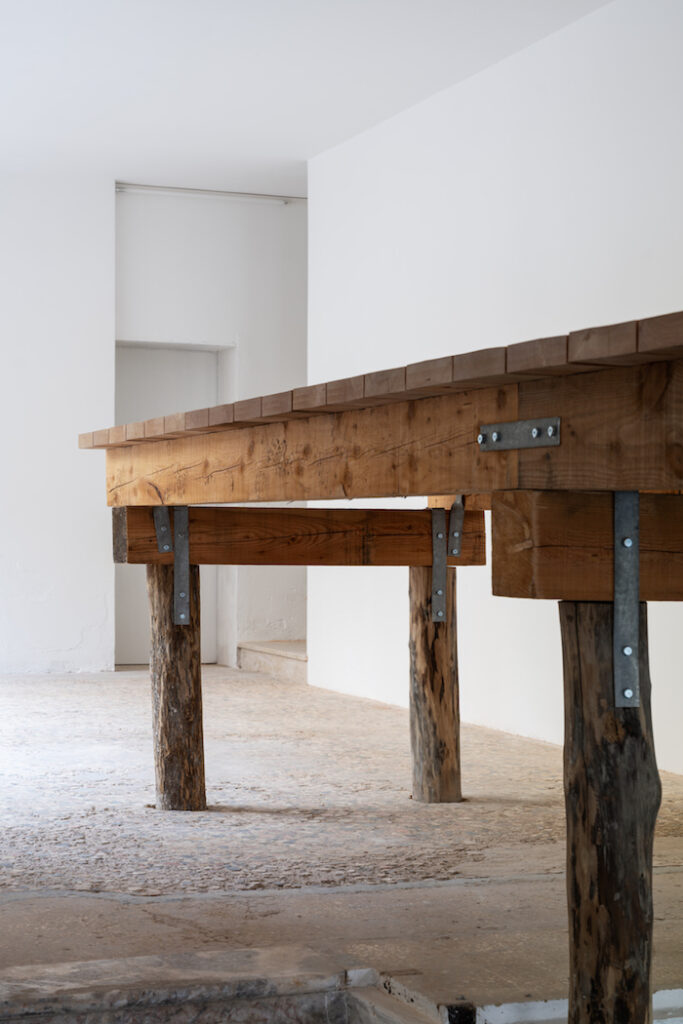
In this sense, the pier constructed by Lydia Ourahmane for the island does not appear merely as a functional infrastructure, but as the silent reactivation of a historical threshold: an access point toward a place that continues to question the relationship between exclusion, maintenance, and collective survival.
It is within this porous geography that 5 Works, Lydia Ourahmane’s exhibition at the Nicoletta Fiorucci Foundation, curated by Polly Staple, unfolds. More than an exhibition, it resembles a field of pressure. An organism dispersed throughout the Venetian landscape before it even enters the rooms of the Foundation. The works do not simply arrive within the site: they emerge from it, as though they had been slowly absorbed by the humidity of the lagoon, by the human labour that keeps it alive, by the invisible economies sustaining its daily survival. Yet what makes this process particularly radical is its refusal of extraction. Faced with Poveglia — an island that for decades resisted its transformation into a private enclave and the tourist commodification of the lagoon — Ourahmane deliberately avoids the almost automatic gesture, so common in contemporary art, of taking materials, images, or ruins and converting them into aesthetic content. As though certain places retained the right not to become fully transparent, to resist the complete legibility of the gaze. The pier instead emerges as a form of restitution: not something taken from the island, but something left to it. An infrastructure destined to continue existing long after the exhibition has ended. Here, the work does not arise from a gesture of appropriation; it does not extract matter from the site, but remains implicated within it.
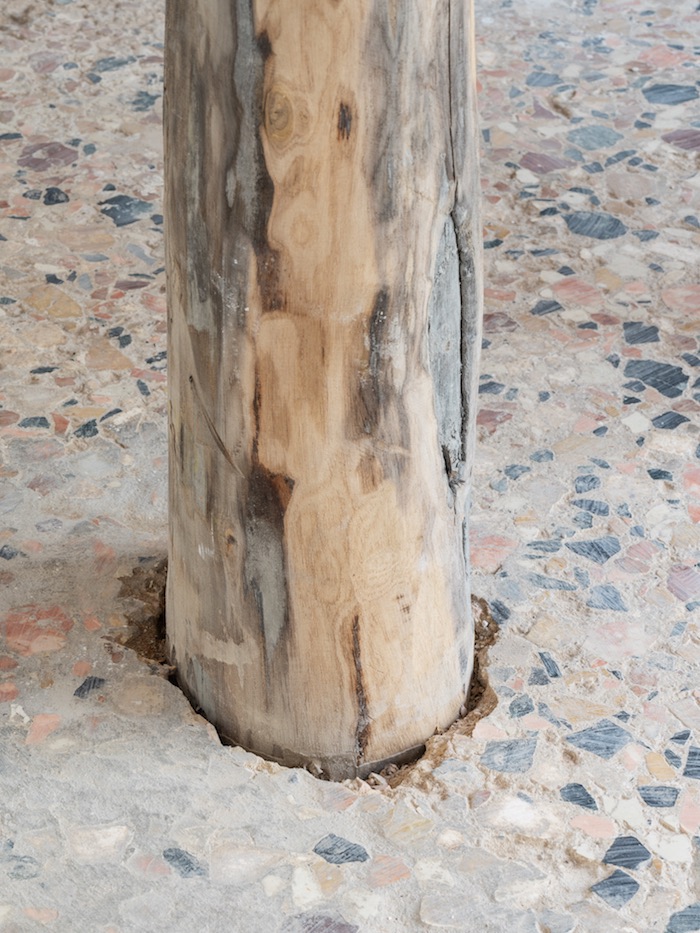
Polly Staple approaches Ourahmane’s work not as a constellation of autonomous objects, but as a network of material negotiations. Everything here seems to pass from one state into another: the pier built for the island of Poveglia is simultaneously sculpture and infrastructure; discarded hotel sheets become both sculptural accumulation and human archive; a curtain of murrine beads oscillates between Mediterranean domestic memory and prison labour. It does not occupy space: it holds it in suspension, the way certain veils move with the breathing of water. Each murrina carries the patient duration of incarcerated hands, hands that threaded glass beads one after another without haste, allowing entire days, silences, and indistinguishable hours to pass through their fingers. The repeated gesture has worn down time itself until it becomes almost transparent. Light passes through the curtain and fractures into small fevers of colour, yet never fully manages to grasp it. Like the lagoon, this material too seems to safeguard something that continues to withdraw.
The pot remains on the fire like a vigil. The broth slowly releases the smell of humble things: bones, herbs, and water that has learned patience. Steam rises gradually, clouding the air, entering memory before it enters sight. It is a smell familiar with narrow homes, with kitchens where time is measured by waiting for something to arrive and nourish someone. It does not pass through the eyes: it enters directly into the body. Within that warm breath of matter, something human persists that refuses to be consumed: a voiceless, stubborn form of care that continues to remain in the world.
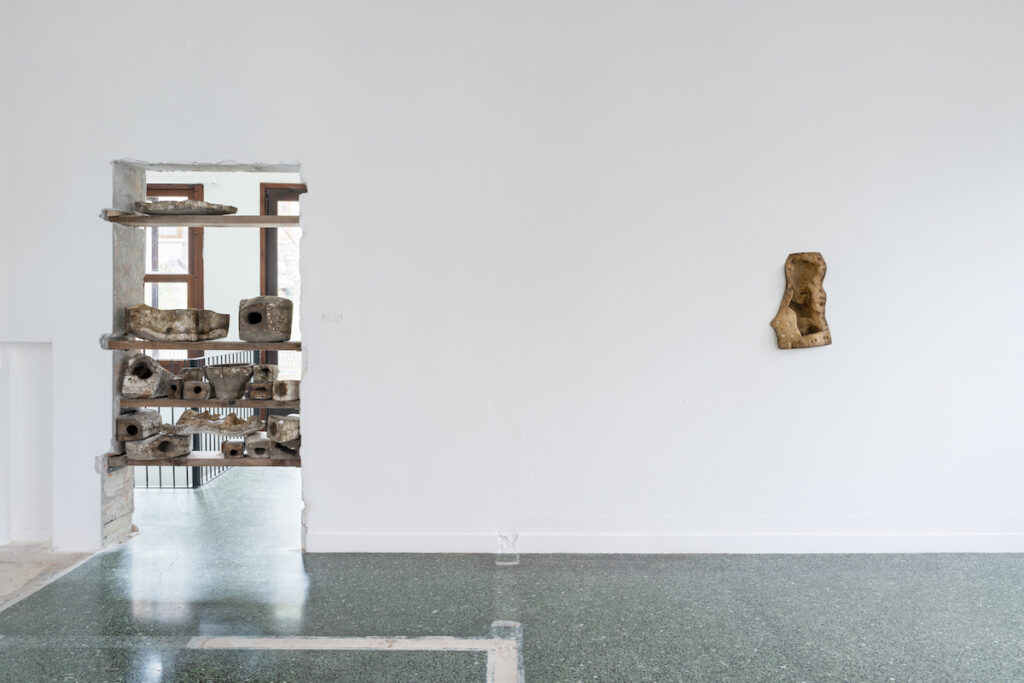
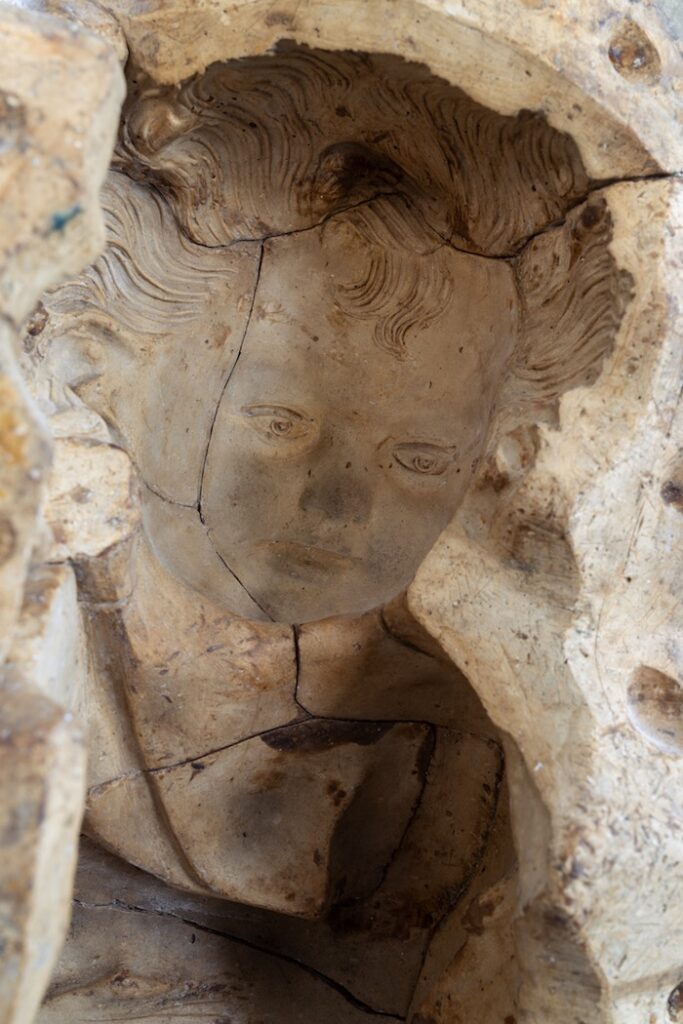
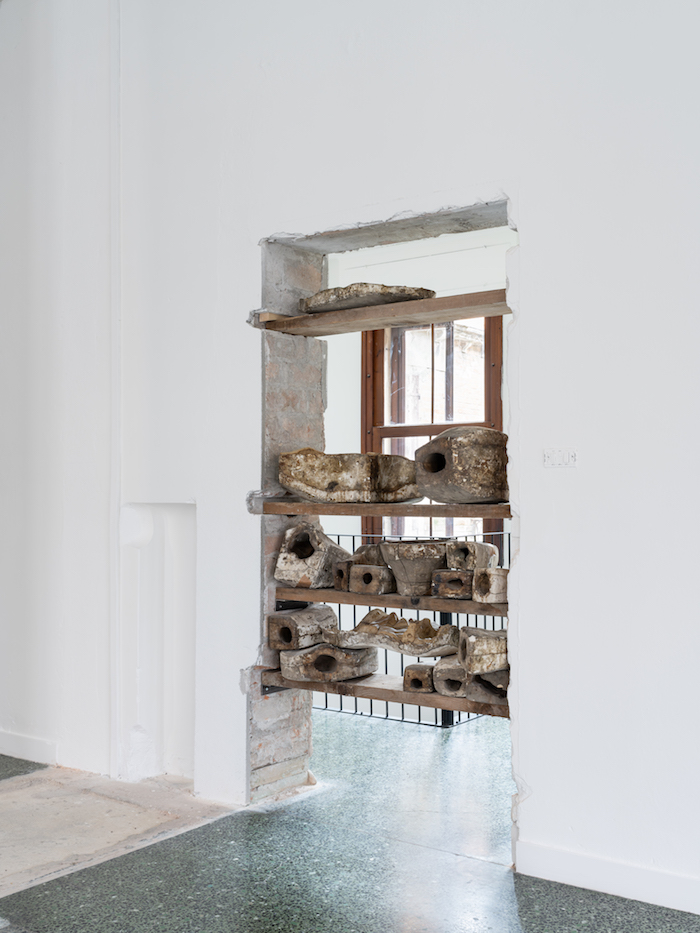
A cast preserves the absence of the object it once contained: an angel that does not descend, but remains. It remains like a minimal pressure within matter, like the trace left behind by something that has already passed beyond. Nothing allows itself to be fixed definitively. Matter never fully coincides with itself. It migrates, slips, changes status.
Perhaps this is precisely what makes the project so distant from a certain aesthetic of the Venice Biennale, often obsessed with the immediate image, with effect, with the speed of visual consumption. Here, by contrast, everything proceeds through slow transfers, processes of erosion, systems of maintenance, residual economies. Even light, in Venice, seems to obey this logic of activation and exchange. Inside the church of San Giovanni Crisostomo, an old coin-operated mechanism temporarily illuminates Giovanni Bellini’s altarpiece: the vision lasts only for the duration of an offering. Lydia Ourahmane transfers that mechanism into the exhibition itself, transforming the very act of seeing into an economic, ritual, and perceptual threshold. Light no longer appears as something given, but as an intermittent, negotiated, almost precarious condition. The works seem to ask: what happens to an object once it loses its function? What happens when a city no longer belongs to its inhabitants? When a form continues to exist even after having been emptied of its use?
In the conversation that follows, Polly Staple moves through the project by tracing its most unstable thresholds: the relationship between art and function, between sculpture and public service, between monumentality and precarity. Yet another question also emerges, more subterranean than the others: how does one work within a place without extracting from it? How does one produce an exhibition without consuming the territory that hosts it? It is a rare question today, within an art system founded upon rapid mobility, continuous production, and the transformation of every context into an available surface.
For this reason, 5 Works does not merely speak about Venice. It assumes its deeper structure. Venice has always been a city of mediation: between land and water, commerce and ruin, appearance and disappearance. Everything here exists in a state of shifting balance. Even the visitor, upon entering the exhibition, seems to lose any stable position. One moves as though underwater, before a pier suspended at eye level; passes through rooms where light pulses like an intermittent organism; encounters sheets that still retain the ghost of the bodies that once passed through them. Not as nostalgic memory, but as the material persistence of what continues to remain after disappearance. As though every material retained a residual charge: human contact, wear, the invisible pressure of lives that have moved through it.
And perhaps this is the most powerful core of Lydia Ourahmane’s work and of Staple’s curatorial reading: the understanding that matter is never inert. Every object retains relations, labour, memory, friction, violence, desire. As though matter possessed its own silent obstinacy, its ability to continue acting even after having been discarded, consumed, forgotten. Even what has been decommissioned preserves a voice. Even what appears exhausted retains a residual warmth. In the lagoon, nothing ever truly disappears. Everything slowly wears itself into another form.
Perhaps this is what Venice teaches most radically: nothing here ever fully coincides with its own contour. The lagoon does not separate land from water: it slowly draws each toward the likeness of the other. Everything gradually slips toward something else: stone toward salt, light toward water, matter toward drift.
RS In 5 Works, many of the artworks seem to oscillate between sculpture and infrastructure — between symbolic form and real social function. How did you navigate, as a curator, this unstable threshold where an artwork can simultaneously operate as a public utility, a monument and a political gesture?
P.S. All the artworks in 5 Works are born of collaborations, transactions and negotiations with individuals, organisations and historic sites in Venice. I often work as a curator in close collaboration with artists to realise new artworks, exhibitions and publications to expand the definition of what contemporary art can be. So, for me working in this way with Lydia, the producers and the collaborators was not unusual.
True collaboration takes time, care and a lot of effort; it is about trust and understanding the position of others and what is at stake for them. This is an ethical mode of address which is embedded in Lydia’s artworks, my role as curator and the exhibition itself. Lydia is a remarkable person who engages people directly. The show is a direct result of Lydia’s interactions with people and places in Venice, guided by me and the exhibition’s producer Giorgio Mastinu who lives in Venice. As curator I operate between the artist, the commissioner, the collaborators and the audience.
I am precisely interested in this place – which you very nicely describe as an ‘unstable threshold’. This is a site of potential to work from as a curator but also a site for the work to occupy and for the audience to experience. This threshold is a place of becoming which resists easy consumption and enables multiple points of engagement for the viewer. And yes, for me this is political. Within the context of a long art history, I am interested in exploring what the form for our present moment might be. It could be located within this threshold.
For example, the pier starts its life as an artwork in the gallery and then will become a fully functioning pier when it relocates to Poveglia. This duality of being both non-functional and functional – an artwork, monument and public utility – is very powerful to me. Lydia and I are both interested in the real politics of daily life as much as exploring how art itself is valued and produced, distributed and displayed.
R.S.Throughout the exhibition, Venice appears less as a backdrop than as a material under pressure: tourism, labour, abandonment, maintenance, invisible economies. Did you conceive the exhibition as a way of reintroducing friction and social density into an image of Venice that has become overly aestheticised?
P.S.Yes absolutely. We are all aware of the situation in Venice and how the city is perceived as in decline, subject to mass tourism and environmental catastrophe. Lydia is precisely interested in this friction but works through it in a gentle and generous way. This is not just a story about Venice but the geo-political challenges of the world more broadly which we are all grappling with right now.
The bed linen work for example communicates so effectively because yes, it is ‘about’ mass tourism and waste, but it is also about intimacy and our fragile bodies or say, modernist, minimal sculpture and its legacy. The work communicates through its materials on multiple levels: at once political, emotional and art historical.
R.S. The exhibition repeatedly stages a tension between circulation and suspension: the pier waiting to be transferred to Poveglia, discarded hotel linen entering the space of sculpture, the bead curtain oscillating between domestic memory and carceral labour. What role did the idea of “transit” play in your curatorial thinking?
P.S. I’m not sure I was thinking about “transit” per se but I am interested in how Lydia’s work always operates in a state of flux. Right from the start we were discussing concepts of the void, dormant or contained energy, transformation and alchemy. This also seemed to suit – or perhaps it came from – the context of Venice, which is a tidal city. You are always aware of the intense energy of this city – including its sounds and smells – and of course its history as a centre of trade.
The exhibition is staged as a series of encounters with Lydia’s highly charged and somewhat performative objects. There is intentionally lots of space placed between the exhibits to create a sense for the viewer of searching as they move through the building. A choreography of discovery which is for me very pleasurable to be held by – or within – for a moment. I made an exhibition at Tate Britain with the artist Ed Atkins in 2025 which comprised very different work, but I realise now had a similar pace and feel to it.
I was always very conscious that our audience would arrive at the Foundation having seen so many exhibitions and sites across Venice. The idea of ‘an experience’ also became material for Lydia to work with in the staging of the exhibition: the audience’s sense of anticipation perhaps, their expectation and desire. This was as important as creating a calm contemplative environment and the garden having seating for example and being a place to read the exhibition handout or just rest.
The architecture of the Nicoletta Fiorucci Foundation also became a character in Lydia’s show. The building is a bit of a puzzle so once you go upstairs to the bed linen room for example, you lose sense of your precise location, and this means you can concentrate on the experiences you are within at that moment. There are no distractions.
R.S.Many of Lydia Ourahmane’s works seem haunted by forms of latent presence — by what remains unseen yet structurally active: ghosts, discarded matter, exhausted objects, administrative violence, intimate traces. How do you think the exhibition negotiates the relationship between materiality and invisibility?
Venice is not only subject to the tides and the pressure of so many tourists continuously moving through it, but you also cannot fail to feel the weight of history within its faded grandeur and religious iconography. All the ghosts of many centuries past. Lydia became preoccupied by the spirit world of Venice and haunted buildings. She wondered why for example a ghost would obey the rules of architecture and stay within the confines of one building. To cut a long story short and with several leaps of imagination, Lydia installed an ‘angel’ in the wall and hooked a set of LED lights up to a votive light box which can be switched on by the audience with one Euro to view the exhibition…
Matter is always negotiating its terms in this exhibition. The ghosts of the house, absent friends and art history are made present. For example, for me, the history of the building as a Priory and a girl’s orphanage is very lightly drawn out by the flickering lights, the angel in the wall and the bubbling soup. I also can’t fail to see the shadow of the artists Félix González-Torres or Jannis Kounellis in the material gestures Lydia employs with the beaded curtain or the assemblage of bed linen.
With this exhibition, I consciously sought to draw out the shifts of perception and perspective that Lydia employs in her work. Art history shows us that the unfolding of vision and seeing itself is directly related to the socio-economic context that produces the artwork. Exhibitions are sites of knowledge production and for me there is a form of Realism produced in this exhibition.
R.S.You have often worked with artists who challenge the conventional boundaries of what an institution can host or sustain. In the case of 5 Works, the exhibition unfolds through collaborations with laundries, prisons, activist associations, foundries and local communities. Did the Nicoletta Fiorucci Foundation itself have to transform its own operational logic in order to accommodate the exhibition?
Nicoletta Fiorucci is an extraordinary person who believes in artistic experimentation. Nicoletta was incredibly open to the process of producing this exhibition and participating also as a player in the journey with us. She has told me this is a joy for her. Nicoletta was both a champion and a critical friend. She supported Lydia and I with trust and confidence even when at times we may have been uncertain about how the project was unfolding.
The Nicoletta Foundation is still small enough to be nimble and operate in a responsive and energetic way. A central premise for the Foundation’s Venice site has always been to support artists to be in residence and produce new work in Venice. Nicoletta thought very carefully about the resonance of opening a Foundation in Venice and how to make a meaningful contribution to an already dynamic scene.
Gallerist and architect, Giorgio Mastinu who was our producer and guide in Venice has also been integral to developing the overall vision for the Foundation. It has been important for example to work where possible with Venetians not just in the production of Lydia’s artworks but with the photographer, the book designer and so on, and to participate in the cultural infrastructure of the city. Vittoria de Franchis who curates the current programme in the Foundation’s London site has also played a key role as assistant curator on Lydia’s show.
The Foundation is in the process of establishing itself in Venice so the artists and curators invited to make projects thus far – first Tolia Astakhishvili, curated by Hans Ulrich Obrist, who made the inaugural show in 2025 and now Lydia with me – are a dynamic part of how the Foundation forms its operational logic and defines its identity; from how the building is renovated for example to how cultural mediation takes place or the programme is communicated. It is very creative time to be working as a curator with the Foundation in Venice.
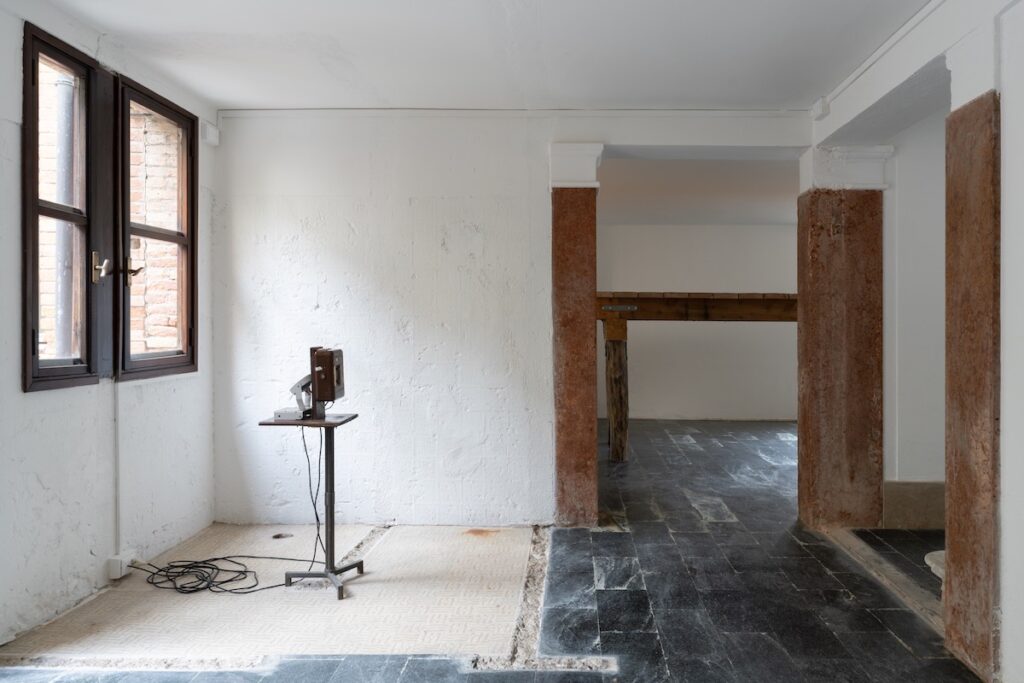
Cover: Lydia Ourahmane, (45.3820696, 12.3294242), 2026. Installation view. Courtesy of the artist and the Nicoletta Fiorucci Foundation. Photo_ Marco Cappelletti, Marco Cappelletti Studio