English text below —
Bones are our oldest words
Anne Michaels, Fugitive Pieces, McClelland & Stewart, 1996.
In Bones of Tomorrow il futuro non si offre come un orizzonte da raggiungere, né come una promessa da decifrare. È già all’opera, ma in una forma muta, sotterranea: un’intelaiatura che sostiene il corpo prima ancora che il corpo possa riconoscersi come tale. Le ossa evocate nel titolo non rimandano alla morte né a un’archeologia del tempo; sono ciò che resta dopo il passaggio della vita attraverso la materia, quando la funzione si è ritirata ma la forza no. Non portano con sé retoriche del macabro: sono residui attivi, materia che non smette di esercitare una pressione silenziosa sul presente.
Le ossa non appartengono al passato. Sopravvivono al tempo senza pacificarsi, come se in esse qualcosa non smettesse mai di accadere. Non custodiscono una memoria ordinata, ma una stratificazione instabile: fratture, accumuli, ritorni. Nella scrittura di Anne Michaels il resto non è mai neutro: è un deposito che agisce, un archivio fisico in cui il tempo non si conserva ma si riorganizza, e la perdita non chiude—sposta. È una concezione del tempo che non procede per eventi, ma per ciò che continua a lavorare nella materia, anche quando il racconto si è interrotto. Bones of Tomorrow può essere attraversata a partire da questa stessa idea di durata non lineare: i residui non “spiegano” ciò che è avvenuto, ma rendono percepibile ciò che non ha ancora trovato un posto definitivo, ciò che insiste senza chiedere di essere interpretato come origine o come esito. Le ossa non funzionano come reliquie, ma come strutture portanti; i resti non chiudono il passato, ma lo mantengono operativo. In entrambi i casi, il futuro non si annuncia come promessa: si insinua nella materia come una possibilità non risolta, come una forza che insiste senza mai organizzarsi in racconto, continuando a operare anche quando l’evento si è ritirato.
Tra “bones” e “tomorrow” si apre una tensione che disinnesca l’idea di progresso lineare. Il domani non inaugura un taglio, non arriva come evento. Si deposita lentamente nei frammenti, nelle minime persistenze, nei materiali che non si lasciano chiudere in una funzione. La mostra lavora su questa durata opaca: ciò che resta non è un avanzo da archiviare, ma una materia che continua a generare possibilità proprio perché non è stata conclusa. Il futuro, qui, non nasce dal nuovo: nasce da ciò che non è stato consumato, da ciò che resiste alla dissipazione e continua a cambiare stato senza proclamare un senso.
Il cuore figurale del progetto potrebbe dirsi un giardino che muore. Un giardino è spazio curato, organizzato, mantenuto; qui interessa il momento in cui la cura viene meno, quando il custode scompare e il selvatico torna—non con fragore, ma con un movimento graduale, quasi domestico. È un cambiamento senza catastrofe: un lento slittamento, in cui la materia comincia a seguire un’altra logica. Eradze non celebra la rovina, né la mostra come spettacolo: osserva la trasformazione nel suo farsi, nell’attesa che la accompagna, nella sua capacità di produrre forme senza dichiarare un esito.
La pratica di Andro Eradze attraversa da tempo questa zona intermedia: video, fotografia e installazione diventano strumenti per misurare relazioni instabili tra umano e non umano, tra interno domestico e paesaggio, tra presenza e spettralità. È un lavoro attento a ciò che accade ai margini dell’evento, dove i processi sono lenti e la materia sembra possedere un’agenda propria. Non c’è un centro da difendere: c’è una costellazione di forze che si scambiano ruolo e priorità, mentre la visione si sposta verso ciò che di solito resta fuori fuoco.
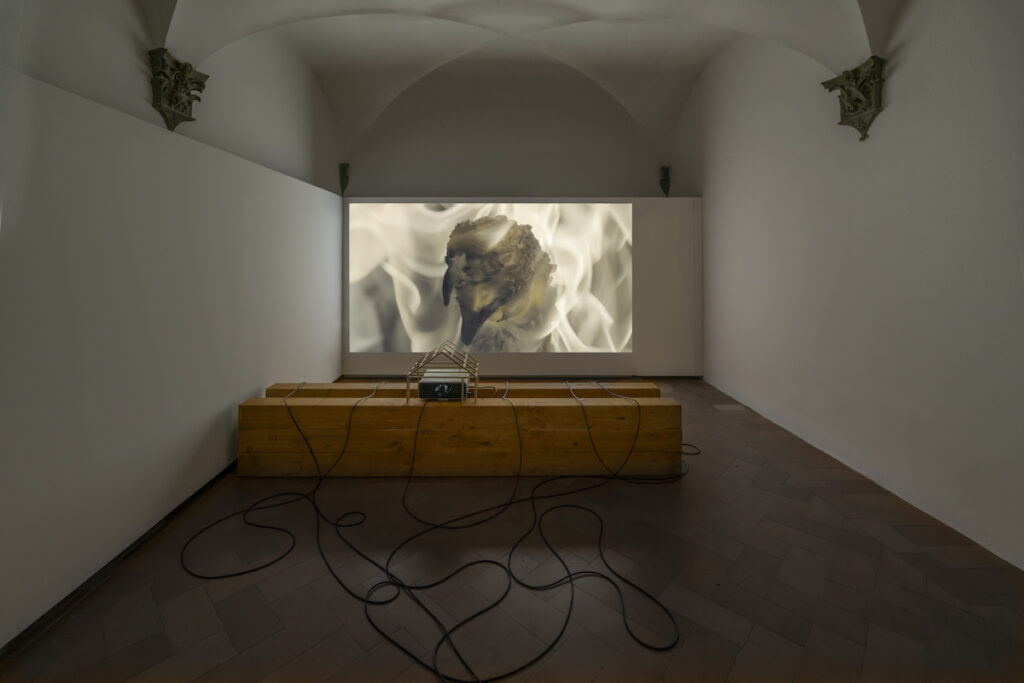
Nella poesia di Wisława Szymborska le ossa assumono una qualità diversa: più spoglia, quasi ironicamente impersonale. Non piangono, non ricordano, non reclamano centralità; restano. Sopravvivono all’umano senza farsene carico, come se la materia potesse continuare a esistere al di fuori di qualsiasi gerarchia di senso. Tenere presente questa postura — laterale, anti-patetica — permette di leggere Bones of Tomorrow senza ricondurre i suoi materiali a un registro simbolico univoco. I lavori di Eradze non chiedono empatia né allegoria: oscillano tra residuo come deposito sensibile e residuo come pura persistenza materiale, senza mai stabilizzare una posizione. È in questa instabilità, più che in un sistema di rimandi, che il lavoro trova la propria precisione. Di conseguenza, le opere non cercano simboli univoci e non si appoggiano al pathos. Le cose—ossa, frutti, fuoco, immagini—sono trattate come strutture minime che continuano a esistere anche quando corpo, funzione e racconto sono venuti meno. È una precisione che sposta l’umano di lato: non lo cancella, ma gli sottrae il monopolio del senso. La materia, qui, non è il supporto di un’idea: è una forza che insiste, che persevera, che procede per trasformazioni minute.
Il tempo che attraversa la mostra non procede verso una conclusione; scorre lateralmente. In questo universo visivo il rapporto tra causa ed effetto si allenta fino quasi a dissolversi: le immagini non sembrano derivare l’una dall’altra, ma coesistere come stati simultanei della materia. La trasformazione non “spiega” se stessa: si fa vedere e insieme si ritrae, lasciando che il visitatore abiti un’incertezza produttiva.
In una città come Firenze, dove il tempo non passa mai del tutto ma si stratifica, questa logica trova una risonanza fisica e strutturale. Palazzo Strozzi, con la sua architettura civile pensata per attraversare i secoli più che per rappresentare un’epoca, diventa così parte attiva del lavoro, corpo che trattiene e redistribuisce il tempo. Non come dialogo monumentale con la storia, né come citazione: piuttosto come esperienza del tempo come deposito, come pressione. Le opere di Eradze sembrano condividere questa condizione: ogni immagine appare come un punto instabile in cui più tempi coabitano, comprimendosi l’uno sull’altro, senza sciogliersi in una forma definitiva.
La mostra—curata da Arturo Galansino insieme a Daria Filardo—si costruisce come un percorso unitario tra due luoghi: il Project Space di Palazzo Strozzi e l’ex Teatro dell’Oriuolo. Non sono sedi autonome, ma stati diversi della stessa materia espositiva, pensati secondo una logica di continuità percettiva più che narrativa. È come se il visitatore entrasse in un organismo che respira: un alternarsi di densità e rarefazione, senza che questo alternarsi diventi racconto.
Palazzo Strozzi, con la sua architettura di misura e contenimento, offre un ambiente in cui la materia sembra rallentare, costretta a mostrarsi senza accelerazioni, diventa così parte attiva del lavoro, corpo che trattiene e redistribuisce il tempo. L’ex Teatro dell’Oriuolo introduce un’altra qualità: uno spazio raccolto, segnato da una memoria scenica, oggi svuotato della sua funzione originaria. L’idea di attesa permane, ma non si compie; la visione si intensifica, come se ogni elemento fosse trattenuto in uno stato di sospensione.
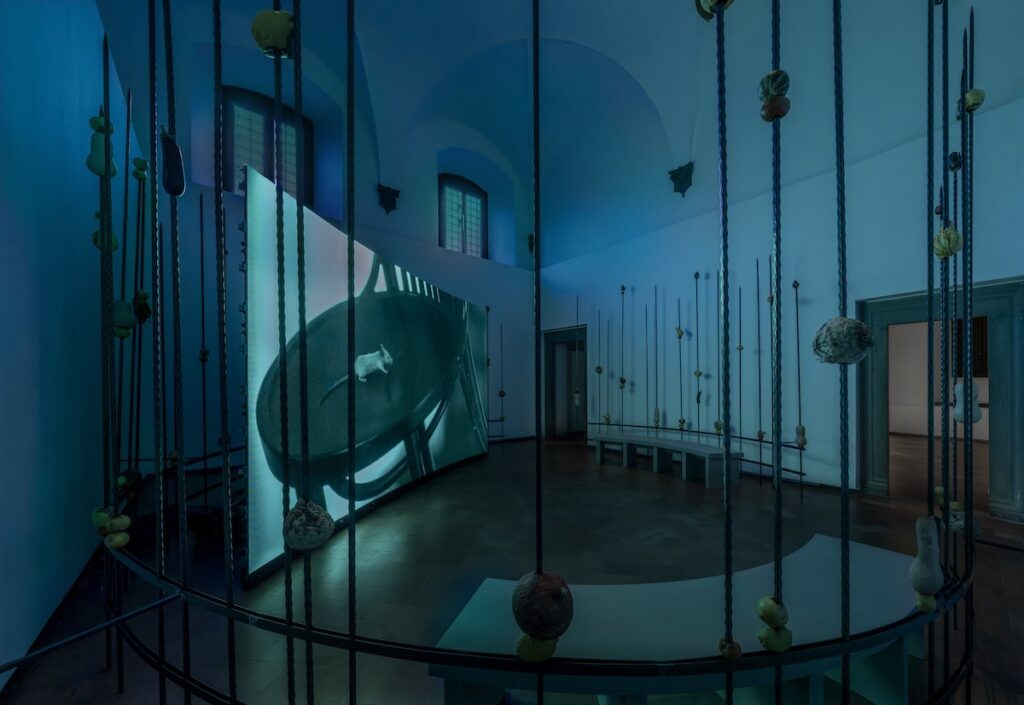

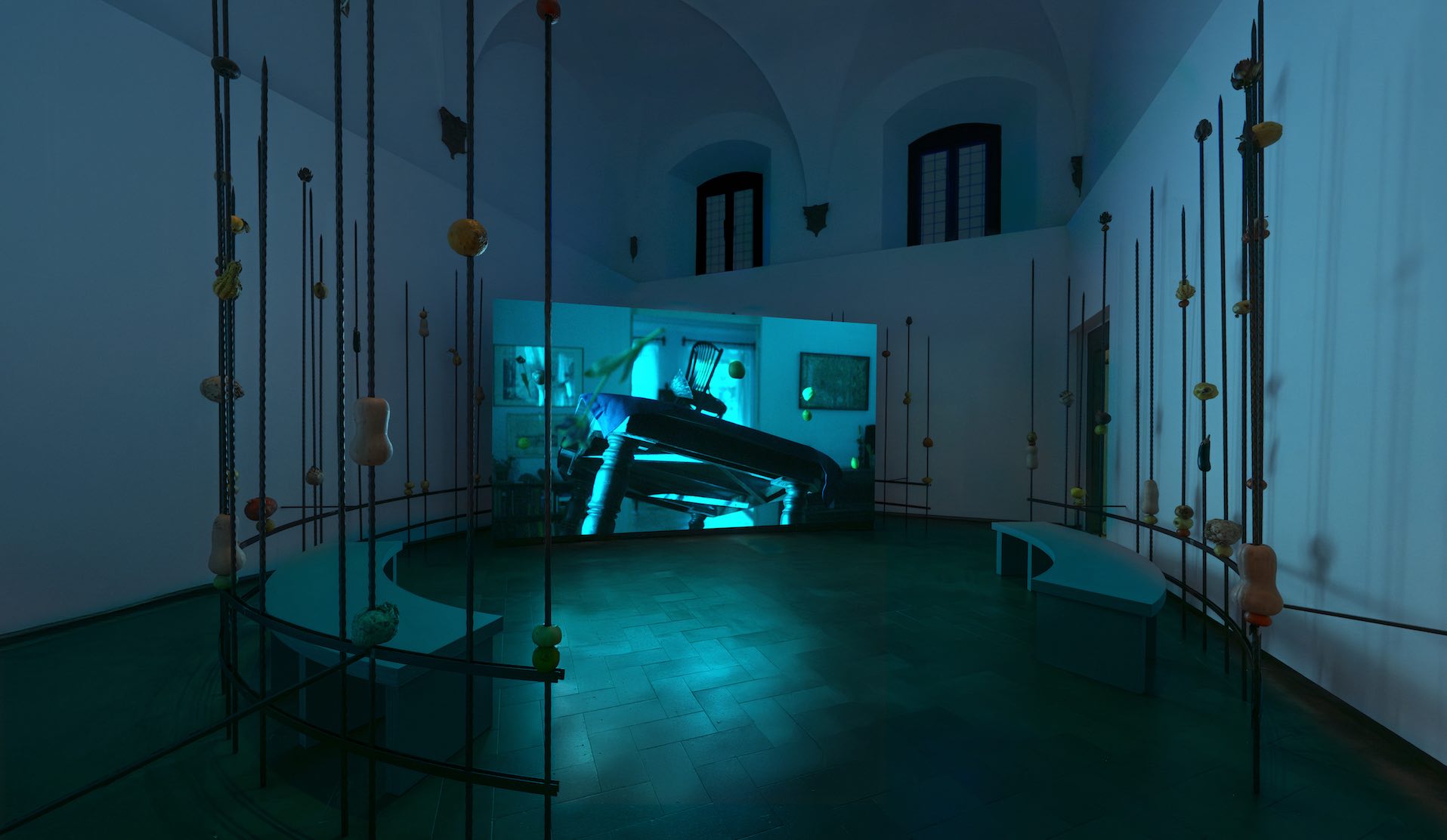
Non è un caso che questo luogo si chiami Oriuolo. È una parola antica, di uso toscano, che significa proprio orologio, derivata dal latino horologium, il dispositivo che dava misura al tempo comune. Il nome viene da un orologio pubblico medievale che un tempo stava qui vicino e scandiva le ore della città. L’orologio non c’è più, ma la misura resta. Anche svuotato della scena, lo spazio misura, non accade: trattiene una durata che scorre, fedele a se stessa, senza cercare un compimento. Nel Project Space l’esperienza si addensa attorno a installazioni che espongono la materia a un tempo non spettacolare. Frutti attraversati da strutture metalliche circondano il video Flowering and Fading (2024), consegnati a una durata che li porta a cambiare stato, a perdere consistenza, a scivolare verso un’altra condizione. La violenza apparente del gesto—l’infilzare—non produce distruzione immediata: introduce un regime di attesa. Ciò che si osserva non è l’atto, ma il suo dopo continuo.
La decomposizione non coincide con la sparizione. I frutti non vengono consumati né abbandonati: sono lasciati a una trasformazione per sottrazione, per esposizione prolungata al tempo. La materia attraversa più livelli senza essere cancellata, come in pratiche di essiccazione o macerazione in cui il tempo non separa ciò che è vivo da ciò che è morto, ma lo conduce altrove. Qui il tempo non funziona come condanna: modifica senza dichiarare, impoverisce una forma per far emergere un’altra qualità della sostanza.
Lo stesso regime attraversa Ghost Carriers (2025), in cui il montaggio lavora per ritorni e slittamenti più che per progressione. Le immagini non conducono, non spiegano, non chiudono: insistono. La durata che ne deriva avvicina il cinema al sogno più che alla narrazione, impedendo allo sguardo di stabilizzarsi e costringendolo a registrare minime variazioni.
All’interno di questa economia del tempo anche il fuoco perde la sua funzione distruttiva e diventa forza di trasformazione. Crescita e dissoluzione condividono lo stesso piano, come se la materia fosse attraversata da un movimento privo di direzione privilegiata. È qui che il lavoro di Eradze si fa più preciso: nel mostrare che la trasformazione non è un tema, ma una condizione.
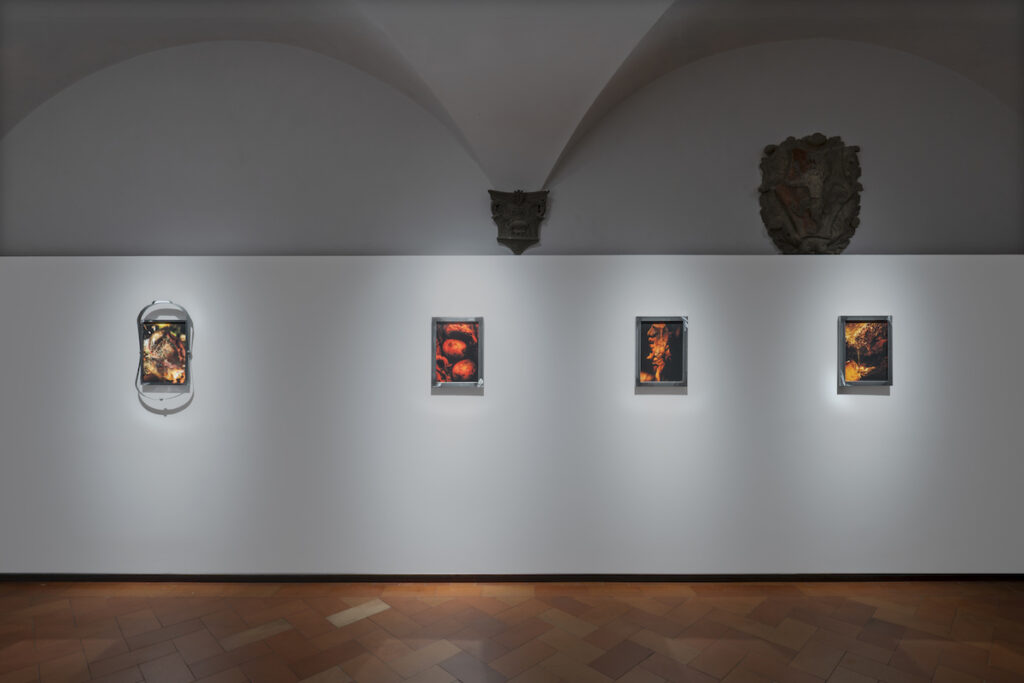
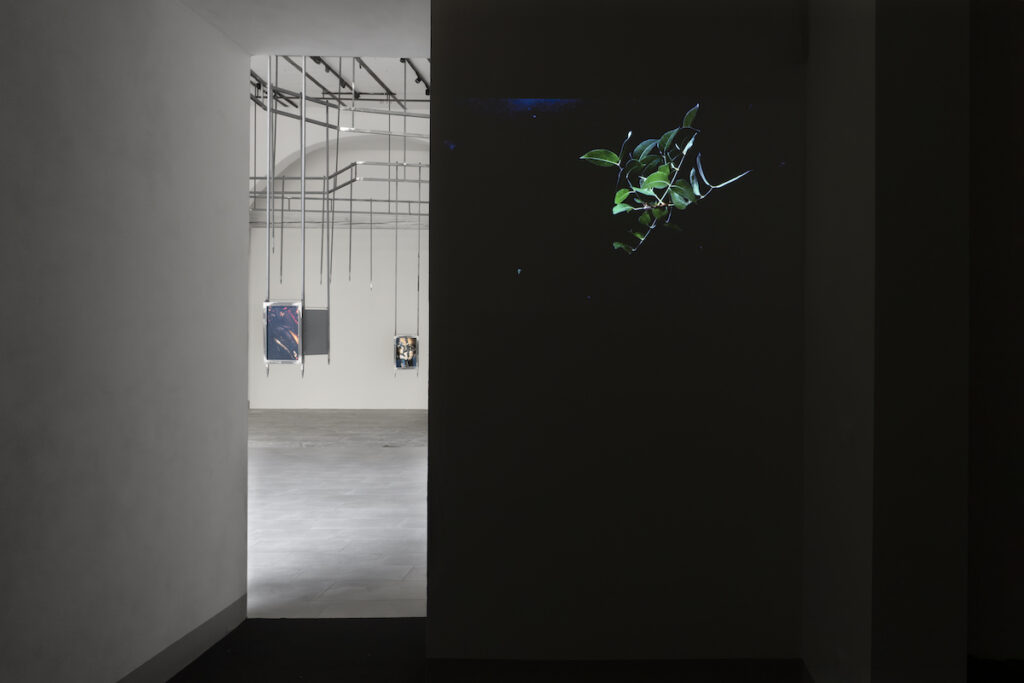
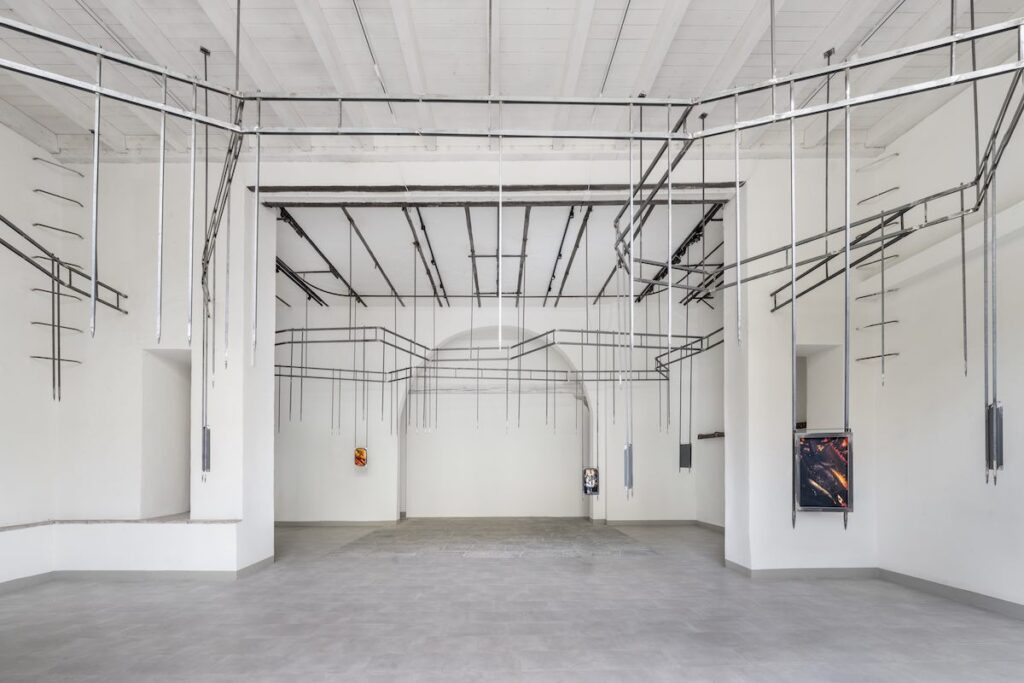
All’Oriuolo, opere come Sinking through (2025) e le serie fotografiche (Sunmap #2, Untitled, Moving on) accentuano questa sensazione di precarietà trattenuta. Le immagini sono protette, ma non stabilizzate; la metamorfosi è sospesa, non risolta. L’ambiente sembra trattenere il respiro, costringendo lo sguardo a muoversi verso l’alto, verso strutture che incombono senza offrire appoggio. Il percorso si chiude con Untitled (2025): un piccolo elemento vegetale che galleggia in uno spazio privo di coordinate riconoscibili. Non è un ritorno, né una conclusione. È una persistenza minima, che riporta lo sguardo all’inizio senza chiudere il cerchio.
Bones of Tomorrow non chiede di comprendere, ma di sostare. Di accettare che non sia chiaro dove ci si trovi nel tempo; che ciò che si osserva possa essere già accaduto o non essere ancora iniziato. Il futuro non si presenta come visione né come promessa: è una condizione che si annida nelle cose e rimane attiva senza mai organizzarsi in racconto.
Il futuro, qui, non accade. Persiste.
Ed è in questa persistenza—nel resto che non si lascia chiudere—che il lavoro di Andro Eradze trova la sua forza più duratura.

What Continues. Bones of Tomorrow | Andro Eradze, Palazzo Strozzi, Florence
Text by Rita Selvaggio —
Bones are our oldest words
Anne Michaels, Fugitive Pieces, McClelland & Stewart, 1996
In Bones of Tomorrow, the future is not offered as a horizon to be reached, nor as a promise to be deciphered. It is already at work, but in a mute, subterranean form: a framework that supports the body before the body knows how to recognise itself as such. The bones evoked in the title do not point to death, nor to an archaeology of time; they are what remains after life has passed through matter, when function has withdrawn but force has not. They carry no rhetoric of the macabre. They are operative residues—matter exerting a silent pressure on the present.
Bones do not belong to the past. They outlast time without settling into it, as if something within them never stopped happening. They do not hold an ordered memory, but an unstable stratification: fractures, accumulations, returns. In Anne Michaels’s writing, the remainder is never neutral. It is an active deposit, a physical archive in which time is not preserved but reorganised, and loss does not close—it shifts. This is a conception of time that does not move through events, but through what continues to work within matter, even when the narrative has broken off. Bones of Tomorrow can be approached from this same idea of non-linear duration: residues do not “explain” what has occurred, but make perceptible what has not yet found a definitive place—what persists without asking to be read as origin or outcome. Bones do not function as relics, but as load-bearing structures; remains do not seal the past, they keep it operative. In both cases, the future does not announce itself as a promise: it insinuates itself into matter as a force that persists without ever organising itself into a narrative, even after the event has withdrawn.
Between “bones” and “tomorrow” a tension opens that disarms the idea of linear progress. Tomorrow does not inaugurate a rupture, it does not arrive as an event. It settles slowly into fragments, into minimal persistences, into materials that refuse to be closed within a function. The exhibition works through this opaque duration: what remains is not a surplus to be archived, but a material that generates possibility precisely because it has not been concluded. Here, the future does not derive from the new; it emerges from what has not been consumed, from what resists dissipation and continues to change state without declaring a meaning.
The figurative core of the project might be described as a garden in the process of withdrawal. A garden is a space that is tended, organised, maintained; here, the focus is on the moment when care begins to withdraw, when the caretaker disappears and the wild returns—not with force, but through a gradual, almost domestic movement. It is a change without catastrophe: a slow drift, in which matter starts to follow a different logic. Eradze does not celebrate ruin, nor does he stage it as spectacle. He observes transformation as it takes place, in the waiting that accompanies it, in its capacity to generate forms without declaring an outcome.
Andro Eradze’s practice has long moved through this intermediate zone. Video, photography and installation become tools for measuring unstable relations between the human and the non-human, between domestic interior and landscape, between presence and spectrality. It is a practice attentive to what happens at the margins of action, where processes unfold slowly and matter seems to follow an agenda of its own. There is no centre to be defended. There is, instead, a constellation of forces that exchange roles and priorities, as the gaze shifts towards what usually remains out of focus.
In the poetry of Wisława Szymborska, bones take on a different quality: more stripped-back, almost ironically impersonal. They do not weep, they do not remember, they do not claim centrality; they remain. They outlive the human without assuming responsibility for it, as if matter could continue to exist outside any hierarchy of meaning. Keeping this lateral, non-empathetic posture in mind allows Bones of Tomorrow to be read without forcing its materials into a single symbolic register. Eradze’s practice does not ask for empathy or allegory. It oscillates between residue as a sensitive deposit and residue as pure material persistence, without stabilising a position. It is in this instability, rather than in any system of references, that the work finds its precision.
As a result, nothing here seeks univocal symbols or relies on pathos. Things—bones, fruit, fire, images—are treated as minimal structures that continue to exist even when body, function and narrative have fallen away. This precision shifts the human to the side. It does not erase it, but it removes its monopoly over meaning. Matter, here, is not the support of an idea; it is a force that persists, that endures, that proceeds through minute transformations.
The time that runs through the exhibition does not move towards a conclusion; it moves laterally. In this visual universe, the relationship between cause and effect loosens to the point of near dissolution: images do not appear to derive from one another, but to coexist as simultaneous states of matter. Transformation does not “explain” itself. It makes itself visible and, at the same time, withdraws, allowing the viewer to inhabit a productive uncertainty.
In a city like Florence, where time never fully passes but instead accumulates, this logic finds a physical and structural resonance. Palazzo Strozzi, with its civic architecture designed to move through centuries rather than represent a single era, becomes an active part of the exhibition—a body that holds and redistributes time. Not as citation, but as an experience of time as deposit, as pressure. Eradze’s works appear to share this condition: each image emerges as an unstable point in which multiple times cohabit, pressing against one another without resolving into a definitive form.
The show —curated by Arturo Galansino together with Daria Filardo—unfolds as a single, continuous trajectory across two sites: the Project Space at Palazzo Strozzi and the former Teatro dell’ Oriuolo. These are not autonomous venues, but different states of the same exhibitionary matter, conceived according to a logic of perceptual continuity rather than narrative sequence. It is as if the visitor were entering a breathing organism: an alternation of density and rarefaction, without that alternation becoming a story.
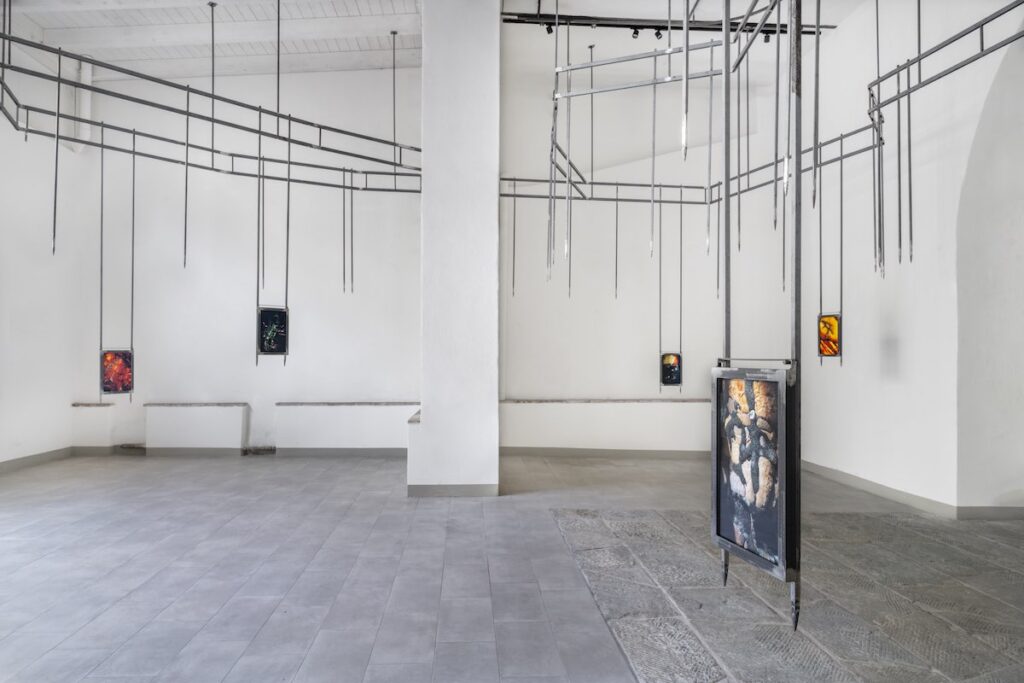
Palazzo Strozzi, with its architecture of measure and containment, creates an environment in which matter appears to slow, compelled to reveal itself without acceleration, becoming an active part of the work—a body that holds time and redistributes it.
The former Teatro dell’ Oriuolo introduces another quality: a contained space, marked by a scenic memory, now emptied of its original function. The sense of waiting remains, but is never fulfilled; the vision sharpens, as if each element were held in a state of suspension. It is no coincidence that this place is called Oriuolo. It is exactly an old Tuscan word for a clock, derived from the Latin horologium, – —the root of the English horologe,a device that once gave measure to shared time. The name comes from a medieval public clock that once stood nearby, marking the hours of the city. The clock is gone, but the measure remains. Even emptied of its stage, the space measures rather than happens: it holds a duration that continues to flow, faithful to itself, without seeking completion.
In the Project Space, the experience condenses around installations that expose matter to a non-spectacular time. Fruits pierced by metal structures surround the video Flowering and Fading (2024), entrusted to a duration that leads them to change state, to lose consistency, to slide towards another condition. The apparent violence of the gesture—the piercing—does not produce immediate destruction; it introduces a regime of waiting. What is observed is not the act itself, but its continuous aftermath.
Decomposition does not coincide with disappearance. The fruits are neither consumed nor abandoned; they are left to undergo a transformation by subtraction, through prolonged exposure to time. Matter passes through multiple levels without being erased, as in practices of drying or maceration in which time does not separate what is alive from what is dead, but leads it elsewhere. Here, time does not function as a sentence: it alters without declaring, impoverishes one form in order to allow another quality of substance to emerge.
The same regime runs through Ghost Carriers (2025), where editing works through returns and slippages rather than progression. The images do not lead, do not explain, do not close; they continue to exert. The duration that results brings cinema closer to the logic of the dream than to that of narrative, preventing the gaze from settling and compelling it to register minute variations. Within this economy of time, even fire loses its destructive function and becomes a force of transformation. Growth and dissolution share the same plane, as if matter were crossed by a movement without a privileged direction. It is here that Eradze’s work becomes most precise: in showing that transformation is not a theme, but a condition.
At the Oriuolo, works such as Sinking through (2025) and the photographic series (Sunmap #2, Untitled, Moving on) intensify this sense of held precariousness. The images are protected, but not stabilised; metamorphosis is suspended, not resolved. The path concludes with Untitled (2025): a small vegetal element floating in a space devoid of recognisable coordinates. It is neither a return nor a conclusion. It is a minimal persistence, one that brings the gaze back to the beginning without closing the circle.
Bones of Tomorrow does not ask to be understood, but to be inhabited. It asks for an acceptance of not knowing where one stands in time; of the possibility that what is being observed may have already happened, or may not yet have begun. The future does not present itself as a vision or as a promise: it is a condition that nests within things and remains active without ever organising itself into a narrative.
Here, the future does not happen. It persists.
And it is in this persistence—in what remains unclosed—that Andro Eradze’s work finds its most enduring strength.