English version below —
Quanto resta nell’aria
La luce arriva quando tutto è già accaduto. Entra nelle stanze, raggiunge una parete, il bordo di un letto, le cose lasciate prima di dormire. Sembra quieta. Eppure, secondo l’ipotesi del grande impatto, la Luna da cui proviene sarebbe nata dalla materia dispersa nello scontro fra la giovane Terra e un altro corpo celeste. A quest’ultimo è stato dato il nome di Theia. Prima che qualcuno potesse sollevare gli occhi, i frammenti avevano trovato un’orbita, una parte del cielo aveva preso la forma che avrebbe accompagnato le notti.
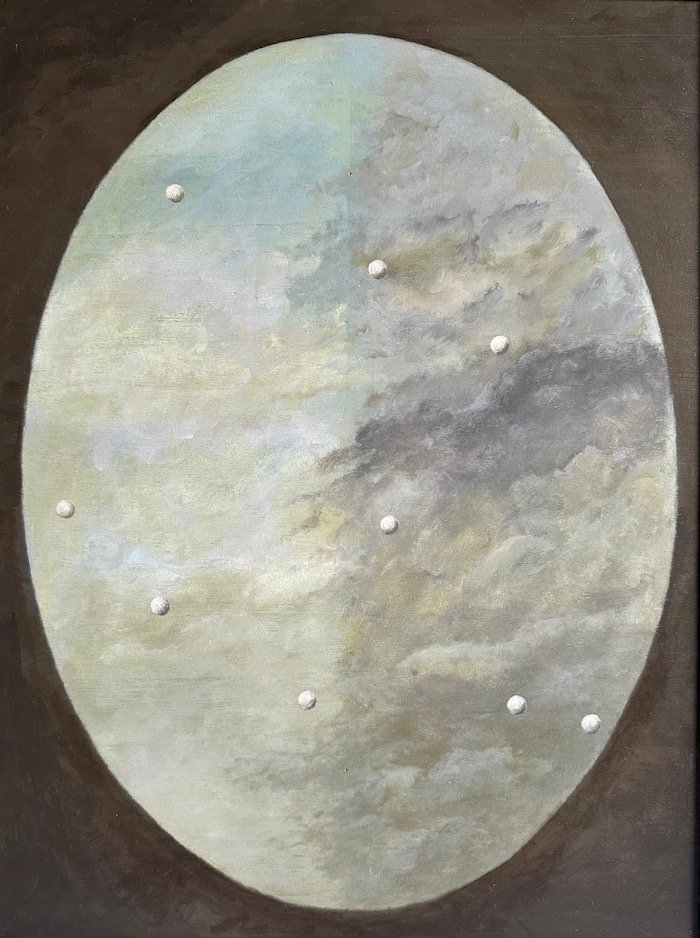
Theia significa «divina». Nella mitologia greca è la madre di Helios, Selene ed Eos, il Sole, la Luna e l’Aurora. La scienza ha ricordato quella parentela scegliendo il suo nome per il corpo che avrebbe contribuito a generare il satellite. È una storia che modifica il modo di guardare una luce familiare: ciò che si posa sul pavimento potrebbe discendere da una collisione, aver attraversato una nascita senza testimoni. Paul Heber-Percy le dedica Theia (2024) e Theia ii (2024), due dipinti nei quali il chiarore appare mescolato alla materia da cui deve emergere.
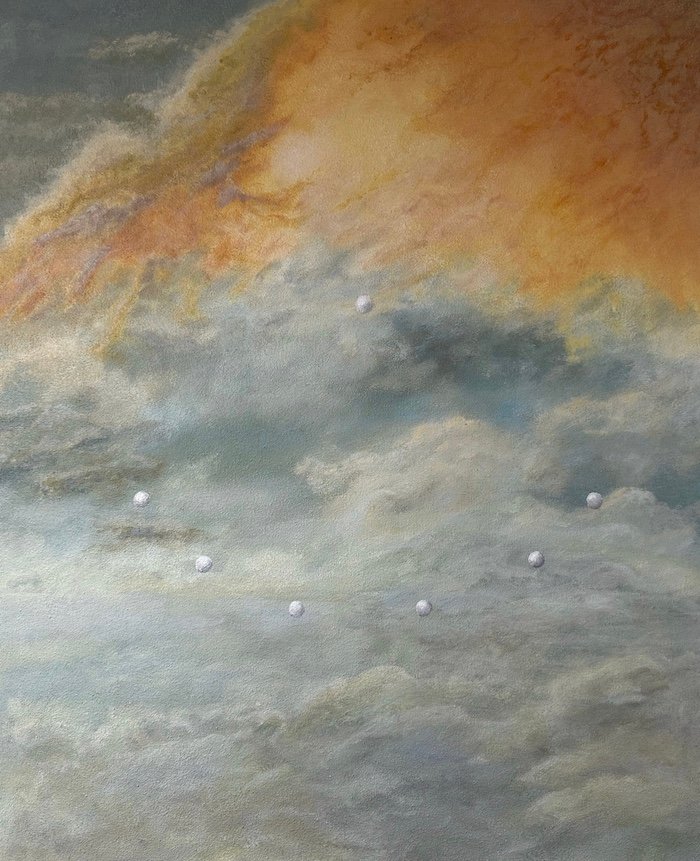
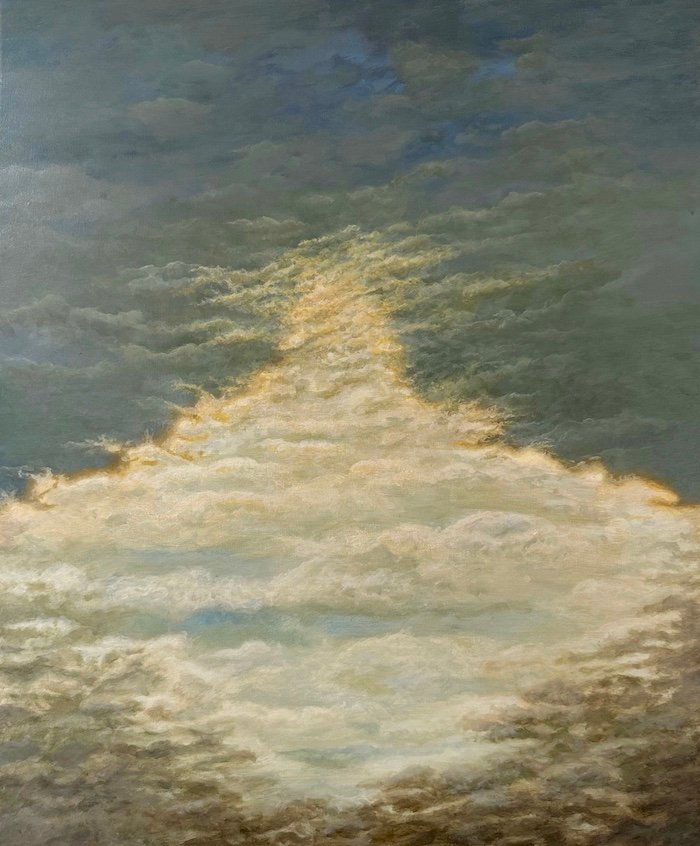
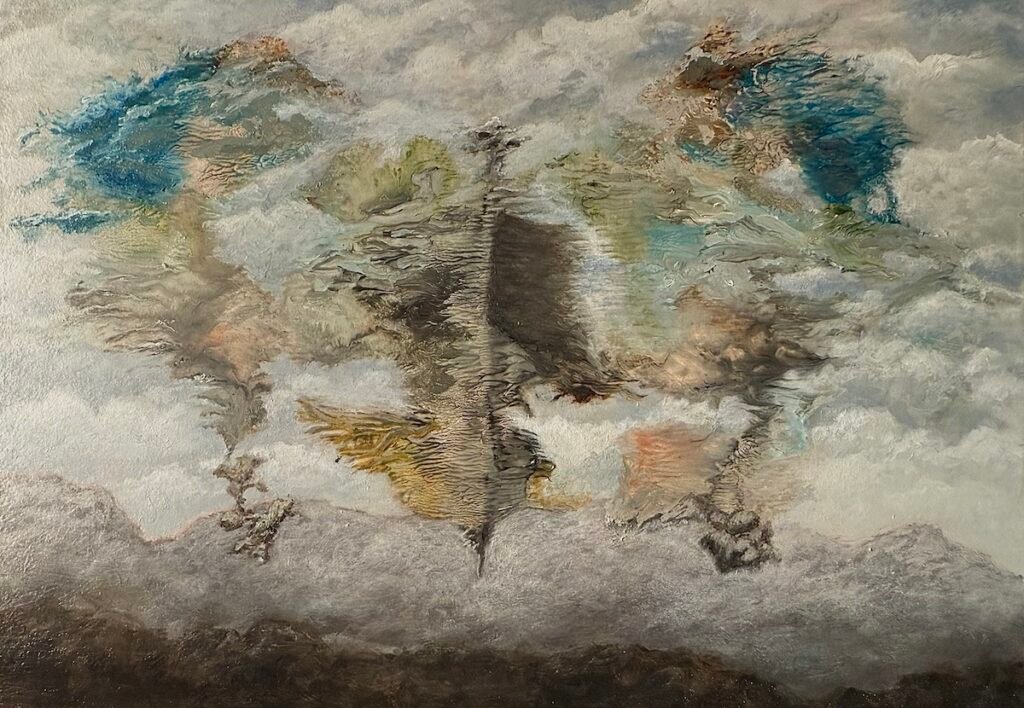
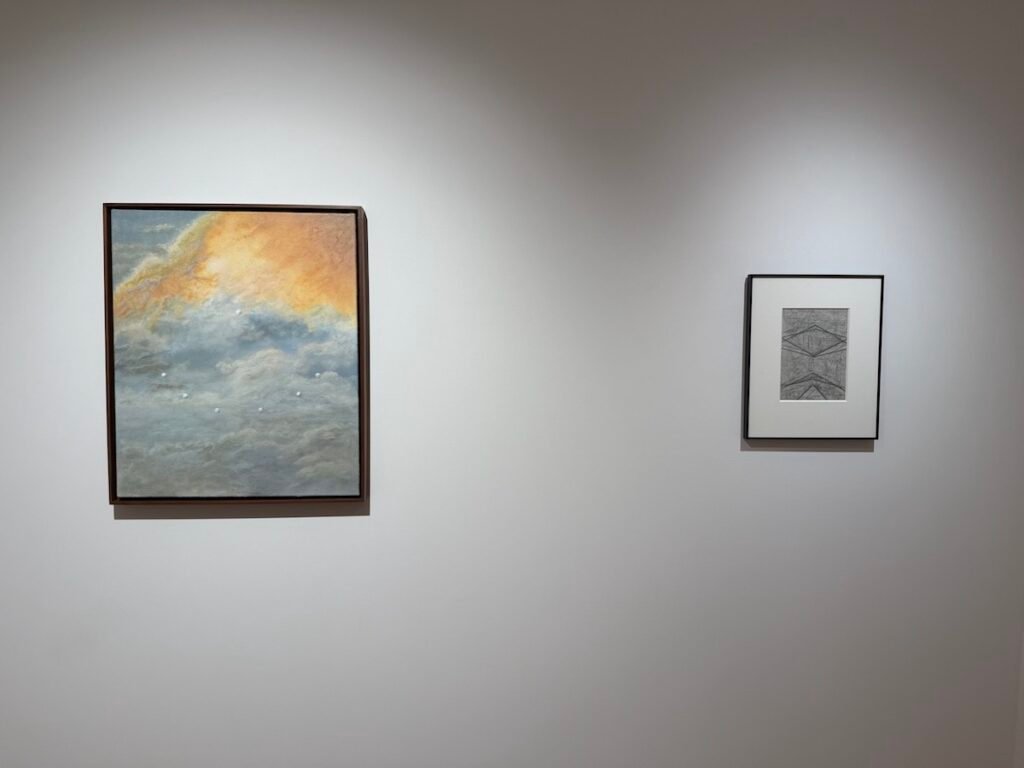
Le nuvole lo trattengono. L’oro affiora dove il grigio comincia ad aprirsi, indugia sui margini, torna a confondersi con una zona più densa. Si può rimanere a lungo davanti a questi cieli senza decidere se la luce stia aumentando o stia per spegnersi. Nel primo dipinto, piccoli corpi bianchi descrivono un arco; nel secondo, il chiarore risale una massa di nubi, dandole quasi il peso di un’elevazione. Il nome porta fino all’urto remoto, mentre il colore lascia accadere qualcosa di lento, una trasformazione che sembra avere ancora bisogno di tempo.
A rendere meno impalpabile quel cielo c’è anche la sabbia, mescolata all’acrilico in Theia (2024). La superficie oppone una resistenza minuta alla luce. Avvicinandosi, si incontra il lavoro della mano là dove prima pareva esserci soltanto aria: un deposito, una differenza di spessore, il punto in cui il colore ha incontrato un granello. La vastità torna per un momento alle dimensioni del gesto. Poi basta arretrare perché quel poco di materia riprenda distanza e diventi nuvola.
Questo movimento accompagna molti dipinti di Heber-Percy. Si guarda da vicino per capire meglio e ci si trova davanti a qualcosa che continua a sottrarsi. Accade soprattutto nelle opere intitolate Antiphon (2024–2026), dove forme inventate dall’artista rimangono sospese sopra alberi, acqua e vallate. La loro presenza ha una precisione sorprendente. Ogni punto luminoso sembra necessario al successivo, ogni curva appartiene a un ordine; manca però la conoscenza che permetterebbe di leggerlo. Si segue il disegno come una scrittura della quale sia rimasta familiare soltanto la direzione.
In Antiphon ii (2024), le linee e le piccole luci compongono un reticolo che si regge da sé nell’aria. Il paesaggio sottostante porta il proprio peso, mentre sopra gli alberi quella misura rimane quasi senza spessore. In Antiphon ii (2026), invece, il bianco si raccoglie in un corpo, si tende in filamenti e circonda cavità attraverso le quali passa il cielo. L’occhio vi cerca una conchiglia, un osso, la piega di qualcosa che cresce.
Anche le dimensioni diventano difficili da stabilire. La forma potrebbe essere vicina, una piccola cosa tenuta davanti al paesaggio; un istante dopo sembra avere raggiunto gli alberi e la sua grandezza cambia. Il dipinto consente a queste possibilità di alternarsi. Chi guarda prova a trovare il proprio posto e intanto scopre quanto dipenda da quel posto ciò che credeva di vedere. Il bianco ha lo stesso contorno, ma continua a cambiare relazione con il mondo che lo circonda.
Il nome Antiphon aggiunge a questa esperienza una memoria d’ascolto. L’antifona appartiene alla liturgia e accompagna il salmo; nella pratica del canto antifonale, voci o cori si alternano, così che una parte riceva ciò che l’altra ha cantato. La musica suggerisce un modo di sostare davanti ai quadri. Le linee paiono prolungare una tensione, i vuoti accoglierla; qualcosa potrebbe passare dall’una all’altra forma e continuare fuori di esse. Sotto, gli alberi non manifestano alcuna sorpresa.
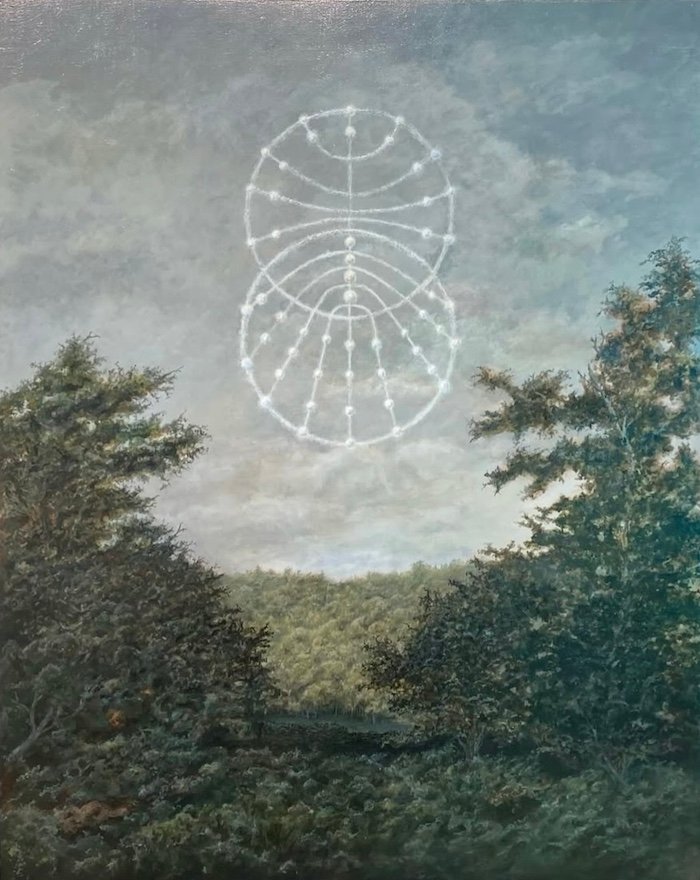
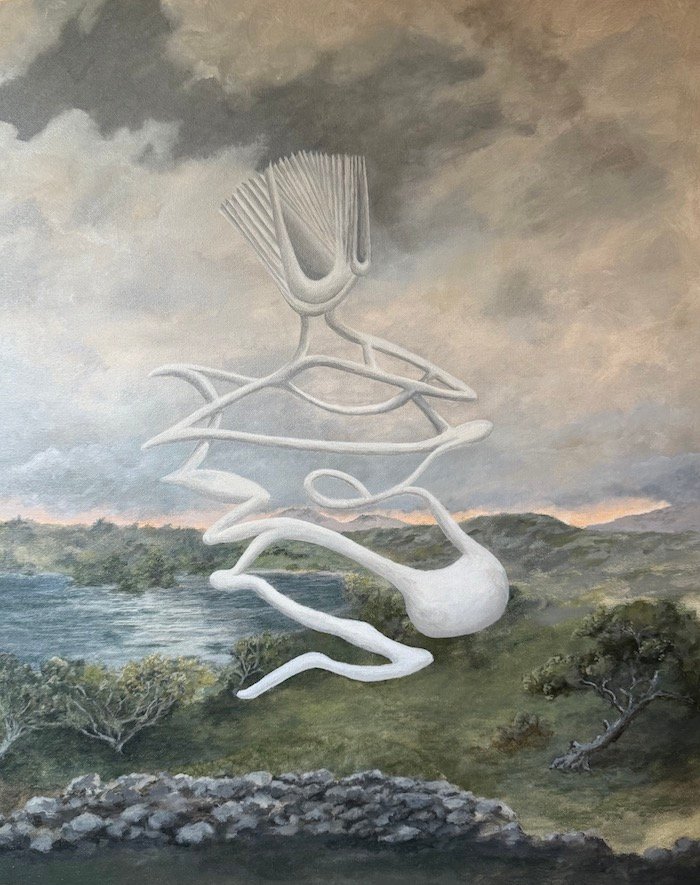
È questa calma a rendere le apparizioni tanto persistenti. Il paesaggio offre loro posto con la stessa disponibilità con cui riceve una nube. Eppure, dopo aver incontrato quelle strutture, anche il resto chiede un’attenzione diversa. Si torna a guardare una chioma, un tratto di terreno, cercandovi ciò che prima era sfuggito. Il diagramma rimane sospeso, ma il suo effetto si è già propagato oltre i propri margini.
Il poeta e saggista Antonio Prete, nel Trattato della lontananza (2008, Bollati Boringhieri), segue le figure attraverso cui l’immaginazione rende presente ciò che manca: l’orizzonte, il cielo, il ricordo. Davanti alle Antifonie la lontananza non nasce dove la vista si indebolisce, ma dove si fa più nitida. Ogni filamento è esatto, ogni cavità trattiene una porzione di cielo, e proprio questa esattezza tiene a distanza la forma intera: se ne distinguono le parti, mentre continua a sfuggire la legge che le tiene insieme. Queste forme hanno bisogno, per esistere, anche di quanto non occupano. L’occhio può attraversarle, continuare oltre, tornare.
Nel paese ulteriore cercato da Yves Bonnefoy in L’Arrière-pays (1972), una strada lasciata alle spalle continua a promettere un’esistenza diversa. Quel richiamo può rendere insufficiente il luogo in cui ci si trova. Heber-Percy lascia che l’occhio parta, ma gli prepara un ritorno: sotto le apparizioni rimangono alberi dipinti con pazienza, una terra che riceve l’ombra. Anche il cielo più estraneo deve qualcosa a questa fedeltà.
Il titolo della mostra, Last House before the Far-Off, è tratto da «Eingang», la poesia che apre il Libro delle immagini di Rainer Maria Rilke, nell’edizione italiana del 1947. Qualcuno esce dalla stanza dove ogni cosa è conosciuta e lentamente, con gli occhi, solleva un albero nero davanti al cielo. Il mondo è stato fatto. La vastità ha trovato un profilo attraverso cui apparire, ma negli ultimi versi il gesto cambia: gli occhi lasciano andare, con dolcezza, ciò che hanno composto.
La studiosa Lorna Martens, nel saggio «Rilke’s “Schauen”», segue il lavoro rilkeano del vedere fino al suo limite. In «Wendung», una poesia successiva, le immagini lungamente accolte dentro di sé chiedono ancora un lavoro del cuore: essere state guardate non basta a renderle conosciute. È quanto accade davanti alle Antifonie. Il bianco ha ricevuto un contorno, i punti luminosi sono al loro posto, la mano si è fermata; ciò che il vedere ha composto resta da affidare a chi verrà dopo.
Il pittore ha lavorato vicino a ciò che ora mantiene la propria distanza anche da lui. In questo congedo, Theia e le Antifonie trovano una parentela. Il corpo celeste ha lasciato conseguenze nelle quali sarebbe impossibile ricomporlo; il segno si è allontanato dal gesto che lo ha tracciato. Qualcosa dura attraverso la separazione, prende posto altrove. La pittura può seguirlo soltanto fino a un certo punto, poi lasciargli spazio.
Quando in A Room Without (2024) compare un frammento d’interno fra le nuvole, questa separazione diventa improvvisamente domestica. Rimangono una scala, una sedia, un passaggio illuminato. Tutto conserva le misure richieste da un corpo. Ci si accorge di saper abitare quella stanza prima di aver compreso che manca la strada per raggiungerla. La luce, invece, entra ancora e trova una parete su cui posarsi.
La nebbia ha occupato lo spazio delle fondamenta senza alterare la disposizione degli arredi. Qualcuno potrebbe spostare la sedia, salire, fermarsi nel passaggio; il dipinto mantiene intatte queste azioni al condizionale. La stanza ha perduto la casa, ma conserva il riguardo con cui era stata preparata per una vita. Guardandola, il corpo sente il proprio peso e cerca un appoggio. Basta quel bisogno elementare a dare alla lontananza una misura più acuta di qualsiasi orizzonte.
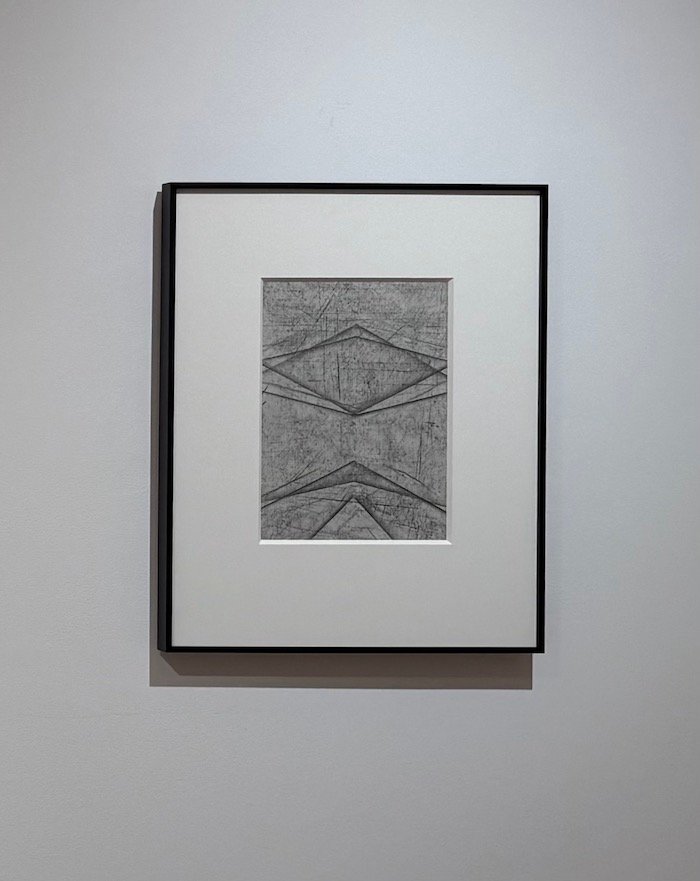
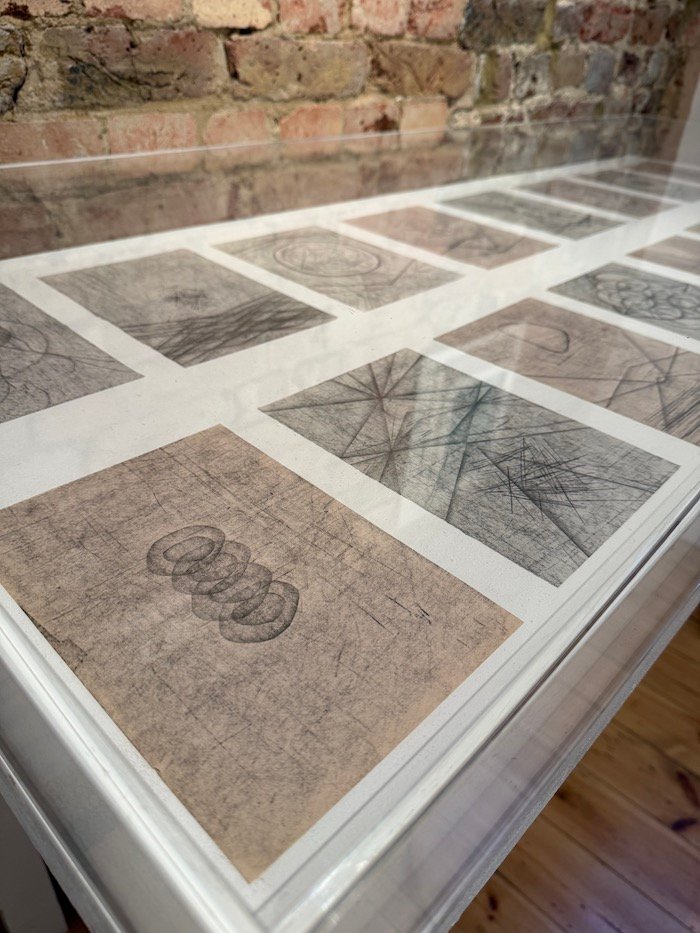
Nei Notices (2020), piccoli frottage su carta da giornale, la grafite riporta ogni partenza a un contatto. La mano preme, incontra una resistenza; emergono linee, curvature, cavità che sembrano appartenere a uno spazio remoto. Il gesto più ravvicinato produce qualcosa capace di allontanarsi. Questi fogli permettono di tornare ai cieli con una diversa attenzione per ciò che li sostiene: il colore depositato, l’attrito, il tempo necessario a far affiorare una forma e a riconoscere il momento in cui lasciarla.
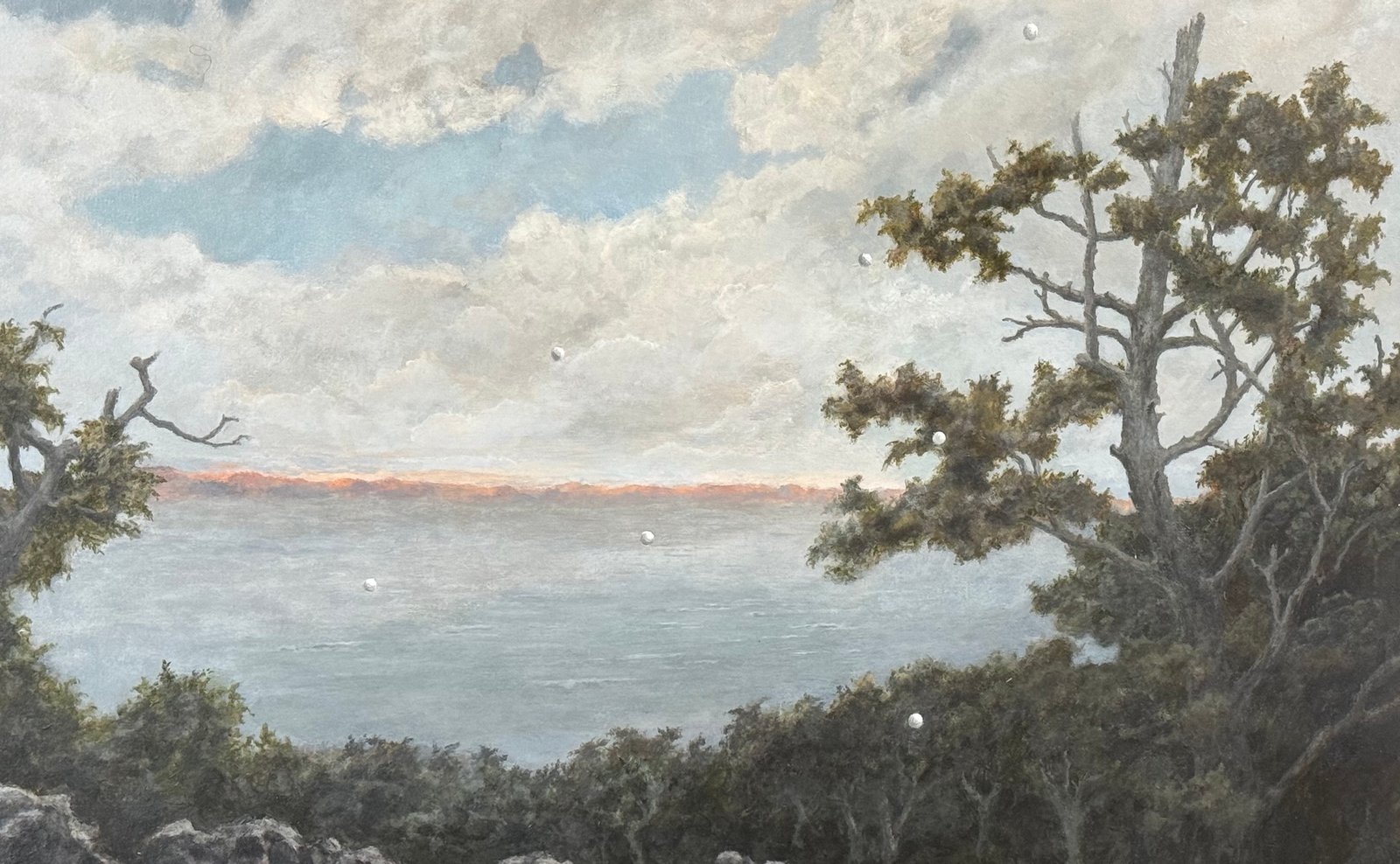
Fra gli alberi scuri di The Far-Off (2026) rimane una luce bassa. Il giorno si è ritirato quasi ovunque; là rischiara ancora un tratto di terra. L’occhio può seguirlo fino al punto in cui i profili cominciano a confondersi, poi fermarsi, lasciandolo dov’è. Il quadro conserva il peso degli alberi e quel poco di giorno che continua oltre la vista. La mano ha finito. Sull’orlo del buio, la luce ha ancora qualcosa da fare.
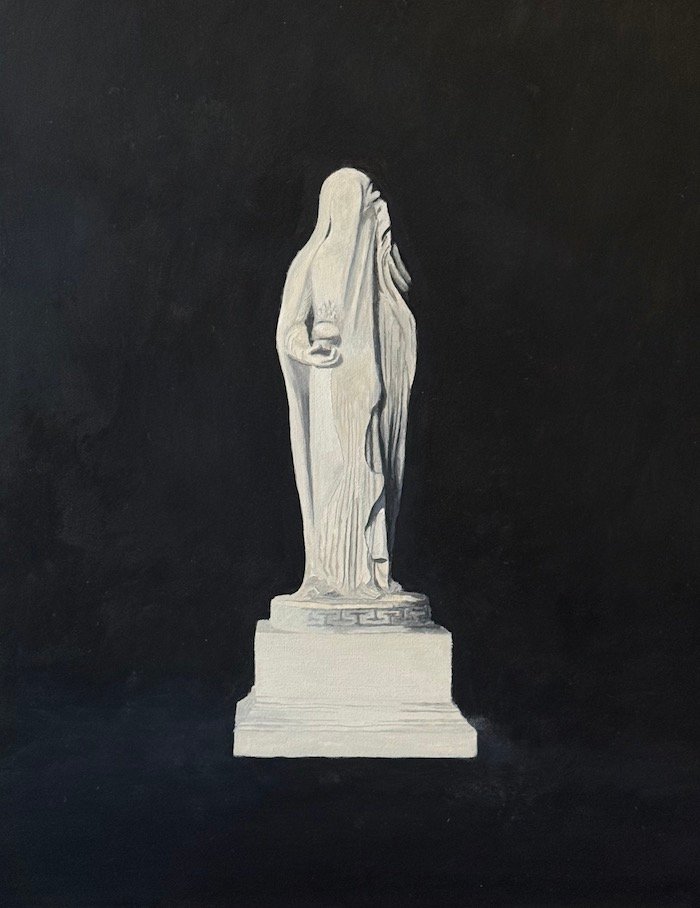
Cover: Veil ii 2024 Acrylic on board 28 x 35.5 cm – Courtesy Paul Heber-Percy and England & Co.
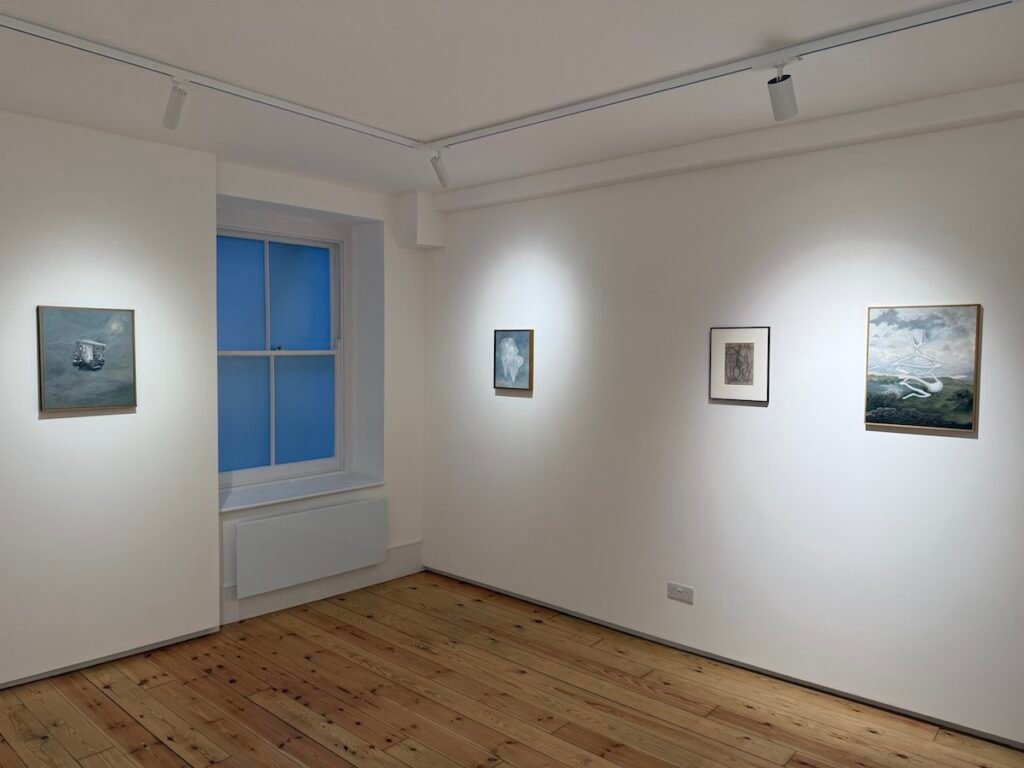
Paul Heber-Percy, Last House Before the Far-Off | England & Co, Londra
Text by Rita Selvaggio
From 7 to 24 October, England & Co presents Last House Before the Far-Off, a solo exhibition by Paul Heber-Percy in London. Through imagined landscapes, suspended diagrams and rooms emerging from mist, paintings and works on paper give distance the precision of things close at hand.
What Remains in the Air
Light arrives when everything has already happened. It enters rooms, reaches a wall, the edge of a bed, the things left out before going to sleep. It seems still. Yet according to the giant-impact hypothesis, the Moon from which it comes was formed from matter scattered in a collision between the young Earth and another celestial body. That body has been named Theia. Before anyone could raise their eyes, the fragments had found an orbit; a part of the sky had taken the shape that would preside over the nights to come.
Theia means ‘divine’. In Greek mythology, she is the mother of Helios, Selene and Eos: the Sun, the Moon and the Dawn. Scientists drew on that kinship when naming the body thought to have helped bring the Moon into being. It is a story that changes the way a familiar light is seen: the light falling across the floor might owe its existence to a collision, to a birth without witnesses. Paul Heber-Percy takes up this story in Theia (2024) and Theia ii (2024), two paintings in which the glow is still mingled with the matter from which it must emerge.
The clouds hold it back. Gold surfaces where the grey begins to open, lingers at the edges, merges back into denser cloud. One can linger before these skies, unable to tell whether the light is growing stronger or about to go out. In the first painting, small white bodies describe an arc; in the second, the glow rises through a mass of cloud, lending it something of a mountain’s weight. The name leads back to the remote impact, while a slower transformation unfolds in the paint, one that still seems to need time.
Sand, mixed with acrylic in Theia (2024), also gives that sky a more tangible presence. The surface offers a minute resistance to the light. Up close, the work of the hand appears where there seemed to be only air: a build-up of paint, a change in thickness, the point where the paint met a grain. For a moment, vastness returns to the scale of a gesture. Then a step back is enough for that small amount of matter to recede again and become cloud.
This movement runs through many of Heber-Percy’s paintings. A closer look promises understanding, yet something remains elusive. This happens especially in the works titled Antiphon (2024–2026), where forms invented by the artist remain suspended above trees, water and valleys. There is a striking precision to their presence. Each point of light seems to require the next, every curve to belong to an underlying order; what is missing is the knowledge that would make it legible. The eye follows the drawing as it might follow an unfamiliar script, recognising only the direction in which it runs.
In Antiphon ii (2024), lines and small lights form a lattice suspended in the air, with nothing to support it. The landscape below bears its own weight, while above the trees the measured pattern has almost no thickness. In Antiphon ii (2026), by contrast, the white takes on bodily form, stretches into filaments and encloses hollows through which the sky shows. The eye searches for the likeness of a shell, a bone, a fold in something growing.
Scale, too, becomes difficult to establish. The form might be close, a small thing held in front of the landscape; a moment later it seems to have reached the trees, and its size changes. The painting allows these possibilities to alternate. In trying to locate themselves in relation to it, viewers discover how much their position determines what they thought they saw. The white form retains its outline, yet its relationship with the surrounding world continues to change.
The title Antiphon also invites a kind of listening. An antiphon is a liturgical chant accompanying a psalm; in antiphonal singing, voices or choirs alternate, each receiving what the other has sung. Music suggests a way of lingering before the paintings. The lines seem to carry a tension onwards, the spaces between them to receive it; something might pass from one form to another and continue beyond them. Below, the trees show no surprise.
It is this calm that makes the apparitions so persistent. The landscape makes room for them as readily as it receives a cloud. Yet once the eye has encountered these structures, the rest of the painting also calls for a different kind of attention. The eye returns to a tree’s canopy, a stretch of ground, searching for something previously overlooked. The diagram remains suspended, but its effect has already spread beyond its edges.
Antonio Prete, the Italian poet and essayist, explores in Trattato della lontananza (Bollati Boringhieri, 2008) the images through which imagination gives presence to what is absent: the horizon, the sky, memory. In the Antiphons, distance emerges not as vision falters, but as it sharpens. Every filament is precisely defined, every cavity holds a portion of sky, and this very exactness keeps the whole form at a distance: its parts can be distinguished, while the law that holds them together remains elusive. These forms depend as much on the space they leave empty as on the space they occupy. The eye can pass through them, continue beyond, return.
In The Arrière-pays (translated by Stephen Romer, Seagull Books, 2012), Yves Bonnefoy searches for a country beyond the familiar, where a road left behind continues to promise a different existence. Its promise can make the place one inhabits seem inadequate. Heber-Percy lets the eye wander, but gives it somewhere to return: beneath the apparitions are patiently painted trees and earth where their shadows fall. Even the most unfamiliar sky owes something to this fidelity.
The exhibition’s title, Last House Before the Far-Off, is drawn from ‘Eingang’ (‘Entrance’), the poem that opens Rainer Maria Rilke’s The Book of Images (translated by Edward Snow, revised bilingual edition, North Point Press, 1994). Someone steps out of a room where everything is familiar and, slowly, raises a black tree against the sky with their eyes. The world has been made. Vastness has found an outline that makes it visible, but in the final lines the gesture changes: the eyes gently let go of what they have composed.
In her essay ‘Rilke’s “Schauen”’, collected in The Tender Gaze: Compassionate Encounters on the German Screen, Page, and Stage (edited by Muriel Cormican and Jennifer Marston William, Camden House, 2021), the scholar Lorna Martens traces Rilke’s exploration of seeing and its limits. In ‘Wendung’ (‘Turning Point’), a later poem discussed by Martens, the images long held within still call for the work of the heart: looking at them has not been enough to know them. The Antiphons prompt a similar experience. The white form has its outline, the points of light are in place, the hand has stopped; what the eye has composed must now be entrusted to those who come after.
The painter has worked at close quarters with something that now keeps its distance even from him. This leave-taking reveals a kinship between Theia and the Antiphons. What remains of the celestial body could never be gathered back into its original form; the mark has moved away from the gesture that traced it. Something survives the separation and finds a place elsewhere. Painting can follow it only so far, then give it room.
In A Room Without (2024), a fragment of an interior appears among the clouds, and separation suddenly takes on a domestic scale. A staircase, a chair, a lit passage remain. Everything is still scaled to the human body. The sense of knowing how to inhabit that room comes before the realisation that there is no way to reach it. Light, meanwhile, still enters and finds a wall to settle on.
Mist has taken the place of the foundations without disturbing the arrangement of the furniture. Someone might move the chair, climb the stairs, pause in the passage; the painting holds these gestures suspended in a perpetual ‘might’. The room has lost its house, but still bears the care with which it was made ready for someone to live in. Looking at it, the body feels its own weight and seeks support. That basic need makes distance more keenly felt than any horizon could.
In the Notices (2020), small frottages on newsprint, graphite brings every departure back to a point of contact. The hand presses, meets resistance; lines, curves and cavities emerge that seem to belong to a remote space. Working at such close quarters, the hand brings something into being that can recede from it. These works on paper lead back to the painted skies with renewed attention to what sustains them: the paint laid down, the friction, the time needed to bring a form to the surface and to recognise the moment to let it go.
Among the dark trees of The Far-Off (2026), a low light remains. Daylight has retreated almost everywhere; there it still illuminates a stretch of ground. The eye can follow it to the point where outlines begin to blur, then stop, leaving it where it is. The painting holds the weight of the trees and the little daylight that continues beyond sight. The hand has finished. At the edge of darkness, the light still has something to do.