Scroll down for English Version –
«Ascoltare significa aprirsi all’altro e lasciarsi trasformare dall’altro nel luogo più intimo di sé. L’intimità, in questa prospettiva, non è né rifugio né riparo, ma il luogo di una più ampia esposizione.»
— Jean-Louis Chrétien, The Call and the Response (2004), p. 63. Traduzione dell’autrice.
A Venezia si ascolta prima ancora di vedere.
L’acqua arriva sempre in anticipo rispetto all’immagine. Tocca le fondamenta, risale lentamente la pietra, modifica il peso dell’aria, trasporta motori lontani, corde che battono contro gli attracchi, passi dispersi nei sottoportici, campane deformate dalla nebbia. Nulla resta isolato dal proprio riverbero. L’architettura appare costruita non soltanto per essere attraversata dallo sguardo, ma per assorbire umidità, eco, variazioni atmosferiche.
Forse è anche per questo che il Padiglione della Santa Sede alla Biennale Arte 2026 evita di imporsi come semplice spazio espositivo. L’orecchio è l’occhio dell’anima è il progetto curato da Hans Ulrich Obrist e Ben Vickers tra il Giardino Mistico del Convento dei Carmelitani Scalzi e il Complesso di Santa Maria Ausiliatrice. Più che occupare due luoghi, il percorso si insinua dentro la città come una diversa disciplina della presenza. Rifiuta di aggiungere nuove immagini al rumore della Biennale, lavorando invece per rallentamenti, soglie percettive, intensità minime. Questa scelta nasce anche da un dialogo con la proposta curatoriale di Koyo Kouoh per la Biennale Arte 2026, costruita attorno alla necessità di rallentare il ritmo, sottrarsi alla saturazione e ritrovare forme più profonde di presenza. In questo senso, L’orecchio è l’occhio dell’anima non occupa una posizione laterale rispetto alla Biennale, ma ne raccoglie una delle domande più profonde: come continuare a percepire quando il mondo sembra chiedere continuamente di reagire? In un tempo in cui tutto sembra voler diventare immediatamente immagine, non si chiede allo sguardo di possedere, ma di sostare abbastanza a lungo perché qualcosa cominci gradualmente a trasformarsi. Il riferimento a Ildegarda di Bingen emerge così, quasi per infiltrazione. Affiora come affiorano le acque sotterranee: senza annunciarsi, ma cambiando a poco a poco la consistenza del terreno.
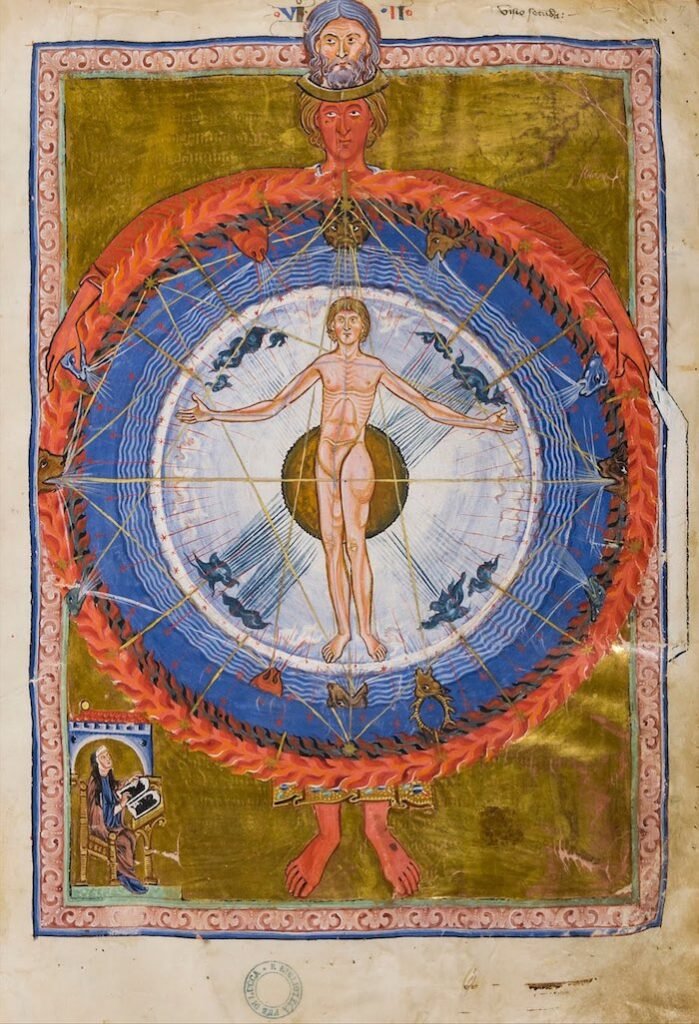
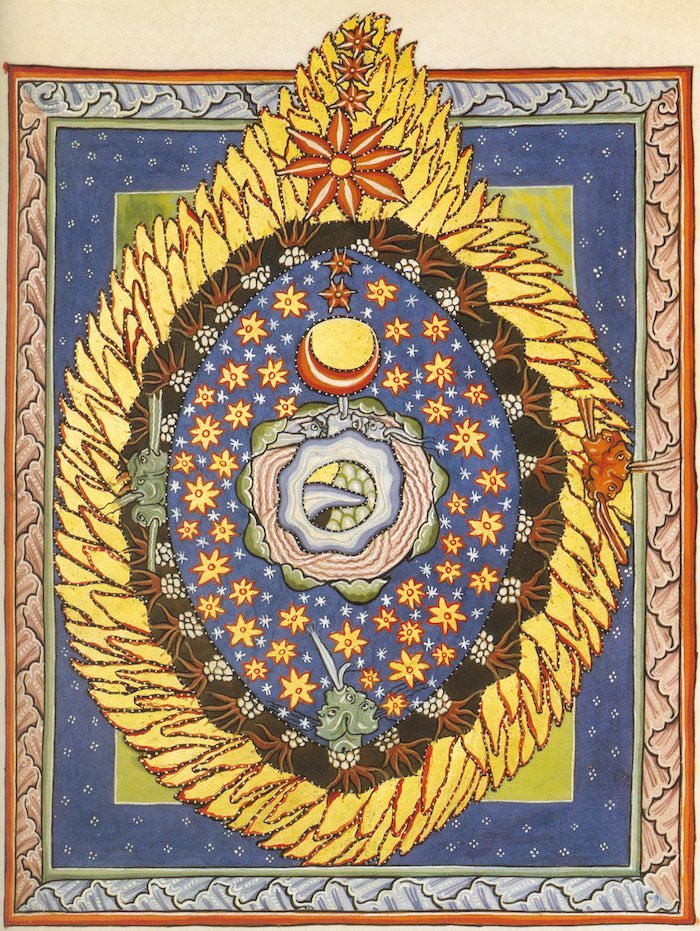
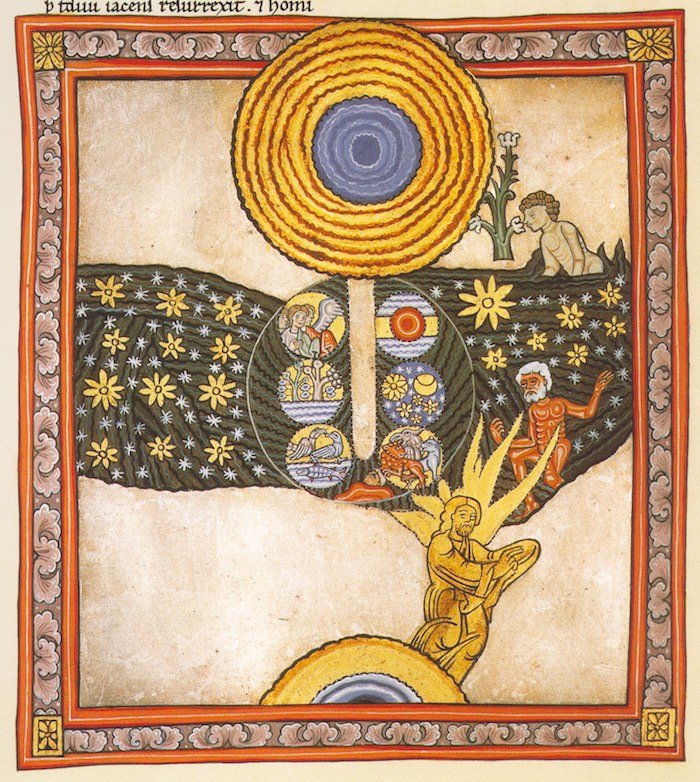
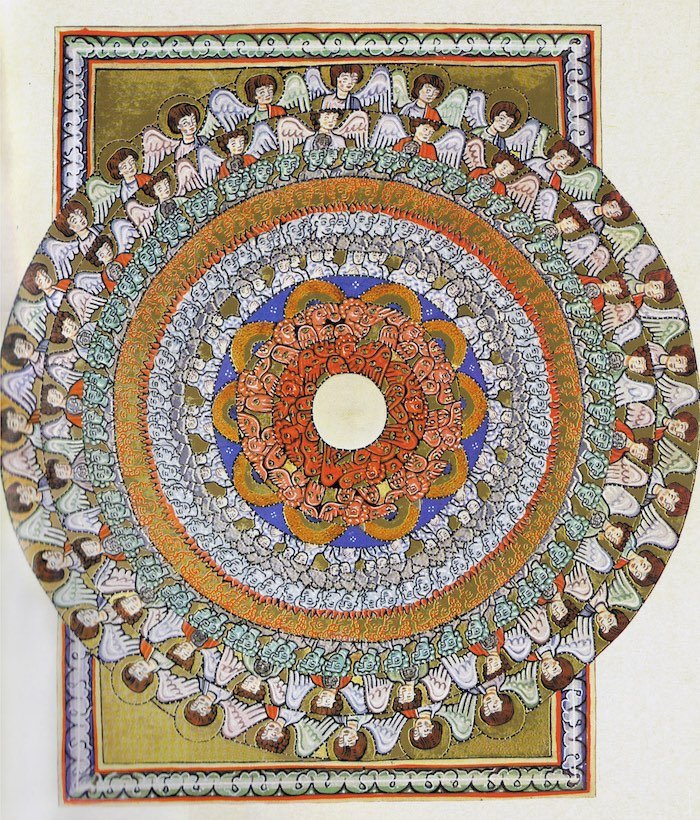
Nelle ore fredde del Reno medievale, Hildegarda scriveva mentre il resto del monastero dormiva. Le candele consumavano l’ossigeno, l’inchiostro si ispessiva per il freddo, le erbe medicinali essiccavano accanto ai muri umidi della clausura. Monaca, badessa, guaritrice, copista, visionaria insonne, trascorse la propria vita ascoltando corpi febbrili, respirazioni alterate, mutazioni della luce, improvvise irruzioni del cosmo nella materia quotidiana. Annotava visioni che sembravano nascere dal suo stesso interno organico. Le sue miniature conservano qualcosa di perturbante: figure umane aperte come anatomie cosmiche, vene che diventano fiumi, vegetazioni che proliferano dentro il corpo, architetture percorse da fuoco e liquidi, cieli che assomigliano più a membrane viventi che a sfondi celesti. Il cielo non si distingue mai davvero dalla carne.
La sua voce, nelle composizioni liturgiche, nasce da una soglia mobile tra corpo e visione. Il canto si dilata oltre il linguaggio, si fa vibrazione liquida, propagazione respiratoria, lunga corrente sonora che percorre insieme pietra, aria e tessuto umano. In Hildegarda nulla è astratto, nemmeno la spiritualità. Tutto passa attraverso il corpo: stanchezza, pressione atmosferica, voce, mutazioni lente del vivente. Forse è proprio qui che la sua presenza continua a risultare così contemporanea. Per Hildegarda comprendere il mondo non significava descriverlo, ma partecipare alla sua guarigione. Nella sua opera non esistono confini netti tra ciò che oggi chiameremmo arte, scienza, medicina, teologia o osservazione della natura. Ogni forma del sapere appare parte di una stessa trama di relazioni. È anche questa, forse, una delle intuizioni più radicali che il Padiglione raccoglie dalla sua eredità: l’idea che comprendere significhi anzitutto ricucire connessioni interrotte, restituendo continuità a ciò che la modernità ha separato. Cura del corpo, conoscenza delle piante, musica, preghiera, osservazione della natura e scrittura appartenevano a uno stesso gesto riparativo. Un sapere fondato sulla ricomposizione, più che sulla separazione, di ciò che appariva ferito, disperso o disgregato.
La sua idea di viriditas non coincide con una semplice allegoria della natura. È una forza umida, germinativa, una lenta energia di trasformazione che passa tra uomini, pietre, piante, stagioni, superfici. Cresce per propagazione, come il sale nei muri veneziani o l’acqua lagunare che modifica senza fretta tutto ciò che tocca. Il Padiglione si muove dentro questa stessa temporalità organica, rifiutando le immagini stabili a favore di materia, suono, architettura e corpi in scambio continuo. Ed è forse proprio qui che il progetto della Santa Sede raggiunge la propria zona più esposta. Perché invocare una diversa qualità della presenza oggi non è un gesto innocente. Non lo è dentro Venezia, non lo è dentro la Biennale, non lo è in un presente attraversato da guerre, polarizzazioni, conflitti di rappresentazione, economie della reazione continua. In questo contesto, ogni invito al silenzio rimane esposto a due possibilità opposte: trasformarsi in rifugio oppure aprire una diversa qualità della presenza. Il silenzio qui rifiuta tanto la sottrazione quanto la purezza contemplativa, somigliando piuttosto a certe ore lagunari in cui Venezia rallenta improvvisamente la propria pressione visiva: la nebbia trattiene le distanze, l’acqua smorza i rumori, le superfici iniziano piano piano ad assorbire luce e umidità. Questo progetto lavora dentro la stessa sospensione atmosferica. Non oppone il silenzio al mondo contemporaneo. Lascia invece che siano suono, evaporazione, durata e attraversamento a modificare progressivamente il ritmo della percezione.
La cosiddetta “lingua ignota” di Hildegarda sembra riaffiorare qui come una materia instabile più che come un sistema simbolico. Più che una lingua per nominare il mondo con precisione, serve ad avvicinarsi a ciò che nel mondo continua a sfuggire: febbri, visioni, mutazioni del corpo, movimenti invisibili dell’aria, vibrazioni interiori. Le parole appaiono allora come organismi incompleti, attraversate da vegetazione, acque, costellazioni, residui sonori.


I Carmelitani Scalzi costruirono la propria spiritualità contro l’eccesso. Contro il rumore, contro l’ornamento, contro la dispersione del desiderio. Dormivano poco, mangiavano poco, attraversavano lunghe ore di veglia e silenzio, lasciando che il corpo diventasse più spoglio, quasi consumato dalla disciplina della preghiera. L’architettura del convento riflette ancora questa tensione estrema verso la sottrazione: corridoi stretti, celle nude, luce trattenuta, superfici prive di enfasi. Nulla doveva distrarre dalla vita interiore.
Poi arrivò la stazione. Nell’Ottocento il convento venne amputato per fare spazio alla ferrovia di Santa Lucia. Una parte del giardino fu sacrificata all’ingresso della modernità: vapore, metallo, attraversamenti, folla. Da allora vive accanto a uno dei punti più rumorosi e instabili di Venezia. Tuttavia, proprio questa prossimità produce oggi una tensione quasi irreale. Il flusso continuo dei viaggiatori, gli altoparlanti, le valigie trascinate sui masegni, il movimento dei vaporetti: tutto questo scorre oggi a pochi metri dalle sue mura. Eppure il Giardino Mistico continua a sopravvivere come una zona di rallentamento improvviso, una piega umida sottratta al ritmo accelerato della città. La clausura non esiste più come separazione assoluta. Respira invece accanto al traffico, ai motori, agli arrivi e alle partenze. Come se il silenzio carmelitano e il rumore della modernità veneziana fossero rimasti lì, per oltre un secolo, a sfiorarsi senza mai riuscire davvero a cancellarsi.
A custodire questo luogo non è soltanto una comunità religiosa, ma una precisa geografia interiore. La riforma carmelitana avviata da Teresa d’Avila immaginava infatti il cammino spirituale come l’attraversamento di un castello composto da stanze successive, soglie, camere di raccoglimento e zone sempre più profonde dell’attenzione. Non è un caso che il Giardino Mistico conservi ancora oggi questa struttura simbolica: le sue sette aiuole riprendono le sette dimore del Castello Interiore (1577), trasformando il percorso botanico in una lenta architettura della contemplazione. Qui il giardino non rappresenta la natura. Diventa una forma del pensiero, una mappa vegetale dell’interiorità. Per secoli tale sapere è passato anche attraverso pratiche minime e quotidiane. Tra queste, la coltivazione e la distillazione della melissa, da cui nasce la tradizionale Acqua di Melissa ancora oggi legata alla tradizione carmelitana. Più che un semplice rimedio, essa appartiene a una concezione della cura in cui botanica, contemplazione e attenzione al corpo non risultano separate. In questo senso, il giardino conserva la memoria di una conoscenza che si trasmette attraverso gesti, stagioni, raccolti e trasformazioni graduali della materia.
Il suono non proviene soltanto dagli artisti invitati. È il giardino stesso a entrare poco a poco nella composizione. Il vento attraversa le foglie, l’acqua rimane trattenuta nel terreno, gli insetti incidono frequenze minime, le vibrazioni bioelettriche delle piante attraversano uno strumento sonoro concepito da Soundwalk Collective, capace di ascoltare il giardino in tempo reale. Il vivente smette qui di comportarsi come semplice paesaggio contemplativo. Diventa presenza attiva, organismo sonoro, materia viva che continua a produrre relazioni invisibili.
In Being Alive (Routledge, 2011), Tim Ingold immagina il mondo non come un insieme di cose compiute, ma come un meshwork, un intreccio di linee ancora in via di formazione: radice, pioggia, capillare radicale, e ancora radice, ciascuna intenta a trascinare in avanti la successiva. Il giardino si lascia leggere allo stesso modo: ciò che cresce è sempre nel mezzo della cucitura, un nodo che continua ancora ad annodarsi.
La percezione non appartiene più esclusivamente all’umano. Si sposta verso soglie più incerte, dove ambiente, tecnologia e forme di vita entrano continuamente in contatto. Sensori bioacustici, sistemi generativi, composizioni algoritmiche e pratiche contemplative convivono allora senza mai stabilizzarsi del tutto. La tecnologia non appare separata dal paesaggio, ma immersa dentro i suoi stessi processi di trasformazione.
La presenza degli artisti percorre il Padiglione in questa forma mobile e diffusa. Patti Smith porta una voce che da decenni oscilla tra invocazione, fragilità pubblica e poesia orale; le composizioni ambientali di Brian Eno modificano la temperatura percettiva dello spazio senza mai imporsi frontalmente allo sguardo; la ricerca vocale di Meredith Monk dissolve continuamente il confine tra corpo, respiro e paesaggio sonoro. Il cinema di Jim Jarmusch si muove dentro temporalità sospese, derive, silenzi e intervalli che alterano progressivamente la percezione della durata. Il fado spogliato di Carminho recupera invece un lutto antico, una saudade che si fa materia vocale prima ancora che canto. Terry Riley e Laraaji lavorano sulla ripetizione come soglia meditativa, un unico accordo che si dilata fino a diventare tempo sospeso. Suzanne Ciani restituisce al sintetizzatore una qualità quasi liturgica, un respiro elettronico che precede il linguaggio.
Accanto a queste pratiche convivono archivi sonori diasporici, ecologie computazionali, sistemi generativi, rituali collettivi. Le opere di Holly Herndon e Mat Dryhurst interrogano forme contemporanee della voce algoritmica e delle identità distribuite; Caterina Barbieri lavora sulle qualità ipnotiche della computazione sonora; Moor Mother attraversa memoria diasporica, rovine storiche e paesaggi acustici radicali; Kali Malone riapre la dimensione quasi architettonica della risonanza; Otobong Nkanga trasforma invece materia, estrazione ed ecologia in organismi percettivi instabili. Precious Okoyomon lavora sulla decomposizione come forma di conoscenza, un compostaggio della memoria che è insieme ferita e rigenerazione. Bhanu Kapil e Raúl Zurita portano la scrittura fino alla soglia del corpo malato, migrante o ferito da un continente intero. Devonté Hynes e FKA Twigs innestano nel Padiglione una voce pop già attraversata da lutto e trasformazione; Kazu Makino scompone la melodia in architetture visive quasi pittoriche.
Il Padiglione somiglia allora a un ecosistema poroso in cui tecnologia, botanica, voce, architettura e memoria continuano a contaminarsi.
Molte di queste pratiche insistono sul respiro — non come metafora spirituale, ma come ritmo che lega voce, fatica, durata, corpo e ambiente.
La presenza di Alexander Kluge introduce una diversa idea di montaggio percettivo: frammenti, lacune, sopravvivenze, passaggi temporali, più che immagini compatte o narrazioni lineari. È significativo che proprio da Kluge provenga il titolo L’orecchio è l’occhio dell’anima. Nel suo lavoro percezione e memoria non emergono mai attraverso forme stabili della visione, ma tramite interferenze continue tra immagini, testi, rovine storiche e suoni residuali.
Il Padiglione evita continuamente di stabilizzarsi in una sola forma. Non è un ambiente immersivo, né un archivio o un giardino sonoro. Ricorda piuttosto una struttura anfibia, attraversata da stati differenti della materia e dell’attenzione. Come Venezia stessa, sembra esistere dentro una condizione di trasformazione permanente, dove nulla rimane mai completamente separato da ciò che lo circonda.
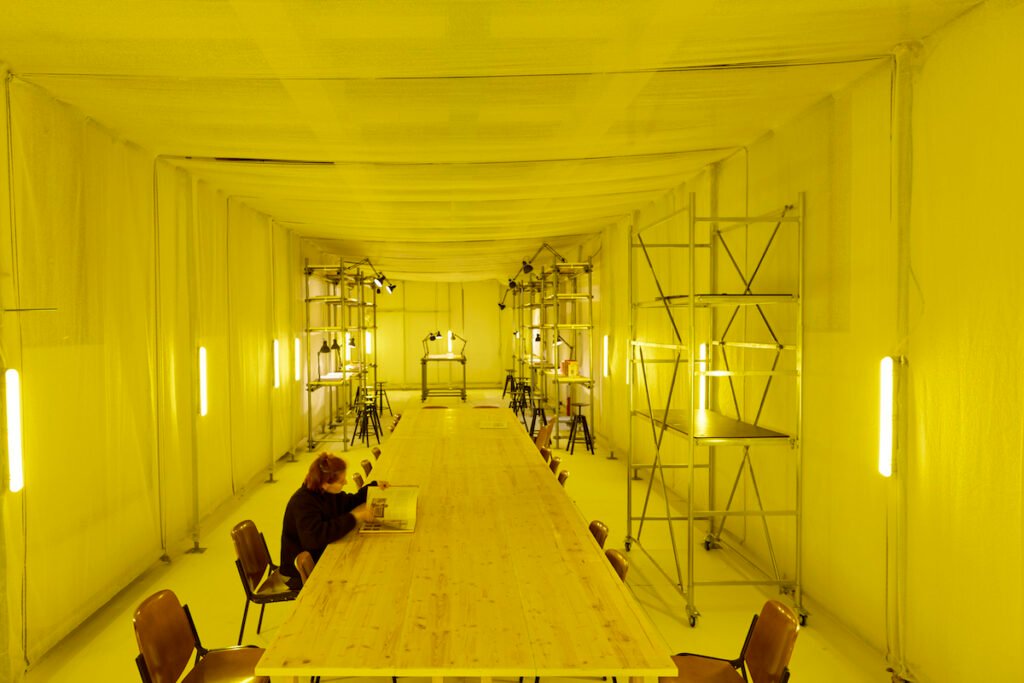
Una parte di esso assume la forma di uno scriptorium contemporaneo: non una ricostruzione nostalgica del monastero medievale, ma uno spazio in cui scrittura, attenzione e durata tornano a intrecciarsi. Nella tradizione monastica copiare un testo significava anzitutto modificare il ritmo del corpo: lasciare che la mano, il respiro e il tempo entrassero nella stessa disciplina dell’attenzione.

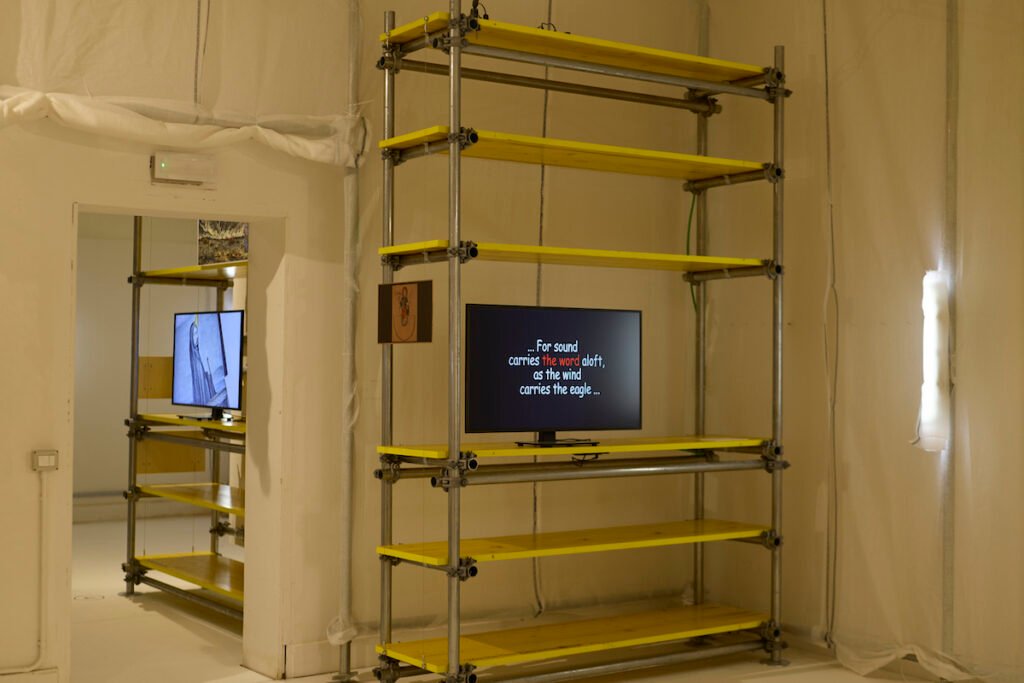
Qui la scrittura funziona meno come produzione di contenuti che come pratica di sedimentazione. Più che conservare documenti o testimonianze, questo luogo interroga la possibilità stessa della trasmissione. Lo scriptorium si trasforma così in un archivio vivente. Più che uno spazio dove il passato viene custodito al riparo dal presente, è un organismo in continua riattivazione, attraversato da letture, voci, traduzioni, pratiche di studio e nuove forme di interpretazione. Qui la memoria non appare come deposito. È piuttosto una materia ancora capace di generare futuro. Vi si affiancano i libri d’artista di Ilda David’, nei quali la pittura diventa esercizio spirituale e cartografia dell’invisibile. La biblioteca multilingue dedicata ai testi di Hildegarda non nasce da una semplice fascinazione contemporanea per la sua figura. Alle sue spalle si estende una lunga genealogia di studi, traduzioni, ricerche e pratiche di conservazione, sostenute in particolare da suor Maura Zátonyi e dalla St. Hildegard Academy di Eibingen. Attraverso il loro lavoro, questa eredità continua a essere non soltanto custodita, ma interrogata, tradotta e rimessa in circolazione. A questa eredità si affianca la liturgia sonora delle Monache Benedettine dell’Abbazia di Eibingen, il monastero fondato dalla stessa Hildegarda nel 1165. Resta così aperto il dialogo tra il XII secolo e il presente. L’ultima opera di Alexander Kluge e il nuovo spazio monastico progettato da Tatiana Bilbao Estudio, MAIO Architects e DOGMA trasformano il Complesso di Santa Maria Ausiliatrice in un’infrastruttura lenta della memoria.
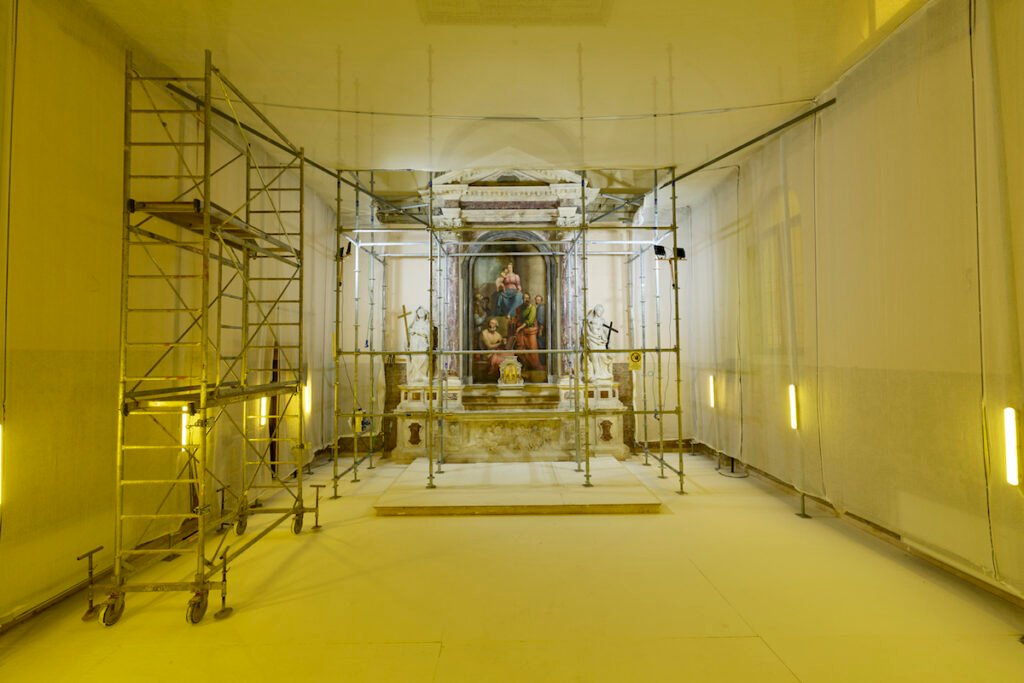
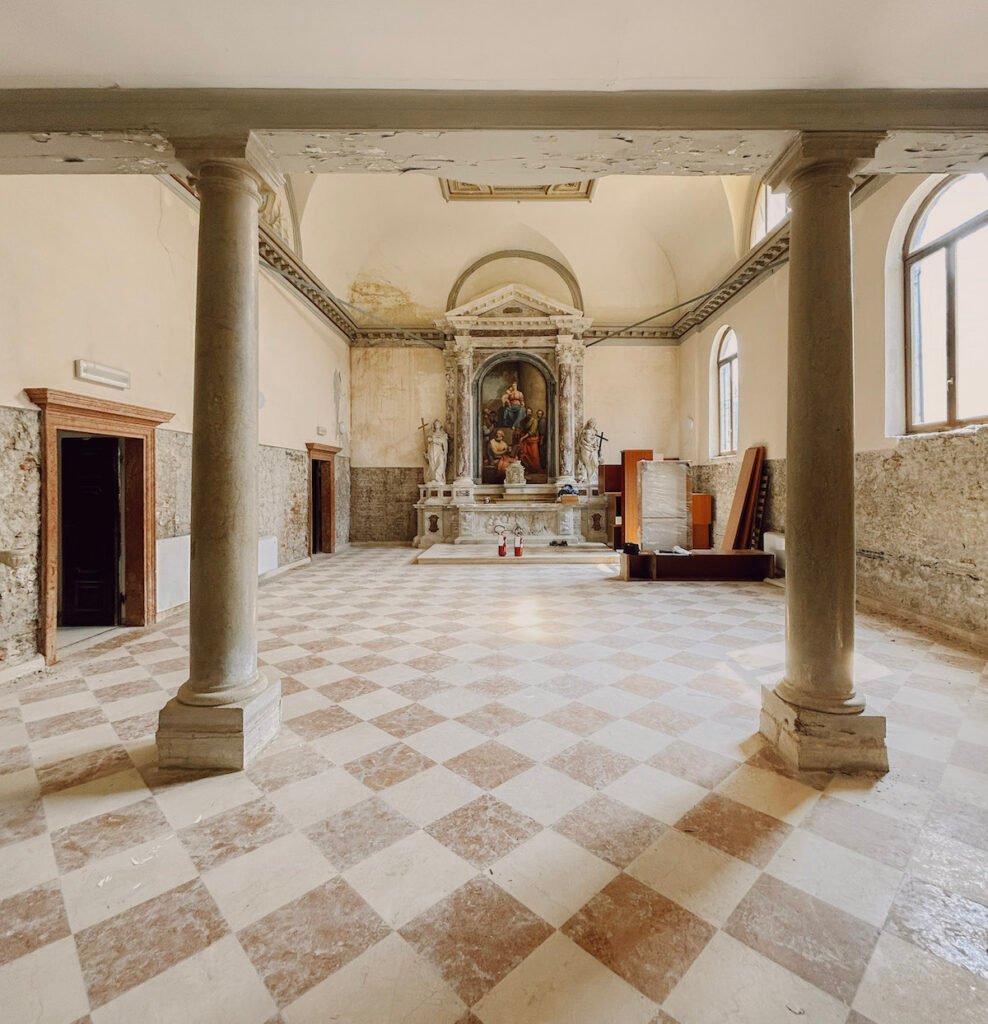
Nel sestiere di Castello, Santa Maria Ausiliatrice custodisce una temporalità diversa rispetto al Giardino Mistico. Qui Venezia sembra rallentare non attraverso apertura e dispersione atmosferica, ma tramite accumulo, stratificazione, permanenza. I muri trattengono umidità e salnitro, la luce lagunare si deposita con lentezza sulle superfici consumate, le stanze conservano ancora qualcosa della memoria silenziosa dei corpi passati. Anche l’architettura appare incompleta, esposta, continuamente attraversata dal tempo.
In continuità con Opera Aperta, il progetto presentato dalla Santa Sede alla Biennale Architettura del 2025, anche qui il cantiere smette di apparire come fase provvisoria da nascondere. Diventa piuttosto una condizione permanente della materia: manutenzione, vulnerabilità, trasformazione continua. Gli edifici stessi, in questo senso, restano strutturalmente incompiuti.
Le due sedi del Padiglione sembrano allora articolare due differenti temporalità del vivente. Da una parte il Giardino Mistico dei Carmelitani Scalzi, attraversato da evaporazione, vegetazione, aria e lente variazioni atmosferiche. Dall’altra Santa Maria Ausiliatrice, dove il tempo appare invece trattenuto dentro muri consumati, corridoi silenziosi, superfici segnate dal sale e dalla polvere d’acqua veneziana. Le due sedi diventano così due diverse respirazioni della stessa città.
Attraversare il Padiglione significa allora percorrere anche Venezia stessa. Camminare tra le due sedi vuol dire passare per calli, ponti, riflessi, aperture improvvise della laguna, lasciando che la città continui, senza fretta, a lavorare sul corpo. Una parte dell’esperienza accade proprio lì, negli intervalli: nel tempo necessario per spostarsi tra acqua, pietra, luce e distanza.
Anche per questo L’orecchio è l’occhio dell’anima non chiede di essere consumato frontalmente come un’unica esperienza. È piuttosto una graduale modificazione del rapporto tra attenzione, ambiente e durata. Chiede di rallentare abbastanza da lasciare che siano umidità, riverbero, evaporazione, oscillazioni luminose e respirazione dello spazio a trasformare progressivamente la qualità della presenza.
Gran parte delle esposizioni contemporanee continua a intensificare immagini, velocità e stimoli. Qui il gesto sembra quasi opposto: alleggerire, sottrarre, lasciare emergere ciò che normalmente rimane ai margini della percezione. Non l’immagine che si impone immediatamente allo sguardo, ma ciò che muta senza fretta, restando a lungo prima di farsi vedere.
È forse questo, in fondo, ciò che il Padiglione tenta di rendere percepibile: non un altrove separato dal presente, ma una diversa qualità dell’attenzione dentro il presente stesso.
A Venezia nulla rimane davvero immobile — la materia muta senza sosta, quasi senza farsi notare. Anche il Padiglione si muove dentro questa stessa logica di trasformazione impercettibile.
Per questo la risonanza, qui, è più vicina a una pratica di esposizione reciproca: tra corpi e architetture, tra tecnologia e vegetazione, tra memoria e materia, tra laguna e respiro. Una condizione mobile, da attraversare piuttosto che da possedere immediatamente.
È anche questo, forse, che Venezia continua a insegnare. Che esistono forme del vivente che non si impongono frontalmente allo sguardo. Non sorprende allora che il Padiglione porti con sé anche una dimensione di eredità e di congedo. Da un lato Alexander Kluge, la cui ultima opera conclude una lunga vita dedicata a interrogare le forme della memoria, della percezione e del racconto. Dall’altro Koyo Kouoh, alla cui visione curatoriale la Biennale continua a rispondere ben oltre la sua scomparsa. In modi diversi, entrambe queste presenze attraversano il progetto come una trasmissione ancora attiva: energia viva che continua a circolare attraverso opere, luoghi e comunità, più che memoria monumentale. Entrambe continuano a lavorare lentamente ai margini: come ciò che muta silenziosamente prima ancora di diventare immagine.
Non tutto ciò che dura, lo fa per essere visto. Qualcosa dura per essere, semplicemente, ancora capace di ascoltare.

Dove il significato eccede l’informazione
La conversazione che segue comincia là dove il testo precedente si interrompe: dalle domande che il Padiglione lascia aperte. Hans Ulrich Obrist e Rita Selvaggio si muovono tra memoria e teoria, ripercorrendo gli incontri, le letture, i rituali e i progetti irrealizzati che hanno dato forma al Padiglione e al pensiero curatoriale che lo sottende.
1. Sull’inversione epistemologica occhio/orecchio
Rita Selvaggio: Michel Serres, ne I cinque sensi, sosteneva che l’Occidente ha costruito la conoscenza sopprimendo il tatto e l’udito a favore della vista, e che il rumore — non il silenzio — è la condizione originaria di ogni comunicazione. Se il Padiglione capovolge davvero la gerarchia occhio-orecchio, non sta forse rovesciando l’intera metafisica della presenza su cui si fonda il sapere occidentale? È un progetto che pensa questa rottura, o che semplicemente la mette in scena?
Hans Ulrich Obrist: Per noi, per quanto io ami Michel Serres, in un certo senso è stato probabilmente Alexander Kluge a influenzare maggiormente il pensiero alla base di questo progetto. Ed è anche lui ad aver trovato il titolo, L’orecchio è l’occhio dell’anima.
Ho parlato con Alexander Kluge con grande regolarità per oltre venticinque anni.
Nelle nostre conversazioni degli ultimi due anni discutevamo molto spesso dell’importanza della viriditas per il XXI secolo, dell’idea di viriditas, sai. Direi dunque che Alexander Kluge è stato influente, ma anche Joachim-Ernst Berendt è interessante. Il suo libro Nada Brahma: The World Is Sound è un testo che leggo da molto tempo.
Secondo Serres, la modernità occidentale ha preso una direzione complessa e ha posto l’accento quasi esclusivamente sull’occhio, su questa centralità della vista. L’occhio è l’organo della distanza. Ha a che fare anche con il controllo e il possesso, e crea naturalmente una separazione, un taglio tra chi osserva e ciò che osserva.
È interessante che l’udito, l’ascolto, faccia esattamente il contrario, perché il suono entra dentro di noi. Vi siamo immersi. Ci circonda e non possiamo tenerlo lontano. Si tratta quindi più di ricevere che di possedere. Se la nostra civiltà non fosse stata così centrata sulla vista, in un certo senso avrebbe potuto svilupparsi in modo molto diverso.
Con Berendt, tutto ruota attorno all’acustica. È un pensiero molto olistico; l’ultima parte del libro si addentra in una dimensione profondamente mistica. Berendt è interessante anche perché, come Ildegarda, collega il suono alla guarigione. In quel punto diventa forse un po’ sopra le righe.
Ma Serres resta naturalmente fondamentale, perché ha pubblicato Les Cinq Sens (I cinque sensi), opponendosi con forza all’idea che il corpo si riduca alla vista. E la cosa interessante è il suo primo capitolo — di cui in effetti ho discusso con lui personalmente — che lì è assolutamente centrale.
C’è poi una grande differenza tra Berendt e Serres: per Serres c’è sempre il rumore, in un certo senso. È interessante: il rumore, o il rumore di fondo. In Berendt prevale forse l’armonia; Serres è forse più vicino alla turbolenza.
Trovo interessante anche il tuo accostamento a Serres in relazione a La Légende des anges, il libro sugli angeli. Lì Serres riflette sulla figura acustica e sul messaggero, che non è un oggetto ma una trasmissione, in un certo senso. Forse è un’altra connessione interessante, direi.
Anche nel suo ultimo libro, Relier, c’è questa idea del legare. E penso che, in un certo senso, con la mostra non vogliamo una rottura. Vogliamo piuttosto un’espansione, una nozione allargata — diciamo un’espansione multisensoriale. E credo che Ildegarda, come figura, sia molto legante.
2. Sul paradosso istituzionale
RS. La Chiesa cattolica è stata per secoli l’istituzione che ha regolato per prima la visibilità legittima in Occidente — il Concilio di Trento (1545–1563), l’iconografia come dottrina, l’immagine come strumento di controllo dottrinale. Come si concilia, nella pratica curatoriale, questa lunga eredità visiva con la scelta di un Padiglione che privilegia l’orecchio sull’occhio? Cosa significa, per te come curatore, costruire un paradigma percettivo alternativo dentro una storia così radicata nell’immagine?
HUO:Credo che riguardi entrambi i sensi. E credo che uno dei due sia stato talvolta dimenticato dalla storia dell’arte: l’orecchio è stato realmente trascurato. Per Ildegarda, la voce era una forma di viriditas, una forza verdeggiante, alcuni secoli prima del periodo a cui fai riferimento. Anche le campane svolgevano un ruolo centrale nell’organizzazione della vita quotidiana all’epoca di Ildegarda: scandivano la giornata e funzionavano come strumenti del tempo.
Non credo dunque che il Padiglione capovolga una gerarchia. Penso piuttosto che si tratti di dare spazio e tempo — oppure «visibilità» non è forse la parola giusta — di dare rilievo a un senso che non ha ricevuto l’attenzione che merita.
Ed è interessante, naturalmente, che il suono sia molto diverso dall’immagine: un’immagine può essere incorniciata, può essere spedita, mentre il suono ha molto più a che fare con la risonanza, con il suo ambiente; è condiviso.
Ecco, forse questa è la mia risposta alla domanda complessa che mi poni.
Per Ben Vickers, Soundwalk Collective e me, l’opera di Ildegarda arriva nel presente, nel mondo di oggi, con una forza rinnovata. È un richiamo all’attenzione e all’interiorità, e possiamo farne esperienza mentre si dispiegano le nuove composizioni commissionate ai diversi compositori nell’installazione olistica di Soundwalk Collective. Ci sono momenti strumentali, momenti affidati alla voce, momenti di poesia, di canto e di scrittura, ma anche momenti di silenzio.
3. Sulla curatela come partitura
RS. Hai sempre trattato le mostre come partiture da interpretare più che come oggetti da esporre — un’eredità Fluxus che risale a George Brecht. Ildegarda era una compositrice. Il Padiglione, diviso in due sedi che il visitatore attraversa fisicamente, è una partitura ancora incompiuta che si “esegue” camminando? E se sì: dove finisce il curatore e comincia il compositore?
HUO: Sì, le partiture sono state centrali nel mio lavoro curatoriale fin dai primi anni Novanta. Naturalmente il progetto do it ne fu in un certo senso l’inizio, ispirato da Christian Boltanski e Bertrand Lavier.
Fin dall’inizio, quando cominciai a curare mostre nei primi anni Novanta, mi interessava il fatto che una mostra arriva e poi se ne va. E mi interessava, inizialmente, questa idea: come si potrebbe avere davvero un repertorio di mostre?
Conobbi il drammaturgo Eugène Ionesco quando ero davvero molto giovane. Ero un adolescente, avevo sedici, diciassette anni, a San Gallo, nel 1985. Ionesco, il pioniere del Teatro dell’Assurdo, verso la fine della vita non scriveva quasi più, ma realizzava disegni, ed era a San Gallo per eseguire alcune acqueforti e litografie presso l’Erker Press.
Ebbi l’incredibile fortuna di prendere un caffè con lui. Gli parlai della mia passione per l’arte e del fatto che, già da adolescente, avevo cominciato il percorso che mi avrebbe portato a diventare curatore. Mi diede una vera e propria lezione. Davanti a un caffè, mi spiegò tutto questo attraverso qualcosa di immateriale: la sua pièce La Cantatrice calva, rappresentata ogni sera ormai da molti decenni. Mi raccontò che lo scultore César, che conosceva, aveva alcuni monumenti in bronzo installati come se dovessero restare lì per sempre; dieci, venti, trent’anni dopo, però, erano stati smontati e trasferiti altrove. Rideva, dicendo che la sua pièce, La Cantatrice calva, aveva avuto una durata — o forse «presenza» è la parola più giusta — più lunga di un bronzo.
Per me fu un pensiero interessante. In sostanza mi parlava di repertorio, ma anche della possibilità di una lunga durata. Da lì nacque, naturalmente, l’idea di una mostra che potesse essere immateriale senza mai fermarsi.
Volevamo dunque realizzare una mostra composta di partiture, con do it, che prosegue dal 1992-93 — quindi da trentatré, trentaquattro anni — senza mai fermarsi. C’è sempre stata, da qualche parte nel mondo, una versione di do it in corso. A oggi se ne contano circa duecento.
Anche questo, naturalmente, si ispirava a The Family of Man, la mostra di Steichen, che non finiva mai. Dunque l’idea di una mostra che si potesse eseguire più e più volte.
I riferimenti erano naturalmente le partiture aperte di Fluxus e George Brecht; anche Alison Knowles, Yoko Ono, che pubblicò molto presto Grapefruit, e John Cage facevano parte di questa storia. Tutte queste figure e le loro partiture aperte furono per me una grande fonte di ispirazione.
Ed è interessante pensarci in relazione a Ildegarda, perché in un certo senso i neumi non sono prescrittivi quanto le partiture musicali più recenti. Danno un’indicazione vaga — o, meglio, aperta — a chi le canta, lasciando molto spazio.
In questo senso, le partiture di Ildegarda non sono sovradeterminate, ma aperte. Si può dunque tracciare una linea. C’è anche l’idea della partitura come tecnologia di coordinamento: è la persona che la esegue a metterla in atto; è una comunità a metterla in atto. Ecco il legame con Ildegarda.
Mi interessa anche la tua domanda sulla passeggiata tra i due luoghi: tra il Padiglione e Santa Maria Ausiliatrice, vicino all’Arsenale.
La passeggiata è sempre stata centrale nel mio lavoro, fin da quando fondai il Museo Robert Walser. Vale la pena ricordare Robert Walser: nei primi anni Novanta fondai per lui un museo — un museo di strollologia, per così dire — dove si ripercorreva una delle sue celebri passeggiate nelle prealpi vicino ad Appenzell.
Installammo poi una vetrina nel ristorante dell’Hotel Krone a Gais e presentammo opere di artisti come Thomas Ruff, Hugo Suter e Dominique Gonzalez-Foerster, che realizzò anche uno dei primi progetti del museo, dedicato all’ultima passeggiata di Walser nella neve. È interessante applicare quell’idea a Venezia: cosa potrebbe essere una strollologia veneziana?
La strollologia rimanda, naturalmente, al sociologo svizzero Lucius Burckhardt, che fondò la scienza del camminare all’Università di Kassel. Pensando all’attraversamento di Venezia a piedi, un’altra fonte di ispirazione è il testo del 1977 di Georges Perec e Harry Mathews, Roussel et Venise: Esquisse d’une géographie mélancolique. I due scrittori dell’Oulipo scrissero un libro su Venezia che costituisce una sorta di psicogeografia veneziana. Forse è un riferimento per collegare le due mostre.
In questo senso, sono in gioco diverse partiture. Le partiture relativamente aperte di Ildegarda sono il punto di partenza — e questa è una mostra interamente dedicata a lei. Molti compositori e poeti hanno scritto composizioni ispirate alla sua figura.
Abbiamo poi il meta-compositore Soundwalk Collective, invitato da Ben Vickers e da me. Soundwalk Collective è un collettivo di artisti che ha creato una meta-composizione capace di riunire più di venti composizioni in un’esperienza olistica.
Se loro sono i meta-compositori, allora Ben Vickers e io, come curatori, potremmo essere i meta-meta-compositori, perché abbiamo invitato i meta-compositori e, insieme a loro, i compositori.
Non credo che il curatore sia il compositore. Abbiamo invitato dei compositori e, soprattutto, Ildegarda stessa è una compositrice straordinaria. Ben e io non abbiamo scritto musica: abbiamo rivolto un invito. Curare significa prendersi cura. Forse abbiamo meta-meta-composto la costellazione.
4. Sul non-finito e la morte come categoria curatoriale
RS. Buona parte della tua pratica si è costruita attorno a progetti non realizzati. Qui, però, accade qualcosa di più difficile: Kluge completa i suoi dodici film poco prima di morire; Kouoh muore prima di vedere realizzata la Biennale che aveva concepito. Non lo chiedo con leggerezza, sapendo quanto fossi vicino a entrambi. Ma il Padiglione è costruito, in senso molto letterale, attorno a due assenze — e questo sembra richiedere una categoria che il nostro campo non possiede davvero. Tra il realizzato e il non realizzato, esiste un nome per un’opera portata a compimento da altri, dopo la morte di chi l’aveva concepita?
HUO: In effetti sì: con la compianta Koyo Kouoh ho collaborato, insieme a Daniel Baumann e Philip Ursprung, Cristina Bechtler e Dayle Bechtler-Lustenberger, agli Engadin Art Talks, un progetto che si svolge ogni gennaio a Zuoz, nell’Engadina svizzera. Si tratta, si potrebbe dire, di una conversazione di montagna, fatta di performance e incontri.
L’ultima volta che ci vedemmo fu nel gennaio dell’anno scorso e avemmo lunghe conversazioni. Quello fu, in effetti, il mio ultimo incontro con Koyo. Era diretta a Venezia e ricordo che desiderava davvero che gli spettatori e i visitatori della Biennale rallentassero. Koyo aveva concepito la mostra principale della Biennale, mentre noi curavamo uno dei padiglioni nazionali. Idealmente, c’era sempre l’idea che il padiglione nazionale entrasse in risonanza con il tema della direttrice, e ci siamo concentrati molto su questo aspetto. Articoliamo questa risonanza anche nel testo.
Ed è interessante la nozione di risonanza. Hartmut Rosa, uno dei miei pensatori preferiti degli ultimi anni, parla di risonanza in relazione all’affetto. La risonanza comporta affetto e trasformazione, ma non può essere prodotta a comando: si possono soltanto creare le condizioni perché accada, e poi accade.
Direi che il nostro Padiglione della Santa Sede risuona con il tema di Koyo.
Inoltre, agli Engadin Art Talks di quest’anno, in gennaio, abbiamo reso omaggio a Koyo con una performance della sua amica Otobong Nkanga, artista centrale anche nel Padiglione a Venezia quest’anno. Nella mostra di Koyo, ha realizzato la facciata e il giardino del Padiglione Centrale.
Con Alexander Kluge è stato molto diverso perché, naturalmente, Alexander è rimasto presente molto più a lungo, nel senso che ha potuto quasi completare l’opera. È scomparso solo poche settimane prima dell’apertura della Biennale e aveva effettivamente terminato i suoi dodici film — i suoi ultimi film — per la mostra. Il lavoro era probabilmente completo al novanta, novantacinque per cento. Insieme ai suoi collaboratori e a suo figlio Leonard Kluge, abbiamo poi ultimato l’installazione.
Con Alexander Kluge si trattava, com’è ovvio, di una collaborazione diretta, quotidiana. Più ancora, l’intera mostra su Ildegarda di Bingen, articolata nelle due sedi, è stata profondamente ispirata dalle mie conversazioni con lui, protrattesi per più di trent’anni, durante le quali menzionava molto spesso Ildegarda di Bingen.
Ben Vickers e io cominciammo a concepire la mostra con Soundwalk Collective, dopo l’invito del cardinale José Tolentino de Mendonça, prefetto del Dicastero per la Cultura e l’Educazione, il grande poeta portoghese.
Oggi è molto raro che un grande artista — qualcuno che conosce profondamente l’arte e prova per essa un affetto profondo, sentendosene vicino — sia responsabile della cultura di un paese, come lo fu André Malraux in Francia. È accaduto anche con alcuni grandi scrittori latinoamericani, come Vargas Llosa o il mio amico Carlos Fuentes, appartenenti a una generazione di scrittori spesso coinvolti in politica. Oggi accade troppo raramente.
Così, sì, quando lo straordinario cardinale ci invitò a creare il Padiglione, una delle prime cose che facemmo fu andare a parlare con Alexander.
Invitai per la prima volta Alexander Kluge a partecipare a un progetto a Stoccolma, nel 1998. Si trattava del progetto per la Capitale Europea della Cultura, e decisi che, invece di realizzare una mostra fisica, avrei creato un’esposizione televisiva, con cortometraggi d’artista trasmessi dopo il telegiornale delle otto di sera.
Commissionammo cortometraggi a circa dodici artisti, e Alexander fu uno di loro. Rimase assolutamente affascinato dall’idea di Arkipelag TV: l’idea di avere molti brevi film commissionati. Fu un’idea che avrebbe poi sviluppato ampiamente attraverso la sua serie di cortometraggi, compresi i dodici film su Ildegarda di Bingen realizzati per la Biennale.
Nel corso degli anni, abbiamo istituito un rituale. Viviamo in un mondo sempre più privo di rituali. Perciò l’idea di introdurne è importante.
Alexander e io ci incontravamo ogni 1° gennaio, alle tre del pomeriggio in punto, a Sils Maria, sulle montagne svizzere, all’Hotel Waldhaus, per un caffè o un tè. Discutevamo dell’anno nuovo, dei temi, delle sfide, dei nostri progetti. Durante queste conversazioni del 1° gennaio, parlavamo anche molto spesso dell’importanza delle pratiche olistiche di Ildegarda di Bingen per il nostro tempo.
Così, non appena Ben e io ricevemmo l’invito del cardinale e cominciammo a lavorare a questo progetto con Soundwalk Collective, chiamammo Alexander, andammo a trovarlo e gli chiedemmo se volesse partecipare. Trovò immediatamente il titolo, L’orecchio è l’occhio dell’anima. Fu straordinario e lo scegliemmo subito.
Alexander abbracciò anche l’idea di creare, nel giardino, una mostra interamente dedicata al suono, benché lui stesso volesse realizzare film. Fu così che nacque la seconda idea: creare anche una mostra a Santa Maria Ausiliatrice.
L’idea nasce naturalmente anche da un altro mio progetto rimasto irrealizzato. In sostanza, il progetto veneziano della Santa Sede è la realizzazione di due progetti che avevo sempre desiderato compiere ma che erano rimasti irrealizzati.
Uno è il progetto su Ildegarda che io e Ben sviluppavamo, credo, da quindici anni come progetto irrealizzato. Il secondo è l’idea di creare un padiglione capace di sottrarsi alla logica della tabula rasa.
Quando curai il Padiglione svizzero più di dieci anni prima, creammo il Padiglione della Svizzera per la Biennale di Architettura attorno a Lucius Burckhardt e Cedric Price.
Realizzammo quel Padiglione, e curare un padiglione a Venezia significa, com’è ovvio, tornarci ripetutamente — per allestirlo, disallestirlo e vedere lo spazio quando è vuoto. Mi resi conto che, se ci si va a novembre, per esempio, dopo la chiusura della Biennale, tutti i padiglioni vengono svuotati, tutto viene gettato via, le pareti abbattute e tutto ricomincia da zero.
Feci a me stesso una promessa: se mai avessi curato di nuovo un padiglione — non avevo alcuna certezza che sarei mai più stato invitato a curare un padiglione nazionale nel corso della mia vita — avrei senz’altro resistito a questo approccio da tabula rasa. Avrei pensato, invece, a come un padiglione potesse svilupparsi piuttosto come un giardino: a come potesse crescere e accumulare strati.
E, meravigliosamente, il padiglione precedente era Opera aperta. Era stato concepito come un’opera aperta per la Biennale di Architettura.
Parlammo con Alexander e decidemmo che, oltre al giardino — poiché era ormai chiaro che il giardino dovesse essere dedicato esclusivamente al suono, concentrato sul suono piuttosto che sul film — avremmo mostrato i film altrove. C’era una sala nel giardino dove avremmo potuto proiettarli, ma volevamo che restasse esclusivamente un giardino sonoro, un giardino mistico.
Parlammo dunque con Alexander e discutemmo la possibilità di mostrare i film all’interno della struttura espositiva già esistente, mantenendo l’allestimento di Opera aperta. E lui si mise al lavoro. Sì: Opera aperta era il Padiglione della Santa Sede alla 19ª Biennale di Architettura del 2025, curato da Marina Otero Verzier e Giovanna Zabotti, con due studi di architettura: Tatiana Bilbao ESTUDIO e MAIO Architects.
Con Tatiana Bilbao ero già in dialogo su Ildegarda in occasione di una conferenza di alcuni anni fa, a proposito del monastero che sta attualmente progettando e costruendo in Germania. La contattammo dunque immediatamente, proponendole di presentare, accanto ai film di Alexander Kluge, anche il suo progetto di monastero del XXI secolo, ispirato a Ildegarda e concepito per il presente.
Abbiamo inoltre allestito una biblioteca dedicata a Ildegarda di Bingen all’interno dell’allestimento ereditato da Opera aperta. In questo senso, c’erano tre strati: la biblioteca, il progetto di monastero di Tatiana Bilbao Estudio e MAIO Architects e i film di Alexander, insieme a tutti i suoi documenti e testi.
Non si tratta soltanto di un’installazione filmica: comprende anche numerose stampe. Alexander ha stampato su immagini preesistenti e su materiali diversi. E, naturalmente, vi è anche moltissimo testo.
Questi tre strati si sono aggiunti a Opera aperta. In questo senso, è stato il contrario del consueto approccio da tabula rasa della Biennale. Così ha dato vita a entrambi i progetti rimasti a lungo irrealizzati.
Interessante è anche il fatto che Alexander avesse realizzato un film di cui avevamo discusso. Si intitolava The Assault of the Present on the Rest of Time, del 1985 — Der Angriff der Gegenwart auf die übrige Zeit. Affronta il modo in cui questo presente frenetico domina e spesso cancella le nostre relazioni e risonanze sia con il passato sia con il futuro.

The Slow Shapes of the Living | Conversation with Hans Ulrich Obrist
The Ear Is the Eye of the Soul. Holy See Pavilion, Venice Biennale 2026
“To listen is to be opened to the other and transformed by the other at our most intimate core. Intimacy, in these ways of thinking, is neither escape nor shelter, but rather the place of broader exposure.”
— Jean-Louis Chrétien, The Call and the Response, trans. Anne A. Davenport, Fordham University Press, 2004, p. 63
In Venice, hearing comes before sight.
Water always arrives ahead of the image. It touches the footings, climbs the stone by degrees, alters the weight of the air, carries engines from far off, ropes slapping the moorings, footsteps scattering under the vaulted passageways, bells warped out of shape by fog. Nothing stands clear of its own echo. The architecture seems raised not only to be crossed by the eye, but to take the damp into itself, and the echo, and the changes in the weather.
Perhaps this is also why the Holy See Pavilion at the 2026 Venice Biennale steers clear of announcing itself as just another exhibition space. The Ear Is the Eye of the Soul is the project curated by Hans Ulrich Obrist and Ben Vickers, set between the Mystic Garden of the Discalced Carmelites and the Complex of Santa Maria Ausiliatrice. More than occupying two sites, the path works its way into the city like a different discipline of presence. It refuses to add new images to the Biennale’s noise, working instead through slowing, through thresholds of perception, through small intensities. This choice also grows out of a dialogue with Koyo Kouoh’s curatorial proposal for the 2026 Biennale, built around the need to slacken the pace, pull back from saturation, and find deeper forms of presence. In this sense, The Ear Is the Eye of the Soul does not stand apart from the Biennale — it takes up one of its deepest questions: how to keep perceiving when the world seems always to demand a reaction? In a time when everything wants to become an image at once, the eye is not asked to possess, but to stay a while, long enough for something to begin, slowly, to change. The reference to Hildegard of Bingen surfaces this way, almost by seepage. It rises the way groundwater rises: unannounced, but changing, bit by bit, the give of the ground underfoot.
In the cold hours by the medieval Rhine, Hildegard wrote while the rest of the monastery slept. The candles ate into the air, the ink thickened with the cold, medicinal herbs dried out beside the damp walls of the enclosure. Nun, abbess, healer, copyist, sleepless visionary — she spent her life listening to fevered bodies, broken breathing, the changing of the light, the cosmos breaking suddenly into the stuff of the everyday. She set down visions that seemed to be born from her own organic inwardness.
Her illuminations hold something unsettling: human figures split open like cosmic anatomies, veins that turn into rivers, vegetation thickening inside the body, buildings run through with fire and liquid, skies that look less like backdrops than living membranes. The sky is never truly cut off from the flesh.
Her voice, in the liturgical compositions, rises from a threshold that will not hold still, somewhere between body and vision. The chant stretches past language, turns to liquid vibration, to the propagation of breath, a long running current of sound moving through stone, air and human tissue all at once. In Hildegard nothing is abstract, not even the spirit. Everything passes through the body: tiredness, air pressure, voice, the slow mutations of living things. Perhaps this is exactly why her presence still reads as so contemporary. For Hildegard, to understand the world did not mean to describe it, but to take part in its healing. In her work there are no clean borders between what we would now call art, science, medicine, theology, or the observation of nature. Every form of knowledge appears part of a single weave of relations. This, too, may be one of the most radical intuitions the Pavilion draws from her legacy: the idea that to understand means, first of all, to stitch broken connections back together, restoring continuity to what modernity has torn apart. Care of the body, knowledge of plants, music, prayer, the observation of nature, and writing all belonged to the same act of mending. A knowledge built on putting back together, rather than on tearing apart, what had come to seem wounded, scattered, or broken.
Her idea of viriditas is not just an allegory for nature. It is a damp, germinal force, a slow energy of change passing between men, stones, plants, seasons, surfaces. It grows by spreading, the way salt spreads through Venetian walls, or the way lagoon water works, unhurried, on everything it touches. The Pavilion moves inside that same organic time, turning away from fixed images in favour of matter, sound, architecture and bodies in constant exchange. And perhaps it is exactly here that the Holy See’s project reaches its most exposed ground. Because to call for a different quality of presence today is no innocent gesture. Not in Venice, not at the Biennale, not in a present cut through by war, polarisation, quarrels over representation, economies that run on nothing but reaction. In such a climate, every call to silence remains open to two opposite possibilities: tipping into refuge, or opening onto a different quality of presence. Here silence refuses both subtraction and contemplative purity, closer instead to those hours on the lagoon when Venice suddenly eases off its own visual pressure: fog holds the distances back, water muffles the noise, surfaces begin, little by little, to take in light and damp. This project works inside that same suspended air. It does not set silence against the contemporary world. It lets sound, evaporation, duration and crossing do the work instead, changing the pace of perception by degrees.
Hildegard’s so-called ‘unknown language’ seems to resurface here less as a symbolic system than as unsettled matter. Rather than a tongue for naming the world precisely, it serves to draw closer to what in the world keeps slipping away: fevers, visions, the body’s changes, the invisible movement of air, inward tremors. The words come across, then, as unfinished organisms, run through with vegetation, water, constellations, the leftover hum of sound.
The Discalced Carmelites built their spirituality against excess. Against noise, against ornament, against the scattering of desire. They slept little, ate little, kept long hours of vigil and silence, letting the body grow steadily barer, all but worn down by the discipline of prayer. The architecture of the convent still carries that extreme pull toward subtraction: narrow corridors, bare cells, light held back, surfaces stripped of emphasis. Nothing was meant to draw the mind away from its own interior.


Then the station came. In the nineteenth century the convent was cut back to make room for the Santa Lucia railway. Part of the garden was given up to the entry of the modern world: steam, metal, crossings, crowds. Ever since, it has lived next to one of the noisiest, most unsettled spots in Venice. And yet that very closeness produces, today, an almost unreal tension. The steady flow of travellers, the loudspeakers, suitcases dragged over the masegni, the coming and going of the vaporetti — all of it now runs a few metres from its walls. And yet the Mystic Garden survives as a sudden pocket of slow time, a damp fold pulled out of the city’s hurrying rhythm. Enclosure no longer exists as absolute separation. Instead, it breathes alongside the traffic, the engines, the arrivals and departures — as though the Carmelite silence and the noise of modern Venice had gone on, for more than a century, brushing against each other without either one ever quite managing to rub the other out.
What sustains this place is not only a religious community, but a precise inner geography. The Carmelite reform begun by Teresa of Ávila pictured the spiritual path as the crossing of a castle made up of successive rooms, thresholds, chambers of recollection, ever deeper zones of attention. It is no accident that the Mystic Garden still holds this symbolic structure today: its seven beds take up the seven dwelling-places of the Interior Castle (1577), turning the walk through the plants into a slow architecture of contemplation. Here the garden does not stand in for nature. It becomes a shape of thought, a green map of the inner life. For centuries this knowledge has also passed down through small, everyday practices. Among them, the growing and distilling of lemon balm, source of the traditional Carmelite Melissa Water made here to this day. More than a simple remedy, it belongs to an idea of care in which the plants, the contemplation, and the attention paid to the body are never held apart. In this sense the garden keeps the memory of a knowledge passed on through gesture, season, harvest, and the slow changes worked on matter.
The sound does not come only from the invited artists. The garden itself works its way into the composition, bit by bit. Wind moves through leaves, water is held back in the soil, insects cut small frequencies into the air, the bioelectric flicker of the plants runs through an instrument devised by Soundwalk Collective, capable of listening to the garden in real time. Here the living stops behaving like mere contemplative scenery. It becomes an active presence, a sounding organism, live matter that keeps producing relations no one can see.
Tim Ingold pictures the world in Being Alive (Routledge, 2011) less as a set of finished things than as a meshwork of lines still being drawn — root, rain, root hair, and root again, each tugging the next one forward. The garden reads the same way: what grows is always mid-stitch, a knot still being tied.
Perception no longer belongs only to the human. It shifts toward less certain thresholds, where environment, technology, and living forms keep coming into contact. Bio-acoustic sensors, generative systems, algorithmic compositions, and contemplative practice live side by side here, never quite settling into one fixed shape. Technology does not stand apart from the landscape — it is caught up inside the same processes of change.
The artists’ presence moves through the Pavilion in this same shifting, scattered way. Patti Smith brings a voice that for decades has swung between invocation, public frailty, and spoken poetry; Brian Eno‘s ambient compositions shift the felt temperature of the space, never pressing themselves on the eye; Meredith Monk’s work with the voice keeps dissolving the line between body, breath and soundscape. Jim Jarmusch‘s cinema moves through suspended time, drift, silence, and intervals that gradually alter how duration itself is felt. Carminho‘s bare fado retrieves an ancient grief, a saudade that turns to voice before it turns to song. Terry Riley and Laraaji work on repetition as a kind of meditative threshold, one chord stretched until it becomes suspended time. Suzanne Ciani gives the synthesizer something close to liturgy, an electronic breath that comes before language.
Beside these there are diasporic sound archives, computational ecologies, generative systems, collective rituals. The work of Holly Herndon and Mat Dryhurst questions what algorithmic voice and distributed identity look like now; Caterina Barbieri works the hypnotic edge of computational sound; Moor Mother moves through diasporic memory, historical ruin, and radical soundscapes; Kali Malone reopens the almost architectural weight of resonance; Otobong Nkanga, in turn, transforms matter, extraction and ecology into unsteady, perceptual organisms. Precious Okoyomon works on decomposition as a form of knowledge, a composting of memory that is wound and regrowth at once. Bhanu Kapil and Raúl Zurita carry writing to the threshold of the sick body, the migrant body, a body wounded by an entire continent. Devonté Hynes and FKA Twigs bring into the Pavilion a pop voice already worked through by grief and change; Kazu Makino breaks melody down into visual, almost painterly architectures.
The Pavilion comes to resemble, then, a porous ecosystem in which technology, plant life, voice, architecture and memory bleed into one another.
Many of these practices lean on breath — not as spiritual metaphor, but as the rhythm that ties voice, effort, duration, body and surroundings together.
Alexander Kluge‘s presence brings a different idea of montage into the Pavilion: fragments, gaps, survivals, temporal passages, rather than tidy images or straight-line narrative. It is telling that the title The Ear Is the Eye of the Soul comes from Kluge himself. In his work, perception and memory never surface through settled forms of seeing, but through constant interference among images, texts, historical ruin, and the residue of sound.
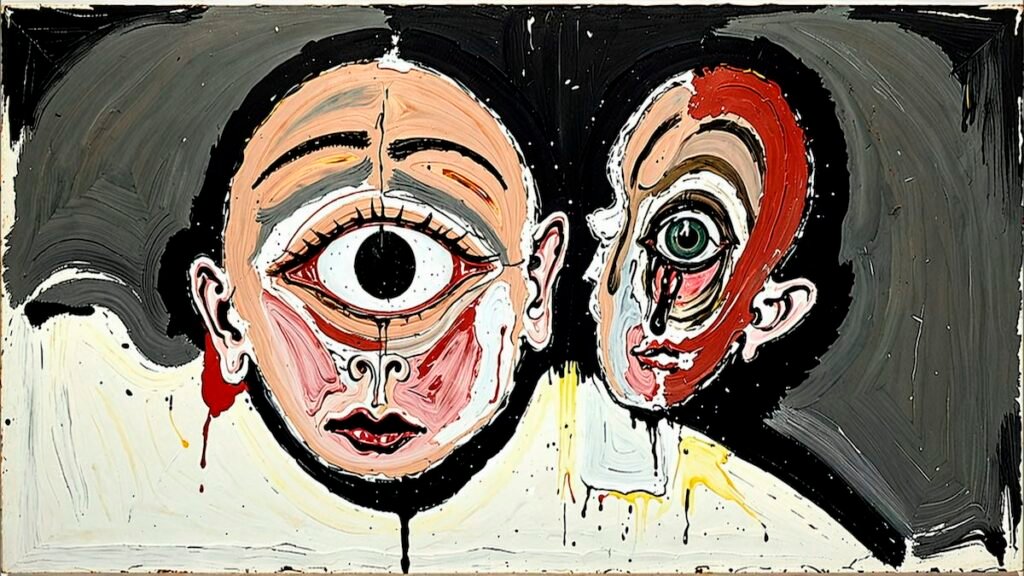

The Pavilion keeps refusing to settle into one single shape. It is not an immersive environment. It is not an archive. It is not a garden of sound. It calls to mind, instead, an amphibious structure, crossed by different states of matter and of attention. Like Venice itself, it seems to exist inside a permanent state of change, where nothing is ever quite cut off from what surrounds it.
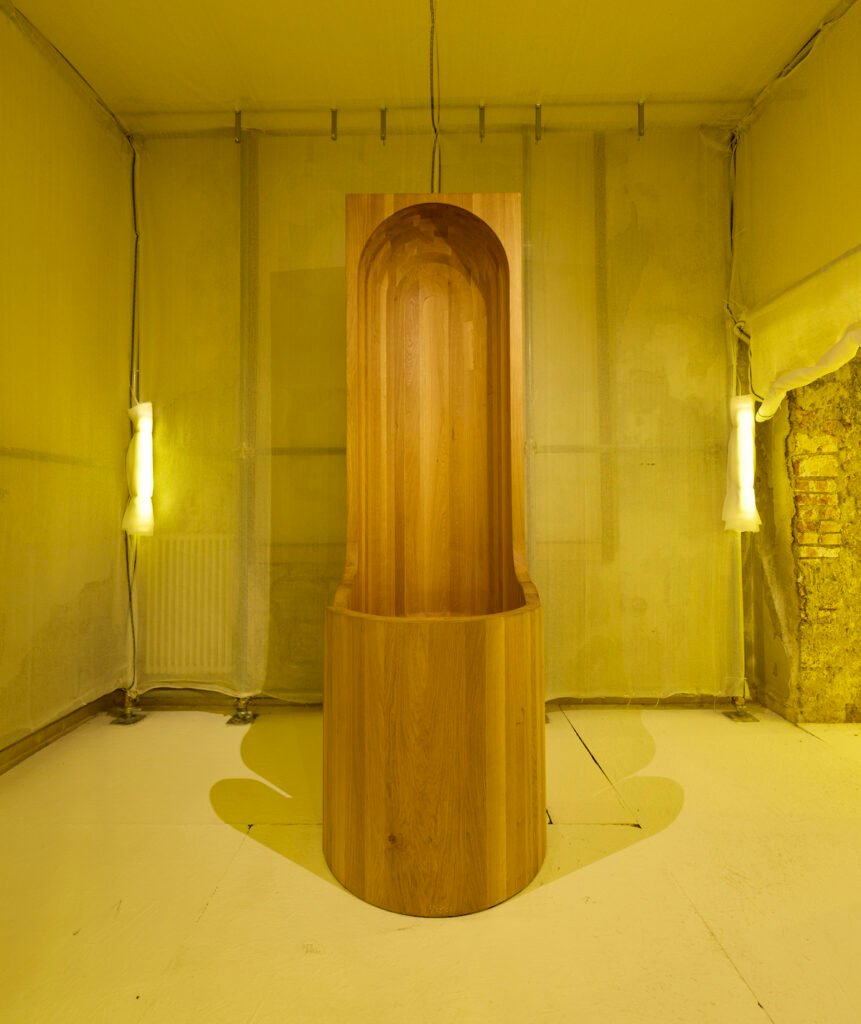
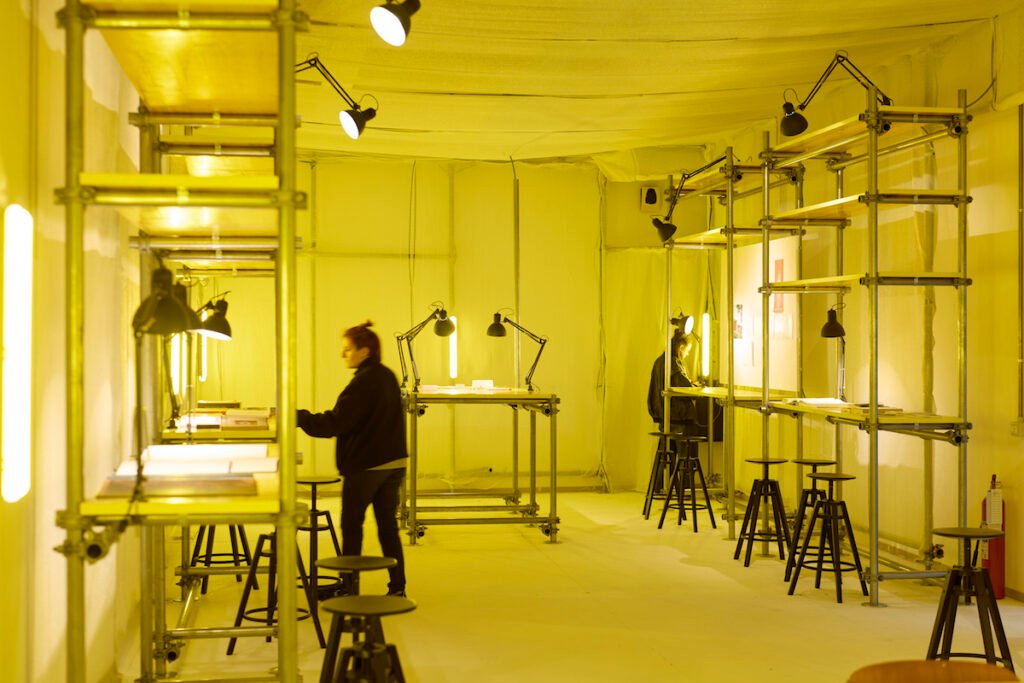
Part of it takes the shape of a contemporary scriptorium — not a nostalgic rebuilding of the medieval monastery, but a space where writing, attention and duration come to weave back together. In the monastic tradition, to copy a text meant first of all to change the body’s rhythm: to let hand, breath and time settle into one and the same discipline of attention.
Here writing works less as the production of content than as a practice of settling, like sediment. More than preserving documents or testimony, this place questions the very possibility of transmission. In this way, the scriptorium becomes a living archive. More than a space where the past is kept safe from the present, it is a living organism continually reactivated with readings, voices, translations, forms of study, new ways of interpretation. Here memory does not sit like something laid down and left. It is, instead, matter still capable of making a future. Alongside it stand the artist’s books by Ilda David’, in which painting becomes spiritual exercise, a cartography of the unseen. The multilingual library devoted to Hildegard’s texts does not spring from some passing fascination with her figure. Behind it runs a long lineage of study, translation, research and conservation, carried above all by Sister Maura Zátonyi and the St. Hildegard Academy at Eibingen. Through their work, this legacy remains not just kept, but questioned, translated, put back into circulation. Beside it lies the sung liturgy of the Benedictine Nuns of the Abbey of Eibingen, the monastery Hildegard herself founded in 1165. The dialogue between the twelfth century and the present stays open this way. Alexander Kluge’s last work, and the new monastic space designed by Tatiana Bilbao Estudio, MAIO Architects and DOGMA, turn the Complex of Santa Maria Ausiliatrice into a slow infrastructure of memory.
In the sestiere of Castello, Santa Maria Ausiliatrice keeps a different time from the Mystic Garden. Here Venice seems to slow not through openness and the loosening of air, but through accumulation, layering, permanence. The walls hold onto damp and saltpetre, lagoon light settles slowly onto worn surfaces, the rooms still keep something of the silent memory of the bodies that passed through. Here too the architecture looks unfinished, exposed, worked on constantly by time.
In continuity with Opera Aperta, the project the Holy See presented at the 2025 Architecture Biennale, the building site here, too, stops looking like a stage to be hidden away before completion. It becomes, instead, a lasting condition of matter itself: upkeep, vulnerability, ongoing change. The buildings, in this sense, remain structurally unfinished.
The Pavilion’s two sites seem, then, to set out two different times of the living. On one side, the Mystic Garden of the Discalced Carmelites, run through with evaporation, plant growth, air, and slow shifts in weather. On the other, Santa Maria Ausiliatrice, where time instead seems held inside worn walls, quiet corridors, surfaces marked by salt and the fine spray of Venetian water. The two sites become, this way, two different ways the same city breathes.
To walk through the Pavilion, then, is to walk through Venice itself. Moving between the two sites means passing along calli, over bridges, through reflections, sudden openings onto the lagoon, letting the city keep working, unhurried, on the body. Part of the experience happens right there, in between — in the time it takes to move through water, stone, light and distance.
This, too, is why The Ear Is the Eye of the Soul does not ask to be taken in all at once, as a single experience. It is, instead, a slow shift in the relation between attention, surroundings and duration. It asks you to slow down enough to let damp, echo, evaporation, shifting light and the breathing of the space work, bit by bit, on the quality of presence itself.
Most contemporary exhibitions keep intensifying images, speed, stimulus. Here the gesture runs almost the other way: to lighten, to strip back, to allow what usually stays at the margins of perception to surface. Not the image that forces itself on the eye at once, but what changes without hurry, holding off a long while before it lets itself be seen.
Perhaps this, in the end, is what the Pavilion is trying to make felt: not some elsewhere set apart from the present, but a different quality of attention inside the present itself.
In Venice nothing truly stays still — matter keeps changing, restless, almost without being noticed. The Pavilion, too, moves inside that same logic of change too slow to catch.
That is why resonance here is closer to a practice of mutual exposure: between bodies and buildings, between technology and plant life, between memory and matter, between lagoon and breath. A shifting state, to pass through rather than to take hold of at once.
This, too, may be what Venice goes on teaching. That there are forms of the living that do not force themselves on the eye. It is no surprise, then, that the Pavilion also carries a note of legacy, of leave-taking. On one side, Alexander Kluge, whose last work closes a long life spent questioning the shapes of memory, of perception, of story. On the other, Koyo Kouoh, whose curatorial vision the Biennale keeps answering, long past her death. In different ways, both these presences run through the project as a transmission still live: a living energy still moving through works, places, communities, more than a monument to memory. Both keep working slowly at the edges — like whatever changes without a sound, long before it becomes an image.
Not everything that lasts does so to be seen. Some things last simply to go on being able to listen.

Where Meaning Exceeds Information
The following conversation begins where the preceding text leaves off: with the questions the Pavilion keeps open. Hans Ulrich Obrist and Rita Selvaggio move between memory and theory, tracing the encounters, readings, rituals, and unrealised projects that shaped the Pavilion and the curatorial thinking behind it.
1. On the epistemological reversal of eye and ear
Rita Selvaggio: Michel Serres, in The Five Senses, argued that the West built its knowledge by suppressing touch and hearing in favour of sight, and that noise — not silence — is the original condition of all communication. If the Pavilion truly reverses the eye-ear hierarchy, isn’t it overturning the entire metaphysics of presence on which Western knowledge itself rests? Is this a project that actively thinks through that rupture, or one that simply stages it?
Hans Ulrich Obrist: For us, as much as I love Michel Serres, in a way Alexander Kluge was probably more influential on the thinking around this project. And he’s also the one who found the title, The Ear Is the Eye of the Soul.
I had been speaking with Alexander Kluge very regularly for more than twenty-five years.
In our conversations over the last couple of years, we very often discussed the importance of viriditas for the twenty-first century, the viriditas idea, you know. And so I would say Alexander Kluge was influential, but also Joachim-Ernst Berendt, I think it’s interesting. Berendt’s book, Nada Brahma: The World Is Sound is something I’ve been reading for a long time.
According to Serres, Western modernity took a complicated turn, and it sort of put the emphasis only on the eye, with this eye-centricity. The eye is the organ of distance. It’s also about control, it’s about possession, and it creates, of course, a separation, a cut between the person who observes and what he or she or they do observe.
And it’s interesting that hearing, listening, does the exact opposite, because sound enters us. We are immersed. It’s all around us, and you can’t sort of keep it away. So it’s more about receiving, and it’s not about possession. And this, of course, would have led to a very different civilisation, in a way, if it had not been so eye-centric.
So with Berendt, it’s all about acoustics. It’s very sort of holistic; the last part of the book goes into a very mystical zone. Berendt is also interesting because, like Hildegard, he connects sound to healing. It was a little bit over the top there, right?
But, of course, Serres is very relevant because he published Les Cinq Sens (The Five Senses), and very much opposed the idea that the body is reduced to vision. And the interesting thing is his Chapter One, which I had actually discussed with him once, which is fundamental there.
And then there is a big difference between Berendt and Serres, because with Serres it’s always the noise, in a way. It’s interesting. It’s noise or background noise. So with Berendt it’s more harmony, maybe, and with Serres it’s maybe more related to turbulence.
I was also thinking your connection to Serres is interesting, actually, in relation to La Légende des anges, the book on angels. He thinks about the acoustic figure and the messenger, which is not an object, but which is a transmission, in a way, you know. So maybe that’s another interesting connection, I would say.
And in his last book, Relier, there is this idea of binding. And, in a way, I don’t think that we want a rupture with the exhibition. We want an expansion, an expanded notion of, sort of, a multisensory expansion, maybe. And I think Hildegard, as a figure, is very binding.
2. On the institutional paradox
RS: The Catholic Church was, for centuries, the first institution to regulate legitimate visibility in the West — the Council of Trent (1545–1563), iconography as doctrine, the image as an instrument of doctrinal control. How, in curatorial practice, do you reconcile this long visual legacy with a Pavilion that chooses the ear over the eye? What does it mean, for you as a curator, to build an alternative perceptual paradigm within a history so deeply rooted in the image?
HUO: I think that it’s about both senses. And I think that one of the senses was sometime forgotten by art history, there is a real neglect of the ear.
For Hildegard, the voice was a form of viriditas, a greening force, several centuries before the period you address. Bells were also deeply involved in organising time in Hildegard’s era: they structured the day and functioned as instruments of time.
So I do not think that the Pavilion inverts a hierarchy. I think it’s more about giving space and time, in a way—or visibility is maybe not the right word—giving emphasis to a sense which was not given the attention it deserves.
And, of course, it’s also interesting that sound is very different, in a way, from an image, because an image can be framed, it can be shipped, and sound has much more to do with resonance, with its environment; it’s shared.
So yeah, that’s maybe my answer to this complex question you’re raising.
And for Ben Vickers, Soundwalk Collective and myself, Hildegard’s work arrives in the present tense, in the present world, with a very renewed force. It’s about a call to attention, to inwardness, and we can experience this as we experience the unfolding of the new commissions by various composers in the holistic installation by Soundwalk Collective. There are moments, you know, moments of instrumentation, there are moments of voice, there are moments of poetry, chants, writings, but there are also moments of silence.
3. On curating as score
RS: You have long treated exhibitions as scores to be interpreted rather than objects to be displayed — a Fluxus inheritance going back to George Brecht. Hildegard was a composer. Is the Pavilion, split across two sites between which the visitor physically walks, an unfinished score that gets “performed” by walking? And if so: where does the curator end and the composer begin?
HUO:Yes, scores have been very much central to my curatorial work since the early ’90s. Of course, the do it project was kind of the beginning of it, which was inspired by Christian Boltanski and Bertrand Lavier.
And I was always interested when as a curator I began to curate shows in the early ’90s, in the fact that an exhibition comes and an exhibition goes. And I was interested in this idea, initially: how would one actually have a repertoire of exhibitions?
I met Eugène Ionesco, the playwright, when I was really, really young. I was a teenager. I was like sixteen, seventeen, in St. Gallen, in 1985. Ionesco, the pioneer of the Theatre of the Absurd, towards the end of his life no longer really wrote, but he made drawings and was in St. Gallen to make some etchings and lithographs at the Erker Press.
And I had the incredible luck to actually have a coffee with him. I told him about my passion for art and that, even as a teenager, I was already beginning the journey towards becoming a curator. And he gave me this master class. Over coffee, he explained this to me through something immaterial: his play La Cantatrice chauve, which is still performed every evening and has been so for many decades. He mentioned that the sculptor César, whom he knew, had some monuments in bronze which had been installed. It looked as if they would be there forever, and then, like ten, twenty, thirty years later, they were dismantled and put elsewhere. And he was kind of laughing and saying that his play, La Cantatrice chauve, has had a longer shelf life, so to say—or presence is maybe a better word—than a bronze.
And for me, that was an interesting thought. He told me basically about repertoire, but he told me also that actually it can be about long duration. From that developed, of course, the idea of an exhibition which could be immaterial but could not stop.
So we wanted to do an exhibition with scores, with do it, which, you know, has been going on since 1992, ’93, so for thirty-three, thirty-four years, without ever stopping. There has always been a version of do it taking place somewhere in the world. To date, there have been around 200 versions.
And this was, of course, kind of inspired also by The Family of Man, Steichen’s exhibition, which would never, never end. So this idea of an exhibition which one could play again and again.
Of course, the references were the open scores of Fluxus and George Brecht; Alison Knowles, Yoko Ono, who published Grapefruit very early on, and John Cage were also part of this history. All of these figures and their open scores were very inspiring.
And it is interesting that we think about it in relation, of course, to Hildegard, because in a way the neumes are not as prescriptive as other musical scores. They give a certain kind of vague—or, better, open—direction to the person who sings them, leaving a great deal of space.
In that sense, Hildegard’s scores are not overdetermined, but open. A line can therefore be drawn. There is also the idea of the score as a coordination technology: it is the person who performs it, who enacts it; it is a community that enacts it. That is the connection to Hildegard.
I am also interested in your question about the walk between the two places: between the Pavilion and Santa Maria Ausiliatrice, near the Arsenale.
The walk has always been important in my work, ever since I created the Robert Walser Museum. We should mention Robert Walser here, because in the early 1990s I founded a museum for him—a strollology museum, so to speak—where people followed one of his famous walks in the Alpine foothills near Appenzell.
We then installed a vitrine in the restaurant at the Hotel Krone in Gais and presented works by artists like Thomas Ruff, Hugo Suter and Dominique Gonzalez-Foerster, who also created one of the museum’s first projects, devoted to Walser’s final walk in the snow. It is interesting to apply that idea to Venice: what might a Venetian strollology be?
Strollology refers, of course, to the Swiss sociologist Lucius Burckhardt, who established the science of walking at the University of Kassel. When thinking about crossing Venice on foot, another inspiration is Georges Perec and Harry Mathews’s 1977 text, Roussel et Venise: Esquisse d’une géographie mélancolique. The two Oulipo writers wrote a book on Venice that constitutes a kind of Venetian psychogeography. That is perhaps a reference for linking the two exhibitions.
In this sense, several scores are at stake. Hildegard’s relatively open scores are the point of departure—and this is an exhibition entirely about Hildegard. Many composers and poets have written compositions inspired by her.
We also have meta-composer, Soundwalk Collective, invited by Ben Vickers and myself. Soundwalk Collective are artists, and they created a meta-composition that brings more than twenty compositions together in a holistic experience.
If they are the meta-composers, then Ben Vickers and I, as curators, might be the meta-meta-composers, because we invited the meta-composers and, together with them, the composers.
I do not think the curator is the composer. We invited composers, and above all Hildegard herself is a extraordinary composer. Ben and I did not write music; we issued an invitation. To curate means to care for. We may, perhaps, have meta-meta-composed the constellation.
4. On the unfinished and death as a curatorial category
RS: You have built much of your own practice around unrealised projects. Here, though, something harder happens: Kluge completes his twelve films shortly before his death; Kouoh dies before seeing the Biennale she conceived come to fruition. I don’t ask this lightly, given how close you were to both. But the Pavilion is, in a very literal sense, built around two absences — and that seems to call for a category the field doesn’t really have. Between the realised and the unrealised, is there a name for a work carried to completion by others, after the death of the person who conceived it?
HUO: In fact, yes, the late Koyo Kouoh and I collaborated, together with Daniel Baumann and Philip Ursprung, Cristina Bechtler, and Dayle Bechtler-Lustenberger, on the Engadin Art Talks, a project which takes place every January in Zuoz, in the Swiss Engadin. It is a mountain conversation, one could say, with performances and talks.
The last time we saw each other was in January last year, and we had long conversations. And this was actually my last meeting with Koyo. She was on her way to Venice, and I remember that she really wanted the viewers and visitors to the Biennale to slow down. Koyo conceived the main exhibition of the Biennale, while we curated one of the national pavilions. Ideally, there was always this idea that the national pavilion would resonate with the director’s theme, and this is something we focused on very strongly. We also articulate this resonance in the text.
And the notion of resonance is interesting. Hartmut Rosa, one of my favourite thinkers of recent years, talks about resonance in relation to affection. Resonance involves affection and transformation, but it cannot be produced at will: one can only create the conditions for it, and then it happens.
I would say that our Pavilion of the Holy See resonates with Koyo’s theme.
Also, at this year’s Engadin Art Talks, in January, we paid tribute to Koyo through a performance by her friend Otobong Nkanga, the artist who is also central to the Pavilion in Venice this year. In Koyo’s exhibition, she created the façade and the garden of the Central Pavilion.
With Alexander Kluge it was very different because, of course, Alexander was there much longer, in the sense that he could almost finish the work. He passed away only weeks before the Biennale opened and had actually finished his twelve films — his last films — for the exhibition. The work was probably ninety to ninety-five per cent finished. And then, with his collaborators and his son Leonard Kluge, we finalised the installation.
With Alexander Kluge, it was obviously a very direct, day-to-day collaboration. More than that, the entire exhibition about Hildegard von Bingen, across the two venues, was very deeply inspired by my conversations with him over more than thirty years, during which he also mentioned Hildegard von Bingen very often.
Ben Vickers and I began conceiving the exhibition with Soundwalk Collective, following the invitation from Cardinal José Tolentino de Mendonça, Prefect of the Dicastery for Culture and Education, the great Portuguese poet.
It is very rare in politics today for a great artist—someone who knows art deeply and has a profound affection for and connection to it—to be in charge of a country’s culture, as André Malraux once was in France. It also happened with some of the great Latin American writers, such as Vargas Llosa or my friend Carlos Fuentes, who belonged to a generation of writers very often involved in politics. This happens too rarely today.
So, yes, when the extraordinary Cardinal invited us to create the Pavilion, one of the first things we did was to go and talk to Alexander.
I first invited Alexander Kluge to participate in a project in Stockholm in 1998. There was a European Capital of Culture project, and I decided that, instead of doing a physical exhibition, I would create an exhibition on television, with short films by artists shown after the eight o’clock evening news.
We commissioned about twelve artists to make short films, and Alexander was one of them. He was absolutely fascinated by this idea of Arkipelag TV: the idea of having many short commissioned films. It was something he would later pursue extensively through his series of short films, including the twelve films on Hildegard von Bingen that he made for the Biennale.
Over the years, we established a ritual. We live in a world increasingly bereft of rituals. So the idea of introducing rituals is important.
Alexander and I would meet every 1 January, at three p.m. on the dot, in Sils Maria in the Swiss mountains, at the Hotel Waldhaus, for coffee or tea. We would discuss the new year, the topics, the challenges and our projects. During these New Year’s Day conversations, we would also very often discuss the importance of Hildegard von Bingen’s holistic practices for our time.
So, obviously, as soon as Ben and I received the invitation from the Cardinal and began working on this project with Soundwalk Collective, we called Alexander, went to visit him and asked whether he wanted to participate. He immediately came up with the title, The Ear Is the Eye of the Soul. That was amazing, and we immediately decided on it.
Alexander also embraced the idea of creating an exhibition in the garden devoted entirely to sound, although he himself wanted to make films. And that was how the second idea emerged: to also create an exhibition at Santa Maria Ausiliatrice.
The idea behind that is, of course, also very much based on another unrealised project of mine. So, basically, the Venice project for the Holy See is the realisation of two projects we had always wanted to do but which had remained unrealised.
One is the project on Hildegard that Ben and I had been developing for, I think, fifteen years as an unrealised project. The second is the idea of creating a non–tabula rasa pavilion.
When I curated the Swiss Pavilion more than a decade earlier, we created the Pavilion of Switzerland for the Architecture Biennale around Lucius Burckhardt and Cedric Price.
We created this Pavilion, and curating a pavilion in Venice obviously means going there repeatedly — to install it, to deinstall it and also to see the space when it is empty. I realised that, when you go there in November, for example, after the Biennale has ended, all the pavilions are emptied, everything is thrown away, the walls are taken down, and everything starts again from scratch.
I made a promise that, should I ever create another pavilion — I had no idea whether I would ever again be invited to curate a national pavilion during my lifetime — I would definitely resist this tabula rasa approach. I would think instead about how a pavilion might develop more like a garden: how it could be allowed to grow and to accumulate layers.
And, wonderfully, the previous pavilion was Opera aperta. It was conceived as an open work for the Architecture Biennale.
We spoke to Alexander and decided that, in addition to the garden — because it had become clear that the garden should be devoted exclusively to sound, that it should be very focused on sound rather than film — we would show the films elsewhere. There was a room in the garden where we could have projected them, but we wanted it to remain exclusively a sound garden, a mystical garden.
So we spoke to Alexander and discussed the possibility of showing the films within the existing display structure, retaining the display structure from Opera aperta. And he started to work. So, yes, Opera aperta was the Holy See Pavilion at the 19th Architecture Biennale in 2025, curated by Marina Otero Verzier and Giovanna Zabotti, with two architectural practices: Tatiana Bilbao ESTUDIO and MAIO Architects.
Tatiana Bilbao and I had already been in dialogue about Hildegard for a conference some years ago, in relation to the monastery that she is currently designing and building in Germany. So we immediately reached out to her and proposed that, in addition to Alexander Kluge’s films, we could also present her twenty-first-century monastery project, inspired by Hildegard and conceived for the present day.
We also installed a Hildegard von Bingen library within the display inherited from Opera aperta. In this sense, there were three layers: the library, the monastery project by Tatiana Bilbao Estudio and MAIO Architects, and Alexander’s films, together with all his documents and texts.
It is not only a film installation; it also contains many prints. He printed over existing images and on different materials. And, of course, there is a great deal of text.
These three layers were added to Opera aperta. In that sense, it was the opposite of the usual tabula rasa approach of the Biennale. In this way, it brought both long-unrealised projects into being.
What is also interesting is that Alexander had made a film which we discussed. It was called The Assault of the Present on the Rest of Time, from 1985 — Der Angriff der Gegenwart auf die übrige Zeit. It addresses how this very fast-paced present dominates and often erases our relations and resonances with both the past and the future.