English text below —
“Nulla accade due volte.”
— Wisława Szymborska, Nulla due volte (trad. Pietro Marchesani), in La gioia di scrivere/Godność pisania, Adelphi.
I. La finestra come soglia che non promette salvezza
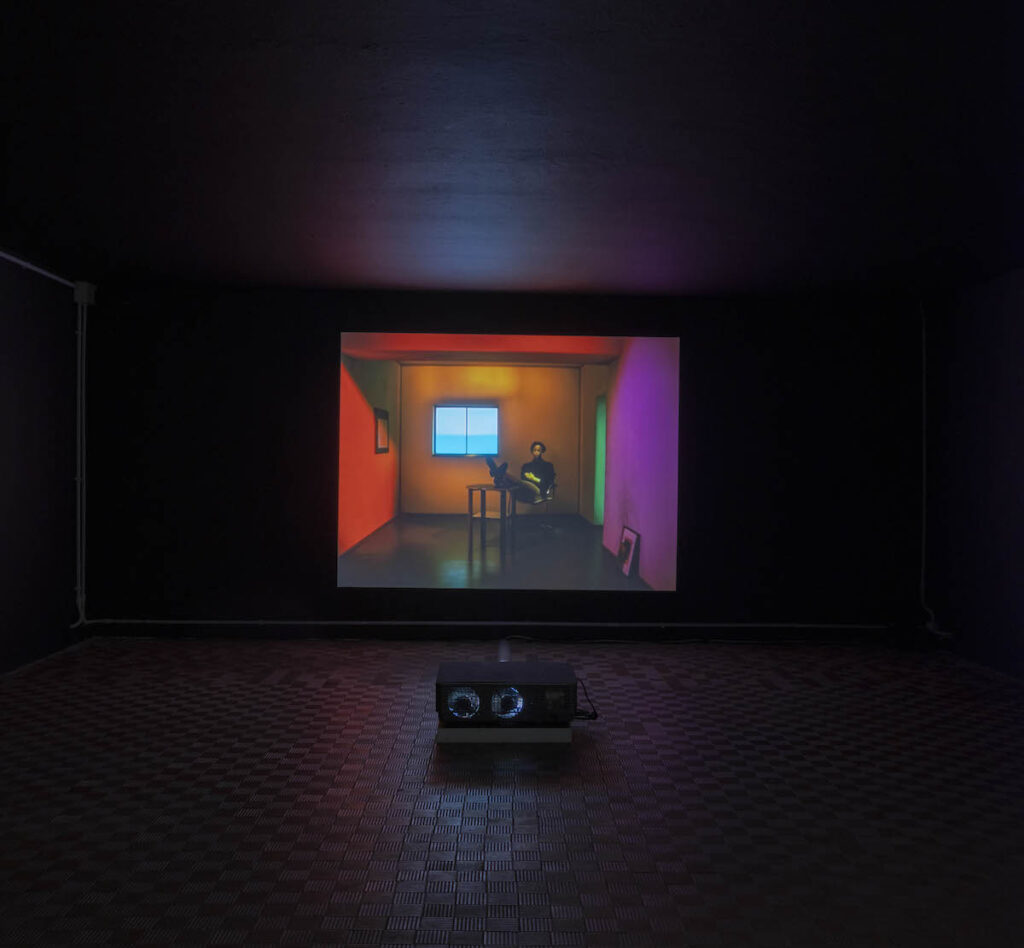
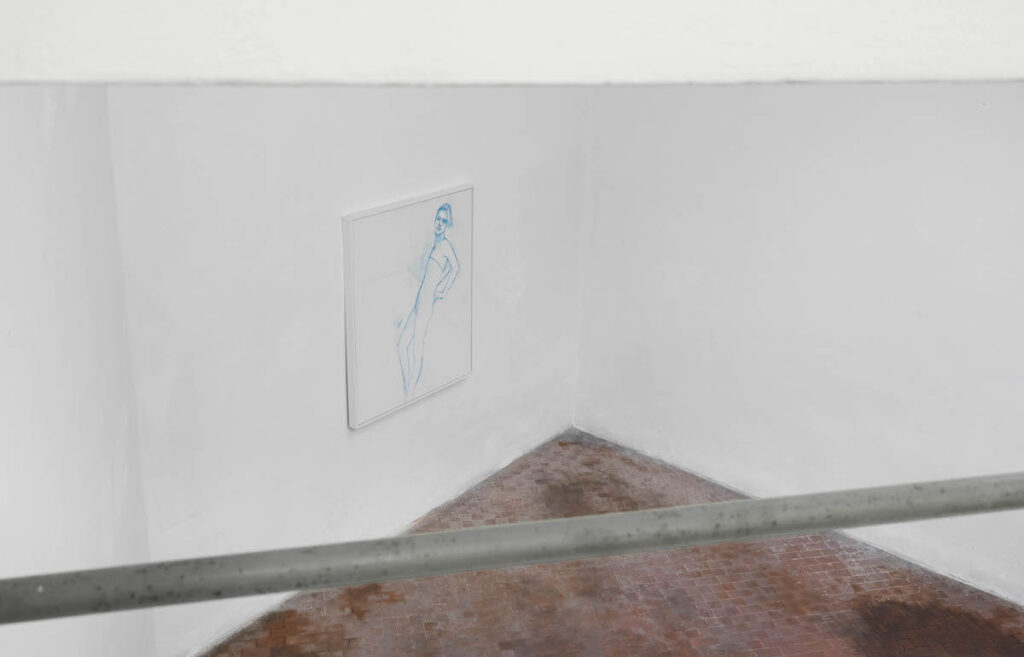
C’è sempre una finestra, nell’opera di Andro Wekua. Non necessariamente visibile. A volte è un rettangolo pallido che si intuisce dietro una figura seduta; altre volte è solo un taglio di luce, un’interruzione nella continuità del colore. In By The Window — la mostra in corso da Ordet a Milano, realizzata in collaborazione con la Nicoletta Fiorucci Foundation (sino all’11 aprile)— la finestra non è un elemento architettonico, ma una condizione mentale. È il punto in cui il dentro e il fuori smettono di opporsi e iniziano a farsi instabili. Guardare fuori da una finestra non significa evadere. Significa restare. Restare nel tempo sospeso tra ciò che è stato e ciò che potrebbe ancora accadere. Wekua lavora precisamente in questo interstizio: non nella memoria come nostalgia, non nel futuro come promessa, ma in quel punto di pressione in cui il tempo si piega su sé stesso.
In merito alla sua pratica, Daniel Baumann parla di seam, della cucitura come principio strutturale. La cucitura è ciò che unisce e insieme separa. È ferita e punteggiatura. È il punto in cui due superfici si incontrano senza mai coincidere del tutto. Nelle sculture, nei collage, nei film, nei dipinti su alluminio, la cucitura è sempre presente: nel taglio, nella giuntura, nel passaggio da un’immagine all’altra, nella duplicazione seriale.
Ma la cucitura è anche temporale. È il presente come fenditura tra ieri e domani.
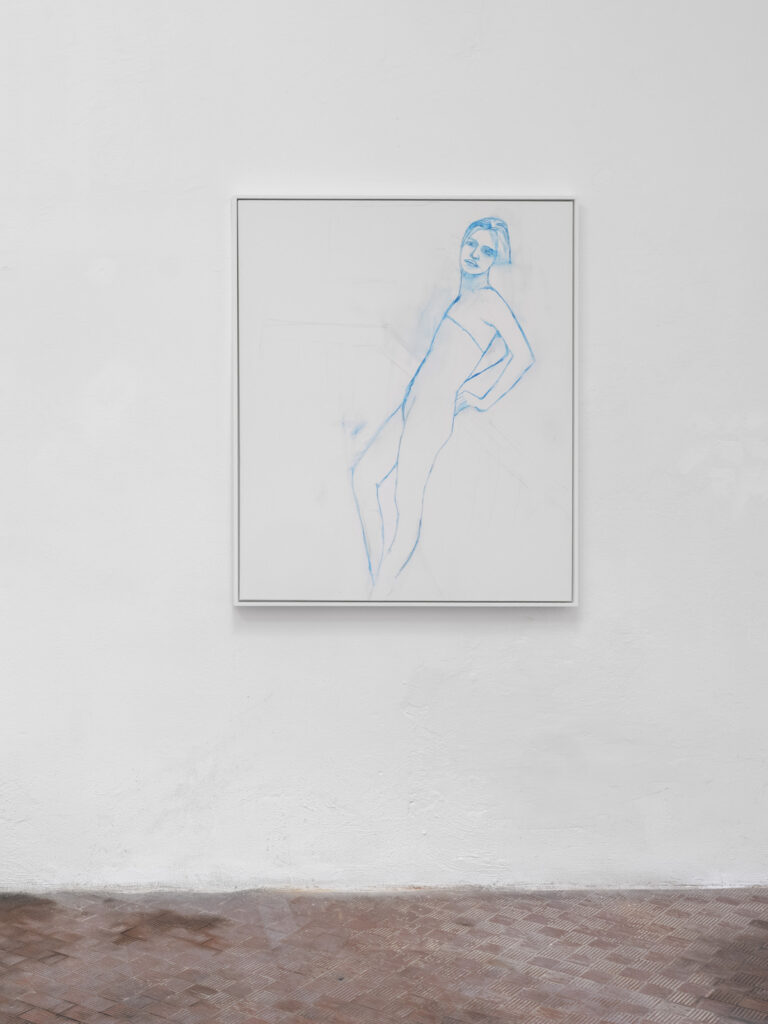
In By The Window tornano figure giovani, immobili, con gli occhi chiusi o cancellati. Non sono ritratti psicologici. Non chiedono empatia. Non restituiscono lo sguardo. Wekua lo dice con chiarezza: le figure non hanno occhi perché non devono guardare indietro, non devono restituire lo sguardo, ma fungere da superficie di proiezione .
Questa scelta non produce distanza. Produce vertigine.
La figura seduta davanti a una finestra è sempre sul punto di andarsene, ma non si muove. È in uno stato di attesa che non coincide con l’aspettativa. L’attesa, per Wekua, non è un intervallo funzionale, non è il tempo che precede un evento. È un luogo.
Walter Benjamin scriveva che la noia è l’uccello del sogno che cova l’uovo dell’esperienza. L’opera di Wekua abita quella noia come spazio generativo. In un mondo ossessionato dalla produttività, dalla crescita, dall’accelerazione, egli insiste su un tempo che non produce nulla. Un tempo che non promette nulla.
La finestra, allora, non è apertura. È sospensione. In questo senso, la finestra di Wekua non apre su un altrove, ma su un tempo che non si compie. In Ghosts of My Life, Mark Fisher parla di una “slow cancellation of the future”, di un presente infestato da futuri mancati che continuano a riverberare senza compiersi. La figura seduta davanti alla finestra sembra abitare proprio questo scarto: non contempla un paesaggio, ma una possibilità che resta inesausta, irrealizzata.
II. Il mare che non smette di ritornare
Il Mar Nero non è mai davvero rappresentato. È evocato. Compare come un blu abraso, come una superficie raschiata via, come una distesa che sembra solidificata in una geologia del colore. In Licking Black Sea (2015–16), il mare appare fossilizzato, come se l’acqua fosse diventata memoria minerale . Non è un paesaggio. È una condizione. Anche in By The Window, dove il mare non appare, la sua tonalità persiste come temperatura dell’immagine.
Sokhumi — la città dell’infanzia, la città perduta — non viene mai ricostruita. Viene coperta. Strato dopo strato. Come l’alluminio che, anche sotto spessi depositi di olio, continua a lasciar filtrare una luce fredda, quasi impercettibile. L’alluminio non assorbe. Riflette. È una superficie che trattiene la pittura senza mai concederle piena stabilità.
In questo senso, la pittura di Wekua non è mai pura superficie. È sempre una soglia tra apparizione e cancellazione. Nel 1992, l’anno in cui Sokhumi scompare dalla sua vita, Wekua è adolescente. In un’opera intitolata semplicemente 1992, l’immagine fotografica di un ragazzo — forse l’artista stesso — fluttua in un paesaggio frammentato, attraversato da delfini e da campiture rosse . Il delfino non è simbolo lirico. È una presenza ambigua. Sokhumi era una località balneare sul Mar Nero; i delfini abitano quella costa. Ma nell’opera, la loro apparizione non consola. È una memoria che non sa dove depositarsi.
Paulina Pobocha osserva come i suoi collage costituiscano il deposito primario delle immagini: fotografie familiari, JPEG trovati online, frammenti di riviste, ricordi stampati e ristampati . Il collage, per sua natura, è compressione. È accumulo. È la materializzazione di un ambiente visivo saturo. Ma quando il collage diventa pittura, qualcosa accade. La giuntura si fa invisibile. Il taglio scompare. Resta un’immagine che sembra sognata più che costruita. La pittura non espone il processo; lo assorbe. E in questo assorbimento si produce una trasformazione quasi alchemica.
Wekua ha parlato del desiderio di “tirare fuori dal tempo” le figure, di riportarle nel presente mentre le dipinge . Non si tratta di nostalgia. Non è un ritorno. È un tentativo di sottrarre le immagini alla linearità. Per lui, le cose non passano. Restano in forme diverse.
Questo spiega la ripetizione.
La donna di profilo che riappare negli anni. Il ragazzo seduto che si moltiplica. Il ciclo dei ritratti di “W.” su pannelli di alluminio, dove la stessa immagine viene riprodotta, alterata, ingrandita, privata degli occhi . La serialità non è esercizio formale. È un modo per dire che nessuna immagine basta. Nessun volto esaurisce la persona. Nessuna rappresentazione trattiene la totalità.
La ripetizione è un gesto di insistenza. Ma è anche un gesto di perdita.
Ogni volta che un’immagine ritorna, ritorna diversa. Più fragile. Più distante. Più astratta. Come se l’artista stesse cercando una forma che non coincide mai con quella precedente.
E allora la finestra torna a farsi sentire. Non come elemento architettonico, ma come distanza interna all’immagine. C’è sempre uno scarto tra la figura e il fondo. Tra il corpo e lo spazio. Tra il ricordo e la sua apparizione.
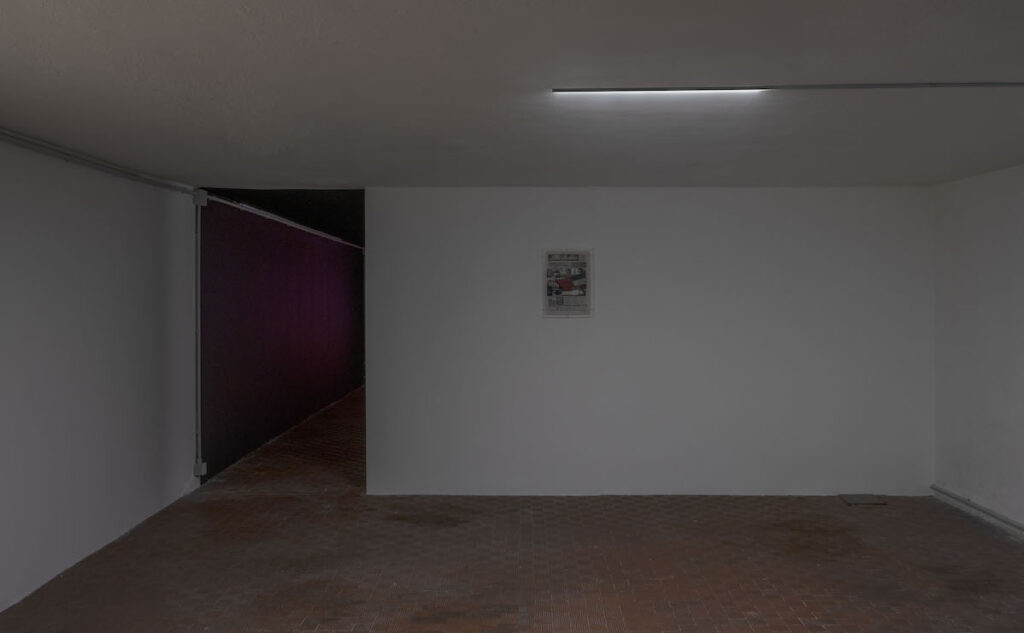
Quello scarto è la vera patria dell’opera. A Milano, nello spazio di Ordet ridisegnato per l’occasione come sequenza di passaggi e slittamenti, questa geografia non si espone come racconto, ma si deposita come atmosfera: non vediamo Sokhumi, ma ne respiriamo la temperatura, come un fondo marino che affiora sotto le superfici.
III. Volti senza occhi e adolescenti senza tempo
Le figure di Andro Wekua non sono mai pienamente presenti. Sono lì, e insieme altrove. Giovani, quasi sempre. Non bambini, non adulti. In quell’età instabile in cui il corpo non ha ancora deciso chi sarà.
In una conversazione con Ali Subotnick, l’artista parla dell’adolescenza come del momento più aperto, prima che la figura diventi “troppo personale”. L’adolescente non è ancora definito. È una forma in potenza. Forse per questo, nelle sue sculture e nei suoi dipinti, la giovinezza non è una categoria anagrafica, ma una condizione ontologica: essere in transizione, essere sul punto di.
Gli occhi sono spesso chiusi, o cancellati. Talvolta assenti. Non è un espediente formale. È un atto di sottrazione radicale. L’occhio è ciò che stabilisce la relazione. È il luogo del riconoscimento. Privare una figura degli occhi significa interrompere la reciprocità.
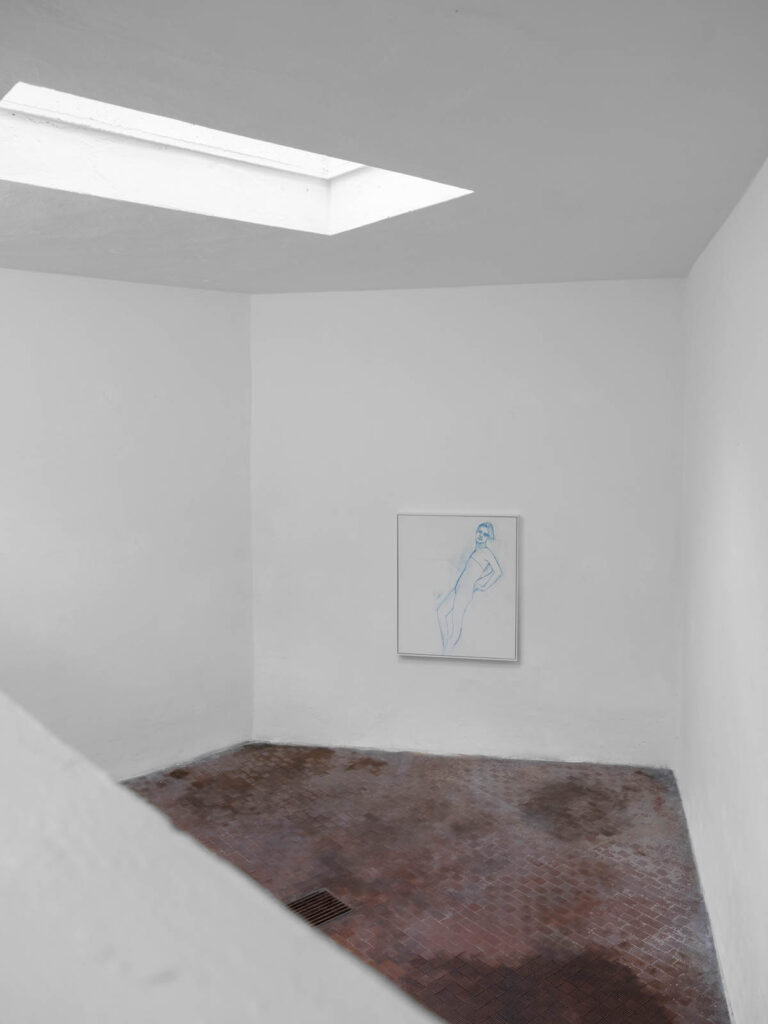
In una delle versioni del ritratto di “W.”, gli occhi vengono letteralmente rimossi . Non è mutilazione. È silenzio. È come se l’immagine rifiutasse di essere interrogata. Non c’è psicologia da decifrare. Non c’è confessione. C’è una superficie che trattiene qualcosa, ma non lo consegna.
In questo senso, le figure di Wekua funzionano come icone laiche. Non perché siano sacre, ma perché sono frontali, essenziali, ridotte a una presenza che non si lascia spiegare. L’icona non rappresenta: manifesta. Anche qui, la pittura non racconta una storia. Può contenere frammenti narrativi — Wekua stesso lo ammette — ma non costruisce un racconto lineare .
La narrazione, se c’è, è interrotta. Tagliata. Cucita.
L’idea dell’interstizio occupa uno spazio centrale nella pratica di Wekua . L’interstizio è il luogo tra prima e dopo. È l’“inframince” duchampiano, quella soglia quasi impercettibile in cui qualcosa cambia senza che si possa indicare il momento preciso della trasformazione. Le figure di Wekua abitano quell’inframince. Sono sempre sul punto di diventare altro, ma restano immobili.
Questa immobilità non è quiete. È tensione trattenuta.
C’è un elemento quasi cosmico in questo trattenimento. Quando gli viene chiesto del suo interesse per lo spazio, Wekua parla dell’infinito e dell’incompiuto . Lo spazio come ciò che non è finito. Come dimensione in cui il tempo si comporta diversamente. Forse è questo che accade nei suoi dipinti: il tempo si dilata, si comprime, si sospende. Non scorre. Si stratifica.
Le figure sembrano galleggiare. Non poggiano mai con sicurezza sul terreno. Anche quando siedono, è come se fossero sollevate da una forza invisibile. La gravità è attenuata. Lo spazio non è stabile. È un campo mentale.
E allora la finestra di By The Window diventa quasi un telescopio rovesciato. Non si guarda fuori per scoprire un mondo altro. Si guarda per misurare la distanza interna tra sé e il proprio passato, tra sé e la propria immagine.
Il colore diventa così un dispositivo di trasformazione, ma anche di protezione. Wekua ha parlato della necessità di intervenire sullo spazio espositivo prima di inserirvi l’opera, come se dovesse creare uno strato protettivo . È lo stesso gesto che compie sulla superficie del dipinto: coprire, velare, schermare.
Paint is all that he can see, scrive Pobocha a proposito della scultura del 2004, dove il volto del ragazzo è bloccato da una colata di bianco. Il colore non è filtro. È barriera. È ciò che impedisce il passaggio diretto tra interno ed esterno.
Ma forse è proprio in quella barriera che si produce la visione.
IV. Est e Ovest non sono direzioni, sono fratture
Andro Wekua lascia la Georgia nel 1994. Sokhumi è ormai una città perduta, teatro di una guerra che ha espulso quasi tutti i georgiani. La biografia è netta, ma l’opera non la illustra mai. Non c’è documento. Non c’è testimonianza diretta. Non c’è denuncia.
Daniel Baumann parla di un intreccio complesso tra Est e Ovest, non come opposizione ma come tessitura contraddittoria. In Wekua non c’è mai un folklore dell’origine. Nessun colore locale. Nessuna estetica della nostalgia post-sovietica. L’Est non è un tema. È una tensione.
Quando si trasferisce in Svizzera e poi in Germania, Wekua entra in contatto con una tradizione modernista che fino ad allora aveva conosciuto solo per frammenti. Alla Goetheanum di Dornach, in ambito steineriano, apprende una concezione della pittura come forza spirituale, come energia trasformativa . È un passaggio decisivo. Non tanto per l’adesione a una dottrina, quanto per la consapevolezza che l’immagine può essere veicolo di qualcosa che eccede la rappresentazione.
Ma la modernità occidentale, con il suo culto della produttività e dell’innovazione, non coincide con il tempo dell’opera. Wekua sembra opporre a quell’accelerazione un regime differente: il regime dell’attesa. Sempre Baumann cita Benjamin e Valéry per parlare di una modernità alternativa, una modernità che non abbrevia, che non comprime, che non riduce . L’opera di Wekua non accelera. Non promette sviluppo. Si offre come spazio di sospensione.
In questo senso, la dimensione politica della sua pratica non è mai esplicita, ma è strutturale. Rifiutare la narrazione lineare è già un gesto politico. Rifiutare l’efficienza dell’immagine è un atto di resistenza. Insistere sulla ripetizione, sulla serialità, sulla variazione lenta è una forma di disobbedienza temporale.
Est e Ovest, allora, non sono coordinate geografiche. Sono tempi diversi che si sovrappongono. Sono memorie che non si integrano. Sono cuciture che non si chiudono. Wekua stesso, in un dialogo con Boris Groys, parla di “diverse realtà” messe a confronto, e di uno spazio libero che si apre proprio nella loro differenza . Questo spazio libero non è neutrale. È instabile. È il luogo in cui si può ancora pensare qualcosa che non sia già previsto dal sistema dell’arte o dal mercato. Nell’allestimento di By The Window, questo spazio libero prende forma concreta: non come dichiarazione politica, ma come disallineamento percettivo tra le opere, come distanza calibrata tra i corpi e le immagini, come tempo che non coincide mai con la direzione del percorso.
Eppure, paradossalmente, l’opera non si offre come piattaforma relazionale. Wekua afferma di non essere interessato a collaborare con lo spettatore nel senso in cui molta arte contemporanea ha teorizzato la partecipazione. Lo spazio che si crea tra l’opera e chi guarda non è uno spazio di interazione programmata. È uno spazio di divisione.
Quando il pubblico ha accesso, l’opera si divide. E quella divisione non si ricompone.
C’è qualcosa di radicale in questa posizione. L’opera non si completa nello sguardo dell’altro. Non chiede di essere attivata. Esiste già, autonoma. E tuttavia, proprio in questa autonomia, genera uno spazio intermedio che non appartiene né all’artista né allo spettatore.
È lì che accade la visione.
V. “Come ti chiami, figlio mio?” — L’identità come superficie instabile
Nel 2004, Wekua realizza un’installazione intitolata Wie heisst du mein Kind? — Come ti chiami, figlio mio? . La figura di un ragazzo in uniforme scolastica è posta su un piedistallo nero. Le mani sono sporche di fuliggine. Il volto è coperto da una colata di bianco che ne cancella occhi, naso, bocca. La pittura non rivela. Blocca. La domanda del titolo resta sospesa. Non riceve risposta. Nominare significa fissare. Stabilire un’identità. Consegnare una forma stabile a qualcosa che, forse, non lo è mai stata. Nell’opera di Wekua, il nome non è mai definitivo. Le figure non hanno biografia. Non sono personaggi. Non sono nemmeno alter ego dichiarati. Sono presenze che resistono alla definizione.
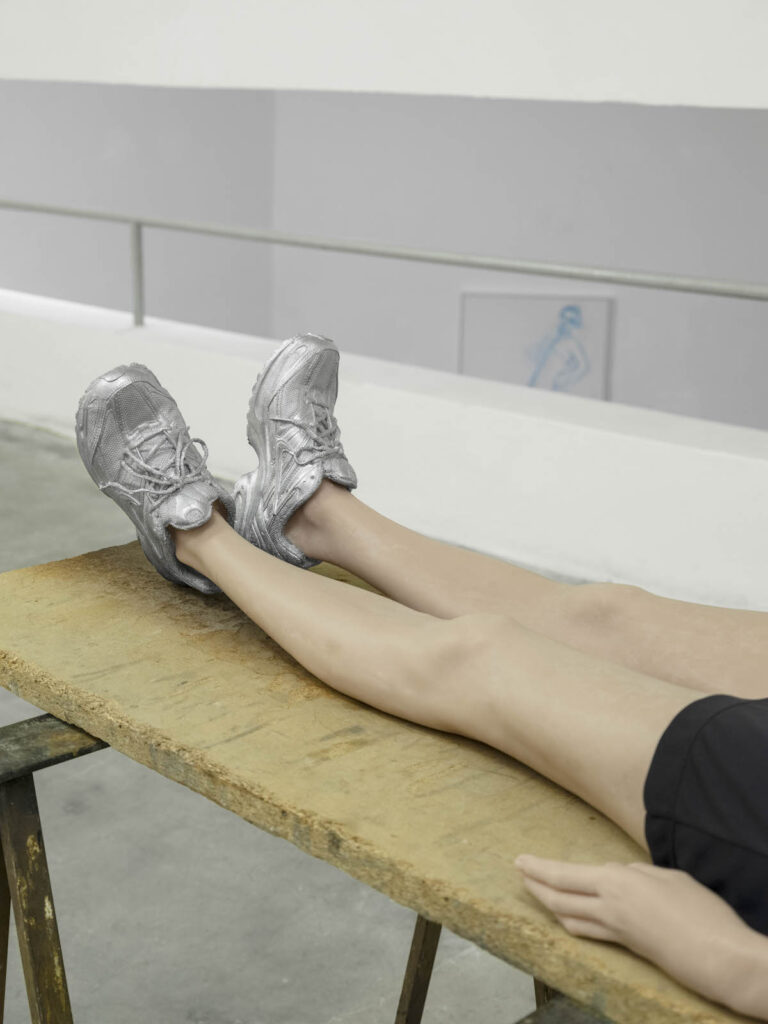
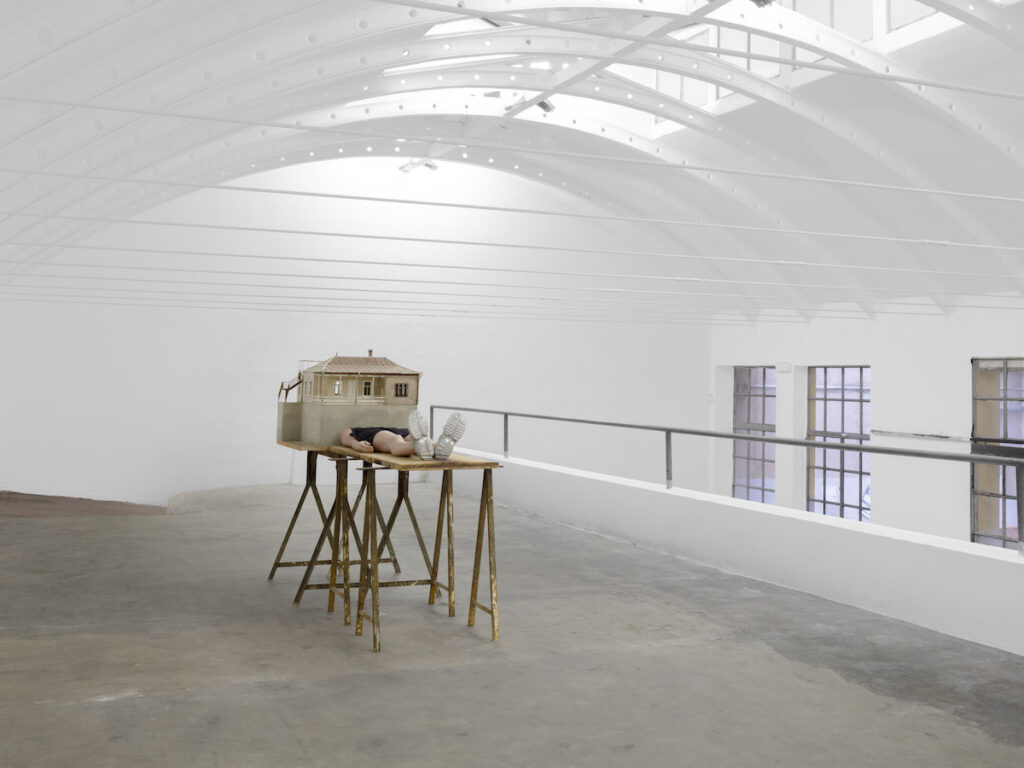
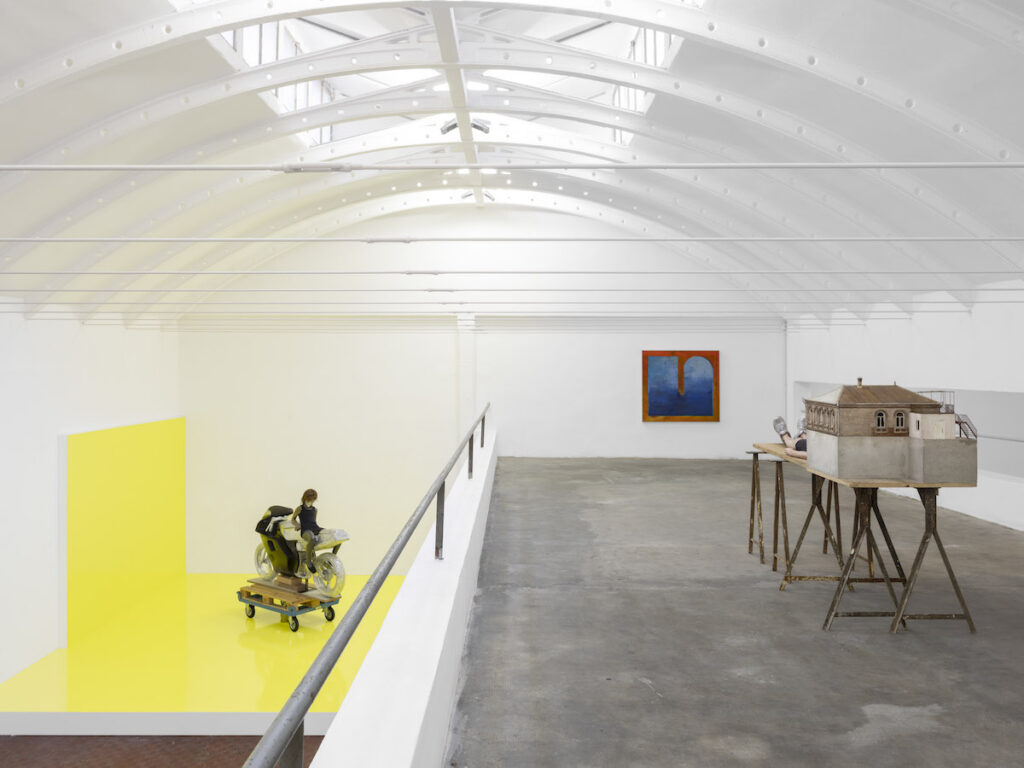
In By The Window, questa resistenza si intensifica. La mostra milanese riunisce opere di anni diversi secondo un criterio non cronologico . Il tempo non viene esposto come sequenza, ma come costellazione. Le opere si guardano lateralmente. Si rispondono attraverso risonanze sottili. Un film del 2008 dialoga con una scultura del 2011. Un dipinto recente vibra accanto a un collage più antico. In Untitled (2011), Wekua non nasconde il volto: lo trasforma in spazio. La casa non è appoggiata come un segno simbolico, ma come un oggetto reale, preciso, quasi ordinario. Il corpo in cera resta disteso, esposto, mentre l’architettura prende il posto del pensiero. Abitare la propria memoria, qui, non significa rievocarla, ma darle forma materiale, renderla volume, superficie, costruzione.
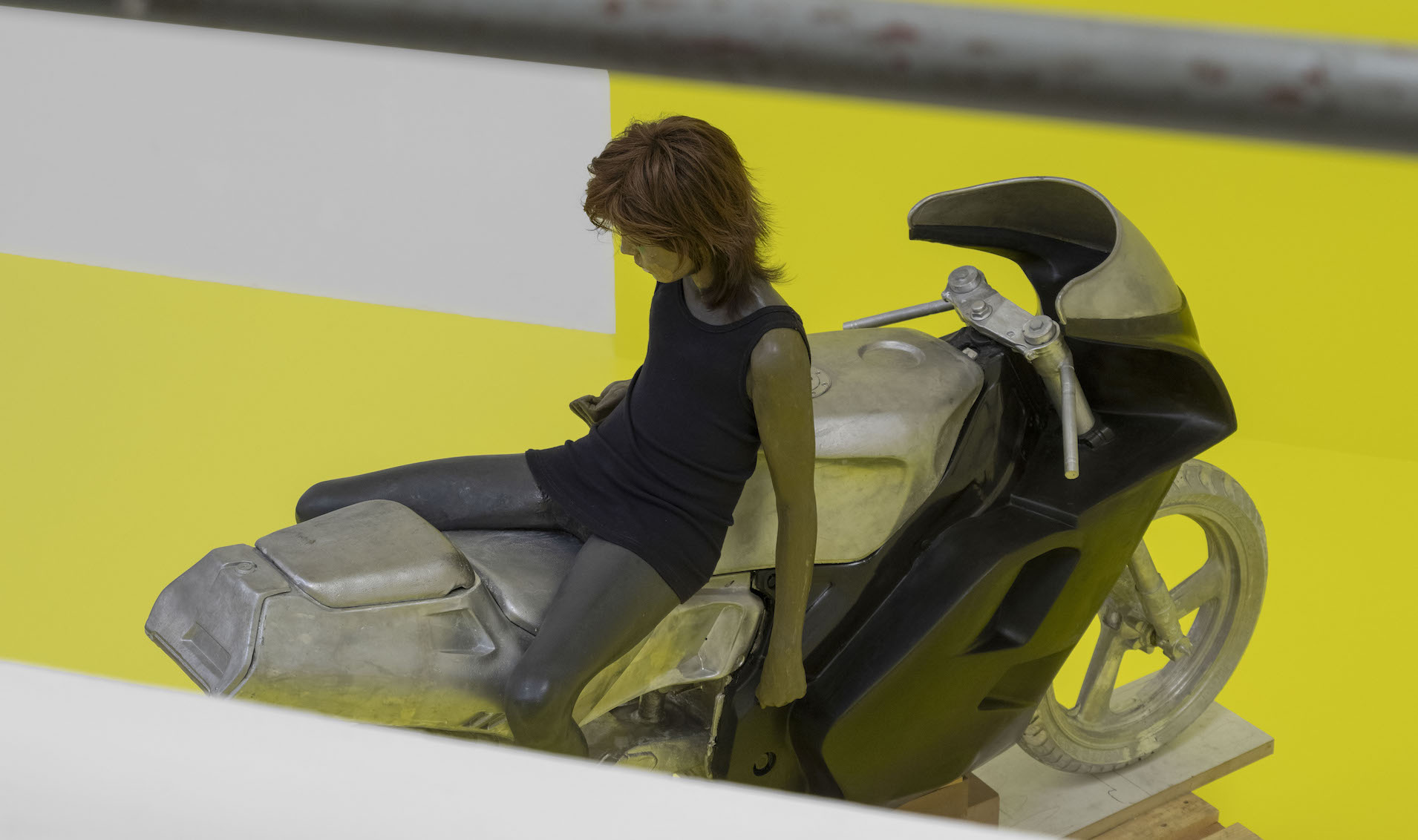
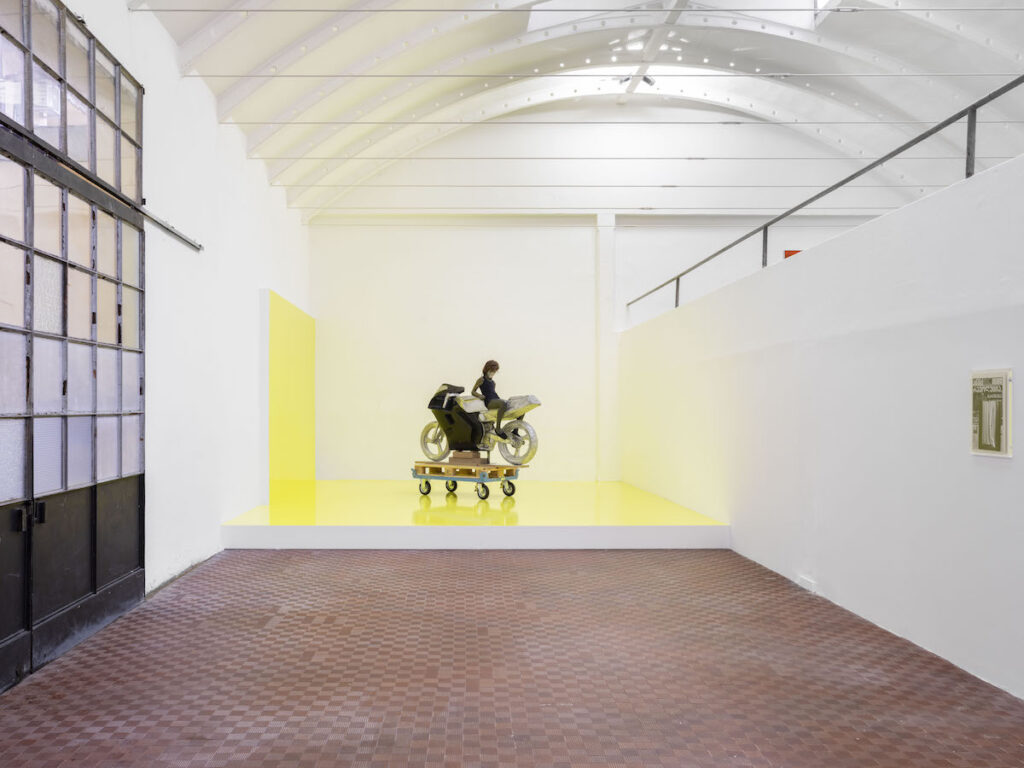
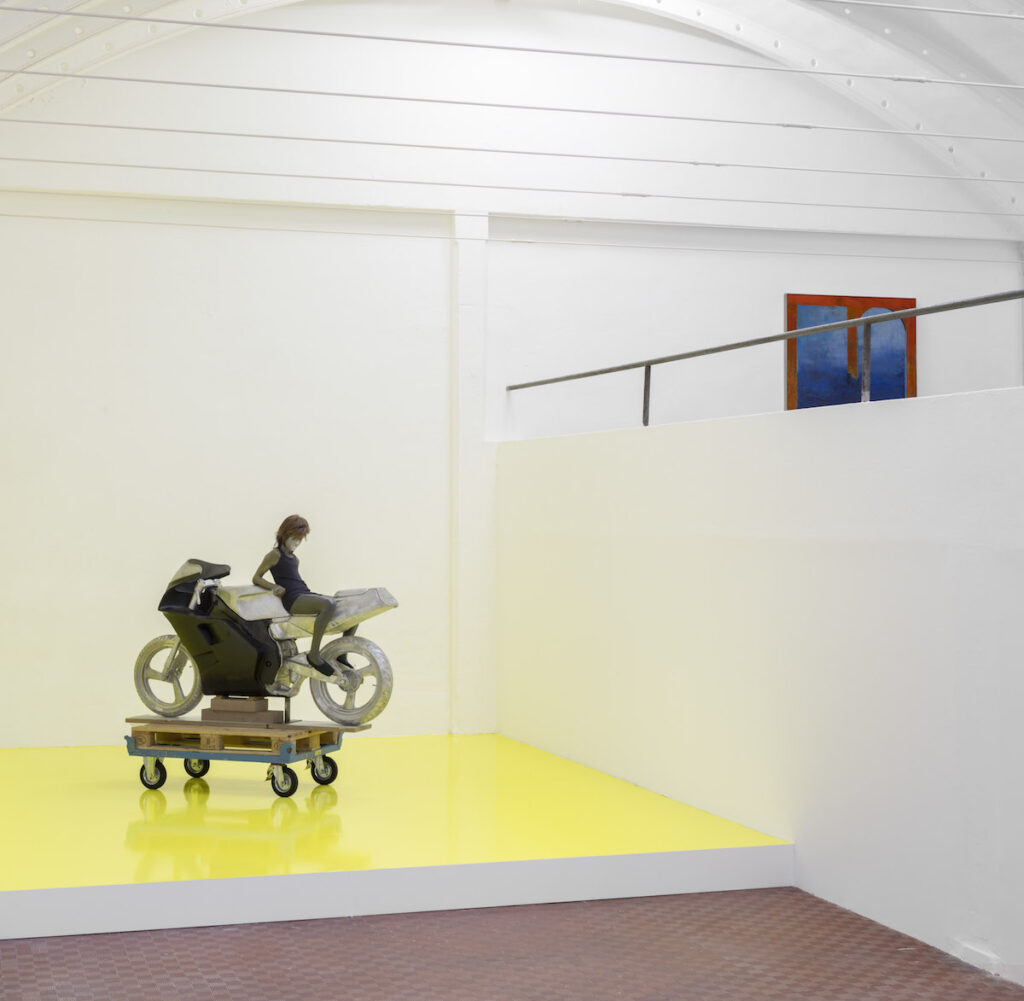
La finestra, ancora una volta, non è apertura verso un fuori. È dispositivo di risonanza interna. C’è una figura seduta su una motocicletta argentata, sospesa su un cavalletto: My Bike and Your Swamp (6pm), 2008 . Il corpo è rivolto all’indietro, gli occhi chiusi. Il veicolo, simbolo di movimento, è immobilizzato. La moto non parte. Non può partire. Il gesto che normalmente indicherebbe fuga diventa ripiegamento.
La scena non è tragica. È sospesa.
In un mondo che esige direzione, l’opera di Wekua sottrae la direzione. In un’epoca che chiede posizionamento, l’opera offre indecisione. Non come debolezza, ma come condizione di possibilità.
Forse è per questo che l’adolescenza torna, insistentemente. L’adolescenza è il tempo in cui l’identità non è ancora irrigidita. In cui il nome non coincide ancora con il destino. In cui lo sguardo non ha ancora imparato a rispondere secondo attese predefinite.
Guardare un’opera di Wekua significa sostare in quella condizione.
La pittura, la scultura, il film, il collage: ogni medium viene utilizzato per produrre una superficie che non si lascia attraversare facilmente. Ma quella superficie non è opaca. È porosa. Lascia filtrare luce, come l’alluminio sotto il colore. Lascia passare e insieme trattiene.
C’è una frase di Wekua che potrebbe funzionare come chiave: “Things are always there somehow, in different forms.”. Le cose non scompaiono. Cambiano forma. Si sedimentano. Ritornano come frammenti, come sogni, come campiture di colore.
La finestra non promette un altrove. Promette trasformazione.
Da Ordet questa trasformazione non si annuncia: si avverte. È inscritta nella distanza tra le opere, nella luce che non stabilizza le superfici, nel modo in cui lo spazio stesso sembra trattenere qualcosa che non si lascia nominare.
Alla fine, forse, la domanda non è “Chi sei?” ma “In quale forma ritorni?”. L’opera non cerca di ricomporre l’unità perduta. Non tenta di guarire la frattura tra Est e Ovest, tra infanzia e presente, tra immagine e memoria. Tiene aperta la cucitura.
E in quella apertura, fragile ma tenace, si produce qualcosa che assomiglia a una possibilità.
Non redenzione. Non consolazione.
Possibilità.
Cover: Andro Wekua, My Bike and Your Swamp (6pm), 2008, detail. Aluminum, wax, hair. Courtesy of the artist and Nicoletta Fiorucci Collection. Photo: Nicola Gnesi
By The Window | Andro Wekua, Ordet, Milan
Text by Rita selvaggio —
“Nothing can ever happen twice.”
— Wislawa Szymborska, in Nothing Twice: Selected Poems / Nic dwa razy, Wydawnictwo Literackie, Kraków, 1997
I. The Window as a Threshold That Promises No Salvation
There is always a window in the work of Andro Wekua. Not necessarily visible. At times it is a pale rectangle sensed behind a seated figure; at others, merely a cut of light, an interruption in the continuity of colour. In By The Window—the exhibition currently on view at Ordet in Milan, staged in collaboration with the Nicoletta Fiorucci Foundation (through 11 April)—the window is not an architectural element but a mental condition. It is the point at which inside and outside cease to oppose one another and begin to destabilize. To look out of a window does not mean to escape. It means to remain. To remain in the suspended time between what has been and what might still occur. Wekua works precisely within this interstice: not in memory as nostalgia, nor in the future as promise, but at that point of pressure where time bends back upon itself.
In discussing his practice, Daniel Baumann speaks of the seam as a structural principle. The seam is what binds and at the same time separates. It is both wound and punctuation. It is the point where two surfaces meet without ever fully coinciding. In the sculptures, collages, films, and paintings on aluminium, the seam is always present: in the cut, the joint, the transition from one image to another, the serial duplication.
But the seam is also temporal. It is the present as a fissure between yesterday and tomorrow.
In By The Window, young figures return, motionless, their eyes closed or erased. They are not psychological portraits. They do not solicit empathy. They do not return the gaze. Wekua states this clearly: the figures have no eyes because they are not meant to look back or reciprocate the viewer’s gaze, but to function as surfaces of projection.
This choice does not create distance. It produces vertigo.
The seated figure before a window is always on the verge of departure, yet never moves. It exists in a state of waiting that does not coincide with expectation. For Wekua, waiting is not a functional interval, not the time preceding an event. It is a place.
Walter Benjamin wrote that boredom is the dream bird that hatches the egg of experience. Wekua’s work inhabits that boredom as a generative space. In a world obsessed with productivity, growth, acceleration, he insists on a time that produces nothing. A time that promises nothing.
The window, then, is not an opening. It becomes suspension. In this sense, Wekua’s window does not open onto an elsewhere, but onto a time that never comes to completion. In Ghosts of My Life, Mark Fisher speaks of a “slow cancellation of the future,” of a present haunted by lost futures that continue to reverberate without ever materializing. The seated figure before the window seems to inhabit precisely this gap: it does not contemplate a landscape, but a possibility that remains unexhausted, unrealized.
II. The Sea That Never Ceases to Return
The Black Sea is never truly represented. It is invoked. It appears as an abraded blue, as a scraped surface, as an expanse that seems solidified into a geology of colour. In Licking Black Sea (2015–16), the sea appears fossilized, as though water had turned into mineral memory. It is not a landscape. It is a condition. Even in By The Window, where the sea does not appear, its tonality persists as the image’s temperature.
Sokhumi—the city of childhood, the lost city—is never reconstructed. It is covered. Layer after layer. Like aluminium that, even beneath thick deposits of oil paint, continues to filter a cold, almost imperceptible light. Aluminium does not absorb. It reflects. It is a surface that holds the paint without ever granting it full stability.
In this sense, Wekua’s painting is never pure surface. It is always a threshold between apparition and erasure. In 1992, the year Sokhumi disappears from his life, Wekua is an adolescent. In a work titled simply 1992, the photographic image of a boy—perhaps the artist himself—floats within a fragmented landscape, traversed by dolphins and red fields of colour. The dolphin is not a lyrical symbol. It is an ambiguous presence. Sokhumi was a seaside resort on the Black Sea; dolphins inhabit that coast. Yet in the work, their appearance offers no consolation. It is a memory that does not know where to settle.
Paulina Pobocha observes that his collages function as the primary repository of images: family photographs, JPEGs found online, fragments of magazines, memories printed and reprinted. Collage, by its very nature, is compression. It is accumulation. It materializes a saturated visual environment. But when collage becomes painting, something shifts. The seam becomes invisible. The cut disappears. What remains is an image that seems dreamt rather than constructed. Painting does not expose the process; it absorbs it. And in that absorption, a transformation occurs—almost alchemical.
Wekua has spoken of the desire to “pull figures out of time,” to bring them into the present as he paints them. This is not nostalgia. It is not a return. It is an attempt to withdraw images from linearity. For him, things do not pass. They persist in different forms.
This explains the repetition.
The woman in profile who reappears over the years. The seated boy who multiplies. The cycle of portraits of “W.” on aluminium panels, where the same image is reproduced, altered, enlarged, deprived of its eyes. Seriality is not a formal exercise. It is a way of saying that no single image suffices. No face exhausts the person. No representation retains totality.
Repetition is a gesture of insistence. But it is also a gesture of loss.
Each time an image returns, it returns altered. More fragile. More distant. More abstract. As though the artist were searching for a form that never coincides with the previous one.
And so the window makes itself felt again—not as an architectural element, but as an internal distance within the image. There is always a gap between figure and ground. Between body and space. Between memory and its appearance.
That gap is the true homeland of the work.
In Milan, within Ordet’s space—redesigned for the occasion as a sequence of passages and subtle displacements—this geography does not unfold as narrative. It settles as atmosphere: we do not see Sokhumi, but we breathe its temperature, like a seabed rising beneath the surfaces.
III. Faces Without Eyes and Adolescents Without Time
The figures of Andro Wekua are never fully present. They are there, and elsewhere at once. Young, almost always. Not children, not adults. In that unstable age in which the body has not yet decided who it will become.
In a conversation with Ali Subotnick, the artist speaks of adolescence as the most open moment, before the figure becomes “too personal.” The adolescent is not yet defined. A form still in potential. Perhaps for this reason, in his sculptures and paintings, youth is not an age category but an ontological condition: to be in transition, to be on the verge of.
The eyes are often closed, or erased. At times absent altogether. This is not a formal device. It is an act of radical subtraction. The eye establishes relation. It is the site of recognition. To deprive a figure of its eyes is to interrupt reciprocity.
In one version of the portrait of “W.”, the eyes are literally removed. It is not mutilation. It is silence. As though the image refused to be interrogated. There is no psychology to decipher. No confession. There is a surface that withholds something, without surrendering it.
In this sense, Wekua’s figures function as secular icons. Not because they are sacred, but because they are frontal, essential, reduced to a presence that resists explanation. The icon does not represent: it manifests. Here too, painting does not narrate a story. It may contain narrative fragments—Wekua himself acknowledges this—but it does not construct a linear account.
If narrative exists, it is interrupted. Cut. Sutured.
The idea of the interstice occupies a central place in Wekua’s practice. The interstice is the space between before and after. It is the Duchampian inframince, that nearly imperceptible threshold where something changes without one being able to indicate the precise moment of transformation. Wekua’s figures inhabit that inframince. They are always on the verge of becoming something else, yet remain motionless.
This immobility is not calm. It is restrained tension.
There is something almost cosmic in this restraint. When asked about his interest in space, Wekua speaks of the infinite and the unfinished. Space as that which is not complete. As a dimension in which time behaves differently. Perhaps this is what occurs in his paintings: time dilates, compresses, suspends itself. It does not flow. It stratifies.
The figures seem to float. They never rest securely on the ground. Even when seated, they appear lifted by an invisible force. Gravity is attenuated. Space is unstable. It is a mental field.
And so the window in By The Window becomes almost an inverted telescope. One does not look outward to discover another world. One looks in order to measure the internal distance between oneself and one’s past, between oneself and one’s image.
Colour becomes a device of transformation, but also of protection. Wekua has spoken of the need to intervene in the exhibition space before inserting the work, as though creating a protective layer. It is the same gesture enacted on the surface of the painting: to cover, to veil, to screen.
“Paint is all that he can see,” writes Pobocha of the 2004 sculpture in which the boy’s face is blocked by a spill of white. Colour is not a filter. It is a barrier. It prevents direct passage between inside and outside.
And yet, it may be precisely within that barrier that vision occurs.
IV. East and West Are Not Directions, but Fractures
Andro Wekua left Georgia in 1994. Sokhumi was already a lost city, the site of a war that had expelled almost all Georgians. The biography is stark, yet the work never illustrates it. There is no document. No direct testimony. No accusation.
Daniel Baumann speaks of a complex entanglement between East and West—not as opposition, but as a contradictory weaving. In Wekua, there is never a folklore of origin. No local colour. No post-Soviet aesthetic of nostalgia. The East is not a theme. It is a tension.
When he moved to Switzerland and later to Germany, Wekua encountered a modernist tradition he had previously known only in fragments. At the Goetheanum in Dornach, within a Steinerian context, he absorbed a conception of colour as spiritual force, as transformative energy. It was a decisive passage—not so much in adherence to a doctrine as in the realization that the image can serve as a vehicle for something that exceeds representation.
Yet Western modernity, with its cult of productivity and innovation, does not coincide with the temporality of the work. Wekua seems to oppose that acceleration with a different regime: the regime of waiting. Baumann again invokes Benjamin and Valéry to describe an alternative modernity—one that does not abbreviate, compress, or reduce. Wekua’s work does not accelerate. It does not promise development. It offers itself as a space of suspension.
In this sense, the political dimension of his practice is never explicit, but structural. To refuse linear narrative is already a political gesture. To resist the efficiency of the image is an act of defiance. To insist on repetition, seriality, slow variation is a form of temporal disobedience.
East and West, then, are not geographical coordinates. They are overlapping temporalities. Memories that do not integrate. Seams that do not close. In a dialogue with Boris Groys, Wekua speaks of “different realities” placed in confrontation, and of a free space that opens precisely within their difference. That free space is not neutral. It is unstable. It is the space where something may still be conceived that is not already prescribed by the art system or the market.
In the installation of By The Window, this free space takes on a concrete form—not as political declaration, but as perceptual misalignment between works, as calibrated distance between bodies and images, as a temporality that never coincides with the direction of the viewer’s path.
And yet, paradoxically, the work does not present itself as a relational platform. Wekua has stated that he is not interested in collaborating with the viewer in the sense that much contemporary art has theorized participation. The space that emerges between the work and the viewer is not one of programmed interaction. It is a space of division.
When the public gains access, the work divides. And that division does not resolve.
There is something radical in this position. The work does not complete itself in the gaze of the other. It does not ask to be activated. It already exists, autonomous. And yet, precisely within that autonomy, it generates an intermediate space that belongs neither to artist nor viewer.
It is there that vision occurs.
V. “What Is Your Name, My Child?” — Identity as an Unstable Surface
In 2004, Wekua realized an installation titled Wie heisst du mein Kind?—What Is Your Name, My Child? The figure of a boy in a school uniform stands on a black pedestal. His hands are stained with soot. His face is covered by a spill of white that erases eyes, nose, mouth. Colour does not reveal. It obstructs. The question of the title remains suspended. It receives no answer.
To name is to fix. To establish identity. To assign stable form to something that may never have been stable. In Wekua’s work, the name is never definitive. The figures have no biography. They are not characters. Not even declared alter egos. They are presences that resist definition.
In By The Window, this resistance intensifies. The Milan exhibition brings together works from different years according to a non-chronological principle. Time is not presented as sequence, but as constellation. The works regard one another laterally. They respond through subtle resonances. A film from 2008 enters into dialogue with a sculpture from 2011. A recent painting vibrates beside an earlier collage.
In Untitled (2011), Wekua does not conceal the face; he transforms it into space. The house is not placed as a symbolic sign, but as a real, precise, almost ordinary object. The wax body remains stretched out, exposed, while architecture takes the place of thought. To inhabit one’s memory here does not mean to recall it, but to give it material form—to render it volume, surface, construction.
The window, once again, is not an opening onto an exterior. It is a device of internal resonance. A figure sits on a silver motorcycle, suspended on a stand: My Bike and Your Swamp (6pm),2008. The body turns backward, eyes closed. The vehicle, emblem of movement, is immobilized. The motorcycle does not depart. It cannot depart. The gesture that would normally signify escape becomes withdrawal.
The scene is not tragic. It is suspended.
In a world that demands direction, Wekua’s work withdraws direction. In an era that demands positioning, it offers indecision—not as weakness, but as a condition of possibility.
Perhaps this is why adolescence returns so insistently. Adolescence is the time in which identity has not yet hardened. In which the name does not yet coincide with destiny. In which the gaze has not yet learned to respond according to pre-established expectations.
To look at a work by Wekua is to remain within that condition.
Painting, sculpture, film, collage: each medium is employed to produce a surface that does not yield easily. Yet that surface is not opaque. It is porous. It allows light to filter through, like aluminium beneath pigment. It lets pass and withholds at once.
There is a phrase by Wekua that may serve as a key: “Things are always there somehow, in different forms.” Things do not disappear. They change form. They sediment. They return as fragments, as dreams, as fields of colour.
The window does not promise an elsewhere. It promises transformation.
At Ordet, that transformation is not announced; it is sensed. It resides in the distance between works, in the light that refuses to stabilize surfaces, in the way space itself seems to retain something that resists naming.
In the end, perhaps the question is not “Who are you?” but “In what form do you return?” The work does not seek to restore a lost unity. It does not attempt to heal the fracture between East and West, between childhood and the present, between image and memory. It keeps the seam open.
And within that opening—fragile, yet tenacious—something emerges that resembles possibility.
Not redemption.
Not consolation.
Possibility.