English text below —
Nel tempo dell’altro è una rubrica che attraversa le presenze dell’arte contemporanea nei musei storici, archeologici, universitari. Luoghi dove il tempo si stratifica e l’opera agisce come incontro, attrito o apparizione. Qui si raccontano innesti e interferenze, ascoltando ciò che resta, ciò che torna, e il silenzio che li separa.
La casa come mente
Londra non si offre mai per intero. Si lascia scoprire per veli, come se ogni via custodisse una memoria che non vuole svelarsi.
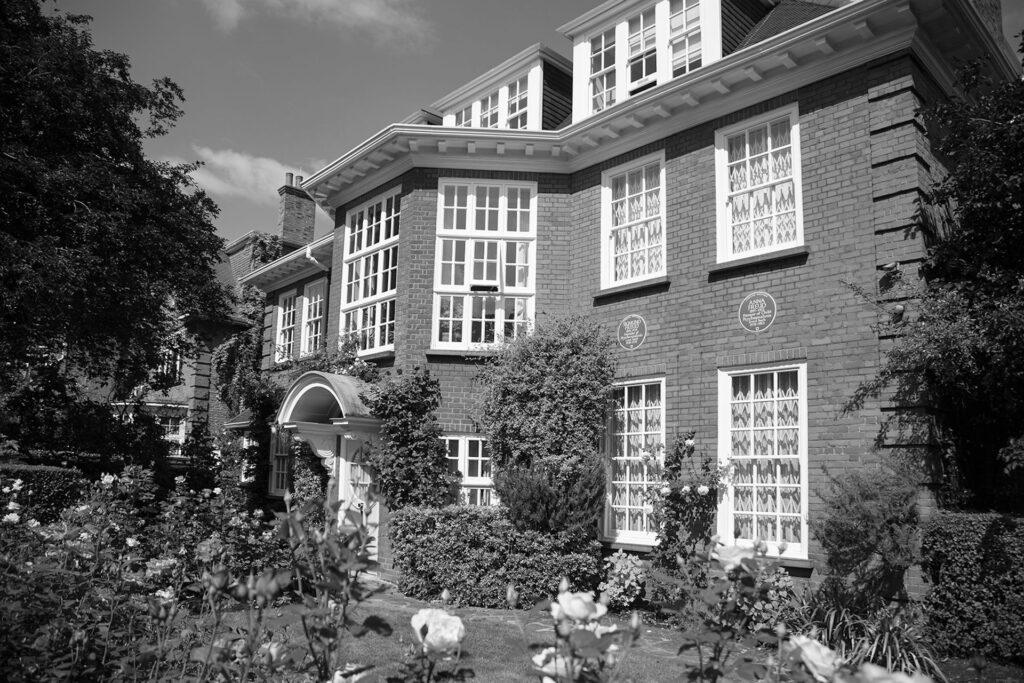
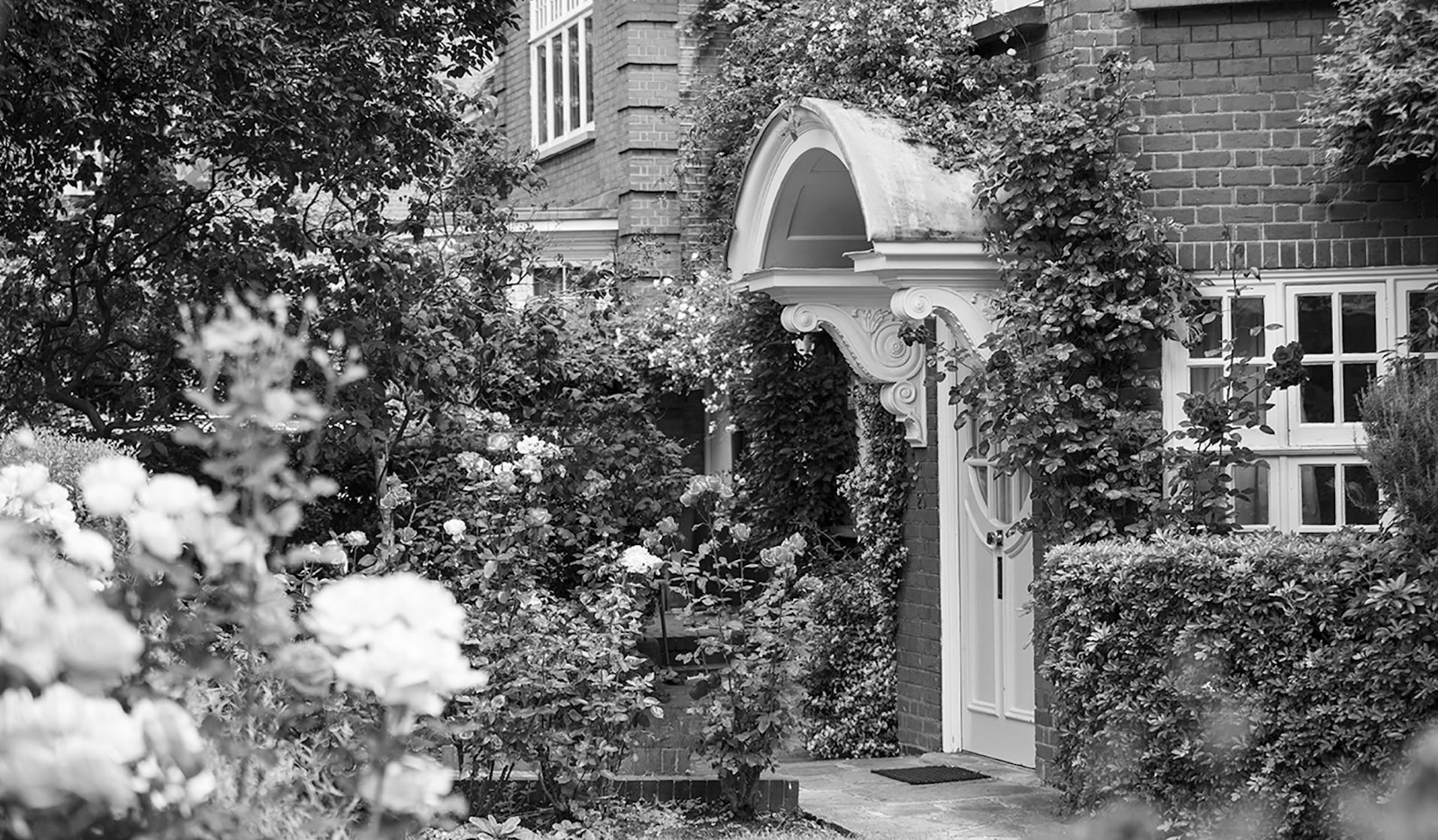
A Hampstead, tra viali inclinati e giardini che odorano di erba umida, le case sembrano respirare una grazia appartata. Dietro le facciate di mattoni rossi, dove le finestre si incurvano come ciglia sulla luce, i giardini posteriori si stendono come distese di verde paziente, popolati da scoiattoli e dal fruscio delle magnolie. È qui, al 20 di Maresfield Gardens, che Sigmund Freud trovò il suo ultimo rifugio, nell’estate del 1938, dopo aver lasciato Vienna. Scelse una casa borghese, discreta, con la calma dignità di ciò che è costruito per durare nel silenzio, la cui architettura non impone, ma ascolta.
Le finestre, ampie e curve, aprono su un giardino che si inclina verso la luce. Dalla vetrata dello studio, il mondo esterno appare come un pensiero che si affaccia alla coscienza. Tutta la casa respira al ritmo di quella visione: ogni oggetto, ogni libro, ogni piccolo idolo in terracotta sembra animato da un’intelligenza segreta, come se il pensiero stesso avesse trovato un corpo in queste stanze.
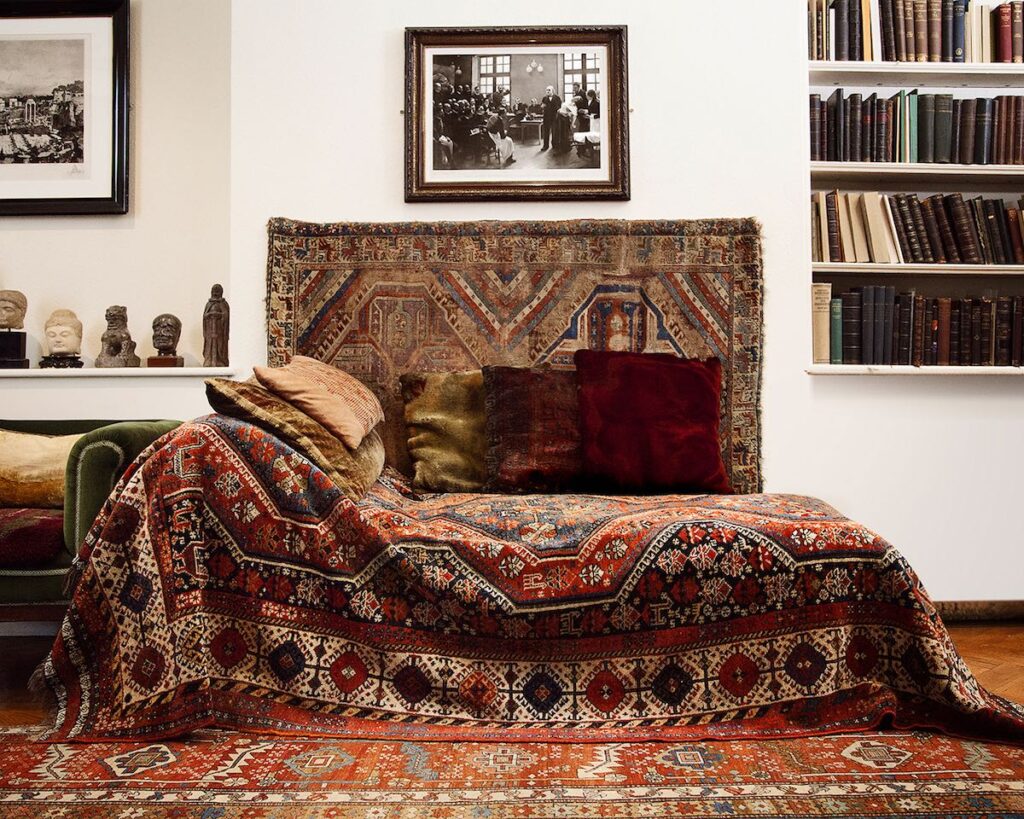
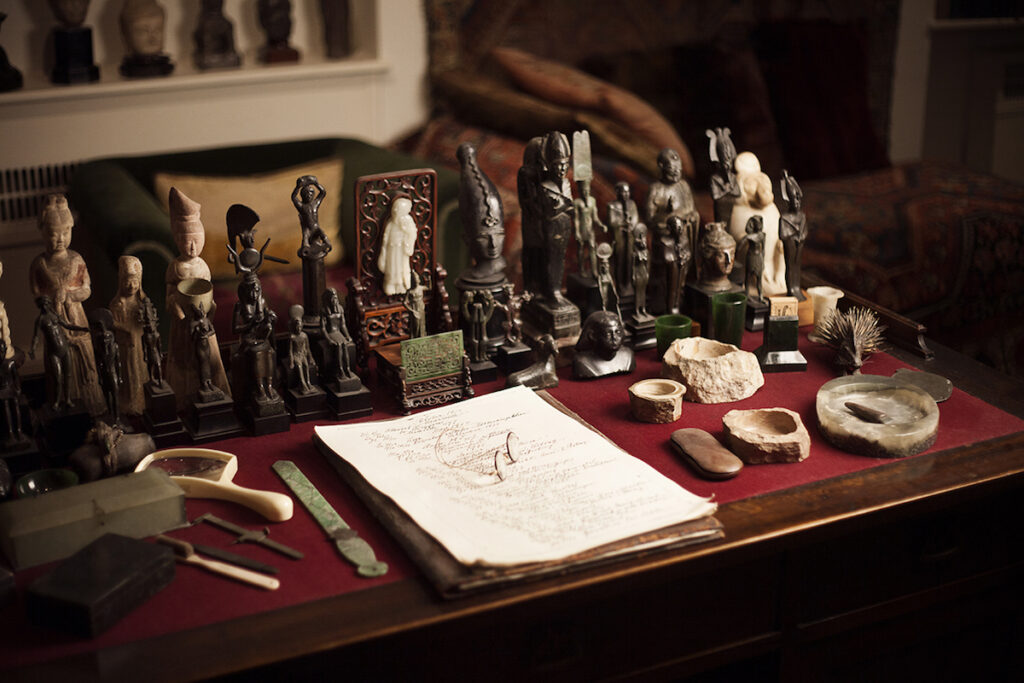
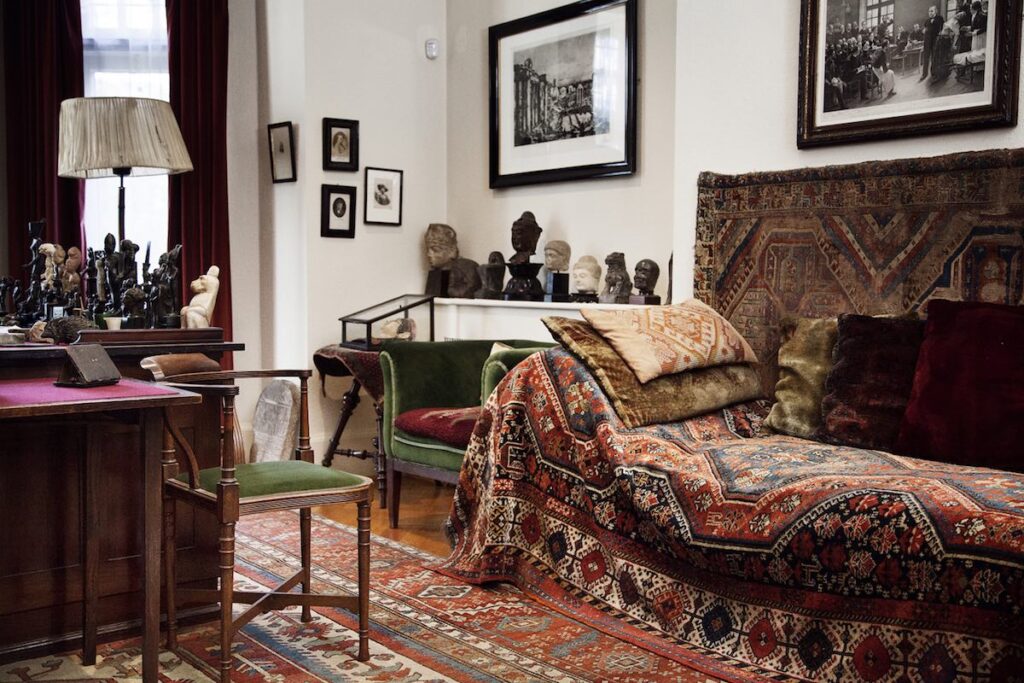
Sulla scrivania, più di duemila figure di divinità egizie e greche vegliano come presenze della mente — non reliquie, ma interlocutrici silenziose di un dialogo incessante tra materia e sogno. Il divano, coperto da tappeti orientali, non è un arredo ma un altare della parola. La luce vi scivola accanto come una sostanza psichica, attraversa i vetri spessi, indugia sulle stoffe, sulle cornici, sui libri aperti. Ogni oggetto sembra contenere un residuo di voce, un battito remoto. È una casa costruita per accogliere la parola: un organismo che continua, anche ora, a sognare. L’aria stessa vi ha imparato la pazienza del silenzio e il tempo vi scorre con la lentezza di chi ha cessato di difendersi.
Freud vi trascorse solo un anno, ma in quel breve tempo la casa si impregnò della sua voce.
Dopo di lui, Anna Freud la abitò come si abita un’eredità viva: vi aprì una scuola, un consultorio, un laboratorio dell’infanzia e del pensiero. Ogni stanza divenne un luogo di cura, un piccolo universo che intrecciava psicoanalisi e quotidiano. Nelle sue mani, la casa divenne un archivio della tenerezza e dell’inquietudine, dove il sapere si trasmetteva non per dottrina, ma per presenza. E quando, nel 1986, fu aperta al pubblico come Freud Museum, nessuno osò spostare un oggetto. Tutto rimase come sospeso in un’aria di fedeltà silenziosa — un luogo che non espone, ma custodisce. Entrarvi significa attraversare una mente sopravvissuta al proprio corpo, un pensiero che non ha smesso di respirare.
Intorno, il quartiere di Hampstead conserva la sua quiete febbrile.
Tra le colline e le strade alberate, il vento dell’Heath incontra un passato fatto di voci e di scritture: Cecil Sharp, che raccoglieva i canti popolari come sogni rurali del tempo; Elias Canetti, che annotava i dialoghi del mondo invisibile; Henry Moore, che scolpiva la gravità del corpo; Lucian Freud, che trasformava la carne in pensiero; Melanie Klein, che insegnava a leggere le paure dei bambini come racconti mitologici. Tutti, in modi diversi, hanno abitato questa geografia mentale che circonda Maresfield Gardens come una corona d’ombre e di lumi. Fuori, i giardini continuano a vibrare della loro antica calma.
Le foglie si piegano come parole trattenute, la luce scivola sui bow windows come un ricordo che torna. All’interno, tra l’odore di legno, carta e incenso, sembra ancora possibile percepire il suono di un pensiero che passa da una stanza all’altra — una corrente d’aria che non vuole spegnersi.
Così, la casa di Maresfield Gardens resta ciò che è sempre stata: una mente che continua a sognare, un corpo abitato dal tempo.
Eppure, questa dimora non è rimasta immobile.
Da quando divenne museo, nel 1986, il Freud Museum ha saputo trasformare la propria intimità in un laboratorio del tempo, aprendo le stanze dell’esilio al linguaggio dell’arte contemporanea.
Gli artisti che vi entrano non occupano lo spazio: lo ascoltano.
Ogni intervento — installazione, video, scultura, suono — diventa una forma di analisi, un esperimento di memoria e di riscrittura. Qui, la contemporaneità non è ospite, ma medium: le stanze sono interpretate come un organismo psichico, dove le immagini agiscono come sogni e gli oggetti si comportano come sintomi. Nel susseguirsi delle mostre, la casa si è fatta camera d’eco del nostro presente inquieto.
Da Ida Applebroog a Cathie Pilkington, da Glenn Brown e Mathew Weir a Holly Stevenson, solo per citarne alcune tra le più recenti, le opere hanno dialogato con il divano, la scrivania, i libri, restituendo al museo il suo respiro originario: quello dell’ascolto.
Ogni mostra non aggiunge qualcosa al passato, ma ne riattiva la tensione: come se la psicoanalisi, attraverso l’arte, continuasse a interrogare i suoi fantasmi — il corpo, il desiderio, la memoria, la perdita.
Così la casa, oggi, non è solo reliquia o documento.
È una mente che pensa ancora, e lo fa attraverso le forme del contemporaneo: immagini che si depositano sulle sue pareti come nuovi sogni del secolo. Non è passata dalla memoria al presente: li ha tenuti insieme.
Prima che imparasse a dialogare con il contemporaneo, Maresfield Gardens ha accumulato tempo come un corpo che ricorda: per stratificazioni lente, per ritorni intermittenti, per immagini che non si cancellano. Gli artisti che l’hanno attraversata non hanno lasciato tracce visibili, ma depositi di attenzione, attriti minimi, presenze silenziose. È in questo accumulo discreto che la casa ha iniziato a pensarsi come luogo espositivo, senza mai smettere di essere una mente abitata.
Più che una sequenza di mostre, ciò che si è lentamente costruito è stato un processo di trasformazione della casa stessa. Non un programma espositivo in senso cronologico, ma un progressivo spostamento di senso che ha riguardato il modo di intendere il corpo, l’immagine, la memoria e, infine, l’abitare. Ogni intervento ha agito come una pressione o una soglia: non ha occupato lo spazio, lo ha fatto pensare.
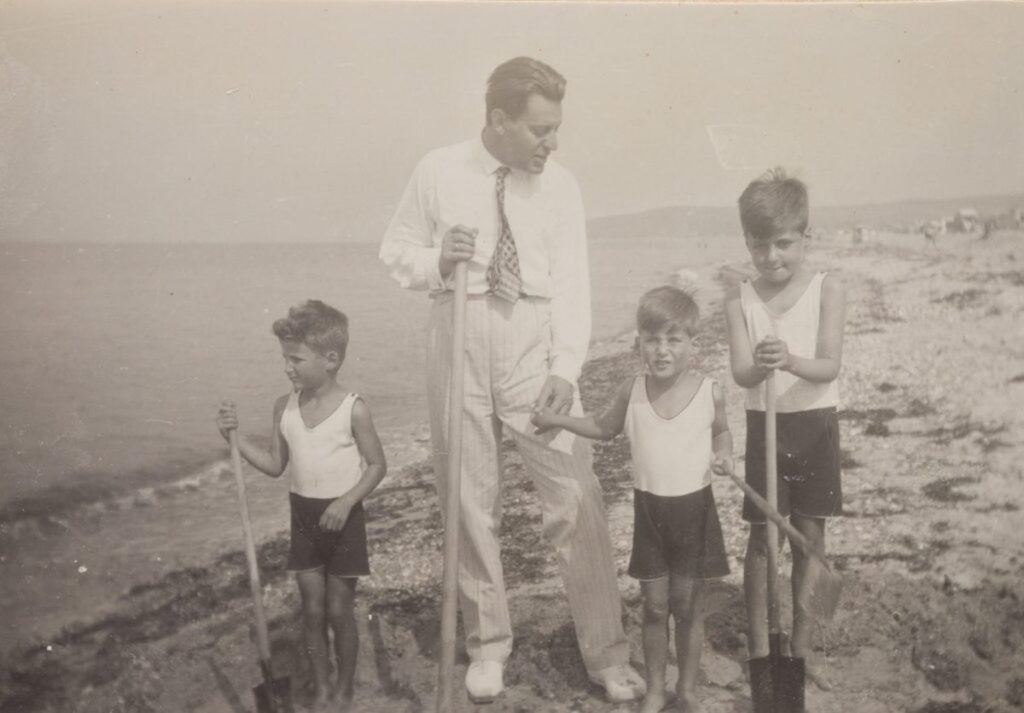
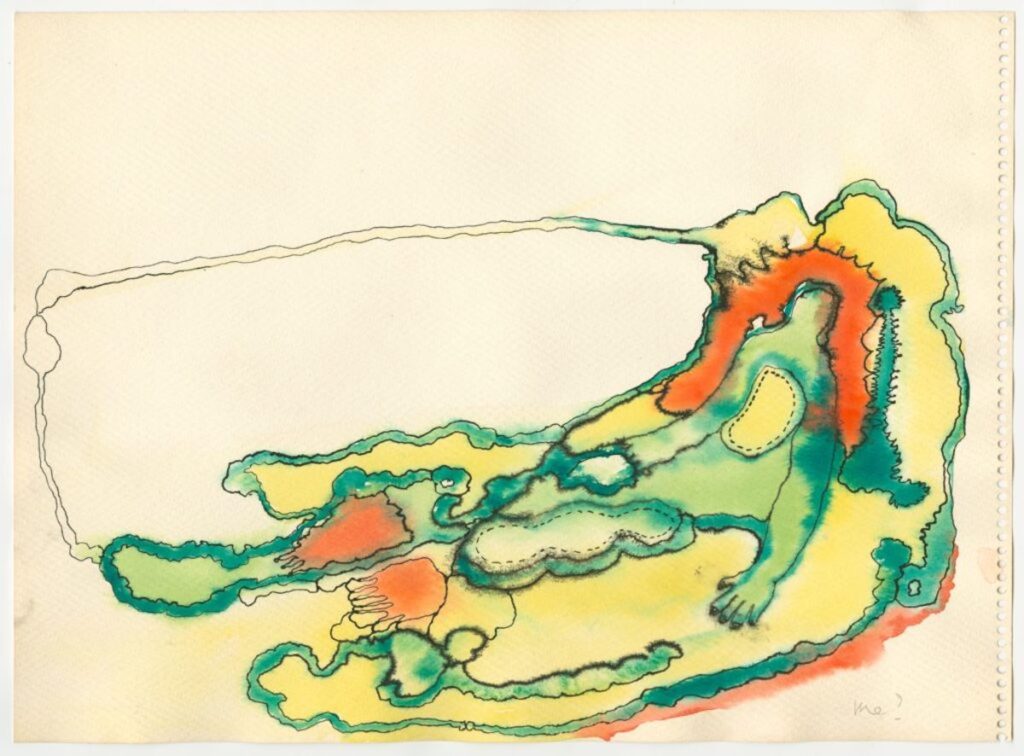
Con Lucian Freud, ad esempio, il corpo è tornato a occupare lo spazio con una forza che non era più simbolica. Non come immagine genealogica o memoria rassicurante, ma come presenza che pesa, che resiste, che consuma lo sguardo. Lo spazio domestico, fino ad allora attraversato soprattutto da oggetti e da parole, ha iniziato a misurarsi con la densità della carne, con ciò che non si lascia attraversare senza attrito. È in questo punto di pressione che la pittura ha trovato posto in questi interni. In Lucian Freud. The Painter and His Family (2015), la figura umana non si è offerta come ritratto, ma come campo instabile di forze. La famiglia non appariva come origine, bensì come configurazione precaria, esposta a una lenta erosione. In quelle stanze, la carne dipinta sembrava ricordare che il vedere non è mai neutro: è un atto che implica resistenza, prossimità, fatica. La casa non accoglieva più l’immagine come superficie, ma come corpo che insiste.
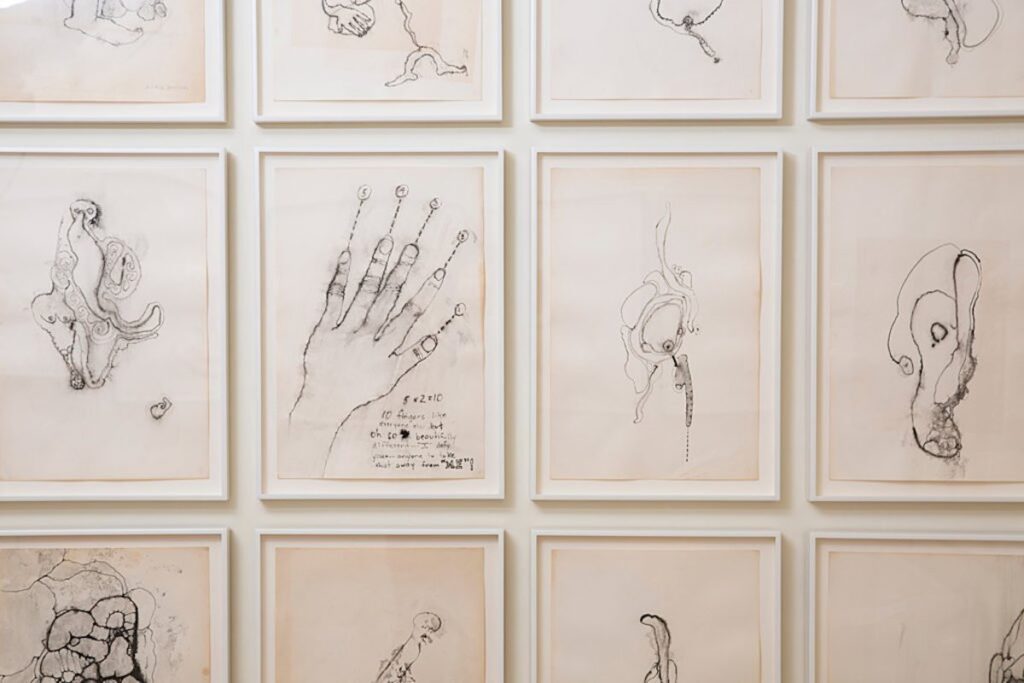
Progressivamente, l’attenzione si è spostata dal corpo intimo al corpo sottoposto a sistemi: osservato, registrato, trattenuto. Le stanze hanno iniziato a interrogare il confine sottile tra cura e controllo, tra protezione e sorveglianza, come se il lessico domestico contenesse già, in forma latente, quello dell’istituzione. Con Ida Applebroog. Mercy Hospital (2020), questo slittamento è diventato esplicito. Le stanze non si sono trasformate in una clinica: hanno rivelato che la clinica era già inscritta nello spazio domestico. Le figure, sospese tra umano e astratto, non abitano un luogo riconoscibile, ma un sistema di orientamenti contraddittori, dove il movimento sembra sempre sul punto di smarrirsi. Le frasi ricorrenti — “this way… no that way…” — non indicano una direzione, ma l’impossibilità stessa di orientarsi. Come nel racconto The Yellow Wallpaper (1892) di Charlotte Perkins Gilman, lo spazio della cura coincide con un dispositivo di reclusione psichica: l’ambiente domestico diventa un apparato che osserva, registra, trattiene. La visione non guarisce, ma resiste. La fragilità non è più una condizione privata, bensì una struttura che si rivela nella sua dimensione politica.
Con Louise Bourgeois at the Freud Museum (2018), si è compiuta una svolta silenziosa ma irreversibile. Le opere non si sono limitate ad abitare la casa: l’hanno attraversata come corpi di memoria non pacificata. Infanzia, desiderio, ripetizione non emergevano come temi, ma come strutture persistenti, come ritorni che non trovano conclusione. In quelle stanze, il tempo non appariva più come successione, ma come materia che lavora dall’interno, che insiste, che ritorna. Il domestico si rivelava definitivamente per ciò che è: non il luogo dell’origine, ma il primo teatro del trauma. La casa non protegge né consola: espone. E nel farlo, trasforma la memoria in una forza attiva, capace di riaffiorare sotto forma di gesto, di oggetto, di immagine che non si lascia quietare. Quando la linearità del tempo non poteva più reggere, con Freud, Dalí and the Metamorphosis of Narcissus (2019), la casa ha accolto il mito non come racconto archeologico, ma come dispositivo di metamorfosi continua. Narciso ha smesso di essere figura dell’auto contemplazione per diventare processo: l’io che si guarda e si perde nello stesso istante. La casa si è fatta superficie riflettente, soglia instabile in cui immagine e desiderio coincidono solo per dissolversi. Il mito non ordinava il passato: lo metteva in movimento, come un sogno che non appartiene a un tempo preciso ma continua a tornare, a mutare forma, a riattivarsi. Dopo il mito, non era più possibile credere all’immediatezza e con la mostra di Toby Ziegler (2022), l’immagine ha iniziato a esibire apertamente la propria costruzione, la propria mediazione. Modelli, simulazioni, fratture percettive hanno reso evidente che nulla si offre senza filtro, nulla si dà come definitivo. Abitare significava ormai muoversi dentro sistemi instabili, immagini sempre sul punto di incrinarsi. La percezione non veniva rassicurata, ma esposta. La casa non garantiva più un punto di vista: lo metteva in crisi.
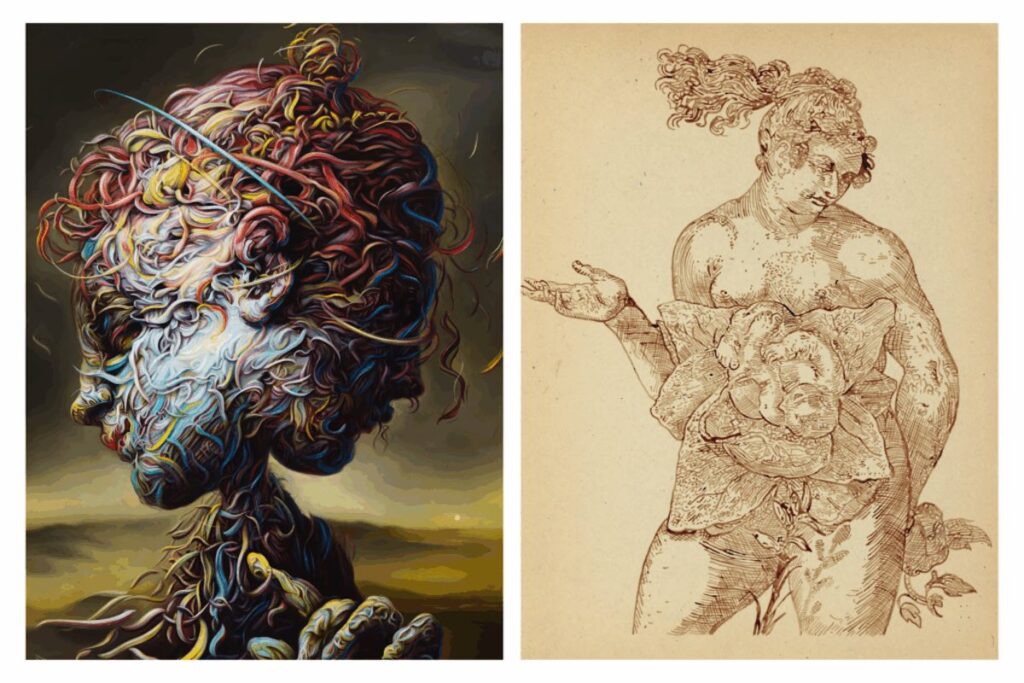
È dentro questa lunga trasformazione che si colloca Glenn Brown and Mathew Weir. The Sight of Something (2025). Il titolo riprende una formula breve e opaca di Freud — the sight of something — che non indica un oggetto, ma un atto di percezione privo di appoggio: un vedere senza nome, senza garanzia. Come scrive Darian Leader nel saggio che accompagna la mostra, l’immagine funziona qui come screen memory: non una finestra sul rimosso, ma uno schermo che lo protegge e lo tradisce allo stesso tempo.
Nel lavoro di Glenn Brown, questa distanza prende corpo. Le immagini della storia dell’arte non vengono citate, ma attraversate: piegate, invertite, fuse, come se il tempo le avesse rese molli. I corpi che emergono sono instabili, stratificati, spesso irriconoscibili; sembrano voltarsi dall’interno verso l’esterno, come se la pelle non bastasse più a contenerli. Leader parla di aftercare: non guarigione, ma attenzione. Non una riparazione del passato, bensì una sua trasformazione lenta. Nella casa di Freud, queste opere non spiegano nulla. Non illustrano la psicoanalisi, non la celebrano. Agiscono come sogni che non chiedono di essere interpretati subito. Il divano, lo studio, gli oggetti archeologici partecipano a una scena analitica dilatata, in cui le immagini funzionano come residui di pensiero che tornano senza annuncio. Nulla viene ordinato, nulla viene risolto.
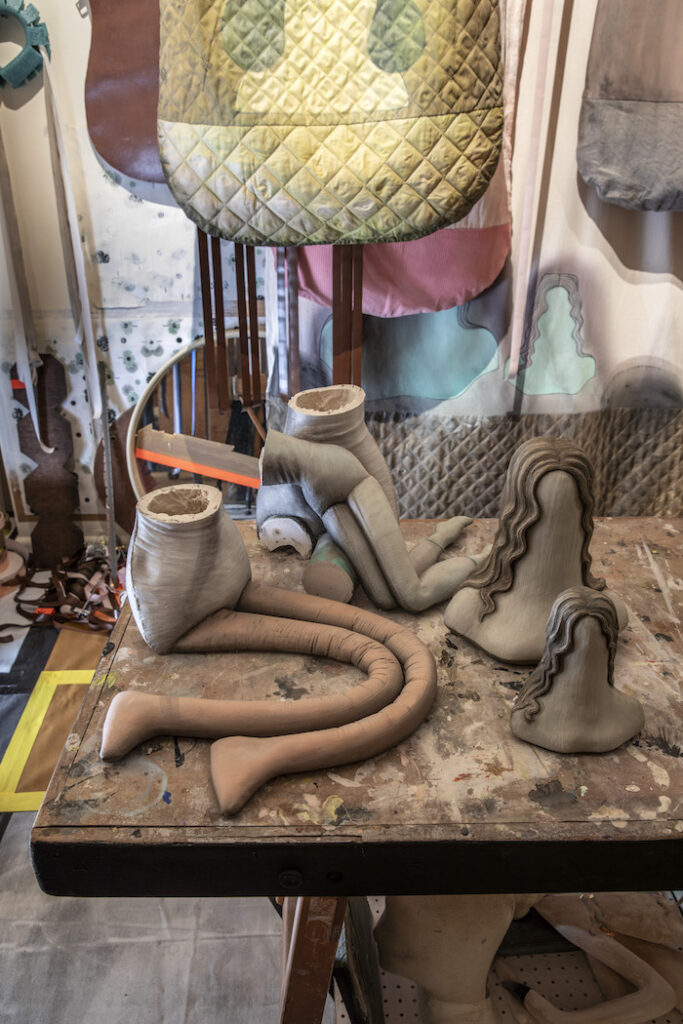
La mostra attualmente in corso Housekeeper di Cathie Pilkington (29 ottobre 2025 – 1 marzo 2026), curata da Gemma Blackshaw, si colloca con precisione in questo processo di trasformazione lenta della casa di Maresfield Gardens. Non lo interrompe e non lo conclude: lo sposta ulteriormente, agendo su un livello che finora era rimasto in ombra. Se molte delle mostre precedenti hanno interrogato la casa come mente, come scena psichica o come archivio del trauma, Housekeeper compie un passaggio decisivo: interroga la casa come struttura di lavoro, come sistema sostenuto da pratiche quotidiane che precedono e rendono possibile ogni forma di pensiero.
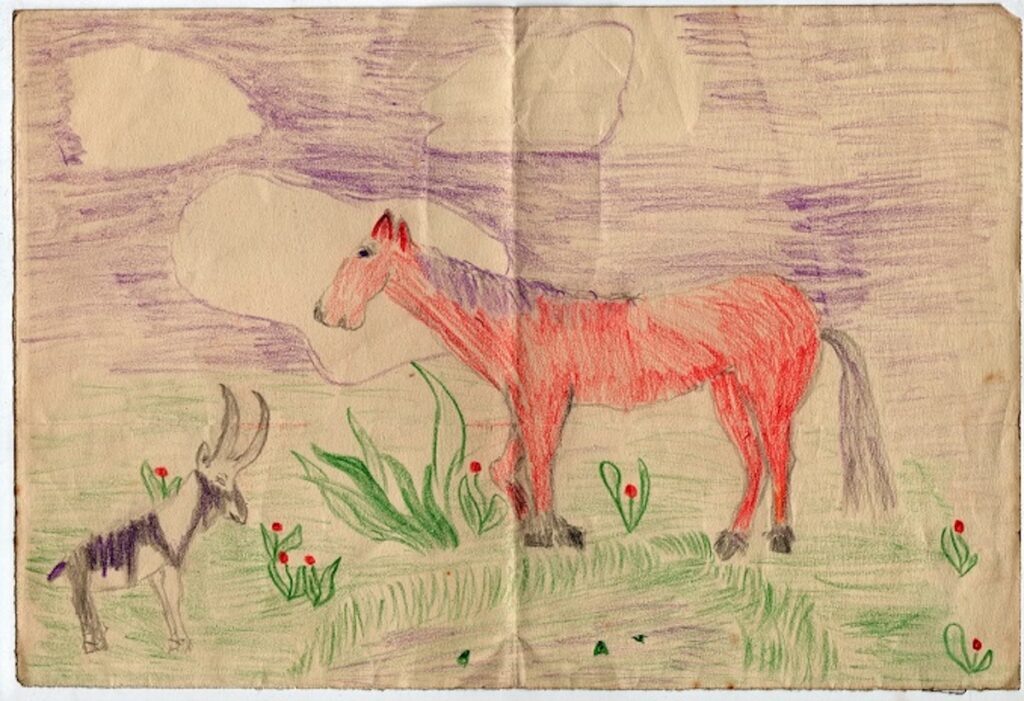
Il punto di partenza non è Freud, né la sua teoria, ma ciò che ha consentito alla sua casa di funzionare, sopravvivere, trasformarsi. La figura che emerge al centro della mostra è quella di Paula Fichtl, governante della famiglia Freud dal 1929 agli anni Ottanta, da Vienna a Londra, testimone silenziosa dell’esilio, della trasformazione della casa, della sua sopravvivenza materiale. Fu lei a partecipare all’imballaggio dello studio nel 1938; poi fu internata come “enemy alien” sull’Isola di Man; tornò a Maresfield Gardens nel 1941, restando fino alla morte di Anna Freud. Eppure, come spesso accade al lavoro di cura, la sua presenza è rimasta ai margini della narrazione, registrata come fatto biografico, mai come posizione strutturale. La curatela di Blackshaw opera qui uno spostamento netto: non recupera una figura dimenticata, ma rilegge il Freud Museum come household prima ancora che come istituzione culturale. Custodire, spolverare, ricordare dove ogni oggetto va collocato, imballare e ricomporre lo studio in esilio: sono questi i gesti che hanno reso possibile non solo la continuità della casa, ma l’esistenza stessa del museo. Non una eccezione domestica divenuta museo, ma un luogo sostenuto da pratiche di housekeeping: pulire, spostare, proteggere, inventariare, ricordare dove ogni cosa deve stare. È un lavoro ripetitivo, non finito, storicamente femminilizzato, che non produce oggetti visibili ma continuità. In questa prospettiva, il museo non appare più come spazio neutro della conservazione, bensì come apparato che dipende da un lavoro invisibile e costante, senza il quale nessun oggetto potrebbe essere mostrato, nessuna memoria trasmessa.
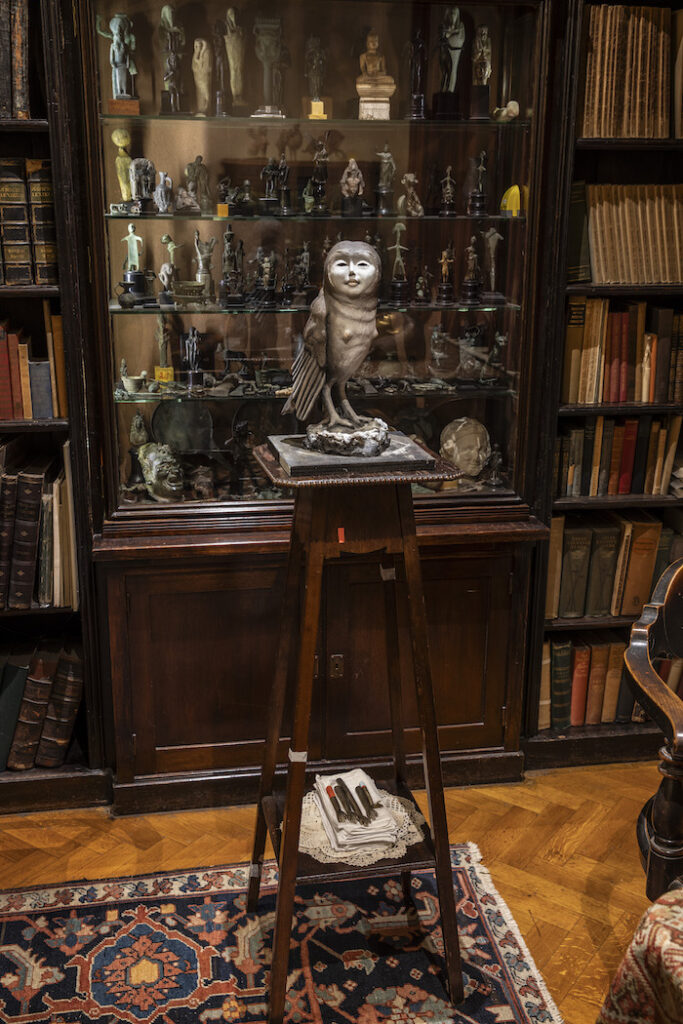
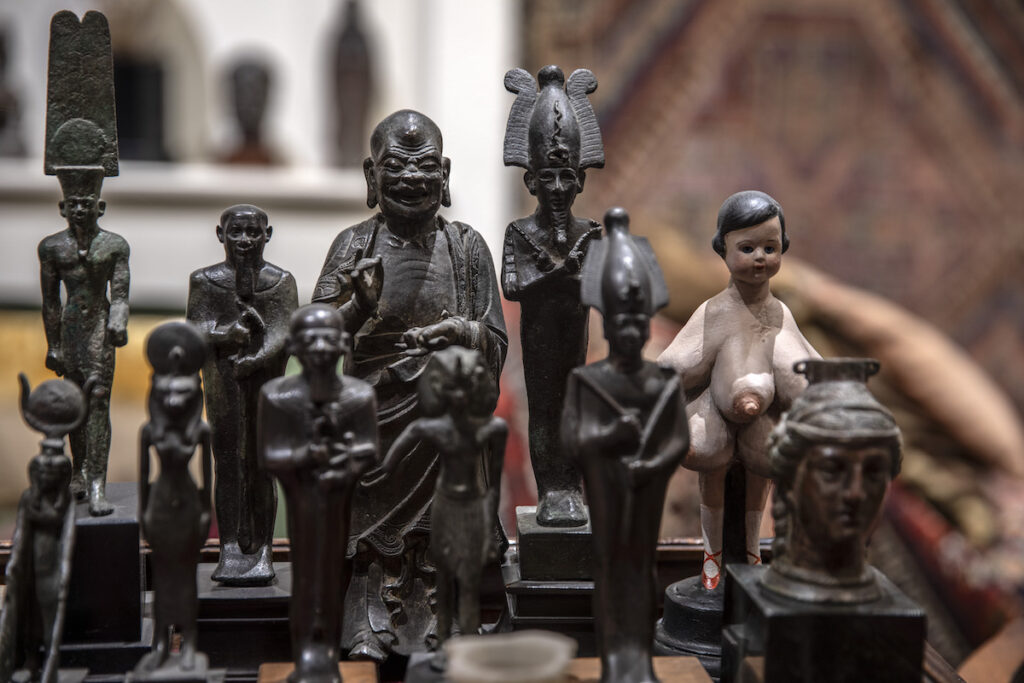
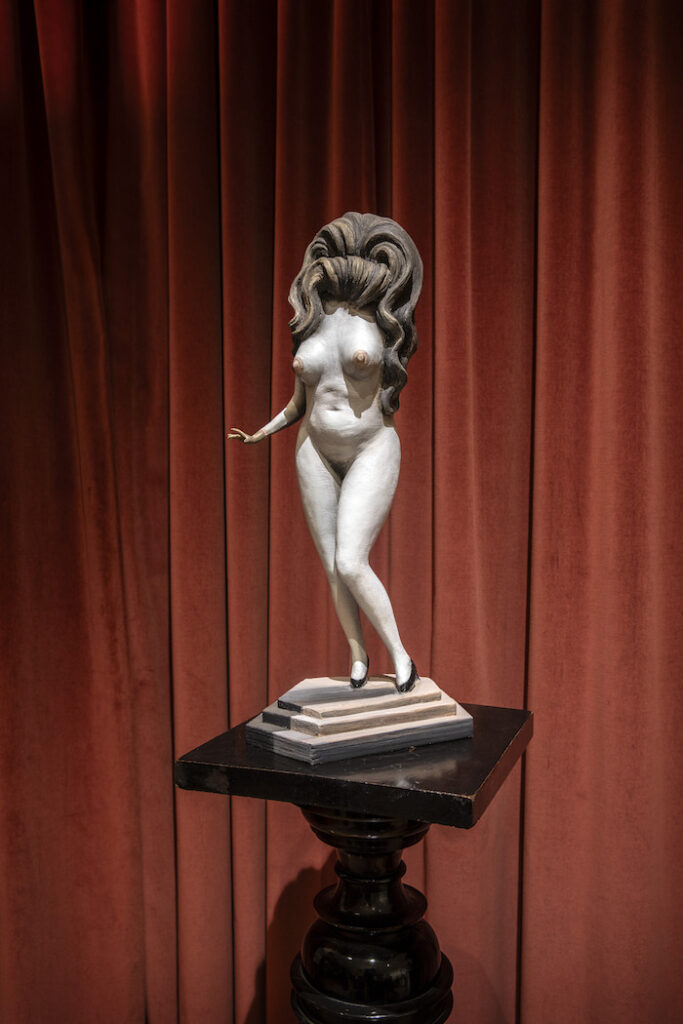
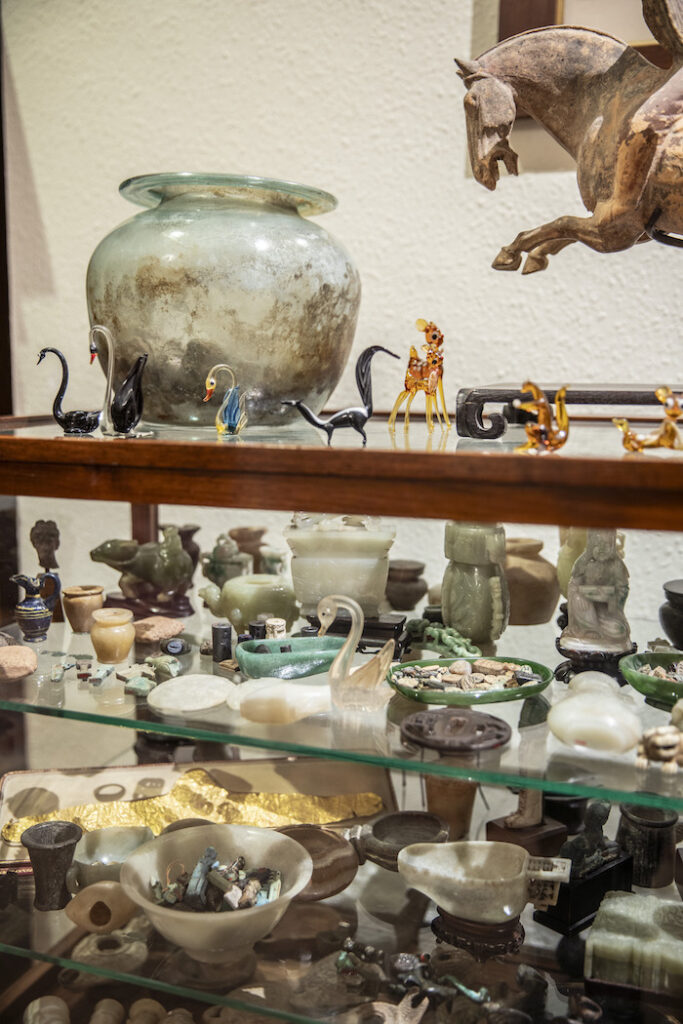
È all’interno di questa lettura che l’intervento di Pilkington prende forma. Le sue opere non illustrano la storia di Paula Fichtl, né si propongono come commento didascalico. Al contrario, agiscono per prossimità e interferenza, insinuandosi tra gli oggetti della collezione con una discrezione che produce incertezza. La mostra introduce una domanda semplice e destabilizzante: si può distinguere con certezza ciò che appartiene al museo da ciò che è stato introdotto dall’artista? Questa ambiguità non è un effetto collaterale, ma una strategia critica che mette in crisi l’autorità silenziosa dell’ordine museale, fondato su attribuzioni, gerarchie e separazioni nette.
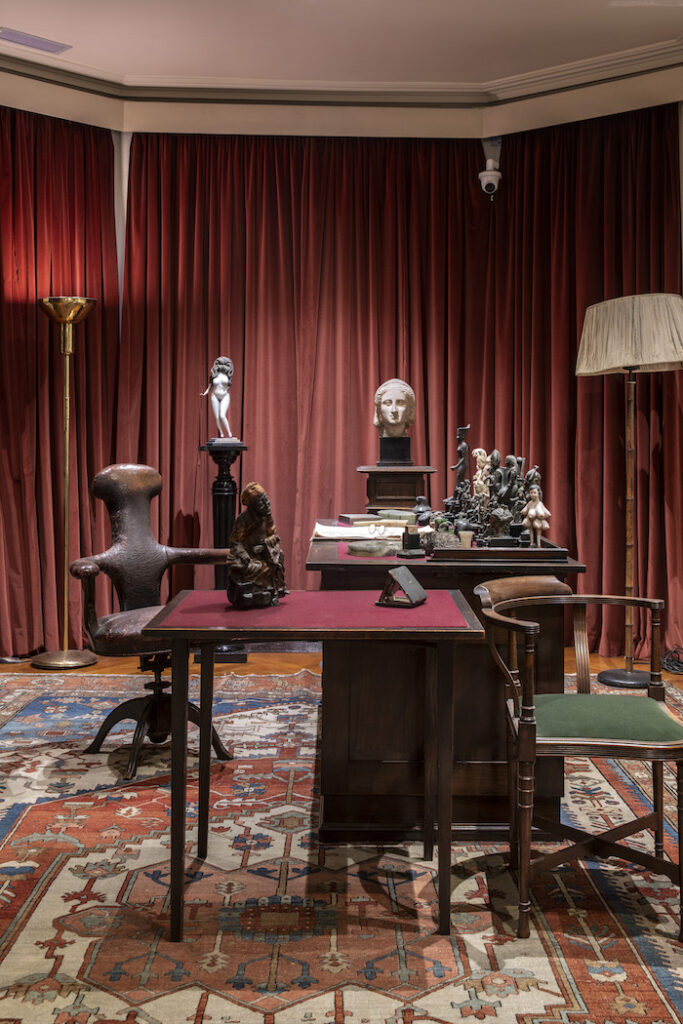
Nello studio, opere come Resistant Materials / Unstable Objects (Study) (2025) convivono con lavori precedenti dell’artista e con gli oggetti freudiani in un equilibrio fragile di superfici e consistenze. Gesso, legno, vetro, pelliccia: materiali che non competono per visibilità, ma che rendono percepibile il lavoro di mantenimento che tiene insieme le cose. Non c’è mimetismo né citazione, ma una frizione controllata che rende lo spazio leggermente instabile, come se l’ordine potesse sempre essere rinegoziato.
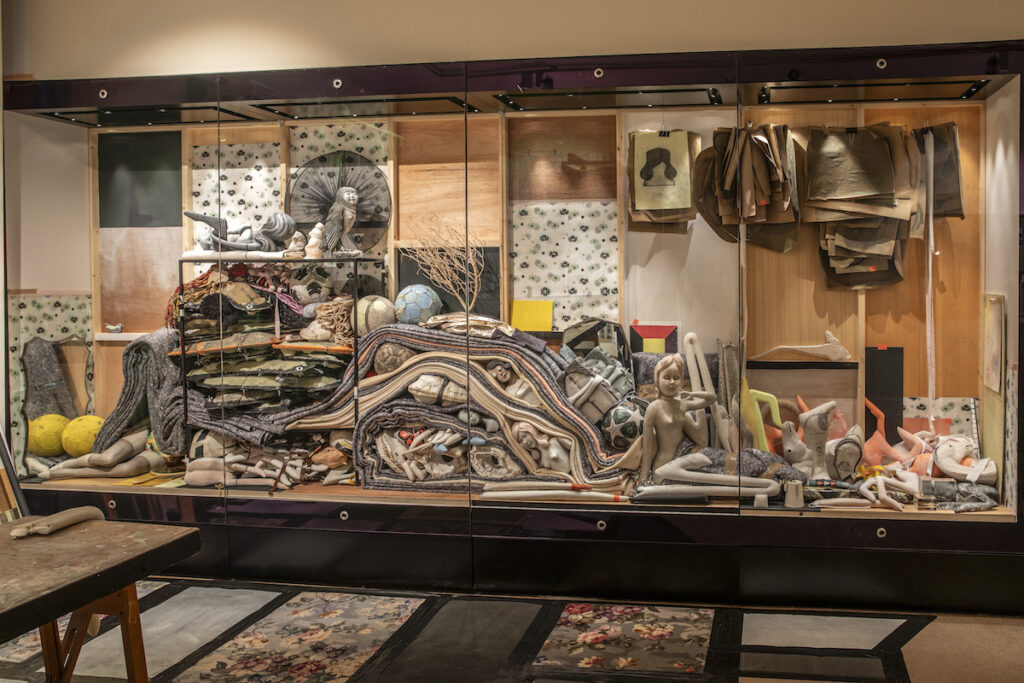
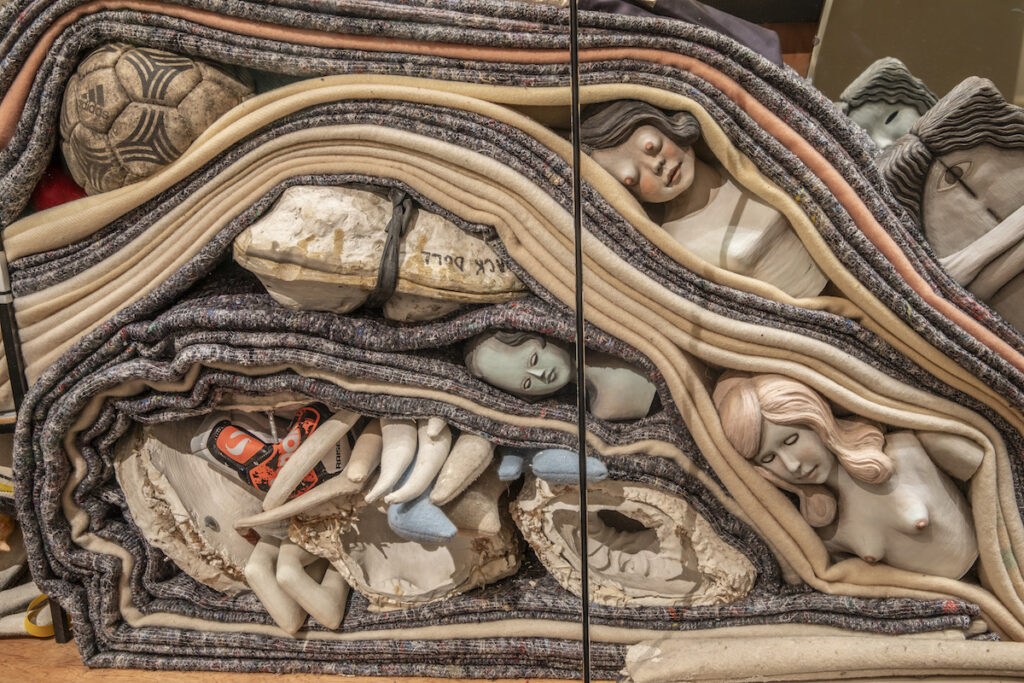
Il gesto più radicale avviene però nell’Exhibition Room, trasformata in storeroom. Qui la mostra abbandona qualsiasi idea di esposizione ordinata per assumere la forma di un deposito stratificato, un retrocasa che coincide con una scena psichica. Strata e Inventory (2025) non promettono classificazione né chiarezza: mostrano l’inventario come pratica provvisoria, sempre incompleta, e lo stoccaggio come condizione necessaria della visibilità. Il pubblico entra nello spazio che normalmente resta nascosto, quello in cui le cose vengono tenute insieme prima di essere esposte o dopo essere state rimosse. Museo e casa si scambiano di posto, e la distinzione tra ciò che è mostrabile e ciò che sostiene il mostrabile si dissolve.
Nel testo curatoriale, Blackshaw insiste sul fatto che Housekeeper non è una mostra nostalgica né riparativa. Non si tratta di rendere giustizia a posteriori, ma di attivare una posizione critica. Pilkington assume la figura dell’interloper: colei che entra, che ha accesso senza possesso, che opera dall’interno senza coincidere con l’autorità. È una forma di agency laterale, minima ma reale, che si manifesta nei gesti di cura e manutenzione, piuttosto che nella parola o nella teoria.
In questo senso, Housekeeper prosegue e insieme riformula la traiettoria del Freud Museum come luogo espositivo. Se le mostre precedenti hanno interrogato il corpo, il desiderio, il mito, la mediazione dell’immagine, qui la questione diventa strutturale: chi tiene insieme le cose? Chi rende possibile la durata di una casa, di una collezione, di una memoria? La casa di Maresfield Gardens si mostra allora non solo come mente che pensa o come archivio che ricorda, ma come organismo sostenuto da un lavoro silenzioso, continuo, materiale.
È forse questa la soglia più recente e più esigente attraversata dal museo. Non una nuova tematizzazione, ma un cambiamento di prospettiva. Il pensiero non viene più interrogato solo per ciò che produce, ma per le condizioni che lo rendono possibile. Housekeeper non chiude un percorso: lo riapre da un punto laterale, riportando l’attenzione su ciò che, proprio perché invisibile, continua a sostenere l’intero edificio del sapere.
LEGGI: Nel tempo dell’altro | Ashmolean Museum Oxford
The house as mind | Freud Museum, London
Text by Rita Selvaggio —
London never presents itself whole. It comes into view in veils, as if every street guarded a memory not yet ready to release.
In Hampstead, among sloping avenues and gardens scented with damp grass, the houses seem to breathe with a reticent grace. Behind red-brick façades, where windows curve like eyelashes catching the light, back gardens stretch out in patient expanses of green, inhabited by squirrels and the soft rustle of magnolia leaves. It was here, at 20 Maresfield Gardens, that Sigmund Freud found his final refuge in the summer of 1938, after leaving Vienna. He chose a discreet bourgeois house, marked by the quiet dignity of things built to endure in silence, an architecture that does not impose itself, but listens.
The wide, curved windows open onto a garden that inclines towards the light. From the glass wall of the study, the outside world appears like a thought edging its way into consciousness. The entire house breathes in rhythm with that vision: every object, every book, every small terracotta idol seems animated by a secret intelligence, as if thought itself had found a body in these rooms.
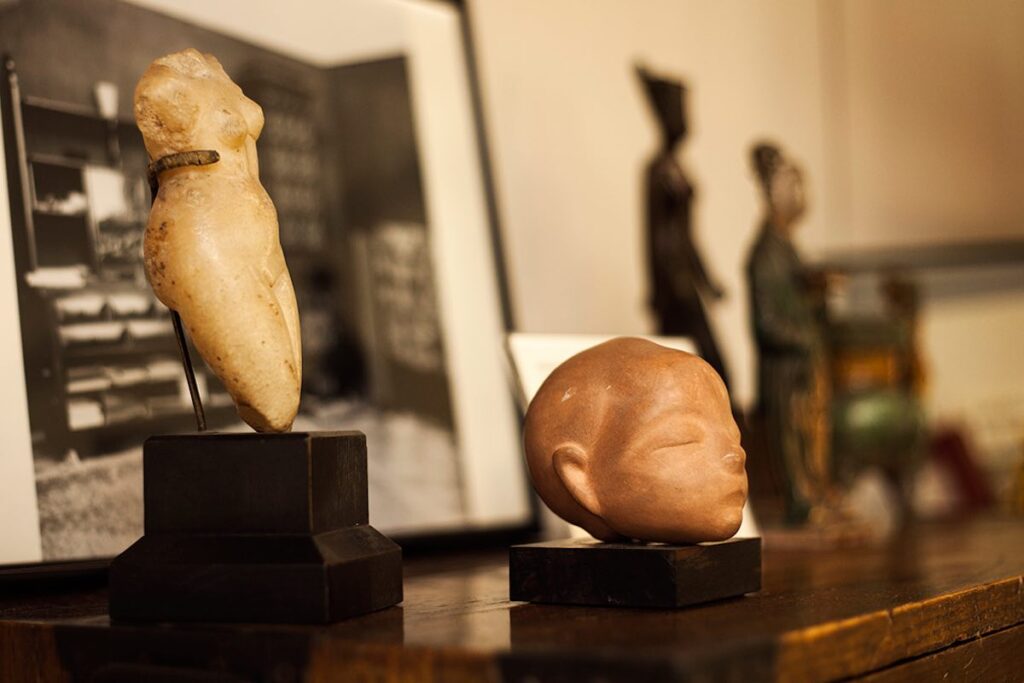
On the desk, more than two thousand figures of Egyptian and Greek deities keep watch as presences of the mind — not relics, but silent interlocutors in an unbroken dialogue between matter and dream. The couch, covered in Oriental rugs, is not a piece of furniture but an altar of speech. Light slips alongside it like a psychic substance, passing through thick panes of glass, lingering on fabrics, frames, open books. Each object seems to contain a residue of voice, a distant pulse. This is a house built to receive words: an organism that continues, even now, to dream. The air itself has learned the patience of silence here, and time moves through the rooms with the slowness of someone who has stopped defending themselves.
Freud lived here for only a year, yet in that brief time the house absorbed his voice.
After him, Anna Freud inhabited it as one inhabits a living inheritance: she opened a school, a consulting room, a laboratory of childhood and thought. Each room became a site of care, a small universe in which psychoanalysis and daily life were interwoven. In her hands, the house became an archive of tenderness and unease, where knowledge was transmitted not through doctrine, but through presence. And when, in 1986, it was opened to the public as the Freud Museum, no one dared to move an object. Everything remained suspended in an atmosphere of quiet fidelity — a place that does not display, but keeps watch. To enter it is to pass through a mind that has survived its own body, a form of thought that has never stopped breathing.
Around it, the neighborhood of Hampstead preserves its febrile calm.
Among the hills and tree-lined streets, the wind from the Heath meets a past made of voices and writing: Cecil Sharp, gathering folk songs like rural dreams of time; Elias Canetti, recording the dialogues of the invisible world; Henry Moore, carving the gravity of the body; Lucian Freud, turning flesh into thought; Melanie Klein, teaching how to read children’s fears as mythological narratives. Each, in different ways, inhabited this mental geography that encircles Maresfield Gardens like a crown of shadow and light. Outside, the gardens continue to vibrate with their ancient calm.
Leaves bend like withheld words; light slides across the bow windows like a returning memory. Inside, amid the scent of wood, paper and incense, it still seems possible to perceive the sound of a thought moving from one room to another — a current of air unwilling to die away.
Thus, the house at Maresfield Gardens remains what it has always been: a mind that continues to dream, a body inhabited by time.
Yet this house has never remained still.
Since becoming a museum in 1986, the Freud Museum has learned how to turn its intimacy into a laboratory of time, opening the rooms of exile to the language of contemporary art. The artists who enter do not occupy the space: they listen to it. Each intervention — installation, video, sculpture, sound — becomes a form of analysis, an experiment in memory and rewriting. Here, contemporaneity is not a guest but a medium: the rooms are read as a psychic organism, images behave like dreams and objects act as symptoms. Through the succession of exhibitions, the house at Maresfield Gardens has become an echo chamber of our disquieted present.
From Ida Applebroog to Cathie Pilkington, from Glenn Brown and Mathew Weir to Holly Stevenson — to name only a few of the most recent — the works have entered into dialogue with the couch, the desk, the books, restoring to the museum its original breath: that of listening. Each exhibition does not add something to the past, but reactivates its tension, as if psychoanalysis, through art, were continuing to question its own ghosts — the body, desire, memory, loss.
Thus, today the house is no longer merely a relic or a document.
It is a mind that continues to think, doing so through contemporary forms: images that settle on its walls like new dreams of the century. It has not moved from memory to the present; it has held them together.
Before learning how to speak with the contemporary, Maresfield Gardens accumulated time like a remembering body: through slow stratifications, intermittent returns, images that do not erase themselves. The artists who passed through it left no visible traces, but deposits of attention, minimal frictions, silent presences. It is within this discreet accumulation that the house began to conceive of itself as an exhibition space, without ever ceasing to be an inhabited mind.
More than a sequence of exhibitions, what slowly took shape was a process of transformation of the house itself. Not an exhibition programme in a chronological sense, but a gradual shift in meaning that reconfigured ways of understanding the body, the image, memory and, ultimately, inhabiting. Each intervention acted as a pressure or a threshold: it did not occupy the space; it made it think.
The body, for instance, with Lucian Freud, returned to the space with a force that was no longer symbolic. Not as genealogical image or reassuring memory, but as a presence that weighs, resists, exhausts the gaze. The domestic space — until then traversed primarily by objects and words — began to measure itself against the density of flesh, against what does not allow itself to be crossed without friction. It was at this point of pressure that painting found its place within these interiors. With Lucian Freud. The Painter and His Family (2015), the human figure did not present itself as portrait, but as an unstable field of forces. The family appeared not as origin, but as a precarious configuration, exposed to slow erosion. In those rooms, painted flesh seemed to remind us that seeing is never neutral: it is an act that entails resistance, proximity, effort. The house no longer received the image as surface, but as a body that insists.
Gradually, attention shifted from the intimate body to the body subjected to systems: observed, recorded, held in place. The rooms began to probe the thin boundary between care and control, between protection and surveillance, as if the domestic lexicon already contained — in latent form — that of the institution. With Ida Applebroog. Mercy Hospital (2020), this slippage became explicit. The rooms did not turn into a clinic; they revealed that the clinic was already inscribed within the domestic space. The figures, suspended between the human and the abstract, do not inhabit a recognisable place, but a system of contradictory orientations, where movement seems perpetually on the verge of losing its way. The recurring phrases — “this way… no that way…” — do not point towards a direction, but towards the very impossibility of orientation. As in Charlotte Perkins Gilman’s The Yellow Wallpaper (1892), the space of care coincides with a device of psychic confinement: the domestic environment becomes an apparatus that observes, records, restrains. Vision does not heal; it resists. Fragility is no longer a private condition, but a structure that reveals itself in its political dimension.
With Louise Bourgeois at the Freud Museum (2018), a silent yet irreversible shift took place. The works did not merely inhabit the house; they moved through it like bodies of unpacified memory. Childhood, desire, repetition did not emerge as themes, but as persistent structures — as returns that find no conclusion. In those rooms, time no longer appeared as succession, but as a material working from within, insisting, returning. The domestic was finally revealed for what it is: not a place of origin, but the first theatre of trauma. The house does not protect, does not console. It exposes. And in doing so, it transforms memory into an active force, capable of resurfacing as gesture, object, image — something that refuses pacification.
When the linearity of time could no longer hold, with Freud, Dalí and the Metamorphosis of Narcissus (2019), the house received myth not as an archaeological narrative, but as a device of continuous metamorphosis. Narcissus ceased to be a figure of self-contemplation and became a process: the self that looks at itself and loses itself in the same instant. The house became a reflective surface, an unstable threshold in which image and desire coincide only in order to dissolve. Myth did not organise the past; it set it in motion, like a dream that belongs to no fixed time but continues to return, to change form, to reactivate itself. After myth, it was no longer possible to believe in immediacy.
With the exhibition of Toby Ziegler (2022), the image began openly to expose its own construction, its own mediation. Models, simulations, perceptual fractures made it evident that nothing presents itself without a filter, nothing is given as definitive. To inhabit now meant to move within unstable systems, images perpetually on the verge of cracking. Perception was no longer reassured, but exposed. The house no longer guaranteed a point of view; it placed it in crisis.
It is within this long transformation that Glenn Brown and Mathew Weir. The Sight of Something (2025) takes its place. The title reprises a brief, opaque formulation by Freud — the sight of something — which names not an object, but an act of perception without support: a seeing without a name, without guarantee. As Darian Leader writes in the essay accompanying the exhibition, the image here functions as a screen memory: not a window onto the repressed, but a screen that both protects it and betrays it.
In Glenn Brown’s work, this distance takes on a body. Images from the history of art are not quoted, but passed through — bent, inverted, fused, as if time had rendered them soft. The bodies that emerge are unstable, stratified, often unrecognisable; they seem to turn from the inside out, as though skin were no longer sufficient to contain them. Leader speaks of aftercare: not healing, but attention. Not a repair of the past, but its slow transformation. In Freud’s house, these works explain nothing. They do not illustrate psychoanalysis, nor do they celebrate it. They act like dreams that do not ask to be interpreted immediately. The couch, the study, the archaeological objects all participate in an expanded analytic scene, in which images function as residues of thought that return without announcement. Nothing is ordered; nothing is resolved.
The exhibition currently on view, Housekeeper by Cathie Pilkington (29 October 2025 – 1 March 2026), curated by Gemma Blackshaw, positions itself precisely within this slow process of transformation at Maresfield Gardens. It neither interrupts nor concludes it; instead, it shifts it further, acting on a level that has until now remained in shadow. If many earlier exhibitions have examined the house as mind, as psychic scene, or as an archive of trauma, Housekeeper marks a decisive passage: it interrogates the house as a structure of labour, as a system sustained by daily practices that precede and make possible every form of thought.
The point of departure is not Freud, nor his theory, but what allowed his house to function, to survive, to transform. The figure that emerges at the centre of the exhibition is Paula Fichtl, housekeeper to the Freud family from 1929 through the 1980s, from Vienna to London — a silent witness to exile, to the house’s transformation, to its material survival. She took part in packing the study in 1938; she was interned as an “enemy alien” on the Isle of Man; she returned to Maresfield Gardens in 1941, remaining there until Anna Freud’s death. Yet, as so often happens with care work, her presence has remained at the margins of the narrative, recorded as a biographical fact, never as a structural position.
Blackshaw’s curatorship enacts a clear displacement here: it does not recover a forgotten figure, but rereads the Freud Museum as a household before it is a cultural institution. To safeguard, to dust, to remember where each object belongs, to pack and reassemble the study in exile — these are the gestures that made possible not only the continuity of the house, but the very existence of the museum. Not a domestic exception turned museum, but a place sustained by practices of housekeeping: cleaning, moving, protecting, inventorying, remembering where everything must be placed. It is repetitive, unfinished labour, historically feminised, which produces no visible objects but continuity itself. Seen from this perspective, the museum no longer appears as a neutral space of preservation, but as an apparatus dependent on invisible and constant work, without which no object could be shown, no memory transmitted.
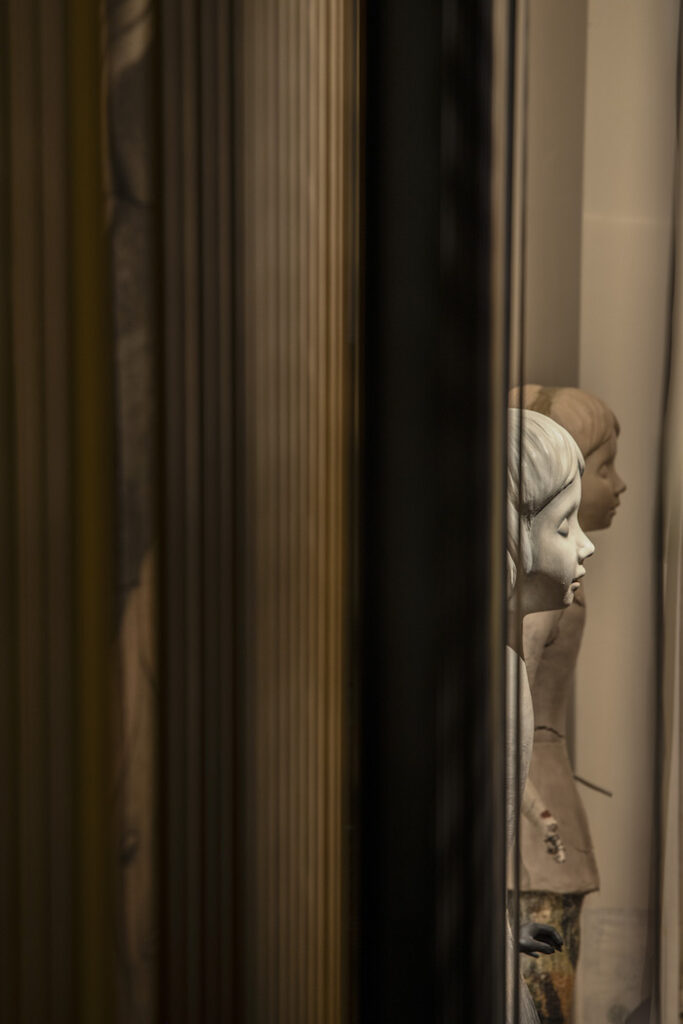
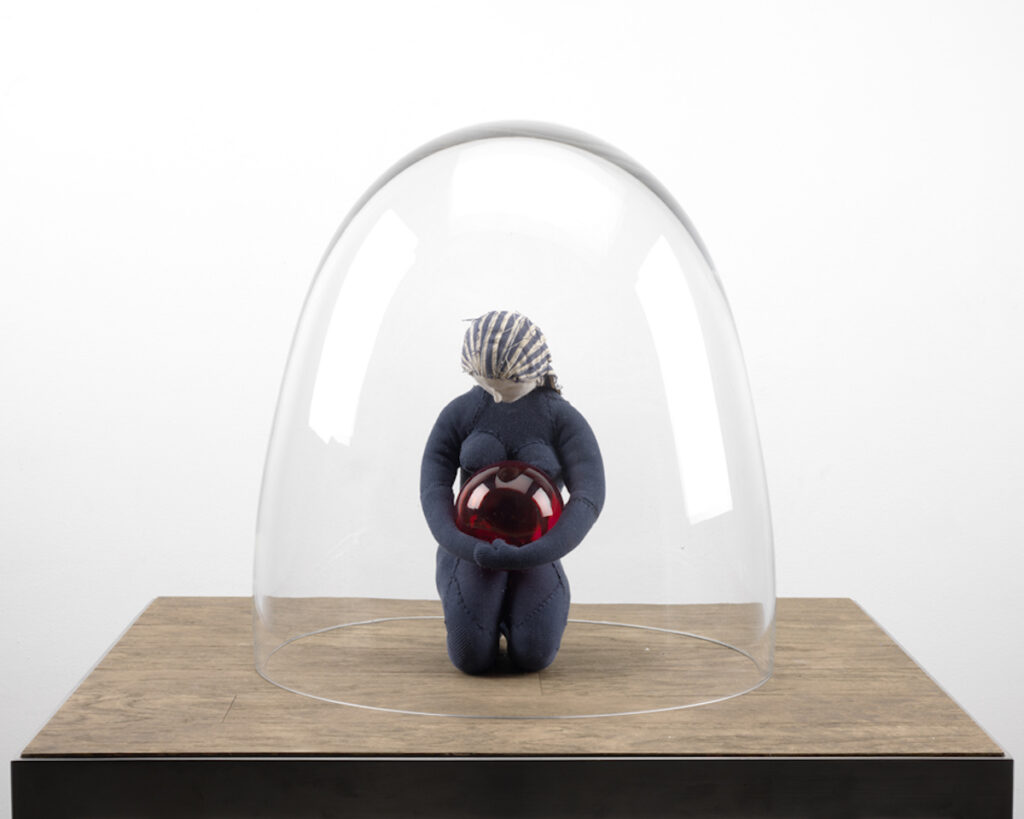
It is within this reading that Pilkington’s intervention takes shape. Her works do not illustrate the story of Paula Fichtl, nor do they present themselves as didactic commentary. Instead, they operate through proximity and interference, insinuating themselves among the objects of the collection with a discretion that produces uncertainty. The exhibition introduces a simple yet destabilising question: can one distinguish with certainty what belongs to the museum from what has been introduced by the artist? This ambiguity is not a side effect, but a critical strategy that unsettles the silent authority of the museological order, founded on attribution, hierarchy, and clear separation.
In the study, works such as Resistant Materials / Unstable Objects (Study) (2025) coexist with earlier works by the artist and with Freud’s objects in a fragile equilibrium of surfaces and consistencies. Plaster, wood, glass, fur: materials that do not compete for visibility, but make perceptible the labour of maintenance that holds things together. There is no mimicry, no quotation, but a controlled friction that renders the space slightly unstable, as though order were always open to renegotiation.
The most radical gesture, however, takes place in the Exhibition Room, transformed into a storeroom. Here the exhibition abandons any notion of orderly display to assume the form of a stratified deposit, a back room that coincides with a psychic scene. Strata and Inventory (2025) promise neither classification nor clarity; they reveal inventory as a provisional, always incomplete practice, and storage as a necessary condition of visibility. The public enters a space that normally remains hidden — where things are held together before being displayed or after being removed. Museum and house exchange places, and the distinction between what is displayable and what sustains display dissolves.
In the curatorial text, Blackshaw insists that Housekeeper is neither nostalgic nor reparative. It is not a matter of rendering justice after the fact, but of activating a critical position. Pilkington assumes the figure of the interloper: one who enters, who has access without possession, who operates from within without coinciding with authority. It is a form of lateral agency — minimal yet real — that manifests itself in gestures of care and maintenance, rather than in speech or theory.
In this sense, Housekeeper both continues and reformulates the trajectory of the Freud Museum as an exhibition space. If earlier exhibitions have interrogated the body, desire, myth, the mediation of the image, here the question becomes structural: who holds things together? Who makes possible the duration of a house, of a collection, of a memory? The house at Maresfield Gardens reveals itself not only as a thinking mind or an archive that remembers, but as an organism sustained by silent, continuous, material labour.
This may be the most recent and most demanding threshold the museum has crossed. Not a new thematisation, but a shift in perspective. Thought is no longer questioned only for what it produces, but for the conditions that make it possible. Housekeeper does not close a trajectory; it reopens it from a lateral point, returning attention to that which — precisely because it remains invisible — continues to support the architecture of knowledge.
READ: In the time of the other| Ashmolean Museum Oxford
Cover: © Freud Museum London. Photo by K. Urbaniak