Scroll down for English Version
Figure della scrittura, a cura di Rita Selvaggio, esplora i passaggi tra arte e letteratura: non cerca nelle parole l’equivalente di un’immagine, ma osserva che cosa accade quando un artista, un’opera o un ritratto diventano materia letteraria e ne trasformano la forma.
Le caviglie di Medusa
Una donna vede un quadro attraverso la vetrina di un parrucchiere ed entra. Non conosce ancora il luogo, non sa se le piacerà il modo in cui vi saranno toccati i suoi capelli. A chiamarla è una riproduzione del Nu rose di Henri Matisse (1935): un grande corpo femminile ripiegato nello spazio, attraversato da linee azzurre, rosa e verdi. Susannah lo guarda e decide di affidarsi a quella promessa di colore.
Comincia così Le caviglie di Medusa, il primo dei tre racconti riuniti da A. S. Byatt in The Matisse Stories (Chatto & Windus, 1993; trad. it. Le storie di Matisse, Einaudi, 1996). Non con un incontro fra due persone, ma con un’immagine che attira un corpo dentro una stanza. Il quadro ne prepara la forma. Il salone di Lucian, con gli specchi, il rosa e il crema, i flaconi e le tende, sembra essersi disposto intorno alla figura dipinta: «come l’interno di una nuvola rosata». Anche Susannah può credere di avere trovato un luogo nel quale sentirsi contenuta.
Nei dipinti di Matisse una stanza non si limita a circondare una figura. Parete, tappeto, abito, finestra e tappezzeria possiedono la stessa intensità del volto e del corpo. Lo sfondo non arretra: si accosta alla figura, la attraversa, sembra talvolta sul punto di assorbirla. La figura non è sola perché lo spazio non le è esterno. Le arriva addosso.
Byatt trasferisce questa relazione nella scrittura. I quadri agiscono sul modo in cui il racconto distribuisce l’attenzione: una stanza, un servizio, un lavoro ripetuto, un corpo che invecchia acquistano un peso che la disposizione iniziale della scena sembrava negare loro. Lo sfondo smette di essere docile.
Jacques Rancière chiama «partizione del sensibile» l’ordine che distribuisce posti e attività, stabilendo ciò che può essere visto e chi può prendere parola (Le Partage du sensible, 2000). Questa prospettiva permette di interrogare gli interni di Byatt: chi dispone del tempo per creare, chi tiene insieme l’ambiente, chi viene ascoltato? La distribuzione cambia nei tre racconti, e ogni volta produce conseguenze diverse per chi vi è coinvolto.
All’inizio Susannah pensa che il salone possa proteggerla dal tempo. Lucian sa ascoltarla, riconosce la qualità dei suoi capelli e il piacere che prova davanti al nudo di Matisse. Sulla poltrona, però, la studiosa abituata alla continuità del pensiero deve affidare la propria immagine alle mani di uno sconosciuto. Lo specchio non conserva nulla: registra ogni volta la distanza fra il corpo ricordato e quello presente.
Anche il Nu rose ebbe una vita scandita dagli sguardi. Durante la lavorazione, nel 1935, Matisse inviò a Etta Cone ventidue fotografie dei successivi stati del dipinto, coinvolgendola nelle sue trasformazioni. La collezionista acquistò l’opera finita nel 1936. Prima di offrirsi nella stabilità di una posa, quel corpo era stato una sequenza di ripensamenti. L’immagine appesa al muro sembra sottratta al mutamento, mentre il corpo che la guarda continua a cambiare.
Con il passare degli anni anche il salone cambia. Il rosa e il crema cedono al bordeaux e al grigio; l’intesa con Lucian si incrina.
Il nudo dipinto continua a offrirsi nella stabilità della propria posa; Susannah vede invece il suo corpo modificarsi, diventare più pesante. Il salone che l’aveva accolta sembra ora chiedere di correggerla. Al posto della donna rosea di Matisse compaiono fotografie di ragazze dai volti grigi, dagli occhi anneriti, dai capelli accesi di tinte violente. Susannah deve affidarsi a quelle immagini proprio mentre le diventa più difficile riconoscersi nello specchio. La promessa di bellezza sopravvive, ma ha cambiato destinataria.
Persino il titolo del racconto concentra questa sproporzione. Di Medusa non è evocato lo sguardo capace di pietrificare, ma la parte più bassa e meno eroica del corpo: le caviglie. Susannah ricorda la bellezza sottile delle proprie, poi le sente scomparire dentro la trasformazione fisica. L’invecchiamento non arriva come un evento. Procede dai margini, modifica una linea alla volta.
Quando Susannah devasta il salone, il gesto non è soltanto un’esplosione psicologica. È un’insurrezione compositiva. La figura che non accetta più di essere corretta invade lo spazio che avrebbe dovuto contenerla. Specchi, flaconi e scaffali partecipano alla sua furia; la cornice diventa materia dell’azione. La stanza ordinata intorno all’immagine di un corpo desiderabile viene infranta dal corpo reale che quella stessa immagine aveva finito per escludere.
Susannah non conquista una nuova armonia. Dopo la distruzione, Lucian le sistema i capelli e restituisce per un istante una forma al suo volto. Ma la donna e la stanza hanno mostrato di appartenere alla stessa composizione: quando l’una non riesce più a riconoscersi nel posto assegnato, anche l’altra si spezza.

Chi tiene insieme i colori della casa
In Lavoro d’arte il quadro non è più appeso alla parete. La casa intera ha assunto la forma di una composizione: stanze attraversate da colori incongrui, tessuti, giocattoli, carte, indumenti. Come negli interni di Matisse, non esiste una zona neutra sulla quale le figure possano semplicemente posarsi. Ogni cosa reclama attenzione.
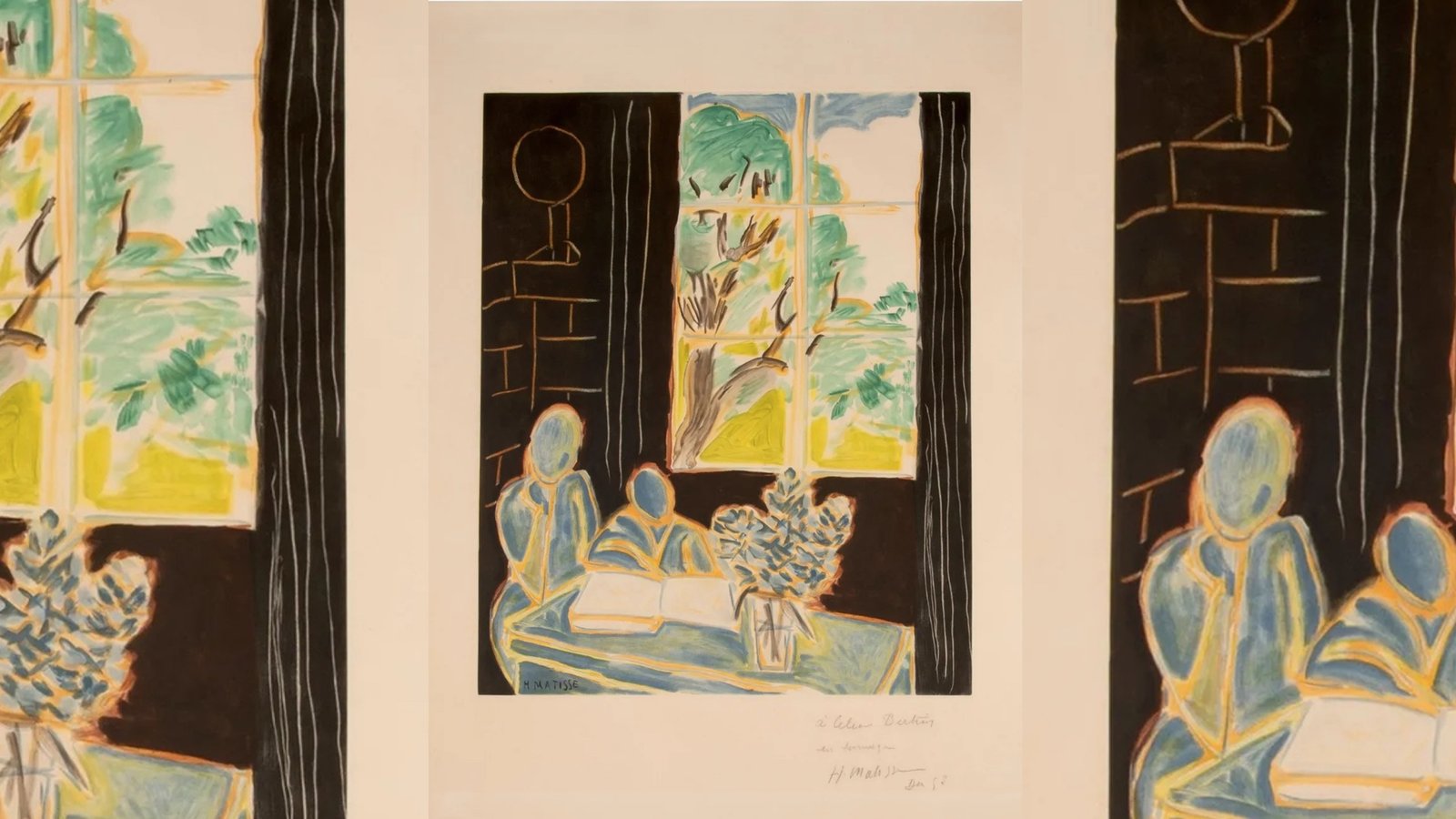
Il racconto si apre sotto il segno di Le Silence habité des maisons (1947). Due figure occupano una stanza mentre, dietro di loro, un volto scuro sembra emergere dall’esterno o dalla notte. Il silenzio della casa è abitato da qualcosa che guarda le figure mentre esse credono di essere sole. Byatt trasforma quell’enigma visivo nella legge del racconto. Anche la casa di Debbie Dennison contiene una presenza che tutti vedono e nessuno guarda veramente.
Il narratore guarda Le Silence habité des maisons nella piccola riproduzione in bianco e nero del volume di Lawrence Gowing. Il colore, decisivo per il pittore, deve essere ricordato o immaginato. Questa perdita accompagna l’ingresso nella casa: anche qui qualcosa sostiene la scena senza essere immediatamente disponibile allo sguardo. La riproduzione non equivale al lavoro domestico; insegna però a diffidare della presunta completezza di ciò che vediamo.
Mrs Brown entra ed esce dalle stanze, lava, raccoglie, accudisce i bambini. Il nome sembra confonderla con la materia domestica: brown, marrone, colore di mescolanza raramente chiamato al centro. I suoi abiti, fatti di lane, frange e ritagli, sfidano il buon gusto. Debbie li osserva a tratti; Robin quasi non li vede. Mrs Brown resta indispensabile e laterale.
È Robin a possedere ufficialmente il nome dell’artista. Dipinge al piano superiore e difende il proprio studio dalle intrusioni. Può dedicarsi alla pittura perché Debbie guadagna, i figli vengono accuditi e Mrs Brown impedisce che il disordine sommerga tutto: una rete di attività tiene il mondo a distanza dalla sua porta.
Debbie è responsabile del design di una rivista femminile. Per mantenere la famiglia ha messo da parte l’incisione su legno, la sua prima passione. La casa distribuisce dunque anche le possibilità di essere artisti: Robin dispone di una durata protetta, Debbie converte la propria competenza in reddito, Mrs Brown crea in un tempo che i Dennison non conoscono. Sotto lo stesso tetto convivono un’opera autorizzata a occupare spazio, un’opera rinviata e un’opera ancora senza pubblico.
Tra i due si muove Mrs Brown. È lei a toccare ciò che gli altri hanno consumato: maglioni infeltriti, fili, bottoni, oggetti rotti. La pulizia le ha insegnato che nessuna cosa scompare davvero; passa dalla zona del visibile a quella dello scarto. Mrs Brown interrompe questo passaggio. Trattiene i frammenti, li cuce, li annoda, li trasforma in forme che sembrano abiti, corpi, animali, presenze fantastiche.
Il suo lavoro nasce dallo stesso gesto con cui mantiene la casa: raccogliere. Ma fra il raccogliere per eliminare e il raccogliere per comporre passa una differenza decisiva. Nel primo caso riconsegna agli altri uno spazio ordinato cancellando le tracce del loro vivere; nel secondo sottrae quelle tracce alla sparizione. Ciò che la famiglia scarta diventa la materia della sua opera.
Mrs Brown non comincia a creare quando il mondo dell’arte la riconosce e le sue sculture di tessuto conquistano la Callisto Gallery. La mostra rende pubblico anche il suo nome: Sheba, come la leggendaria Regina di Saba che nella Bibbia e nelle leggende viaggia coperta d’oro, pietre preziose e tessuti ricchissimi per far visita al Re Salomone. Cambia il nome attribuito a ciò che fa e, insieme, il modo di nominarla. Ma Sheba respinge l’intento di rabbia femminista che si vorrebbe leggere nelle sue figure domestiche. Il riconoscimento porta con sé una nuova richiesta: rendere il lavoro interpretabile secondo le attese di chi lo espone.
Negli interni di Matisse un motivo ornamentale può contendere al corpo il centro del quadro. L’opera di Sheba costringe a guardare di nuovo tutta la casa: i materiali passati fra le sue mani avevano continuato a vivere dove Robin e Debbie vedevano soltanto il residuo delle proprie giornate. Accanto alla pittura protetta dalla porta dello studio cresceva un’altra invenzione, che nessuno dei due aveva saputo riconoscere.
Rozsika Parker ha mostrato in The Subversive Stitch (1984) come la separazione fra ricamo e arte abbia contribuito a costruire una gerarchia fra le pratiche e fra chi le esercita. Byatt complica quel passaggio: entrare in una galleria d’arte significa sottrarsi all’anonimato, ma Sheba si lascia riconoscere senza consegnarsi interamente al racconto del proprio riscatto.
Mrs Brown non chiede però che i suoi lavori somiglino alla pittura. Porta con sé ciò che la pittura ha tentato di lasciare fuori: il tatto, l’usura, la riparazione, il tempo ripetitivo della cura. Ogni frammento conserva la memoria del corpo che lo ha indossato e della casa dalla quale è stato espulso.
Il titolo inglese Art Work indica insieme l’opera e il lavoro necessario perché l’opera possa esistere. Chi cucina mentre qualcuno dipinge? Chi guadagna il denaro, raccoglie gli oggetti, pulisce il pavimento davanti allo studio? Dietro ogni figura riconosciuta esiste un lavoro mantenuto fuori campo.
L’affermazione di Sheba rimette in movimento anche i Dennison: Debbie torna all’incisione, Robin modifica la propria pittura. Il margine non prende semplicemente il posto del centro; ne altera le possibilità. Il colore della casa appartiene anche a chi la tiene insieme, ma nessuno può più rivendicare la stessa posizione di prima.

Il colore davanti al dolore
Nel terzo racconto il colore incontra ciò che non può ricomporre. L’aragosta cinese si svolge durante un pranzo in un ristorante cinese di Londra. Gerda Himmelblau ha convocato Peregrine Diss, pittore e professore, per discutere la denuncia di Peggi Nollett, che lo accusa di avere umiliato il suo lavoro su Matisse e di essersi comportato con lei in modo sessualmente inappropriato. Peggi non compare: parole e opere raggiungono la stanza soltanto attraverso gli altri.
Gerda e Peregrine la ricostruiscono da una lettera, dai ricordi e dalle immagini che ha prodotto. Ogni versione, però, la sposta: per Gerda è una studentessa vulnerabile che l’istituzione deve proteggere; per Diss un’artista che converte il risentimento in teoria; per se stessa, attraverso ciò che scrive, il corpo sul quale convergono potere maschile, autorità accademica e storia della rappresentazione.
Peggi lavora sul corpo femminile in Matisse: nudi offerti alla contemplazione maschile, anatomie piegate al piacere della forma. Altera le riproduzioni con sangue, escrezioni e materiali corporei, restituendo alla levigatezza dell’immagine ciò che essa avrebbe espulso: secrezione, ferita, disgusto, mortalità.
Per Diss quelle opere contengono una risposta decisa prima dello sguardo: la teoria non interroga il quadro, lo processa. Peggi accusa Matisse di avere ridotto la donna a materia visiva; Diss accusa lei di avere ridotto Matisse alla prova di un delitto.
Byatt non consente al lettore di scegliere comodamente. Gerda crede alla smentita di Diss dell’accusa di molestie, ma continua a prendere sul serio la sofferenza di Peggi. La sua responsabilità istituzionale non coincide con il giudizio estetico del professore; d’altra parte, la vulnerabilità della studentessa non convalida ogni sua interpretazione. La scena tiene aperta questa difficoltà, senza risolverla nella vittoria di una delle due posizioni.
Neppure il ristorante è uno sfondo neutro. Rosso, oro, nero, verde, superfici lucide, pietanze tagliate e ricomposte: ogni elemento partecipa alla scena. Gerda e Peregrine discutono di Matisse mentre consumano corpi. Bellezza e dolore occupano lo stesso tavolo senza che l’una redima l’altro.
Verso la fine del pranzo è Diss a evocare La Porte noire (1942). La giovane donna in poltrona, la finestra e la luce colorata ricevono forza dal nero alle loro spalle. Nel ricordo del professore, Matisse lo accoglie malato, in una stanza dalle tende chiuse; al visitatore sgomento risponde con il nero. Quel nero appartiene alla luce: le permette di acquistare intensità. La porta introduce una differenza proprio dove lo sguardo potrebbe credere di trovare soltanto una chiusura.
La prossimità della morte attraversa quel ricordo. Diss aveva visitato Matisse dopo la guerra, quando il pittore era sopravvissuto alla grave operazione del 1941. La convalescenza da cui era nata anche La Porte noire rende meno innocente la serenità dei colori: la loro vitalità è stata conquistata dentro un’esperienza della fragilità. Per Diss, il piacere della pittura ha questa serietà corporea.
La disperazione ha invece la forma di una stanza bianca senza porte né finestre. Gerda e Peregrine vi riconoscono una comune esperienza: lui porta cicatrici sui polsi, lei ricorda Kay e il proprio desiderio di scomparire. Il bianco cancella le differenze e riduce il possibile a una sola uscita. La porta nera del quadro può allora essere letta come ciò che a quella stanza manca: una discontinuità nella superficie uniforme del dolore.
La luce del quadro entra nella conversazione dopo che Gerda e Diss hanno riconosciuto l’uno nell’altra qualcosa della propria disperazione. Il piacere della pittura può essere condiviso proprio fra due persone che conoscono il desiderio di morire. Nel pensiero di Gerda, «le forme luminose continueranno a splendere nel buio». Peggi rimane però fuori da questo incontro: la vitalità che Diss trova in Matisse non la raggiunge necessariamente. Il dolore non diventa più vero perché viene tradotto in immagine, né più sopportabile.
Gerda propone di affidare Peggi a una docente più vicina alle sue posizioni. Diss vi vede una sconfitta; per Gerda è un compromesso praticabile. Sul giudizio restano divisi. Ma la voce con cui si parlano è cambiata: il professore ha smesso per un momento di difendere soltanto la pittura, Gerda di custodire soltanto la propria funzione. Fra loro è passato qualcosa che la decisione sulla studentessa non può riassumere.
All’uscita si fermano davanti all’aragosta nella teca di vetro, esposta senza acqua. Gerda l’aveva già osservata entrando; ora ne sente nuovamente la sofferenza nel proprio corpo. È animale, merce, ornamento e futura pietanza. Il corpo blu-nero perde lucentezza mentre continua a muoversi: la forma resta percepibile mentre la vita si ritira, una natura morta colta nel tempo necessario a diventarlo. Diss avverte insieme l’orrore della scena e la propria indifferenza, e Gerda riconosce quella contraddizione.
Gerda arriva a baciare Diss sulla guancia: un gesto inconsueto, una gratitudine che il racconto lascia accadere accanto alla teca. Il pranzo ha avvicinato i due commensali, eppure l’animale è ancora lì; la tenerezza fra due persone e l’abbandono di un altro corpo rimangono contemporanei. Quando il pranzo finisce, l’aragosta continua a morire. La durata dell’attenzione non coincide con quella della sofferenza.

Matisse senza Matisse
Alla fine Matisse è ovunque senza occupare stabilmente il centro: in una riproduzione, nella struttura di una casa, nelle parole di un professore, nelle immagini violate da una studentessa. La sua opera viene ammirata, usata, contestata. Byatt non ricostruisce il pittore dietro i quadri; lo lascia agire a distanza.
Quando un artista entra nella letteratura, viene spesso ricondotto alla biografia. Il quadro diventa conseguenza di una vita: un amore, una perdita, una malattia spiegano ciò che si trova sulla tela. Qui il movimento è opposto. Non è la vita di Matisse a spiegare le immagini; sono le immagini a modificare il modo in cui le vite possono essere raccontate.
Il colore non rende la prosa simile alla pittura né associa ogni tonalità a un sentimento: interrompe le gerarchie. Una parete acquista la forza di un volto, un abito contiene una biografia, un frammento scartato diventa il principio di un’opera.
David Batchelor, in Chromophobia (2000), ha ricostruito la diffidenza verso il colore, subordinato alla forma e associato al femminile, all’ornamento e all’eccesso. Nei racconti di Byatt quella gerarchia viene messa alla prova, ma il colore non assume un valore morale stabile. Può accogliere Susannah, dare forza al lavoro di Sheba, nutrire l’amore di Diss per la pittura; può anche continuare a brillare accanto a un corpo che soffre. La sua intensità non decide per chi guarda.
Nei quadri di Matisse una finestra apre e chiude; un motivo ornamentale unisce la figura allo spazio e rischia di inghiottirla. Nei racconti, gli ambienti trattengono questa ambivalenza. La loro bellezza può accogliere un corpo o assegnargli una posizione dalla quale fatica a muoversi. Ogni oggetto partecipa a ciò che una persona riesce a fare, a ricordare, a sopportare.
Lo specchio restituisce a Susannah un’immagine sulla quale altri hanno lavorato; le stoffe di Sheba conservano tracce che la pulizia avrebbe dovuto cancellare. La porta dipinta introduce il nero fra i colori della stanza. Sono superfici che rimandano ai corpi quanto hanno ricevuto da loro. Per questo nessuna figura è sola: anche quando tace, l’ambiente prende parte alla sua vita.
Matisse offre ai racconti una grammatica, non un argomento. Le figure entrano nelle sue stanze e ne escono modificate; talvolta rompono ciò che avrebbe dovuto contenerle. Resta l’aragosta dietro il vetro, corpo intensamente colorato fra la vita e la natura morta. Una figura può avanzare fino al centro e continuare a essere prigioniera. La letteratura non spezza necessariamente la teca. Può però costringerci a vedere il vetro.
A. S. Byatt, Le storie di Matisse, traduzione di Anna Nadotti e Fausto Galuzzi, Einaudi, 1996.
A. S. Byatt (Sheffield, 1936 – Londra, 2023) è stata scrittrice e critica letteraria. Ha studiato a Cambridge e insegnato alla Central School of Art and Design e all’University College di Londra. Nei suoi libri intreccia letteratura, arti visive, storia e ricerca intellettuale, esplorando il rapporto fra immaginazione ed esperienza. Tra le sue opere figurano Possessione (1990), Angeli e insetti (1992), Le storie di Matisse (1993), Il libro dei bambini (2009) e il quartetto dedicato a Frederica Potter: La vergine nel giardino, Natura morta, La torre di Babele e Una donna che fischia. Alla narrativa ha affiancato saggi sulla letteratura e sulla rappresentazione, fra cui Ritratti in letteratura. Nel 1990 ha vinto il Booker Prize con Possessione; nel 2016 ha ricevuto il Premio Erasmus e nel 2018 il Premio letterario Hans Christian Andersen.
Cover: Henri Matisse, Le Silence habité des maisons, circa 1947, acquatinta a colori – Courtesy Shapero Modern


No Figure Is Alone A. S. Byatt in Matisse’s Rooms
In “The Matisse Storie’s” A. S. Byatt brings Henri Matisse’s images into her writing, allowing them to reshape its spaces. Figures and backgrounds exchange places; bodies, objects and works that seemed destined to remain on the margins move towards the centre, though becoming visible does not necessarily mean becoming free.
Text by Rita Selvaggio —
Medusa’s Ankles
A woman sees a painting through a hairdresser’s window and walks in. She does not yet know the salon, or whether she will feel comfortable letting someone there touch her hair. What draws her in is a reproduction of Henri Matisse’s Rosy Nude (Nu rose, 1935): a large female body folded into the pictorial space, traversed by lines of blue, pink and green. Susannah looks at it and decides to trust that promise of colour.
So begins Medusa’s Ankles, the first of the three stories brought together by A. S. Byatt in The Matisse Stories (Chatto & Windus, 1993). It begins not with an encounter between two people, but with an image drawing a body into a room. The painting prepares the story’s form. Lucian’s salon, with its mirrors, pinks and creams, bottles and curtains, seems to have arranged itself around the painted figure: “like the interior of a rosy cloud”. Susannah, too, can believe she has found somewhere that will hold her.
In Matisse’s paintings, a room does more than surround a figure. Wall, carpet, dress, window and wallpaper have the same intensity as face and body. The background does not recede: it presses close to the figure, passes through it, sometimes seems about to absorb it. The figure is not alone because space is not external to it. Space bears down on it.
Byatt brings this relationship into her writing. The paintings shape the way each story directs our attention: a room, domestic labour, a repeated task, an ageing body acquire an importance that the scene’s initial arrangement seemed to deny them. The background ceases to be docile.
Jacques Rancière calls the order that allocates places and activities, determining what can be seen and who can speak, the “distribution of the sensible” (Le Partage du sensible, 2000; English translation The Politics of Aesthetics, 2004). This perspective allows us to question Byatt’s interiors: who has time to create, who holds the surroundings together, who is heard? The distribution changes across the three stories, with different consequences each time for those caught within it.
At first Susannah thinks the salon might protect her from time. Lucian knows how to listen; he recognises the quality of her hair and her pleasure in Matisse’s nude. Yet in the salon chair, the scholar accustomed to sustained thought must entrust her appearance to a stranger’s hands. The mirror preserves nothing: each time, it registers the distance between the body remembered and the body now present.
The making of Rosy Nude, too, was punctuated by acts of looking. While working on it in 1935, Matisse sent Etta Cone twenty-two photographs of the painting’s successive states, drawing her into its transformations. She bought the finished work in 1936. Before settling into a fixed pose, that body had undergone a succession of revisions. The image on the wall seems exempt from change, while the body looking at it continues to alter.
As the years pass, the salon changes too. Pink and cream give way to maroon and grey; the understanding with Lucian begins to fracture.
The painted nude remains fixed in its pose; Susannah, meanwhile, sees her body changing, growing heavier. The salon that once welcomed her now seems to demand that she be corrected. Matisse’s rosy woman is replaced by photographs of girls with grey faces, blackened eyes and hair ablaze with violent colours. Susannah must place herself in the care of a salon shaped by these images just as she finds it harder to recognise herself in the mirror. The promise of beauty survives, but it is now addressed to someone else.
Even the story’s title captures this imbalance. Medusa is evoked through the lowest and least heroic part of the body, her ankles, rather than through the gaze that turns others to stone. Susannah remembers the slender beauty of her own ankles, then feels their contours disappear as her body changes. Ageing does not arrive as an event. It advances from the edges, altering one line at a time.
When Susannah wrecks the salon, the gesture is more than a psychological outburst. It is an insurrection within the composition. The figure that will no longer submit to correction invades the space meant to contain her. Mirrors, bottles and shelves take part in her fury; the frame itself becomes matter for the action. The room arranged around the image of a desirable body is shattered by the real body that image has come to exclude.
Susannah does not achieve a new harmony. After the destruction, Lucian puts her hair right and, for a moment, restores a shape to her face. But woman and room have revealed that they belong to the same composition: when one can no longer recognise herself in the place assigned to her, the other breaks apart too.

Who Holds the Colours of the House Together
In Art Work, the painting no longer hangs on the wall. The whole house has become a composition: incongruous colours run through its rooms, among fabrics, toys, papers and clothes. As in Matisse’s interiors, there is no neutral ground against which figures can simply take their places. Everything claims attention.
The story opens with Le Silence habité des maisons (1947). Two figures occupy a room while, behind them, a dark face seems to emerge from outside, or from the night. The house’s silence is inhabited by something watching the figures as they believe themselves alone. Byatt turns that visual enigma into the story’s governing principle. Debbie Dennison’s house, too, contains a presence everyone sees and no one really looks at.
The narrator examines Le Silence habité des maisons in the small black-and-white reproduction in Lawrence Gowing’s book. Colour, so crucial to the painter, must be recalled or imagined. We enter the house with this loss in mind: here, too, something sustains the scene without being immediately visible. The reproduction is not equivalent to domestic labour; it does, however, teach us to distrust the apparent completeness of what we see.
Mrs Brown moves in and out of the rooms, washing, gathering things up, tending the children. Her name seems to merge her with the matter of the household: brown, a composite colour rarely brought to the centre. Her clothes, made of woollens, fringes and scraps, defy good taste. Debbie notices them now and then; Robin scarcely sees them. Mrs Brown remains indispensable and peripheral.
Robin is the one officially recognised as an artist. He paints upstairs and guards his studio against intrusion. He can devote himself to painting because Debbie earns money, the children are cared for, and Mrs Brown keeps disorder from engulfing everything: a web of activities keeps the world at bay outside his door.
Debbie is the design editor of a women’s magazine. To support the family she has set aside wood engraving, her first passion. The household thus determines who gets to be an artist: Robin has uninterrupted time to paint, Debbie turns her skills into income, and Mrs Brown creates in a time of her own that the Dennisons know nothing about. Under the same roof, one person’s art is given room to develop, another’s is put on hold, and a third’s still has no audience.
Mrs Brown moves between them. It is she who touches what the others have used up: felted jumpers, threads, buttons, broken objects. Cleaning has taught her that nothing truly disappears; it passes from the realm of the visible into that of waste. Mrs Brown interrupts this passage. She keeps the fragments, stitches and knots them, transforms them into shapes resembling clothes, bodies, animals, fantastical presences.
Her art begins with the same act as her housekeeping: gathering things up. But there is a crucial difference between gathering to discard and gathering to compose. In the first, she restores order for the others by erasing the traces of their lives; in the second, she saves those traces from disappearance. What the family throws away becomes the material of her work.
Mrs Brown does not begin to create when the art world recognises her and her textile sculptures win acclaim at the Callisto Gallery. The exhibition also makes her name public: Sheba, after the legendary Queen of Sheba who, in the Bible and in legend, travels adorned with gold, precious stones and sumptuous fabrics to visit King Solomon. It changes how her work is described and how she herself is known. Yet Sheba rejects the feminist anger others would read into her domestic figures. Recognition brings a new demand: to make her work fit the expectations of those who exhibit it.
In Matisse’s interiors, an ornamental motif can contest the body’s place at the centre of the painting. Sheba’s work makes us look at the whole house again: the materials that passed through her hands had continued to live where Robin and Debbie saw only the residue of their days. Alongside the painting sheltered behind the studio door, another invention had been growing, one neither had known how to recognise.
In The Subversive Stitch (1984), Rozsika Parker showed how the separation of embroidery from art helped establish a hierarchy of practices and of the people who pursue them. Byatt complicates the passage from craft to recognised art: entering an art gallery means escaping anonymity, but Sheba accepts recognition without wholly accepting the story of redemption told on her behalf.
Mrs Brown does not, however, seek to make her works resemble paintings. She brings with her what painting has tried to leave outside: touch, wear, repair, the repetitive rhythms of care. Each fragment retains the memory of the body that wore it and the house that cast it out.
The title Art Work names both the work of art and the labour necessary for it to exist. Who cooks while someone paints? Who earns the money, gathers up the objects, cleans the floor outside the studio? Behind every recognised figure lies work kept out of the frame.
Sheba’s success sets the Dennisons in motion too: Debbie returns to engraving, Robin changes his painting. The margin does not simply take the centre’s place; it alters what the centre can do. The house’s colour also belongs to the person who holds it together, but no one can now claim the same position as before.

Colour Before Pain
In the third story, colour encounters what it cannot put back together. The Chinese Lobster takes place over lunch in a Chinese restaurant in London. Gerda Himmelblau has asked Peregrine Diss, a painter and professor, to meet her to discuss the complaint made by Peggi Nollett, who accuses him of humiliating her work on Matisse and behaving towards her in a sexually inappropriate way. Peggi does not appear: her words and works reach the room only through others.
Gerda and Peregrine piece together an image of her from a letter, memories and the works she has made. Yet each account places her in a different light: for Gerda she is a vulnerable student whom the institution must protect; for Diss, an artist who turns resentment into theory; in her own writing, she presents herself as the body upon which male power, academic authority and the history of representation converge.
Peggi’s work addresses the female body in Matisse: nudes offered for men to contemplate, anatomies bent to serve the pleasures of form. She alters the reproductions with blood, excretions and other bodily matter, restoring to the image’s smooth surface what it seems to exclude: secretion, wound, disgust, mortality.
For Diss, these works offer an answer reached before any act of looking: theory puts the painting on trial rather than questioning it. Peggi accuses Matisse of reducing women to visual material; Diss accuses her of reducing Matisse to evidence of a crime.
Byatt offers the reader no comfortable choice. Gerda believes Diss’s denial of the allegation of harassment, yet continues to take Peggi’s suffering seriously. Her institutional responsibility does not coincide with the professor’s aesthetic judgement; equally, the student’s vulnerability does not validate every interpretation she makes. The scene holds this difficulty open, without granting either position a victory.
The restaurant, too, is far from a neutral background. Red, gold, black, green, glossy surfaces, dishes cut up and reassembled: every element takes part in the scene. Gerda and Peregrine discuss Matisse as they consume bodies. Beauty and pain occupy the same table, without one redeeming the other.
Towards the end of lunch, Diss recalls The Black Door (La Porte noire, 1942). The young woman in the armchair, the window and the coloured light draw strength from the black behind them. He remembers visiting Matisse, who was ill and received him in a room with the curtains drawn; the painter answered his visitor’s dismay by speaking of black. That black belongs to light: it gives light its intensity. The door opens up a possibility precisely where the eye might see only closure.
Death is never far from this memory. Diss visited Matisse after the war, when the painter had survived the serious operation of 1941. The Black Door, too, emerged from his convalescence, and this makes the serenity of its colours less innocent: their vitality has been won through an experience of fragility. For Diss, the pleasure of painting carries the weight of that bodily knowledge.
Despair, by contrast, takes the form of a white room without doors or windows. Gerda and Peregrine recognise a shared experience there: he bears scars on his wrists; she remembers Kay and her own desire to disappear. White erases differences and reduces the possible to a single way out. The painting’s black door can then be read as what that room lacks: a break in the unbroken surface of pain.
The painting’s light enters the conversation after Gerda and Diss have recognised something of their own despair in each other. Two people who know the desire to die can also share the pleasure of painting. In Gerda’s mind, “the bright forms will go on shining in the dark”. Yet Peggi remains outside this encounter: the vitality Diss finds in Matisse does not necessarily reach her. Pain becomes neither truer nor more bearable when it is translated into an image.
Gerda proposes finding Peggi a supervisor more sympathetic to her position. Diss sees this as a defeat; for Gerda it is a workable compromise. Their judgements remain at odds. But the tone of their conversation has changed: for a moment, the professor has ceased merely to defend painting, and Gerda to speak solely in her official capacity. Something has passed between them that their decision about the student cannot fully express.
On their way out they stop before the lobster in the glass display case, exposed to view and kept out of water. Gerda looked at it when she arrived; now she again feels its suffering in her own body. It is animal, commodity, ornament and a meal to come. Its blue-black body loses its gloss as it continues to move: form remains visible while life ebbs away, a still life caught in the process of becoming one. Diss feels both the horror of the scene and his own indifference, and Gerda recognises that contradiction.
Gerda even kisses Diss on the cheek: an uncharacteristic gesture of gratitude, made beside the display case. Lunch has brought the two diners closer, yet the animal is still there; tenderness between two people coexists with the abandonment of another body. When lunch ends, the lobster continues to die. Attention does not last as long as suffering.

Matisse without Matisse
By the end, Matisse is everywhere without ever occupying the centre: in a reproduction, in the arrangement of a house, in a professor’s words, in images defaced by a student. His work is admired, used, contested. Byatt does not reconstruct the painter behind the paintings; she lets his work act at a distance.
When an artist enters literature, the work is often traced back to biography. The painting becomes the consequence of a life: a love, a loss, an illness explains what is on the canvas. Here the movement is reversed. Matisse’s life does not explain the images; the images alter the ways in which lives can be told.
Colour does not make prose resemble painting, nor does it assign a feeling to each hue: it disrupts hierarchies. A wall becomes as compelling as a face, a garment carries a life story, a discarded fragment becomes the beginning of a work.
In Chromophobia (2000), David Batchelor traced the distrust of colour, subordinated to form and associated with the feminine, ornament and excess. Byatt’s stories put that hierarchy to the test, but colour has no fixed moral value. It can welcome Susannah, lend force to Sheba’s work, nourish Diss’s love of painting; it can also go on shining beside a body in pain. Its intensity does not decide for the person looking.
In Matisse’s paintings a window opens and closes; an ornamental motif binds the figure to its surroundings and threatens to swallow it. In the stories, the surroundings retain this ambivalence. Their beauty may welcome a body or confine it to a place from which it struggles to move. Every object plays a part in what a person manages to do, to remember, to bear.
The mirror shows Susannah an image that others have shaped; Sheba’s fabrics preserve traces that cleaning should have erased. The painted door introduces black among the room’s colours. These surfaces give back to bodies something of what they have received from them. This is why no figure is alone: even in silence, the surroundings take part in its life.
Matisse gives the stories a grammar rather than a subject. Figures enter his rooms and leave them altered; sometimes they break what was meant to contain them. The lobster remains behind the glass, an intensely coloured body between life and still life. A figure may move all the way to the centre and still be captive. Literature does not necessarily break the display case. But it can compel us to see the glass.
A. S. Byatt, The Matisse Stories, London: Chatto & Windus, 1993.
A. S. Byatt (Sheffield, 1936 – London, 2023) was a novelist, short-story writer and literary critic. She studied at Cambridge and taught at the Central School of Art and Design and University College London. Her books weave together literature, the visual arts, history and intellectual inquiry, exploring the relationship between imagination and experience. Her works include Possession (1990), Angels and Insects (1992), The Matisse Stories (1993), The Children’s Book (2009) and the Frederica Quartet: The Virgin in the Garden, Still Life, Babel Tower and A Whistling Woman. Alongside her fiction she wrote essays on literature and representation, including Portraits in Fiction. She won the Booker Prize for Possession in 1990, received the Erasmus Prize in 2016 and the Hans Christian Andersen Literature Award in 2018.